- GOI-IES is real but rare: €10,000 + full fee waiver for ~60 students globally. Deadline was 12 March 2026 for 2026/27 entry; plan for 2027/28 if you missed it.
- Every Irish university has its own merit scheme: Awards range from €1,100 (DCU Business bursary) to €10,000 (University of Galway Excellence). Most are automatic upon admission — GPA above 75% puts you in consideration.
- Stack your funding: An Irish university merit award can sit alongside Inlaks (up to USD 100,000), JN Tata (up to ₹20 lakh), or KC Mahindra (up to ₹10 lakh) — these tiers rarely conflict with each other.
What scholarships are available for Indian students in Ireland in 2026?
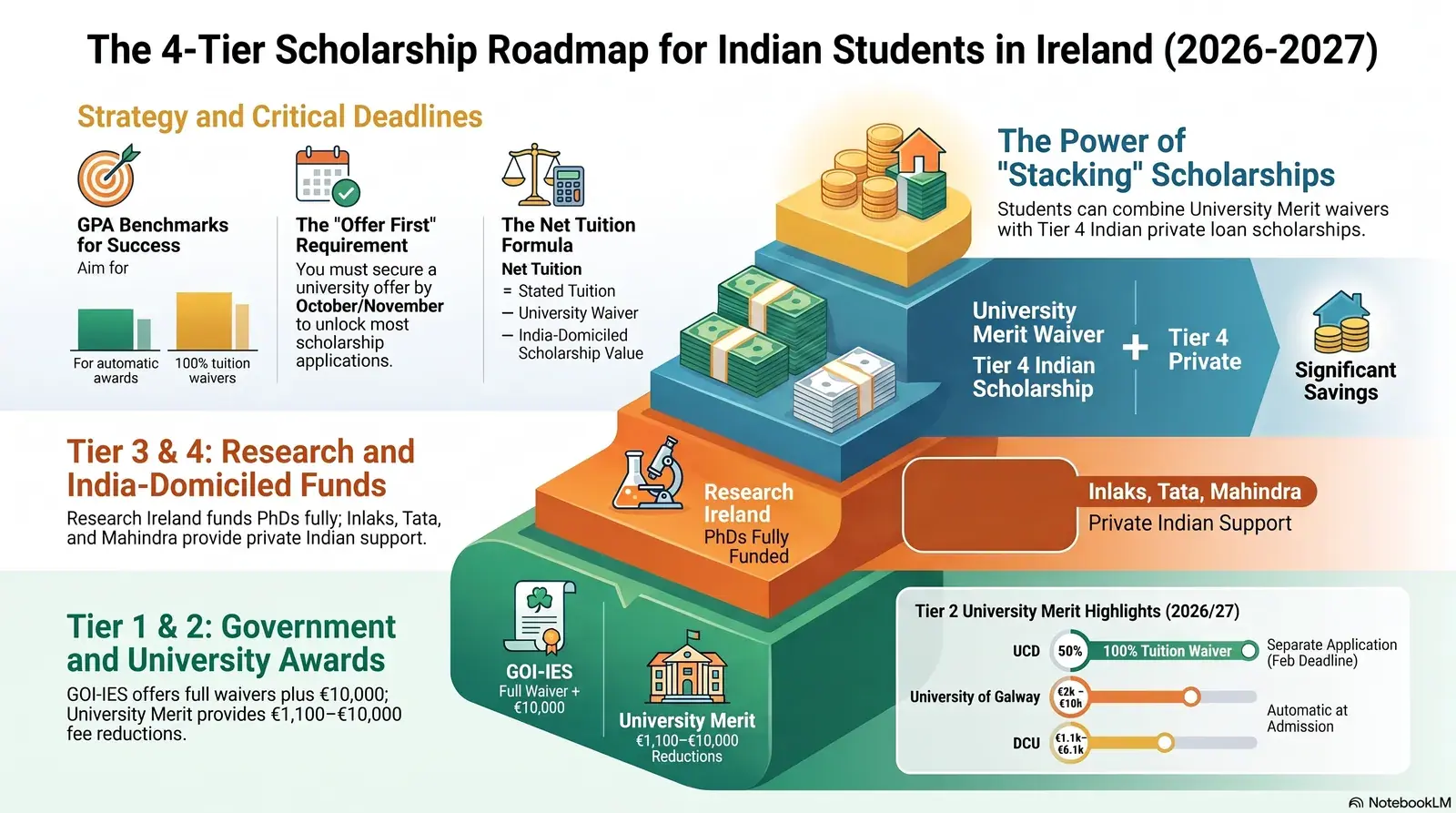
Indian students in Ireland can access funding across four tiers: the Irish government (GOI-IES), Irish university merit awards, Research Ireland (IRC) funded research programmes, and India-domiciled private scholarships such as Inlaks, JN Tata, and KC Mahindra. For a typical taught Master's student, the most realistic path is a combination of a university merit award (€2,000–€10,000 fee reduction) and an India-side loan scholarship (₹5–20 lakh interest-free), since the GOI-IES is extremely limited and IRC funding applies only to research degrees.
€10,000 + full fee waiver. ~60 places globally. Deadline March each year.
€1,100–€10,000 fee reduction. Automatic or via short application. GPA-driven.
Up to €34,000/year stipend. Funded PhD (4 yr) or Research Master's (2 yr). All nationalities.
₹5–20 lakh or up to USD 100,000. Interest-free loans or grants. Stackable.
The Government of Ireland International Education Scholarship (GOI-IES): what you actually need to know
The GOI-IES is the flagship Irish government scholarship for international students — worth €10,000 as a living stipend plus a full tuition and registration fee waiver — but with approximately 60 places for the entire world each cycle, it is intensely competitive. For 2026/27, the call opened on 29 January 2026 and closed at 5pm Irish time on 12 March 2026. Students applying for 2027/28 entry should block this window in their diaries now.
The award is administered by the Higher Education Authority (HEA) and funded by the Irish government. To be eligible, you must hold a domicile of origin outside the EU/EEA, Switzerland, and the United Kingdom — making Indian nationals fully eligible. You must also hold a conditional or final offer as an international fee-paying student at an approved Irish higher education institution, and your programme must be full-time and in-person starting in September or October 2026.
Crucially, successful GOI-IES awardees must reside in Ireland for the full duration of the scholarship year. The award covers one academic year only, though host institutions may extend the tuition fee waiver to a third semester if the programme runs across three semesters. The €10,000 stipend is not renewable — it is a single-year award.
Because the GOI-IES closed in March 2026 for the upcoming academic year, any Indian student beginning in September 2026 who did not apply in time must now focus on Tier 2 (university merit) and Tier 4 (India-domiciled) options. The GOI-IES for 2027/28 entry will reopen in approximately January 2027 based on the pattern of previous cycles.
University merit scholarships mapped: which institution gives what in 2026
Every major Irish university offers a merit-based fee reduction to non-EU students, with values ranging from €1,100 at DCU's Business School bursary level to up to €10,000 at University of Galway for exceptional applicants. The table below summarises the 2026/27 landscape across the seven main institutions Indian students target.
| University | Scholarship Name | Value (2026) | Application Method | Key GPA Threshold | Application Deadline |
|---|---|---|---|---|---|
| Trinity College Dublin (TCD) | Global Excellence Postgraduate Scholarship | €2,000–€5,000 fee reduction | Separate online application | Typically strong 2.1 / 65%+ | 15 June 2026 (most regions); 15 July 2026 (South East Asia & Oceania) |
| University College Dublin (UCD) | Global Excellence Graduate Scholarship | 50% or 100% tuition fee | Separate application (with offer) | 85%+ for 100% waiver | 28 February 2026 for South Asia (2026/27 cycle) |
| University College Cork (UCC) | International Merit / SEFS International | €3,000 to 25% of fees; auto €3,940–€4,460 for Business MSc applicants with 75%+ | Automatic (Business); application for SEFS | 75%+ for automatic Business award | Rolling (with programme application) |
| University of Galway | Postgraduate Merit / Excellence Scholarship | €2,000–€10,000 fee reduction | Automatic consideration at admission | Strong first class / 70%+ | Automatic — no separate deadline |
| Dublin City University (DCU) | International Faculty Scholarships | €1,100–€6,100 depending on faculty | Automatic at admission | Non-EU status alone qualifies for consideration | Automatic — no separate deadline |
| University of Limerick (UL) | International Merit Bursary | Varies by programme (partial reduction) | Via programme application | Programme-specific | Rolling |
| TU Dublin | International Student Scholarship | Programme-specific (typically partial) | Via programme application | Programme-specific | Rolling |
Note on exemptions: Trinity's Global Excellence Postgraduate Scholarships explicitly exclude Medicine, Dentistry, Acting, Engineering, Natural Sciences, and Computer Science and Statistics. If you are applying to any of these programmes at TCD, the scholarship does not apply and you should focus effort on GOI-IES and external funding instead.
UCD's tiered waiver: what 100% actually requires
UCD's Global Excellence Graduate Scholarship is the most generous in the sector — offering a full 100% tuition waiver — but the bar is accordingly high, and the South Asia deadline of 28 February is earlier than most applicants expect. The scholarship is exclusively for self-funded non-EU students on full-time, on-campus graduate taught programmes starting in September. Online, January-start, part-time, clinical, and off-shore programmes are not eligible. You must hold at minimum a conditional offer from UCD before applying, and you need to have that offer in hand before the regional deadline — which means applying to your programme in October or November to give yourself a buffer.
DCU's automatic consideration: the most practical route for many students
DCU is unique in automatically considering all non-EU students for faculty-level scholarships at the point of admission — no separate scholarship application required. The Faculty of Science and Health offers a reduction of €6,100 on the full-time non-EU tuition fee, while DCU Business School offers €2,000 (or a bursary of €1,100 for a broader pool). These awards are automatically applied to your invoice; you do not need to write additional scholarship essays or meet a separate deadline beyond your programme offer.
How Irish university merit awards actually work: automatic vs application-based
Irish university merit scholarships fall into two categories: automatic awards where the institution reviews all admitted non-EU students and applies a discount, and application-based awards where you must submit a separate form by a specific deadline, typically before the general programme deadline. Confusing the two categories is the most common reason Indian applicants miss out — particularly at UCD and Trinity, where the scholarship deadline is separate from and earlier than the programme admission deadline.
The key GPA benchmarks to keep in mind for 2026 award cycles:
- 65–70% aggregate — minimum competitive threshold for most partial merit waivers (€2,000–€3,000)
- 75%+ — triggers automatic Business School awards at UCC; improves odds at Trinity and Galway
- 80–85%+ — required for UCD's 100% waiver and top-tier Excellence Scholarships at Galway
Award conditions almost always require you to maintain academic standing during the programme. Withdrawal or failure to progress typically triggers repayment of the waiver amount — check your offer letter for the exact conditions before accepting.
Centenary and India-specific funds deserve special mention. Several Irish universities have established dedicated recognition schemes for Indian students as part of long-term India-Ireland bilateral relationships. UCD and Trinity both have specific regional scholarship windows for South Asia, reflecting the high volume and academic quality of Indian applicants. While these are not "India-only" awards in name, the regional application window and quota structure mean strong Indian applicants are competing primarily against other South Asian students rather than the global pool.
On-the-Ground Insight: "I applied to UCD's Global Excellence Scholarship in November 2024 alongside my programme application. The window for South Asia closes in February, which I didn't realise was separate from the programme deadline in April. I almost missed it — the scholarship process ran completely in parallel and I had to chase my academic reference at short notice. Apply for the scholarship the same week you send your university application." — Pooja M., UCD MSc Business Analytics, September 2025 intake
Research Ireland (IRC) Government of Ireland Postgraduate Scholarship: the fully funded research route
If you are open to a research Master's or PhD rather than a taught programme, the Research Ireland Government of Ireland Postgraduate Scholarship is the most generous funding source available in the Irish system — paying up to €34,000 per year in stipend plus €3,250 for research expenses, with all tuition fees covered on top. Master's awardees receive funding for two years; PhD awardees for four years. The scholarship is administered by Research Ireland (formerly the Irish Research Council, or IRC).
The scheme is technically open to all nationalities. Most awards go to Category 1 applicants (EU/EEA and qualifying residents), but a Category 2 stream is explicitly funded each cycle for exceptional non-EU candidates — which includes Indian applicants. The key difference is that you must apply through a prospective supervisor at an Irish higher education institution, not directly to Research Ireland. The practical path is: identify a faculty member whose research aligns with your profile, approach them by email from October to December of the preceding year, and if they agree to supervise you, you submit a joint application with them before the Research Ireland deadline (typically late January or February each year).
Bottom-up proposals in any discipline are eligible, including interdisciplinary and emerging fields. Engineering, computer science, life sciences, and business informatics are historically the most common disciplines for Indian awardees, but the scheme has no subject-based exclusions. If your undergraduate degree is in a STEM field and you have a strong research proposal, the IRC route is worth the effort — it transforms the cost of an Irish degree from a significant financial burden into a paid position.
External options: Inlaks, JN Tata, and KC Mahindra loans-cum-scholarships for Ireland
Three major India-domiciled private scholarships — Inlaks Shivdasani Foundation, JN Tata Endowment, and KC Mahindra Education Trust — are all applicable to postgraduate studies in Ireland and can be combined with Irish university merit awards to significantly reduce the effective cost of attendance. All three are structured as interest-free loan scholarships, with Inlaks offering the largest absolute value (up to USD 100,000 for exceptional candidates).
Inlaks Shivdasani Foundation Scholarship
The Inlaks Shivdasani Foundation Scholarship is the most generous India-domiciled award available for students heading to Ireland, providing up to USD 100,000 to cover tuition, living expenses, travel, visa costs, and health allowance. The Inlaks Shivdasani Foundation Scholarship supports exceptional Indian students pursuing full-time Master's, MPhil, or doctoral programmes at top international universities, including those in Ireland. Financial assistance covers tuition fees, living expenses, one-way travel, visa costs, and a health allowance, with a maximum award of up to USD 100,000 (approximately €90,000 at mid-2026 exchange rates). The deadline for the 2026 cycle was 31 March 2026; the 2027 cycle is expected to open in February 2027. Applicants must be Indian citizens and demonstrate outstanding academic achievement — competition is strong.
Con to note: Inlaks prioritises candidates applying to a narrow list of highly ranked institutions. While leading Irish universities such as Trinity and UCD qualify, newer universities and institutes of technology may fall outside the foundation's approved list. Check eligibility with the foundation directly before investing significant time in the application.
JN Tata Endowment Loan Scholarship
The JN Tata Endowment provides an interest-free loan of up to ₹20 lakh (approximately €22,000) for Indian citizens under 45 pursuing postgraduate or doctoral studies abroad — making it one of the lowest-cost education financing options available for students going to Ireland. The JN Tata Endowment provides interest-free loan scholarships of up to ₹20 lakh (approximately €22,000 at mid-2026 rates) for Indian citizens under 45 who hold a recognised Indian university degree with a minimum 60% aggregate and have secured admission to a postgraduate, doctoral, or postdoctoral programme abroad. The loan is repayable after the study period but carries no interest, making it among the cheapest sources of education financing available to Indian students going abroad.
Con to note: The loan must be repaid — it is not a grant. The repayment timeline and mechanism require careful planning. Additionally, competition for JN Tata awards is very high, with thousands of applicants competing for a limited number of loans each year.
KC Mahindra Education Trust Scholarship
The KC Mahindra Education Trust offers interest-free loan scholarships of up to ₹10 lakh for Indian citizens aged 21–28 pursuing postgraduate studies abroad — best used as a top-up fund alongside a university merit waiver rather than as a standalone source. The KC Mahindra Education Trust offers interest-free loan scholarships for postgraduate study abroad to Indian citizens aged 21 to 28 who have completed their undergraduate studies in India. The top three fellows receive up to ₹10 lakh; the remaining awardees receive up to ₹5 lakh. The scholarship is applicable to studies at reputable universities worldwide, which includes Irish institutions. Applicants must demonstrate financial need alongside academic merit.
Con to note: The ₹10 lakh maximum covers only a portion of non-EU tuition fees in Ireland (typically €12,000–€22,000 per year depending on the programme). KC Mahindra is best used as a supplementary fund alongside a university merit waiver rather than as a standalone funding source.
Can you stack scholarships? Combining a fee waiver with external funding
Yes — Irish university merit awards and India-domiciled scholarships (Inlaks, JN Tata, KC Mahindra) can generally be combined, because they originate from different funding pools and there is no shared exclusion clause between Indian private foundations and Irish university scholarship offices. The key constraint is that total funding received cannot exceed the actual cost of the programme (tuition + reasonable living expenses), and each awarding body must be informed of other funding received.
The four-tier stacking hierarchy for Indian students in Ireland is:
- Tier 1 (Irish Government) — GOI-IES: If won, provides €10,000 stipend + full fee waiver. The fee waiver supersedes any university merit discount, but the €10,000 cash component sits separately. Stacking GOI-IES with Inlaks is technically permissible if total awards do not exceed total programme costs, but requires disclosure to both bodies.
- Tier 2 (University Merit): A partial fee waiver (€2,000–€10,000) reduces your tuition invoice. This does not conflict with Indian private scholarships.
- Tier 3 (Research Ireland IRC): Fully funded research positions include stipend + fees and are independent of other scholarships. IRC awardees cannot additionally claim a university taught programme merit waiver, since the research position already covers all costs.
- Tier 4 (India-Domiciled — Inlaks / JN Tata / KC Mahindra): These operate under Indian private foundation rules. They can be stacked with Tier 2 university fee waivers as long as combined funding does not exceed total costs and both awarding bodies consent.
A realistic combined funding scenario for a 2027/28 taught Master's student at UCC in MSc Business Analytics (tuition approximately €18,000): automatic UCC merit waiver of €3,940 (reduces bill to ~€14,060) + KC Mahindra loan scholarship of ₹10 lakh (~€11,000) = effective out-of-pocket cost of approximately €3,000 in tuition, before applying Tier 4 Inlaks or JN Tata on top if eligible.
Net Tuition = Stated Tuition − University Merit Waiver − India-Domiciled Scholarship Value
Application calendar: month-by-month deadlines for Fall 2027 entry
For Indian students targeting September 2027 entry, the scholarship application window runs roughly from October 2026 to March 2027 — beginning with university programme applications in October, which must be in hand before most scholarship deadlines open in January. The most common mistake is treating the scholarship deadline as the same as the programme admissions deadline; they are not — scholarship deadlines are typically one to three months earlier.
| Month | Action | Funding Tier |
|---|---|---|
| October–November 2026 | Apply to Irish university programmes; confirm non-EU fee status; identify potential research supervisors for IRC route | All tiers — prerequisite step |
| November–December 2026 | Email prospective supervisors for IRC/Research Ireland funded PhD positions; research Inlaks, JN Tata, and KC Mahindra eligibility | Tier 3 (IRC), Tier 4 (India-domiciled) |
| January 2027 | GOI-IES call expected to open (~29 January); Research Ireland Postgraduate Scholarship call typically opens; UCD Global Excellence South Asia window opens | Tier 1 (GOI-IES), Tier 2 (UCD), Tier 3 (IRC) |
| February 2027 | UCD Global Excellence South Asia deadline (~28 February); Inlaks Foundation call typically opens; JN Tata applications typically open | Tier 2 (UCD), Tier 4 (Inlaks, JN Tata) |
| March 2027 | GOI-IES deadline (~12 March); KC Mahindra applications typically open; Trinity Global Excellence applications for most regions open | Tier 1 (GOI-IES), Tier 2 (TCD), Tier 4 (KC Mahindra) |
| March–April 2027 | Inlaks deadline (~31 March); KC Mahindra and JN Tata deadlines; UCC rolling deadline for merit awards | Tier 4 (Inlaks, JN Tata, KC Mahindra), Tier 2 (UCC) |
| June–July 2027 | Trinity Global Excellence deadline for South East Asia & Oceania (15 July); confirm offers and scholarship awards; accept best combined package | Tier 2 (TCD) |
The single most important structural point: you need a university conditional offer before applying to most scholarships. GOI-IES explicitly requires a conditional or final offer. UCD's Global Excellence application requires offer status. Even for India-domiciled scholarships, admissions committees want evidence of a genuine academic offer before awarding funds. This means your programme application in October or November is not just a step toward study — it is the prerequisite that unlocks the entire scholarship pipeline.
Frequently Asked Questions
What is the GOI-IES scholarship and how much is it worth?
The Government of Ireland International Education Scholarship (GOI-IES) provides €10,000 as a living stipend plus a full tuition and registration fee waiver for one academic year. Approximately 60 awards are made globally each cycle, exclusively to students from non-EU/EEA countries, including India. Applications are administered by the Higher Education Authority and open each January.
Which Irish universities offer automatic merit scholarships to Indian students?
DCU and University of Galway automatically consider all non-EU applicants for merit awards at the time of admission. Trinity College Dublin, UCD, and UCC require a separate application but assess all eligible applicants who apply on time. Award values range from €1,100 at DCU Business School up to €10,000 at University of Galway for outstanding candidates.
Can I combine the GOI-IES scholarship with a university merit award?
Yes — the GOI-IES scholarship and a university merit award can co-exist. The GOI-IES requires the host institution to provide a full fee waiver, which technically supersedes a partial merit waiver. However, India-domiciled scholarships (Inlaks, JN Tata, KC Mahindra) can generally be stacked on top of any Irish university award as long as the funding does not exceed total programme costs.
What is the IRC Government of Ireland Postgraduate Scholarship?
The Research Ireland (IRC) Government of Ireland Postgraduate Scholarship funds full-time Master's and PhD research at Irish universities. It provides up to €34,000 per year in stipend plus €3,250 for research expenses, covering 2 years for Master's and 4 years for PhD. All nationalities may apply, with exceptional non-EU candidates funded through a Category 2 stream. Applications go through a prospective supervisor, not directly to Research Ireland.
What GPA do I need to get a merit scholarship at Irish universities?
Most Irish university merit scholarships require a minimum undergraduate aggregate of 65–75%. The most competitive awards — such as UCD's 100% tuition waiver and University of Galway's Excellence Scholarship of up to €10,000 — target applicants with 80–85% or above. UCC's automatic business scholarship is triggered at 75%.
Are Inlaks, JN Tata, and KC Mahindra scholarships valid for studying in Ireland?
All three scholarships are available to Indian students pursuing postgraduate studies abroad, and Ireland is an eligible destination. Inlaks covers up to USD 100,000 for Master's, MPhil, or PhD at top international universities. JN Tata provides an interest-free loan of up to ₹20 lakh, and KC Mahindra offers up to ₹10 lakh interest-free. Applications for the 2026 cycle closed in March–April 2026; the 2027 cycle opens around February 2027.
Planning your move to Ireland? Find the best flights first.
Compare live fares on Dublin routes and check the fare calendar to pick the cheapest month to fly — reducing your travel cost frees up more budget for tuition and living expenses.
All scholarship values, deadlines, and eligibility criteria are based on publicly available official sources as of July 2026. Scholarship cycles, award amounts, and application deadlines change annually. Always verify current information directly with the Higher Education Authority, the relevant university's international scholarships office, or the administering foundation before applying. MyFlightOffers is not affiliated with any university, government body, or private foundation mentioned in this article. This article does not constitute financial or educational advice.
- NEW Scholarships for Indian Students in Ireland 2026 — this guide
- GOI-IES Scholarship Roadmap 2026 — step-by-step application guide for the Government of Ireland International Education Scholarship
- Ireland Banking Guide for International Students 2026 — how to open an Irish bank account before and after arrival
- The Indian Student's Money Survival Guide in Ireland — budgeting, remittances, and making your stipend stretch further
- Study in Ireland 2026: Visa, Housing and IRP Guide — everything to sort before you land
- Critical Skills Employment Permit After Stamp 1G: 2026 Roadmap — converting your degree into a long-term work permit