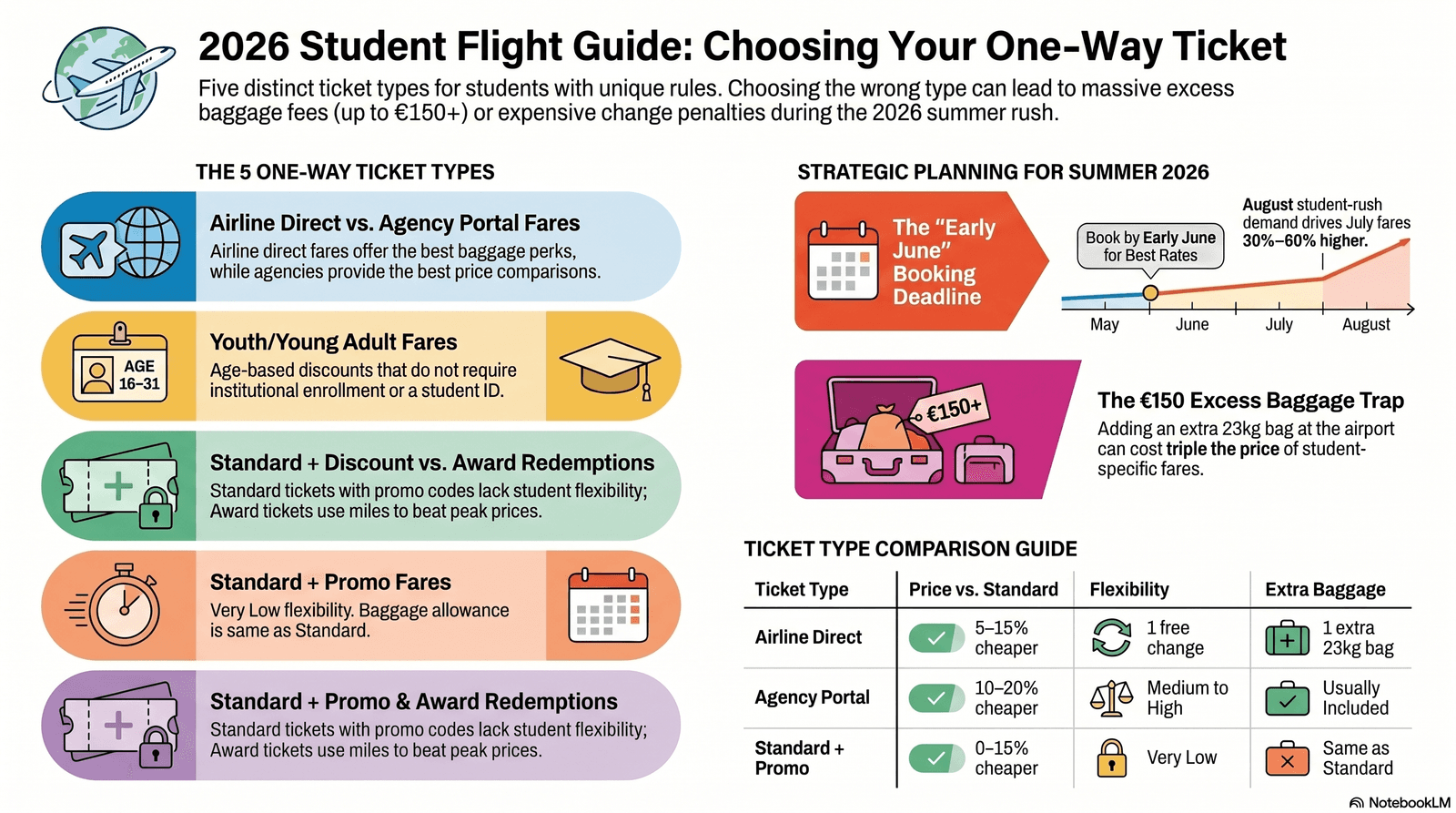
✈ Cheapest Type
Student agency portal fare
Cross-airline comparison + negotiated student rates
🎒 Best for Extra Baggage
Airline direct student fare
Usually includes 1 extra 23 kg checked bag
guaranteed
🔄 Most Flexible
Student travel agency fare
Date changes often low-fee or free for one change
⚠ Summer 2026 Warning
Book by early June
August student-rush drives fares 30–60% higher in
July
What this guide covers — 11 sections
- What is a one-way student ticket?
- Type 1 — Airline direct student one-way fares
- Type 2 — Student travel agency and portal fares
- Type 3 — Youth and young adult one-way fares
- Type 4 — Standard one-way with student discount applied
- Type 5 — Award and points one-way redemptions
- Comparing the five types: price, flexibility, baggage, support
- For Indian students: summer 2026 routes and payment strategy
- How to choose the right one-way ticket type
- Step-by-step: searching for a student one-way ticket
- FAQs
Summer 2026 is shaping up to be the busiest season for student international departures in years. Indian students remain one of the largest groups of new international students entering the UK, Ireland, Canada, and Australia, while university enrolments in Germany, the Netherlands, and the United States continue to draw students from across Asia, Africa, and the Americas. Most of them share one pre-departure challenge: booking a one-way flight.
The problem is not finding a one-way ticket — every airline offers one. The problem is that there are five distinct types of one-way student flight ticket, each with different pricing mechanics, baggage allowances, change conditions, and booking channels. A student who buys a basic low-cost one-way when they should have booked an airline direct student fare may arrive at check-in with 35 kg of luggage, no additional bag included, and a €150+ excess baggage bill before their journey even begins. Equally, a student who pays a premium for a fully flexible agency fare on a short-haul weekend language course has wasted money on conditions they did not need.
This guide maps every type clearly, explains what each one actually delivers, and gives you a practical decision framework based on your specific situation — whether you are an Indian student flying to the UK for a three-year programme, a student from Southeast Asia starting a semester exchange in Ireland, or a North American student beginning a year abroad in Europe.
What Is a One-Way Student Ticket?
A one-way student ticket covers travel in a single direction — from your home city to your study destination — under pricing terms or conditions specifically designed for enrolled students. It is distinct from two other commonly confused fare types:
- A standard one-way economy ticket — available to any passenger, no student eligibility required, and frequently priced at a significant premium to simply half the cost of a return on the same route.
- A student return fare — a round-trip ticket on student terms, giving you student benefits (extra bag, flexible changes) for both legs. Useful only if you know your return date at the time of booking.
Why students specifically need a one-way
The majority of students starting a first year of study abroad do not know their return date at the time of booking. They may stay over summer for work, return home for the Christmas holidays, or remain in the country post-graduation under a graduate work scheme — such as Ireland's Stamp 1G or the UK's Graduate Route visa. Buying a return that locks in a specific return date creates unnecessary risk: most basic return tickets charge €50–€200 to change the return leg, and some cannot be changed at all. A well-chosen one-way removes this entirely.
Who qualifies for student fares?
Eligibility requirements vary by airline and platform, but the typical criteria are:
- Age: Most student fares require passengers aged 16 to 31. Some platforms extend this to 35; others restrict to under 26. Youth fares (a separate category covered in Type 3) are age-based only, with no student enrolment requirement.
- Proof of student status: Accepted proof typically includes a valid ISIC card, an institutional email address (.edu, .ac.uk, .ie), an enrolment confirmation letter, or digital verification via platforms such as SheerID.
- Programme type: Full-time degree and postgraduate programmes are universally accepted. Language schools, vocational programmes, and some short courses may not qualify depending on the specific airline or agency rules.
The International Student Identity Card (ISIC) is issued by the ISIC Association and accepted as proof of student status by over 100 airlines, most student travel platforms, and more than 150,000 discount points globally. Annual cost: approximately €12–€20 depending on your country (isic.in for Indian students; isic.ie for students in Ireland). The ISIC card dramatically simplifies student fare verification across all five ticket types described in this guide.
The Five Types at a Glance
Airline Direct Student Fare
Booked directly with the airline. Usually includes 1 extra 23 kg bag and one free date change.
Agency / Portal Fare
Cross-airline student comparison via platforms like StudentUniverse or USIT. Often the most price-competitive.
Youth / Young Adult Fare
Age-based discount — no student ID needed. Typically covers ages 16–31 depending on airline and market.
Standard + Student Discount
A regular economy one-way with a discount code, ISIC offer, or bank card deal applied at checkout.
Award / Points Redemption
Pay miles or credit card points instead of cash. Only taxes paid; ideal when business class fares are very high.
1 Airline Direct Student One-Way Fares
Several major international airlines maintain dedicated student or youth fare programmes bookable directly through their own website or reservation system. These are not promotional discount codes applied at checkout — they are separately filed fare classes with specific rules designed for students, and they are meaningfully different from the cheapest published economy fares in terms of conditions.
Airlines with documented direct student or youth fare programmes include Lufthansa (student fares in cooperation with Lufthansa City Centre authorised agents, available to passengers under 27 in most European markets), Air France and KLM (Youth fares available in most markets to passengers up to age 27–31), Turkish Airlines (student programme in select markets), and Singapore Airlines (student fares in certain markets including India, via authorised agents). Air India offers student discounts of 10–15% on published fares on eligible domestic and international routes on presentation of valid student ID at check-in, under their Yuva student scheme — particularly relevant for students originating from Indian cities. Emirates, Qatar Airways, and Etihad do not maintain public standalone student fare programmes but frequently have youth-negotiated rates available through authorised student travel agencies.
What airline direct student fares typically include:
- A price reduction of 5–15% compared to the equivalent standard economy fare in the same booking class
- One additional 23 kg checked baggage piece beyond the standard allowance — one of the most tangible and financially significant benefits for students relocating with full luggage
- Reduced or waived date-change fees; many airline student fares permit one free date change where standard economy charges €50–€150 per change
- Miles accrue normally at the standard earn rate for the economy booking class, so frequent flyer members lose nothing by booking a student fare
When airline direct student fares are the right choice:
- Your departure date is confirmed and you know exactly which airline you want to fly
- You are relocating with 25–40 kg of luggage and need the extra bag guaranteed at booking, not purchased as an add-on
- You prefer to deal directly with the airline for any changes or service issues, avoiding an intermediary
- You are loyal to a specific frequent flyer programme and want miles credited without a third-party complication
Several airline student programmes are only accessible through designated authorised student travel agents — not through the airline's standard website booking flow. If you cannot find a student fare on the airline's public site, call their reservations team, check their authorised student agent page, or enquire directly with a student travel agency. Assuming no discount exists because it is not visible online is a costly mistake on routes where airline student programmes are active.
2 Student Travel Agency and Portal Fares
Student travel agencies and specialist booking portals act as intermediaries between airlines and student travellers. They negotiate volume-based student fare agreements with multiple airlines simultaneously, making it possible to compare student-priced one-way fares across carriers on a single platform — something that cannot be done by visiting each airline's website individually.
The most significant global player is StudentUniverse (studentuniverse.com), which partners with over 300 airlines and is available to students worldwide including from India. StudentUniverse verifies student status via institutional email, ISIC card, or SheerID and then unlocks student-negotiated fares not visible on standard booking platforms. In Ireland, USIT (usit.ie) has served the student travel market for decades and specialises in routes to and from Irish universities — particularly relevant for students arriving from India, Asia, and the USA to study at TCD, UCD, UCC, and University of Galway. Note: STA Travel, once one of the world's largest student travel agencies, permanently closed in September 2020 — do not use any platform claiming to be STA Travel.
What student agency portal fares typically include:
- Consolidated student pricing across multiple airlines on your specific route — often the most cost-effective starting point for finding the cheapest student one-way on high-traffic corridors
- Flexible booking conditions: many agency fares come with one free date change or significantly reduced change fees compared to the airline's direct published policy
- Extra checked baggage allowance, typically mirroring or exceeding what the airline's own student fare provides, but explicitly confirmed at booking
- Multi-stop and open-jaw routing options that standard airline booking engines may not display conveniently
- Dedicated student travel support — teams trained in student-specific issues including visa processing delays, exam schedule changes, and first-time international travel logistics
The tradeoff with agency fares: you are not booking directly with the airline. If your flight is cancelled or significantly changed, you will typically contact the agency first rather than the airline directly. For most routine changes, this adds a step. For complex disruptions — especially visa-related delays that require rebooking — an agency with student-specialist experience can actually resolve issues faster than navigating an airline's general customer service queue.
3 Youth and Young Adult One-Way Fares (Age-Based Tickets)
Youth fares are distinct from student fares: they are available to any young traveller within a specified age range, regardless of whether that traveller is enrolled in any educational institution. The typical eligible age range is 16–31, though this varies by airline and market. No student ID, no ISIC card, no enrolment letter — proof of age alone (passport or government-issued ID) is the only requirement. This makes youth fares the most accessible discounted one-way option for a broad range of young travellers.
Airlines that publish youth or young adult fares include KLM (up to age 31 in many markets), Air France (youth fares in select markets), Lufthansa (select youth fares for passengers under 27), and various regional and national carriers. The price reduction versus standard economy is typically 5–15%, and extra baggage is sometimes — but not always — included. Youth fares are generally less comprehensively discounted than dedicated student agency fares, but more widely available because they require no institutional verification.
Who youth fares work well for:
- Language school students whose programmes may not qualify as "full-time degree programmes" under stricter airline student fare definitions — many youth fares accept language course enrolment as informal context, though no proof is required
- Vocational and technical course students enrolled in a recognised institution but pursuing qualifications that are not traditional university degrees
- Gap year travellers heading abroad for volunteer work, informal study, or professional development who fall within the eligible age band
- Recent graduates (within 3–6 months of completing their degree) who are starting a new postgraduate programme but have not yet received their new enrolment documentation — age-based qualification removes this gap
- Exchange students enrolled at their home institution but travelling to a partner institution where verification paperwork is delayed or incomplete
For students who qualify for both, always compare the two on your specific route and date before booking either. On high-demand student corridors such as India to the UK, Ireland, or USA in August, dedicated student agency fares typically beat youth fares by €50–€120 and include better baggage conditions. On less-served routes or outside peak season, youth fares may be the only discounted option available and are worth taking.
4 Standard One-Way Tickets with Student Discounts Applied
This is the most common type of "student ticket" encountered in practice — and the one least understood. It is simply a standard one-way economy ticket, the same fare available to any passenger, on which a student discount code, promotional offer, or card-linked deal has been applied at the point of checkout to reduce the final price.
Critically, the discount does not change the underlying fare rules. If you book a basic economy one-way at €380 and apply an ISIC discount to pay €340, you still hold a basic economy ticket with the same change restrictions, the same baggage allowance, and the same cancellation policy as the undiscounted version. The only difference is a lower price at purchase. Understanding this distinction is essential: many students assume that because they used a "student" discount, they received a student-specific ticket with student-specific conditions. They did not.
Primary sources of student discounts on standard one-way tickets:
- ISIC card discounts: Over 100 airlines recognise the ISIC card and offer varying price reductions — typically 5–10% on published fares — verifiable at isic.org. The discount is usually applied via a dedicated booking link or promo code provided through the ISIC portal.
- UNiDAYS and Student Beans: Both platforms partner with selected OTAs and occasionally with airlines directly to offer student-specific promotional codes. Coverage is inconsistent — check which OTAs and airlines each platform currently covers on your route before relying on them as a primary booking strategy.
- Indian bank card offers: HDFC SmartBuy, Axis Bank Travel EDGE, SBI's OTA partnership offers, and ICICI iShop periodically provide flat discounts or cashback on specific OTAs (MakeMyTrip, Cleartrip, Yatra) for flight bookings. These are not student-specific but are frequently available to students who hold these cards and can reduce the effective price of a standard one-way ticket by ₹1,500–₹7,500 depending on the card and offer.
- Airline flash sales and student-period promotions: Airlines including Air India, Emirates, Qatar Airways, and Turkish Airlines run periodic promotional sales around the August student departure window. Subscribing to their newsletters and setting price alerts 4–5 months ahead captures these reliably.
When a standard one-way with discount applied is the right choice:
- A specific promotional deal makes the discounted standard fare cheaper than any dedicated student or youth fare on the same route and date after accounting for all costs including baggage
- You are travelling light (carry-on only or within standard baggage) and the extra bag benefit of a dedicated student fare is irrelevant
- Your travel dates are completely fixed, you have zero need for flexible change conditions, and the lowest possible cash price is the only criterion
5 Award and Points One-Way Redemptions
A one-way award ticket is booked using airline frequent flyer miles or transferable credit card points rather than cash. The student pays little or no money at checkout — instead, accumulated miles or points cover the ticket, with cash paid only for airport taxes and carrier surcharges (typically €30–€120 on a one-way economy award; higher on business class depending on the airline and routing). One-way award redemptions are explicitly supported by all major airline loyalty programmes and typically cost approximately half the miles of a round-trip award on the same route.
Relevant loyalty programmes for students from India and Ireland:
- Air India Maharaja Club: Redeemable for one-way awards on Air India domestic and international routes, and on select Star Alliance partner airlines. Transfer partners include Axis Bank Atlas (1 EDGE Mile = 2 Maharaja Miles) and SBI Card Miles (1:1 ratio).
- Air France–KLM Flying Blue: One of the most valuable programmes for India–Europe routes. Flying Blue runs monthly Promo Rewards campaigns (25–50% off award prices on specific routes and dates) that can dramatically reduce the miles cost for a one-way. Transfer partners include SBI Card Miles (1:1) and Axis Bank Atlas (1:2 standard ratio on Group B partners).
- British Airways Avios: Distance-based award pricing makes Avios strong for short-haul one-ways within Europe or the UK. India–UK one-ways require more Avios due to distance. Transfer from ICICI Bank, HDFC Diners Club, and selected Axis Bank partners (check current transfer ratios as these were updated in April 2026).
- Singapore Airlines KrisFlyer: Strong for Asia-Pacific connections and India–Singapore–Europe or India–Singapore–Australia routings. One-way Saver awards are available. Transfer from Axis Atlas (1:2, Group B standard ratio) and SBI Card Miles.
- Etihad Guest: Useful for Abu Dhabi–routed one-ways from India to Europe, the UK, or the USA. SBI Etihad Guest co-branded card holders earn miles directly.
When award redemptions make most sense for students:
- Your family has accumulated significant airline miles through frequent business travel that would otherwise expire unused
- Peak-period August cash fares are extremely high (€800–€1,200+ for a one-way on India–UK) and award space is confirmed available
- You specifically want to fly business class for a long-haul move (e.g., India to the USA or Australia) — award redemptions are the primary accessible route to business class for most students and their families
Award space on peak August dates is limited, cannot be guaranteed in advance, and can disappear without notice. Transfer time from credit card points to airline miles takes 3–7 working days on most Indian bank programmes. Do not begin a points transfer for a student flight without a confirmed backup option. Also: some student visa applications require proof of a confirmed flight booking — award tickets are generally accepted, but verify with your visa consultant before relying on an award booking as your visa documentation.
Comparing the Five Types: Price, Flexibility, Baggage, and Support
Price: which type is cheapest, and when
No single type is always cheapest — the answer depends on the route, the departure date, and how far in advance you book. Student agency portal fares (Type 2) are most consistently competitive on high-traffic student corridors — India to the UK, India to Ireland, India to the USA — during the peak July–August window, because agencies hold volume agreements negotiated specifically for this period. Standard one-way tickets with card-linked discounts (Type 4) can win on shorter routes or in off-peak periods when promotional deals are active. Award redemptions (Type 5) offer the best value on a per-euro-saved basis when business class is the target, but require advance accumulation of miles that most first-year students have not done.
Flexibility: changing your date or route
Flexibility is where the five types diverge most sharply. Airline direct student fares (Type 1) and student agency fares (Type 2) typically come with one free date change or significantly reduced change fees — crucial for students whose visa, exam results, or family circumstances may require last-minute adjustments. Standard one-way tickets in basic economy fare classes (Type 4) are often completely non-changeable: the cheaper the fare, the more restrictive the rules. Youth fares (Type 3) sit in the middle. Award tickets (Type 5) can usually be changed but may incur a miles reinstatement fee and require rebooking at whatever award space is then available.
Baggage: who gets the extra 23 kg
Extra baggage allowance is one of the most financially significant benefits of student-specific tickets for students relocating internationally. Adding an extra 23 kg checked bag at booking typically costs €30–€60; at the airport on a long-haul flight, the same excess bag routinely costs €80–€150+. Airline direct student fares (Type 1) and student agency fares (Type 2) reliably include one additional 23 kg bag. Youth fares (Type 3) and standard one-ways with discounts (Type 4) generally do not. Award tickets (Type 5) follow the redemption booking class rules — economy awards receive economy baggage allowance, business class awards receive the generous business baggage allowance.
Booking support: when things go wrong
Booking directly with an airline (Type 1) gives the most direct access to customer service for significant disruptions such as cancellations or missed connections. Agency fares (Type 2) require contacting the agency first, which adds a step to resolution — though USIT and StudentUniverse specifically have teams trained in student travel disruptions, including visa delays, exam-schedule changes, and first-time traveller logistics. For routine issues, both channels are adequate. For complex student-specific problems, an experienced student travel agent can often resolve situations faster than a general airline service queue.
| Ticket Type | Price vs. Standard | Flexibility | Extra Baggage | Support Channel | Best For |
|---|---|---|---|---|---|
| Airline direct student | 5–15% cheaper | Medium — 1 free change often | Usually 1 extra 23 kg bag | Directly with airline | Fixed departure date, heavy luggage, frequent flyer members |
| Agency / portal student | 10–20% cheaper typical | Medium to High | Usually included | Agency, then airline | Price comparison across airlines, new international travellers |
| Youth / young adult | 5–15% cheaper | Low to Medium | Sometimes included | Airline or agency | Language school students, gap year travellers, no student ID available |
| Standard + student discount | 0–15% cheaper | Low (fare class rules apply) | Same as underlying fare class | OTA or airline | Flash sales, Indian bank card offers, light travellers with fixed dates |
| Award / points redemption | Variable (miles cost) | Low (availability-limited) | Booking-class-dependent | Loyalty programme | Business class aspirants, peak-fare periods, family miles balances |
For Indian Students: Summer 2026 Routes and Payment Strategy
Indian students represent one of the world's largest international student populations. The UK, Ireland, Canada, the USA, and Australia are the primary destinations, with Germany and the Netherlands growing steadily. The combined summer departure surge — with September intakes driving most departures from Delhi (DEL), Mumbai (BOM), Bengaluru (BLR), Chennai (MAA), and Hyderabad (HYD) between late July and early September — creates intense competition for seats and a sharp fare spike in the final six weeks of the booking window.
UK and Ireland September intakes: 10 August – 5 September 2026 is the highest-traffic window. US and Canadian September intakes: 20 August – 10 September 2026. Australian July second semester: June – mid-July 2026. Booking your one-way outside these windows — or deliberately on mid-week departures within the window — consistently delivers 15–30% lower fares versus Friday and Sunday peak days.
Main one-way routes from India for summer 2026
India to London Heathrow (Air India direct; Emirates via Dubai; Qatar Airways via Doha; British Airways; Virgin Atlantic) is the highest-volume student route. India to Dublin requires a connection via Dubai, Doha, Amsterdam (KLM), or London. India to Toronto and Vancouver (Air India direct Delhi–Toronto; Air Canada; British Airways via London). India to Sydney and Melbourne (Qantas; Singapore Airlines; Emirates via Dubai). India to Frankfurt, Amsterdam, and Paris (Lufthansa; KLM; Air France).
On all international one-way ticket purchases made with an Indian credit card, forex markup is a direct cost that many students overlook. A card charging 3.5% markup adds ₹3,500 per ₹1 lakh spent in foreign currency — on a ₹55,000 one-way ticket purchased in GBP or EUR, that is ₹1,925 paid purely in conversion fees. A 1.99% markup card (SBI Miles Elite, HDFC Infinia, Axis Bank Magnus) costs ₹1,095 on the same transaction — a saving of over ₹800 per ticket simply by using the right card. Multiplied across your first year of international purchases, this is meaningful.
For detailed card-by-card analysis of which Indian credit card saves the most on international flight bookings — including forex markup, miles earn rates, and OTA offer stacking — see:
- Best SBI Credit Cards for Flights & Travel 2026 — SBI Miles Elite (1.99% forex), KrisFlyer SBI Apex, IndiGo SBI Card
- Axis Bank Credit Cards for Flights 2026 — Atlas EDGE Miles, Magnus (2% forex), Travel EDGE portal
- Best ICICI Bank Credit Cards for Flights 2026 — MakeMyTrip ICICI (0.99% forex), Emeralde Private Metal
How to Choose the Right One-Way Ticket Type as a Student
Start with your situation
The right ticket type flows directly from what kind of student journey you are making:
- Relocating for a 2–4 year degree programme: Prioritise extra baggage and some date flexibility over the absolute lowest price. An airline direct student fare (Type 1) or agency portal fare (Type 2) with an additional 23 kg bag included will save considerably more than it costs versus adding excess bags to a basic economy ticket. The flexibility of one free date change is insurance you will likely need at least once over a multi-year course.
- Semester exchange (3–6 months): Your return window is approximately known but the exact date is not. A student agency fare (Type 2) with low date-change fees, or an airline direct student fare (Type 1) where one free change is included, gives you the protection you need at a reasonable price premium over basic economy.
- Language or short course (4–12 weeks): Your dates are likely fixed, you are probably travelling lighter, and maximum flexibility is less critical. A standard one-way with a student discount applied (Type 4) or a youth fare (Type 3) is entirely adequate and likely the most cost-effective option.
- Gap year or informal study abroad: Youth fares (Type 3) are your primary option if you are not formally enrolled in a degree-granting institution. Standard one-ways with promotional discount codes (Type 4) are a reliable complement.
Check visa and onward-travel requirements
For most student visa categories, a one-way ticket is explicitly acceptable — because your student visa itself is proof of authorised long-term stay. However, important exceptions apply:
- Schengen area (Germany, Netherlands, France, etc.): Some Schengen border officers request proof of onward travel even from student visa holders. Having a confirmed return ticket, or at minimum a bank statement demonstrating sufficient funds, addresses this. Check the current entry requirements for your nationality on the official destination country government website before booking.
- UK Student visa: A one-way ticket is standard and universally accepted. The UK Home Office does not require a return ticket from Student visa holders.
- US F-1 visa: A one-way ticket is acceptable. US Customs and Border Protection officers may ask about your return plans, but holding a valid F-1 visa and I-20 form is sufficient documentation. A return ticket is not mandatory.
- Ireland Stamp 2 (student permission): One-way tickets are standard for students entering Ireland on a student visa. No return ticket is required.
- Airside transit through the UK: If your routing includes a UK transit (e.g., flying from India through London Heathrow to Dublin on separate tickets), verify whether you need a UK Transit Visa. Irish and most EU passport holders do not. Indian passport holders should verify their specific requirements on the UK government visa checker tool before booking any London-connecting itinerary.
An open-jaw ticket lets you fly into one city and depart from a different one — for example, Mumbai to London on arrival and Dublin to Mumbai at the end of term. Open-jaw fares are often comparable to a straight return in price and significantly cheaper than two separate one-way tickets booked independently. If you know your departure and approximate return cities in advance, always compare an open-jaw fare against the one-way options before deciding.
Balance budget against flexibility honestly
The cheapest available option is almost never the most appropriate for a student doing a multi-year international relocation with 30+ kg of luggage who may need to change their date. The relevant question is not "what is the lowest price on this route?" — it is "what is the lowest price that includes the conditions I actually need?" For most students starting a full-degree programme, a student agency portal fare at €60–€120 more than the absolute cheapest basic economy one-way will consistently deliver better total value when extra baggage and one change allowance are factored in.
Step-by-Step: Searching for a Student One-Way Ticket
Use this workflow before committing to any one-way booking — it takes 20–30 minutes and routinely identifies savings of €60–€200 on peak-period student routes.
- Set your price baseline first. Use Google Flights or Skyscanner to find the current standard one-way economy fare on your specific route and departure date. This gives you a benchmark against which to measure every student option. Note the price, airline, and baggage allowance for the cheapest two or three results.
- Check StudentUniverse for the same route and dates. Verify your student status on the platform and compare the student one-way price against your baseline. Note any baggage or flexibility differences. Do this before contacting the airline directly — agency pricing is often more competitive on peak student routes.
- Check the airline's direct website for student fares. Search for youth or student fares if the option is visible. If not, call reservations directly or look for the airline's list of authorised student travel agents. Never assume no discount exists because it is not visible in the standard booking engine.
- Compare student one-way vs. two separate one-ways. On some routes, booking your departure as a student one-way from one airline and your return (at a later date) as a separate standard one-way from a different airline is cheaper than either a single student return or a single student one-way. Always model this option on long-haul routes.
- Check your bank card's OTA and partner offers. If you hold an Indian bank card with flight benefits, verify whether a current flat discount on MakeMyTrip, Cleartrip, or Yatra beats your best student fare price after including baggage costs. Do this as a final check, not a first step.
- Check award availability in parallel if you have miles. If your family holds airline miles with Flying Blue, KrisFlyer, or Air India Maharaja Club, run an award availability search on one-way space for your date. Do not transfer points until availability is confirmed. On peak August dates, check this at least 3–4 months in advance.
- Confirm all documentation required at check-in. Before booking, confirm which student proof the airline or agency requires at check-in or during online verification — ISIC card, enrolment letter, institutional email. Ensure you can produce it on your travel date, not just at the time of booking.
- Book the best option and save all confirmations. Screenshot your booking confirmation, baggage allowance details, and any student discount verification. These documents may be needed at check-in, particularly for the extra baggage allowance. Store them in a cloud backup accessible from your phone — not only on a laptop you might not have with you at the airport.
FAQs About One-Way Student Flight Tickets
Are one-way student tickets always cheaper than returns?
Not always, and this is one of the most persistent misconceptions in student travel. On many long-haul routes — particularly India to the UK, USA, and Canada — a flexible return ticket booked three or more months in advance can be cheaper than a quality student one-way. Airlines frequently charge a pricing premium for one-way travel on high-demand routes because one-way buyers are often committed to a specific date and have less pricing leverage than flexible return purchasers. Always compare the student one-way price against the full cost of a flexible return (which you could then modify later for a fee) before making your decision.
Can I use a student one-way fare after I have already graduated?
Student fare eligibility is assessed at the time of booking, not at the time of travel. If you completed your undergraduate degree in June 2026 and are starting a postgraduate programme in September 2026, you can typically use your new programme's offer letter or conditional admission letter as proof of student status when booking. Most student platforms and agencies accept this documentation. Your previous undergraduate student ID or ISIC card issued during your undergraduate studies will generally no longer be valid, but your new programme documentation is a direct replacement for booking purposes.
Do I earn frequent flyer miles on a student one-way ticket?
Yes, in most cases. Student fares and youth fares are booked in standard economy booking classes — typically M, Q, L, V, or similar — that accrue miles at the airline's normal earn rate for that class. The student discount affects the price, not the earning eligibility. Always add your loyalty programme membership number at the time of booking. Adding it after the flight has been completed is possible on some airlines but can require additional documentation and processing time of several weeks. Award redemption one-way tickets (Type 5) generally do not earn additional miles on the redemption journey.
Can I book a student one-way now and a separate return ticket later?
Yes, and for students who do not know their end-of-term date or post-graduation plans, this is often the optimal approach. Book your departure leg as a student one-way now, securing the extra baggage allowance and any flexibility conditions you need for that journey. Book your return separately — as a standard one-way, a student fare, or a short return — when your date is confirmed and the best available fare can be identified. Booking the two legs separately means any disruption, cancellation, or change on one leg does not affect the other.
Will booking a one-way ticket cause problems at immigration?
For the majority of student visa categories at most destinations, a one-way ticket is standard and accepted. Your student visa is itself proof of authorised long-term stay and is the primary document at immigration, not your travel ticket. However, specific situations require care: Schengen entry points may ask for proof of onward travel; airside UK transits have separate transit visa requirements for certain nationalities. Always verify the entry and transit requirements for your specific nationality, routing, and destination on the official government websites before booking a one-way itinerary. If in any doubt, carry a bank statement showing adequate funds, which addresses most onward travel concerns without requiring a specific return ticket.
Is it better for an Indian student to book internationally from India or from the destination country?
Booking from India with an Indian payment method is generally simpler, avoids foreign currency transaction fees, and gives access to Indian bank card flight benefits — cashback, reward points, OTA discount offers — that are not available to buyers outside India. Indian cards with low forex markup (SBI Miles Elite at 1.99%, HDFC Infinia at 2%, Axis Magnus at 2%) are cost-effective for purchasing tickets priced in GBP, EUR, or USD. StudentUniverse, USIT, and all major OTAs accept Indian payment methods including UPI, net banking, and Indian debit and credit cards. There is no pricing advantage to booking from the destination country — fares on global platforms are not priced based on the buyer's location, though always decline dynamic currency conversion (DCC) if prompted, which adds an additional 2–5% conversion cost.
There is no single "best" type of one-way student flight ticket — the right choice depends on your situation, your baggage requirements, how fixed your dates are, and which payment benefits you can leverage. As a practical framework for summer 2026: if you are a first-year student relocating internationally with full luggage and a firm departure date, start with an airline direct student fare or student agency portal fare and prioritise the extra checked bag allowance — it will save you more than it costs. If your dates are uncertain, agency portal fares with low date-change fees are worth the slight premium. If you are a light traveller on a fixed-date short course, a standard one-way with an ISIC discount or bank card offer is entirely sufficient. And if your family holds airline miles from business travel, check one-way award availability in parallel — the taxes-only cost of a business class award redemption can sometimes be the most cost-effective option of all.
For summer 2026 specifically: the booking window is closing. August one-way fares on major India–UK and India–Ireland corridors historically reach their lowest available prices 3–5 months before departure, putting the optimal booking window in March–June. Waiting until July to book an August one-way means competing with every other student who also waited — and paying a significant premium for the privilege.
Find your student one-way fare now
Check the fare calendar to identify the cheapest week to fly, then compare student portal fares for your specific route before the summer window closes.
If you are a student heading to Ireland or flying from India, these guides cover everything else you need before departure:
- Study in Ireland 2026: Complete Guide for International Students — top universities, tuition fees, GOI-IES scholarship (full tuition + €10,000), IELTS requirements, cost of living, and Stamp 1G post-study work rights
- Finding Affordable Flights from Dublin to Delhi: 2026 Guide — for students planning to fly home for holidays or after graduation, covering all airlines, best booking windows, and visa requirements for Ireland-based students
- Best Practices for Booking One-Way Flights (2026 Complete Guide) — detailed one-way strategy, split-ticket workflow, and risk controls when booking student travel.
- Airport Lounge Access in India: Complete Credit Card Guide 2026 — how to use lounge benefits on your credit card before your student departure flight from Delhi, Mumbai, Bengaluru, or Chennai
For Indian students: compare which credit card earns the most on your international one-way ticket purchase and gives the lowest forex markup:
- Best SBI Credit Cards for Flights & Travel 2026 — SBI Miles Elite (1.99% forex, 14 airline transfer partners), KrisFlyer SBI Apex, IndiGo SBI Card
- Axis Bank Credit Cards for Flights 2026 — Atlas EDGE Miles (5X on direct airline bookings), Magnus (2% forex, unlimited lounges), Travel EDGE portal
- Best ICICI Bank Credit Cards for Flights 2026 — MakeMyTrip ICICI (0.99% forex, lowest in ICICI lineup), Emeralde Private Metal
All information on student fare programmes, eligibility criteria, airline policies, youth fare age bands, platform availability, points transfer ratios, visa requirements, baggage allowances, and pricing benchmarks in this article is based on publicly available information from airline official websites, StudentUniverse (studentuniverse.com), USIT (usit.ie), ISIC Association (isic.org), IATA, and official government immigration portals as of June 2026. Airline fare programmes, student eligibility rules, agency terms, and visa requirements change regularly and without notice. STA Travel permanently closed in September 2020 — do not use any platform claiming to be STA Travel. Always verify current terms directly with the relevant airline, student travel platform, or official government immigration website before booking. MyFlightOffers is not affiliated with any airline, student travel agency, loyalty programme, or credit card issuer mentioned in this article. This article does not constitute financial or travel advice.