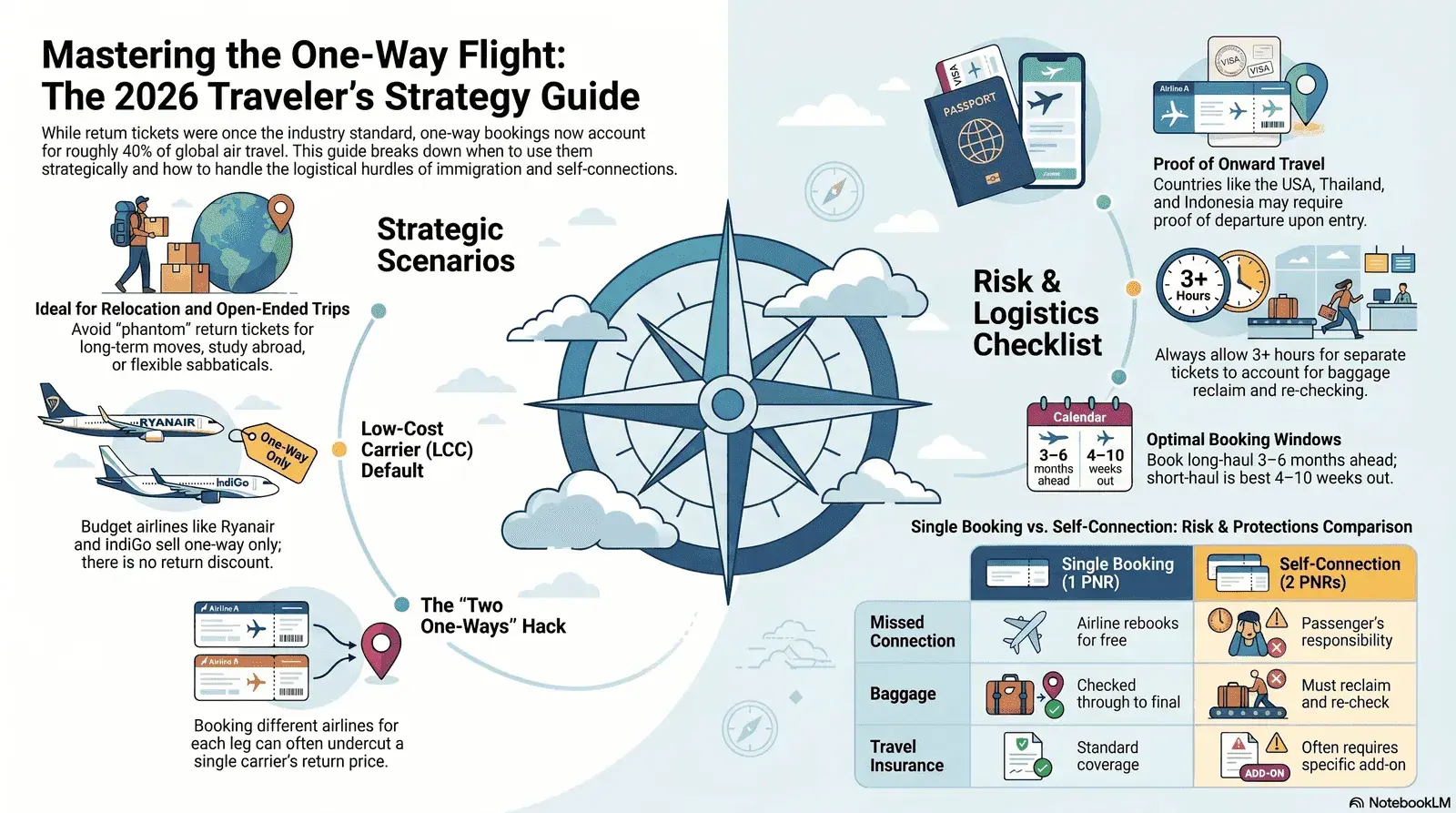
- On low-cost carriers, two one-ways almost always beat a return. Ryanair and easyJet only sell one-ways by design — mixing carriers on outbound and return legs is the standard way to find the cheapest total fare.
- Some countries require proof of onward travel at immigration. A cheap or refundable connecting ticket satisfies this without committing to a return date — the guide explains exactly which entry rules to check for your route.
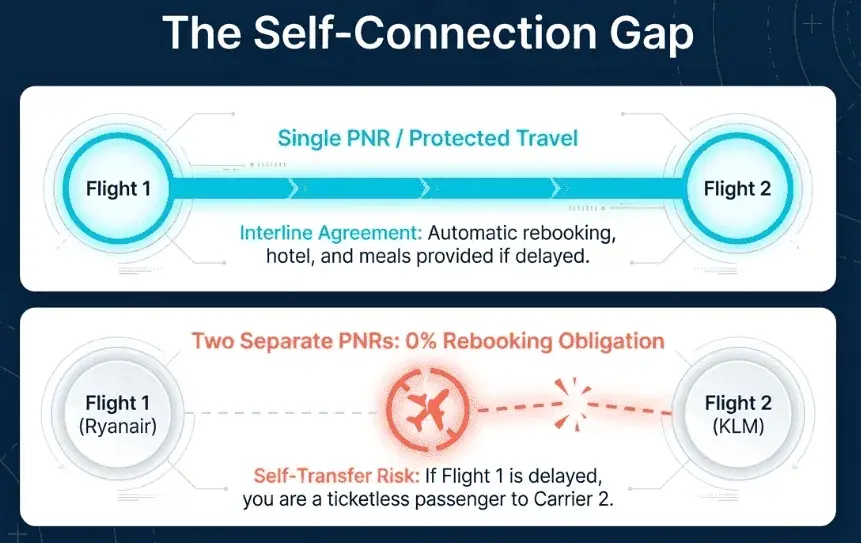
- Self-connection risk is the main pitfall. Booking two separate tickets means the second airline owes you nothing if the first flight is late — build in at least 3 hours between flights and keep baggage within carry-on limits.
One-way flights are no longer a niche booking choice. In 2026, they are standard practice for digital nomads, students relocating abroad, workers on fixed-term contracts, and anyone building a multi-city itinerary that starts in one city and ends somewhere entirely different. Across Europe, every Ryanair and easyJet ticket is already a one-way — the default has shifted quietly, and many travellers have not updated their booking instincts to match.
Many travellers assume a one-way always costs more per leg than the same direction within a return booking, or worry about immigration scrutiny without a confirmed return ticket. Both concerns are legitimate in specific contexts — but neither is a universal rule. This guide covers when a one-way is the right choice, how airlines price them, what entry rules to verify, how to search across carriers simultaneously, and how to manage the risks that separate-ticket travel creates.
✈ Low-cost carrier rule
Ryanair, easyJet, Wizz Air, IndiGo
All sell one-way only — no return fare type exists
🛂 Proof of onward travel
Required in some countries
USA, Canada, Thailand, Indonesia — verify before
travel
⚠ Self-connection risk
No automatic rebooking
Separate tickets = separate responsibility at
connections
📅 Optimal booking window
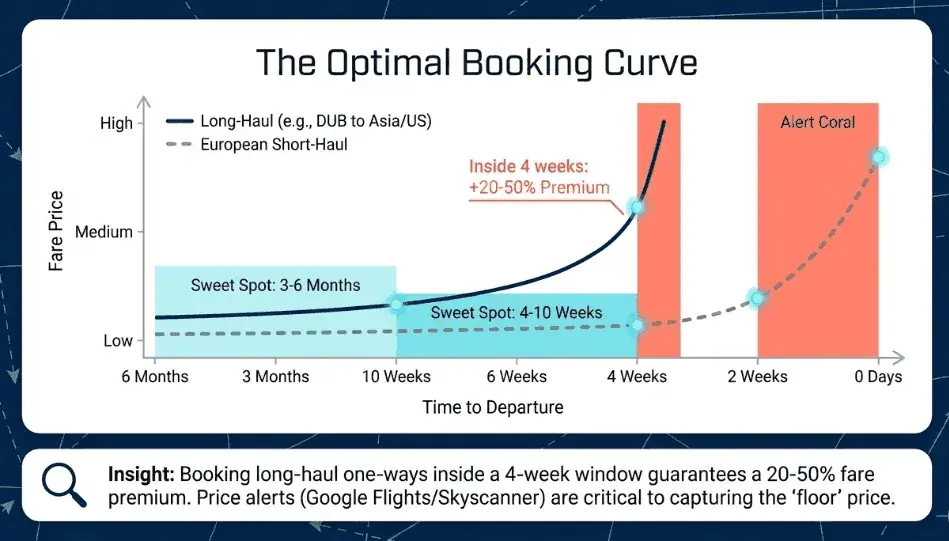
Long-haul: 3–6 months ahead
European short-haul: 4–10 weeks ahead
What this guide covers
1. When One-Way Flights Make Strategic Sense
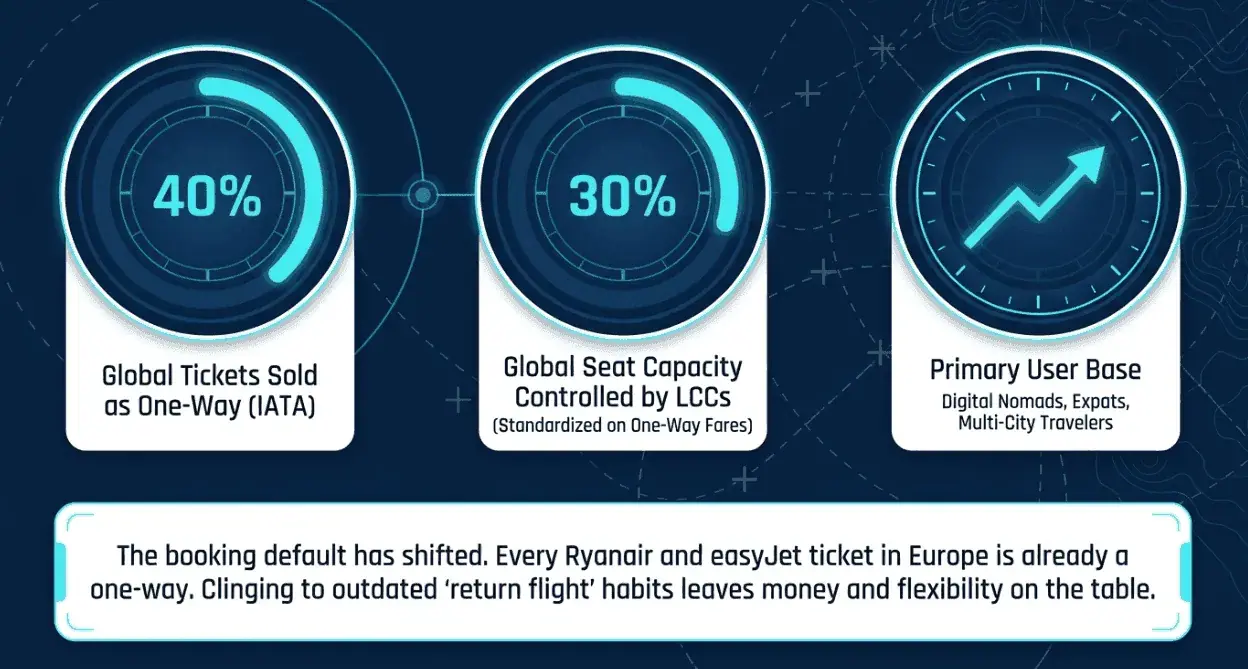
Not every trip warrants a return ticket. The following scenarios are where a one-way booking is genuinely the right tool — not just a convenience, but the better financial and logistical decision.
Scenarios where one-way is the correct choice
Relocation and long-term moves. If you are moving to a new country for work, study, or a long stay, booking a return flight you will never use is wasted spend. Students travelling from India to Ireland for a September university intake, or professionals relocating to Dubai on a two-year contract, have a clear one-way requirement. Buying a phantom return simply to satisfy a booking convention is not justified.
Open-ended trips and sabbaticals. Travellers who cannot commit to a return date — exploring Southeast Asia, doing seasonal work in Australia, or on a career break — cannot benefit from a return ticket's fixed date. A one-way lets them book the return leg independently once their plans settle, often at a similar or better fare if they monitor prices over time.
Multi-city and sequential itineraries. A traveller flying Dublin to Delhi, then Delhi to Bangkok, then Bangkok to Sydney is not making a return journey and should not be forced to price it as one. Building sequential one-ways — or a proper multi-city itinerary on a single booking where pricing is competitive — gives full control over each leg.
Open-jaw routing. Arriving into one airport and departing from another — flying into Mumbai and leaving from Delhi after a trip across northern India, for example — requires either two one-way tickets or an open-jaw return booking. This is one of the most underused trip-construction tools available. Booking an open-jaw return (where both ends are on a single PNR) is often cheaper than two separate one-ways on the same carriers, so compare both options when planning this type of trip.
Redeeming miles in one direction. If you hold loyalty points with one airline and prefer a different carrier for the other direction, booking one direction on an award ticket and the other on a cash one-way fare is a standard strategy among frequent flyers. Most airline loyalty programmes issue one-way award tickets without restriction.
When a return ticket is still the better choice
If you have a fixed return date, are travelling to a destination that enforces onward travel requirements at the border, or are flying on a full-service carrier where the return pricing is only marginally more than a single one-way, a standard return can be simpler and better value. Airlines like Aer Lingus and British Airways on transatlantic routes frequently price their return fares attractively versus two independent one-ways, especially in economy class — the flexibility premium disappears when the economics do not support it.
2. How Airlines Price One-Way vs Return Tickets
Understanding the pricing mechanics is the foundation for every booking tactic that follows.
Low-cost carriers: one-way is the default
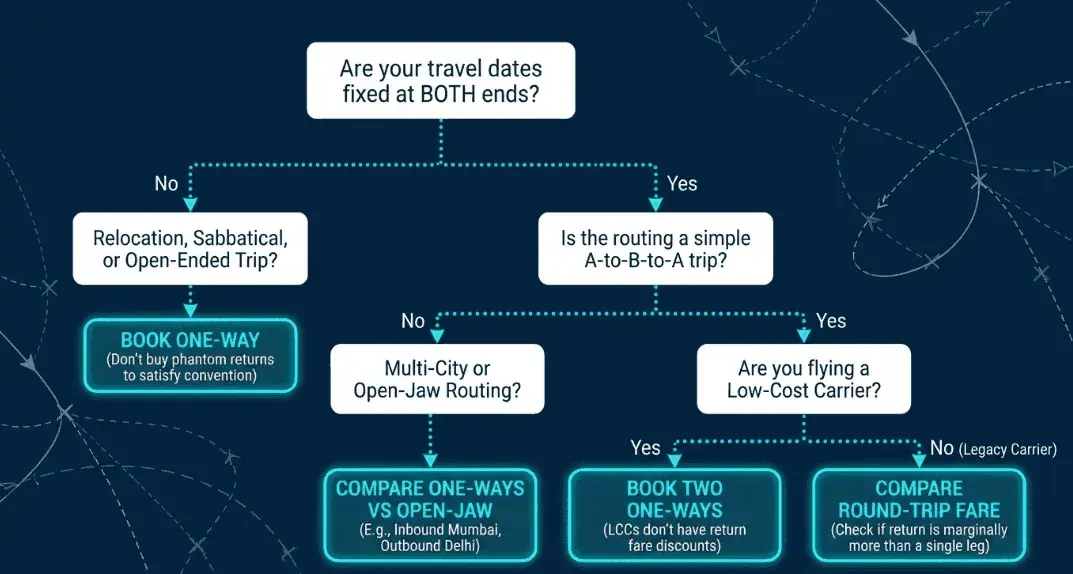
Every ticket sold by Ryanair, easyJet, Wizz Air, Vueling, IndiGo, SpiceJet, and AirAsia is a one-way ticket. These carriers do not have a return fare type — you book two separate one-ways if travelling both directions. There is no "return discount" to lose, and no penalty for using only one direction. This model is already standard for the vast majority of short-haul European and intra-Asian bookings.
Full-service carriers and pricing asymmetry
Legacy and full-service airlines — Aer Lingus long-haul, British Airways, Emirates, Lufthansa, Air India — typically sell both one-way and return fare types. On many of these carriers and routes, a one-way fare sits at 60–90% of the round-trip fare, meaning the round trip is substantially better value per direction for passengers who genuinely travel both ways.
This pricing structure exists because yield management on full-service carriers is historically built around the assumption of a return journey. When only a one-way is sold, the airline captures no revenue on the return leg and prices accordingly. However, this is not universal or static. On routes with high one-way demand — such as India–Ireland for students and workers, or Dublin–New York for open-ended US travellers — one-way fares have become more competitively priced as airlines compete for that specific passenger segment.
The "two one-ways" strategy
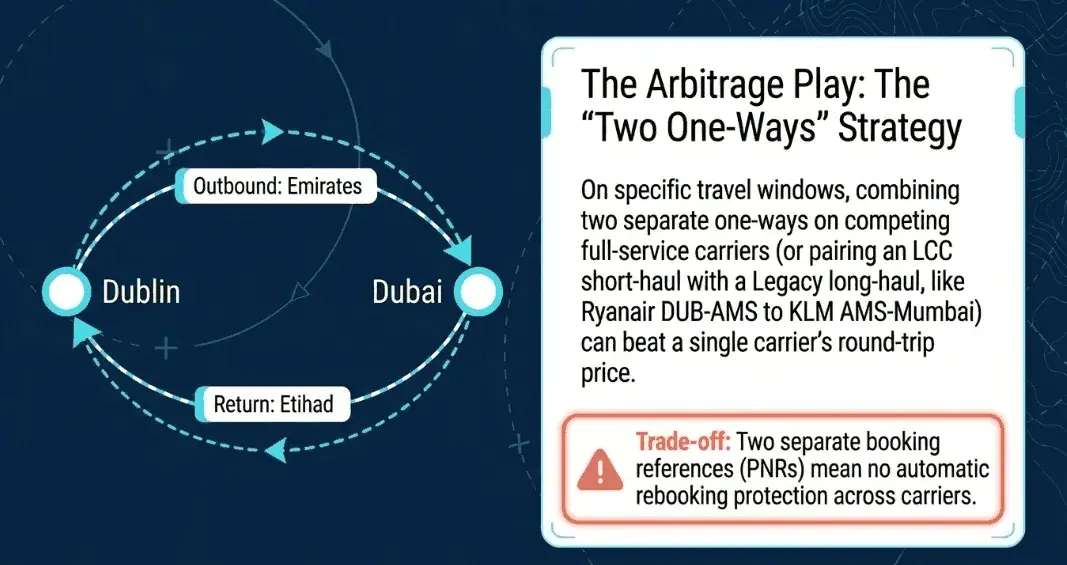
On some routes and date combinations, booking two separate one-ways on different airlines produces a lower combined price than a single return booking on one carrier. A practical example: flying Dublin to Dubai on Emirates for the outbound, and Dubai to Dublin on a competitive Etihad fare for the return, can beat Emirates' round-trip pricing on specific travel windows. The same logic applies to short-haul European connections — a Ryanair leg from Dublin to Amsterdam paired with a KLM transatlantic booking can undercut a single carrier's connecting itinerary price.
The trade-off: two separate booking references, no automatic rebooking protection if you miss a connection, and potentially different baggage allowances. This is a legitimate and widely used strategy, but only with a clear-eyed understanding of the risks detailed in Section 6.
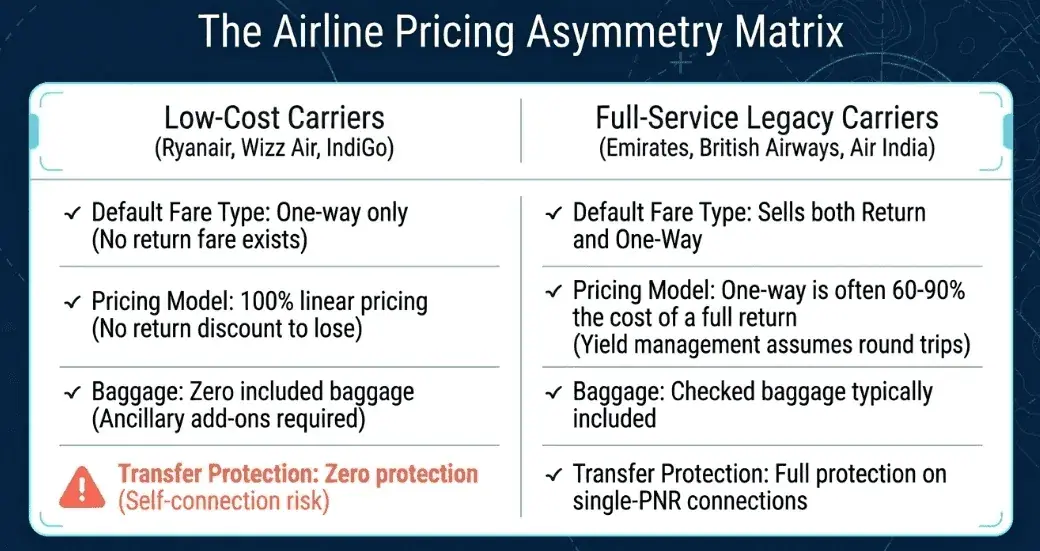
According to the International Air Transport Association (IATA), approximately 40% of all airline tickets globally are now sold as one-way bookings. In Europe, where the low-cost carrier model is dominant, the proportion is significantly higher. IATA reports that low-cost carriers now account for over 30% of global scheduled seat capacity, the majority of which is sold as individual one-way segments.
3. Essential Checks Before You Search
Three checks made before you open a fare comparison engine will eliminate the most common one-way booking problems.
Visa and entry requirements for one-way travellers
A one-way ticket carries no inherent immigration risk, but some countries use the absence of a confirmed return booking as an indicator to ask additional questions about the purpose and duration of a visit. Knowing this in advance removes the anxiety and lets you prepare appropriately.
- United States (ESTA / B-1 / B-2 visa): ESTA terms require that travellers intend to depart at or before the end of their authorised admission period. A one-way ticket does not automatically cause ESTA denial or entry refusal, but US Customs and Border Protection (CBP) officers may ask additional questions. Carry a printout of hotel bookings, a return flight plan, or an onward booking reference if your stay plans are firm.
- Canada: The Canada Border Services Agency (CBSA) may ask travellers arriving on a one-way ticket to confirm their plans to depart within the authorised period. Similar to the US, this does not result in automatic refusal but can trigger additional screening. Clear travel plans and accommodation bookings help.
- Thailand: Thailand has at times required travellers to show proof of onward travel when entering visa-free (30-day stamp) or on arrival. Requirements have varied and are applied inconsistently — verify the current position on the official Thai Embassy website or the Thai e-Visa portal (thaievisa.go.th) before departure.
- Indonesia: Indonesia's visa-on-arrival programme has included onward travel requirements at certain entry points. Check current rules via the Directorate General of Immigration Indonesia (imigrasi.go.id).
- India (eVisa / tourist visa): India's eVisa does not require a return ticket at the time of application, but you must be able to demonstrate the intent and means to depart before the visa's expiry. A one-way ticket into India is standard for students and long-stay visitors; the eVisa application form does ask for your intended date of departure.
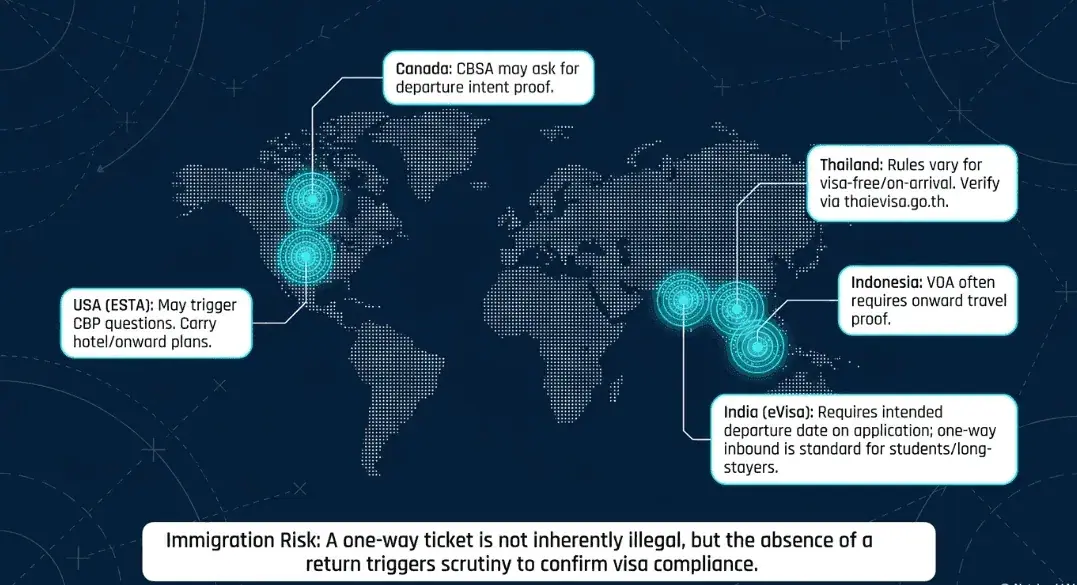
Always verify entry requirements on the official government immigration or embassy website for your destination, not third-party sources. Requirements change without advance notice.
Proof of onward travel: practical options
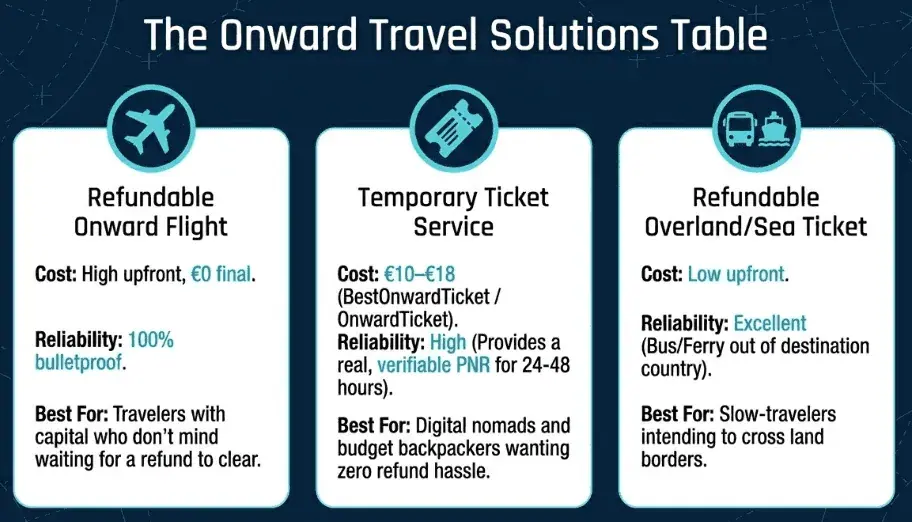
If your destination has an onward travel requirement but you do not yet have a firm return booking, three options cover you:
- Book a fully refundable onward ticket. Purchase a refundable outbound fare on the next leg of your journey or back to your home country. Show it at check-in or the border, then cancel it for a full refund after entry. Refundable tickets are available on most full-service carriers.
- Use a temporary onward ticket service. Services such as Best Onward Ticket (bestonwardticket.com) and Onward Ticket (onwardticket.com) issue a genuine, confirmed booking reference for 24–48 hours — long enough for most immigration checks — for a fee of approximately €10–€18. This is a legal and commonly used approach among long-term travellers and digital nomads.
- Book a refundable overland or sea departure. A refundable bus or ferry ticket from the destination country to a neighbouring country satisfies the onward travel requirement in most jurisdictions where the rule is applied. This works well for travellers planning to leave by land rather than air.
Baggage rules when mixing airlines
When you hold two separate tickets on different airlines, each airline's baggage policy governs that ticket independently. A 23 kg hold allowance included in your Emirates economy fare does not carry over to your separate AirAsia ticket for a connecting leg. On low-cost carriers, hold luggage is typically an add-on purchase — if you forget to add it at booking, the airport price is significantly higher.
4. How to Search Smarter for One-Way Fares
Start with a fare comparison engine
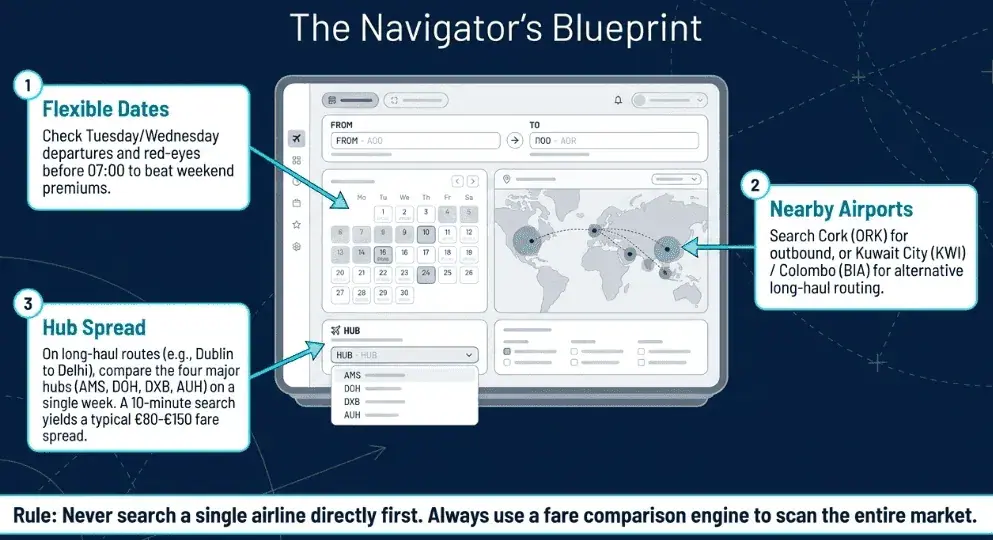
The single most important rule: never go directly to one airline's website and assume the price you see is representative of the market. A fare comparison engine searches across multiple airlines and booking channels simultaneously, returning ranked results for your route, dates, and passenger count in a single view.
On myflightoffers.com, select "One-way" in the search panel, enter your origin and destination airports, set your date, and run the comparison. The results show all available carriers, total fares including taxes and fees, and direct booking links. This takes approximately three minutes and surfaces options that would require an hour or more of manual airline website searching to replicate. Use the monthly fare calendar to identify which month is cheapest on your route before locking in a specific departure date.
Use flexible dates and nearby airports
Most fare comparison engines include a flexible date view that shows fares across a range of departure dates simultaneously. Google Flights' calendar view and Skyscanner's "Whole Month" feature allow you to see fares across 30 days without re-running individual searches — useful for identifying whether shifting your departure by two or three days produces meaningful savings.
Nearby airports are also worth checking at both ends. From Dublin, Cork Airport (ORK) occasionally offers competitive fares on routes connecting via European hubs. At the destination end, flying into a secondary hub and taking a short domestic leg can sometimes reduce the total itinerary cost — particularly on routes to India, where connecting through Colombo (BIA) or Kuwait City (KWI) can produce different pricing to the main Gulf hub options.
Mixing low-cost and full-service carriers
For itineraries involving a short European sector and a long-haul sector, combining a low-cost carrier to a major European hub with a full-service carrier for the long-haul portion can reduce the total fare significantly. Example: Ryanair from Dublin to Amsterdam (€25–€60 typical in economy) followed by KLM Amsterdam to Mumbai can beat a through-ticket Dublin–Mumbai quote on a single carrier on certain departure windows.
The prerequisite: sufficient connection time between the two tickets at Amsterdam. The minimum safe buffer for a Ryanair arrival at AMS followed by a KLM long-haul departure at the same airport is 3 hours, accounting for the possibility of a Ryanair delay.
5. Money-Saving Best Practices
Cheapest days and times to fly
Across aggregate booking data on major fare comparison platforms, Tuesday and Wednesday departures consistently show lower average fares than Friday and Sunday on most short- and medium-haul routes. This reflects lower demand from leisure travellers, who concentrate on weekend departures. On long-haul routes, the day-of-week effect is smaller but still present — midweek departures are worth checking before selecting weekend dates.
Red-eye and early-morning departures (before 07:00) are typically priced below peak-demand daytime slots on the same date. On routes involving a Gulf hub (Dubai, Doha, Abu Dhabi), late-night departures from European cities that arrive at the hub in the early hours often carry lower base fares than daytime options.
Price alerts and target fares
Google Flights, Skyscanner, Kayak, and most major airline apps offer free price alert functionality. Setting an alert on your specific one-way route and target date takes under two minutes and eliminates the need to check manually. When a drop notification arrives, book promptly — long-haul fares at their floor can recover within 24–48 hours as seat inventory tightens.
The price history feature on Google Flights (shown as a graph beneath fare results) is particularly useful for calibrating whether today's fare is high, average, or low for that route. Fares that have recently dropped from a higher level are worth locking in. Fares that have spiked from a lower base may recover if you have schedule flexibility — but only act on this if your dates genuinely can move.
Total journey cost: low-cost carrier pitfalls
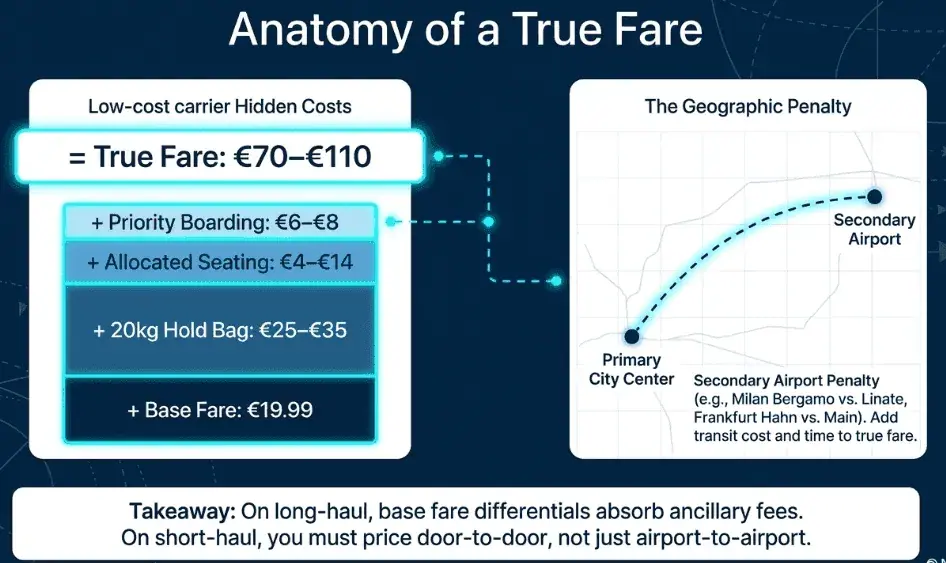
A Ryanair headline fare of €19.99 can reach €70–€110 once a 20 kg hold bag (€25–€35 pre-booked), allocated seating (€4–€14), and priority boarding (€6–€8) are added. On a long-haul comparison, this matters less — the fare differential is large enough to absorb ancillary fees. On European short-haul, the total-cost comparison is essential before declaring a low-cost option the cheapest overall.
Airport location is the other variable. Ryanair's use of secondary airports — Milan Bergamo rather than Linate, London Stansted rather than Heathrow, Frankfurt Hahn rather than Frankfurt Main — adds transfer cost and time that must be factored into the total. Always price door-to-final-destination, not just the fare.
6. Managing Risk on Separate Tickets
The self-connection and no-protection rule
When you hold two separate tickets — two distinct booking references (PNRs) — for flights that connect at an intermediate airport, the second airline has no legal or contractual obligation to rebook you if the first airline causes you to miss the departure. This is the most important risk in building a one-way itinerary from independent tickets.
The automatic rebooking, complimentary meals, and hotel accommodation that passengers receive when disrupted on a single booking (one PNR with interline agreement) do not apply to self-transfers. If Ryanair delays your Dublin–Amsterdam flight by two hours and you miss your KLM Amsterdam–Mumbai departure, KLM will not rebook you free of charge — you are a new, ticketless passenger to them.
A common trick some travelers use to save on one-way flights is "hidden-city ticketing" or "skiplagging" (booking an itinerary with a connection, and exiting at the layover city instead of flying to the final destination). However, this introduces major baggage issues. Under standard international aviation protocols, airlines will automatically tag and route checked luggage to the final ticketed destination. Gate and check-in agents are strictly prohibited from "short-checking" your bags specifically to the intermediate transit city. Furthermore, if the flight is full and you are forced to gate-check your carry-on, it will also be sent to the final destination. This tactic can only be executed with a carry-on personal item that stays with you at all times.
The minimum safe connection buffers for self-transfers:
- International arrival to international departure, same terminal, no baggage reclaim: 2 hours minimum
- International arrival with baggage reclaim, customs, and re-check at the same airport: 3–4 hours minimum
- Connections at known high-congestion hubs (London Heathrow, Frankfurt, Dubai, Istanbul): allow an additional 30–45 minutes beyond the standard buffer
Flexible fares versus saver fares on connecting segments
On the second ticket of a self-transfer itinerary, the value of paying for a flexible (changeable) fare is worth calculating explicitly. If the fare difference between a basic saver and a changeable fare is €40, and the cost of a last-minute one-way replacement if you miss the departure is €250–€500, the flex premium is almost always cost-effective for the second leg. Full flexibility on the first leg matters less, since a delay on the first flight is the risk event — and you cannot change a departure you have already boarded.
Travel insurance and missed connections
Standard annual multi-trip travel insurance policies typically cover missed connections when both flights are on a single booking reference. Coverage for missed connections on separate tickets is less consistent and often excluded unless you hold a specific "trip disruption" add-on.
Before relying on your insurance for a self-transfer itinerary, check your policy's missed connection clause explicitly. Specialist travel insurance products from providers including Allianz Travel, AXA Travel Guard, and Aviva Travel typically offer clearer self-connection coverage than standard annual policies. Some premium bank credit cards (HDFC Infinia, SBI Card ELITE, Axis Bank Magnus) include travel insurance that may cover trip disruption — verify the specific terms with your card issuer.
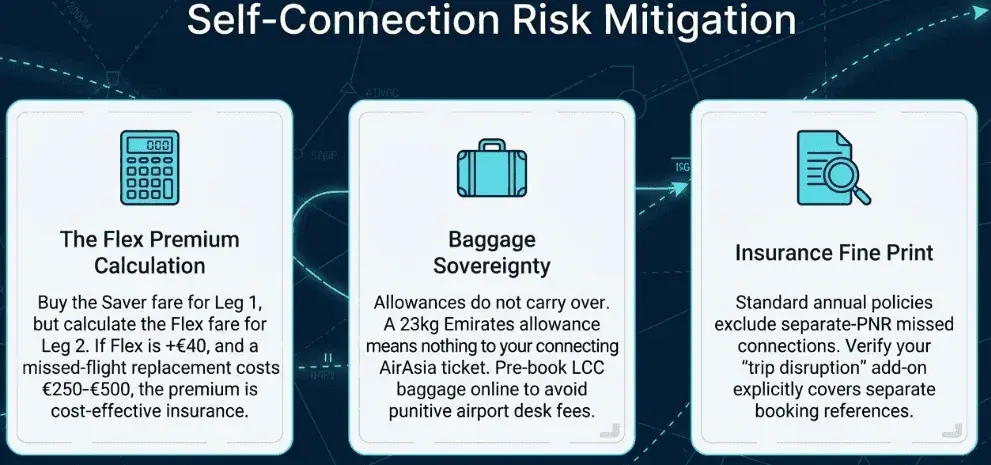
Confirm in writing (via your insurer's policy document or a direct query to their claims team) whether your travel insurance covers missed connections on separate booking references. Generic policy language around "missed connection" almost always refers to single-booking itineraries. This distinction becomes critical if a disruption occurs.
7. Building Multi-City and Open-Ended Trips with One-Ways
Sequential one-ways for multi-destination trips
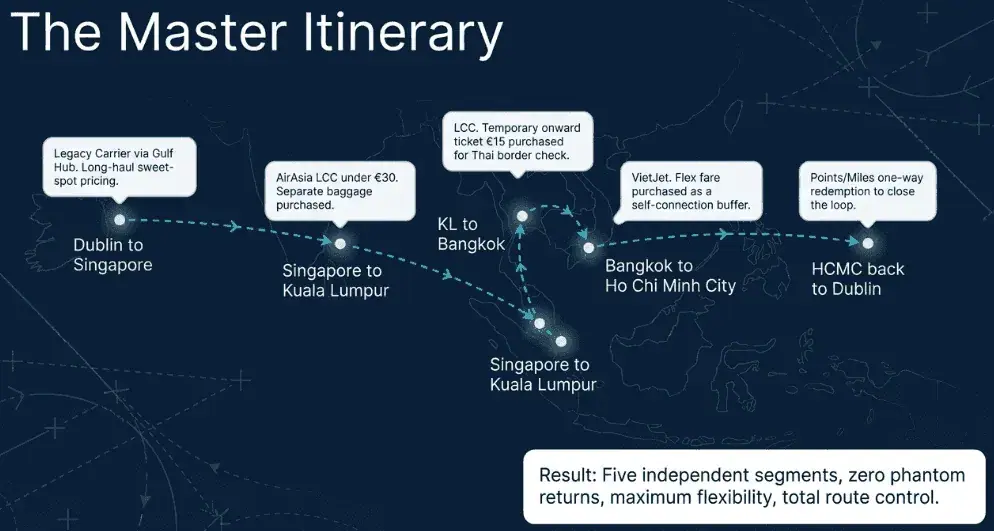
A slow-travel or backpacking itinerary across Southeast Asia is most efficiently built from sequential one-way tickets on the region's dominant low-cost carriers. An illustrative routing:
- Dublin → Singapore: one-way on a full-service carrier via Gulf hub
- Singapore → Kuala Lumpur: one-way on AirAsia (SIN–KUL, frequently under €30)
- Kuala Lumpur → Bangkok: one-way on AirAsia or Malaysia Airlines
- Bangkok → Ho Chi Minh City: one-way on VietJet or Scoot
- Ho Chi Minh City → Dublin (return to Europe): one-way on a Gulf carrier connection
Each leg is priced independently, often on the region's lowest available carrier. The total cost for this five-segment itinerary, constructed from individual one-ways, is typically lower than a multi-city quote from a single carrier — and the flexibility is substantially higher, since you can adjust later legs as your plans develop.
The administrative overhead: five separate booking references to track, five check-in processes, and five sets of cancellation terms. A simple spreadsheet recording each booking reference, airline customer service number, baggage allowance, and cancellation deadline eliminates the confusion.
Combining cash fares and miles on separate one-ways
Most airline loyalty programmes issue one-way award tickets without restriction. If you hold a balance of Emirates Skywards miles, Air India Maharaja Club miles, or Aer Lingus AerClub Avios sufficient for a one-way redemption on a long-haul route, booking that direction on miles and the return on a cash one-way fare is a standard approach. The operational requirement: confirm that your award ticket booking is fully confirmed before booking your cash return, since some award tickets carry cancellation risk if the redemption is not paid for promptly.
For Irish residents using Indian bank cards to book flights: the fare comparison and lounge access guides in the Indian Payment Guides section cover which cards deliver the best earning rates on flight bookings and how to use miles redemptions to maximum effect.
8. FAQs
Are one-way flights more expensive than return tickets?
It depends on the carrier type and route. On all Ryanair, easyJet, Wizz Air, IndiGo, SpiceJet, and similar low-cost carriers, tickets are always sold as one-ways — there is no return type and no penalty for flying in only one direction. On full-service carriers such as Aer Lingus long-haul, British Airways, and Emirates, a one-way can cost between 60% and 90% of the round-trip fare on some routes, making the return substantially better value per leg. On routes with high one-way demand, such as India–Ireland for students and workers, one-way fares on full-service carriers have become increasingly competitive in 2025–26. Always compare both options on a fare comparison engine before deciding.
Do I need proof of onward travel when booking a one-way ticket?
Some countries ask for evidence of an onward or return journey at the border when a traveller arrives on a one-way ticket. The United States, Canada, Thailand, and Indonesia are the most commonly cited examples, though application is at the border officer's discretion and not automatic. The safest approach: if your destination country has this requirement, carry a refundable return booking, a temporary onward ticket service confirmation (€10–€18 for a 24–48 hour booking reference), or a confirmed onward land or sea departure. Always verify current rules via the official embassy or immigration website for your destination.
How far in advance should I book a one-way flight?
For European short-haul routes, the optimal booking window is 4–10 weeks before departure for the best balance of availability and price. For long-haul routes such as Dublin to India, the US, or Southeast Asia, the best prices typically appear 3–6 months before departure. Booking inside 4 weeks of a long-haul departure consistently produces fare premiums of 20–50% compared to prices available in the optimal window — the earlier booking window applies equally to one-way and return tickets on long-haul routes.
Can I mix airlines when booking separate one-way flights?
Yes, without restriction. There is no rule preventing you from booking one airline for the outbound direction and a different carrier for the return or for a connecting segment. The key considerations: separate baggage allowances apply on each individual ticket, and if the first airline causes a delay that results in missing the second airline's departure, the second airline has no obligation to rebook you free of charge. Build adequate connection buffer time — a minimum of 2–3 hours at the connecting hub — to manage this risk in practice.
Do I earn frequent flyer miles on one-way tickets?
Yes. Frequent flyer miles or points accrue on eligible one-way tickets in exactly the same way as on the equivalent segment within a return booking. Accrual is based on distance flown, cabin class, and the fare basis code of the ticket — not on whether the ticket is a one-way or part of a return. There is no penalty in any standard airline loyalty programme for holding a one-way ticket.
Conclusion
One-way flights are a tool, not a compromise. The framework for using them well is consistent: confirm the entry requirements and onward travel rules for your destination, understand how your chosen carriers price one-way fares relative to returns, search across multiple carriers simultaneously before settling on a booking, and build appropriate buffer time into any itinerary involving separate ticket connections.
The shift toward one-way travel is already the norm across European short-haul and increasingly standard on long-haul routes served by multiple carriers. Approaching every booking with the question "should this be one-way, round-trip, or two separate one-ways?" — and finding the answer on a fare comparison engine rather than assuming — consistently produces better outcomes than defaulting to habit.
Plan your next one-way journey
Compare one-way fares across all carriers on your route and find the cheapest month to fly before you commit to a date.
- Hidden City Ticketing and Skiplagged in 2026: How It Works and Why It Can Backfire — before trying hidden city ticketing on a one-way itinerary, understand the five risks: from lost checked bags to cancelled frequent flyer accounts and visa complications for Indian passport holders.
- REAL ID & the New TSA ConfirmID Fee: A 2026 Domestic Flyer's Guide — before booking any US domestic connection as part of your one-way itinerary, confirm your ID is REAL ID compliant or you risk a $45 ConfirmID fee and 10–30 minute delay at the checkpoint.
- ETIAS 2026: What Travelers Need to Know Before Flying to Europe — if your one-way flight destination is Europe and you hold a US, UK, Canadian or Australian passport, you will need ETIAS once it launches (no confirmed date). Essential reading before locking in non-refundable one-way fares to Europe.
- The Legal Loophole: How Temporary Residency Lets You Bypass Massive International Import Taxes — if you're booking a one-way ticket for a permanent move, this guide covers how to import your belongings and vehicle duty-free using Transfer of Residence Relief, ATA Carnets and Carnet de Passages.
- How to Ship Your Life Abroad: Freight vs. Extra Baggage Logistics Compared (2026) — most one-way moves come with heavy luggage; compare sea freight, excess baggage and luggage forwarding to move your belongings without overpaying.
- How to Plan a Multi-City Family Trip Cheaply (2026 Complete Guide) — a practical family-first framework for open-jaw routing, total-cost planning, and safe multi-city booking.
- What Is a Conditional Flight Booking? Complete Guide 2026 — understand when a real temporary reservation can satisfy proof-of-onward-travel or visa file requirements without buying a non-refundable ticket too early.
- Types of One-Way Student Flight Tickets: Complete 2026 Guide — compare student one-way ticket categories, flexibility levels, and when each ticket type saves the most.
- What Is a Fare Comparison Engine? Complete Guide 2026 — understand how metasearch and fare engines surface one-way options across carriers and channels.
- Best Day to Buy Airline Tickets: Smart Booking Guide — compare booking windows and day-of-week pricing patterns to time your one-way purchase better.
- Finding Affordable Flights from Dublin to Delhi — airlines, price benchmarks, best booking windows, and visa requirements for the Dublin–Delhi route.
- Study in Ireland 2026: Complete Guide for International Students — universities, fees, scholarships, and which airlines fly from India and China to Dublin.
- Indian Payment Guides: Bank Cards, Lounge Access & Forex — which Indian bank cards deliver the best reward earn rates and forex savings on flight bookings.
- Airport Lounge Access in India: Complete Credit Card Guide 2026 — maximising lounge benefits on any one-way or return journey through Indian airports.
All airline pricing information, entry and visa requirements, onward travel rules, low-cost carrier policies, baggage allowances, booking window guidance, insurance policy summaries, and fare comparison tool descriptions in this article are based on publicly available information from IATA, official airline websites, government immigration portals (US CBP, CBSA, Thai e-Visa portal, imigrasi.go.id), and major fare comparison platforms as of May 2026. Airline pricing structures, entry requirements, and carrier policies can change at any time without notice. Always verify current entry requirements via the official embassy or immigration website for your destination country, and confirm current fares and baggage policies directly with your chosen carrier before booking. This article does not constitute legal or financial advice.