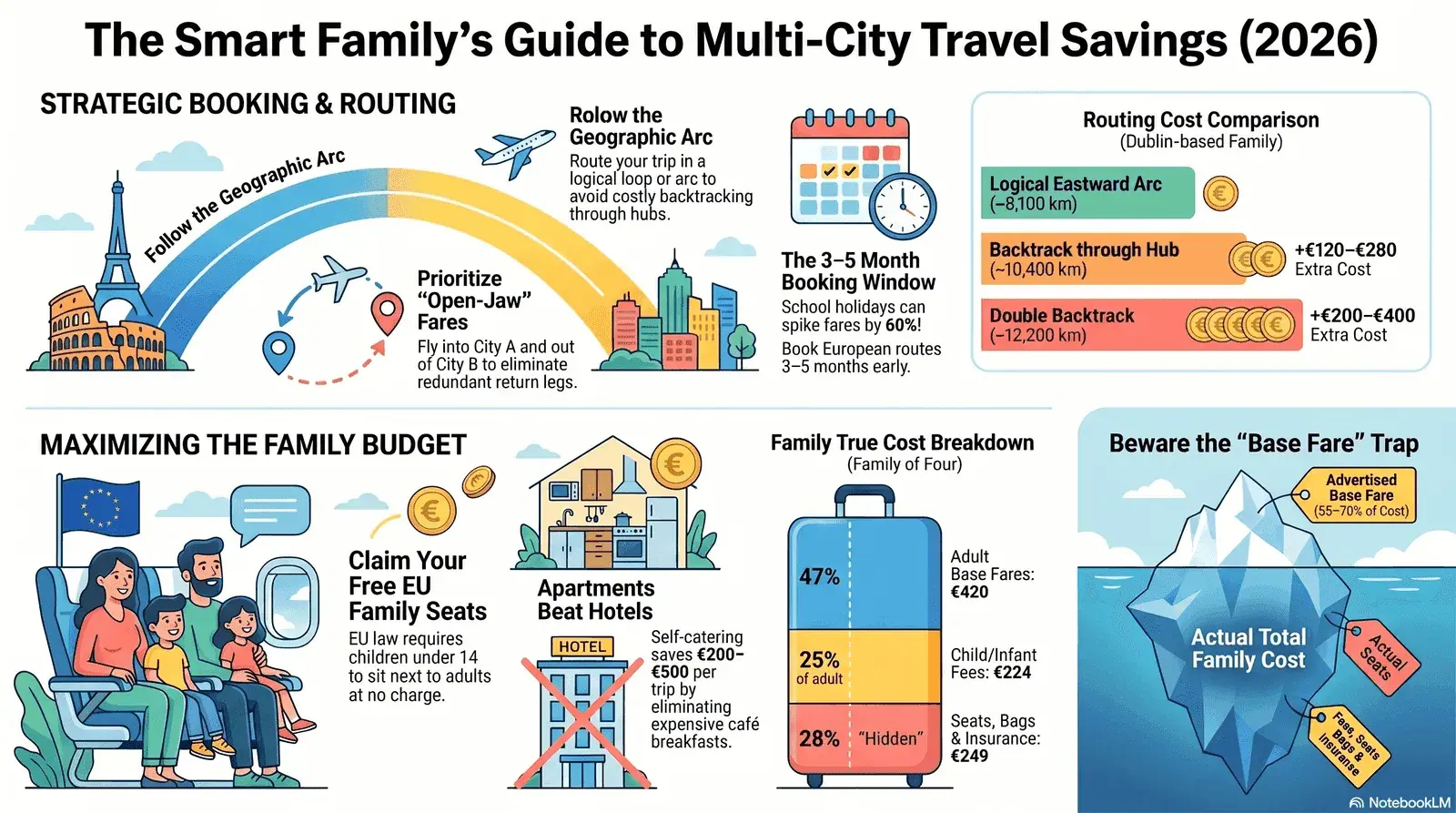
- Multi-city tickets can cut airfare by 20–30% over separate bookings. Geographic routing tricks — choosing the right hub sequence — are the single biggest lever families miss when planning a multi-destination trip.
- Hidden costs routinely double the headline fare. Baggage fees per leg, seat selection across multiple flights, and mid-trip transfer hotels can turn an apparent €600 fare into a €1,200 bill — always model total cost before committing.
- Book as one multi-city ticket, not separate one-ways. A single ticket protects you if one leg is delayed and eliminates repeated baggage check-in hassles that multiply with every city you add.
✈ Safest booking method
Single-ticket open-jaw or multi-city
Airline legally responsible for missed connections
📅 Optimal booking window
3–5 months for Europe; 5–8 months long-haul
School holidays spike fares 25–60% above normal
🗺 Single biggest cost saver
Geographic arc routing
Backtracking through hubs adds €50–€300 per trip
⚖ EU family seating rule
Free by law on EU-departing flights
Children under 14 must sit next to an adult at no
charge
10 questions answered in this guide
- Multi-city, open-jaw, or self-connection — which is right for your family?
- How geographic sequencing cuts airfare by up to 30%
- The true cost formula for multi-city family travel
- When to book — school holidays and the pricing calendar
- How to seat your family together without paying extra
- Accommodation strategies that cut family costs by 25–40%
- Loyalty programmes that actually work for family multi-city travel
- Best multi-city routes for families from Ireland
- Tools and apps for multi-city family planning
- 5 costly mistakes families make on multi-city trips
1 Multi-City, Open-Jaw, or Self-Connection — Which Is Right for Your Family?
The safest and usually cheapest option for families with children is booking a single-ticket itinerary: either a true multi-city or an open-jaw fare. Self-connecting on separate tickets may appear cheaper at the point of purchase but transfers the full financial risk of a missed connection entirely onto your family.
There are three distinct booking structures for multi-destination travel, and the difference between them has direct financial and practical consequences for families:
Open-Jaw — the smart starting point for most families
An open-jaw fare flies you into City A and out of City B, with the gap between them travelled by train, coach, or a budget short-haul flight you book separately. Example: Dublin → Rome (fly in), travel by train to Barcelona, Barcelona → Dublin (fly home). Open-jaw fares are typically priced at or only marginally above a standard return fare — yet they eliminate an entire backtrack leg and let you cover far more ground. For European family trips, this is often the best structure.
True Multi-City — for more complex itineraries
A true multi-city booking covers all legs on a single PNR (booking reference): Dublin → City A → City B → Dublin. The airline is contractually responsible for all connections. Most airlines support up to four or five stops in multi-city mode. Google Flights multi-city mode allows up to six destinations in a single search. This is the right structure for families doing long-haul trips across multiple continents.
Self-Connection — the trap families must avoid
Self-connecting means booking two or more separate one-way tickets and connecting them yourself at an intermediate airport. If the first flight delays and you miss the second, the second airline owes you nothing — no rebooking, no compensation, no responsibility. With young children, an involuntary overnight in an airport can cost €400–€800 in emergency hotel, meals, and new tickets for a family of four. The €40–€80 saving on the initial booking rarely justifies this exposure.
2 How Geographic Sequencing Cuts Airfare by Up to 30%
The single biggest cause of overpaid multi-city airfares is routing that forces backtracking through hubs you have already passed through. Airlines price flights based on the actual distance flown. Every time your itinerary doubles back geographically, you are paying for kilometres you do not need to travel.
The geographic sequencing rule is simple: your multi-city route should form a logical arc or loop on a map. It should never zigzag between destinations in a way that requires the airline to route you back through a hub you have already cleared.
| Route & Order | Type | Approx. Total Distance | vs. Optimal |
|---|---|---|---|
| Dublin → Barcelona → Rome → Athens → Dublin | Logical eastward arc ✓ | ~8,100 km | Baseline |
| Dublin → Athens → Rome → Barcelona → Dublin | Arc reversed | ~8,900 km | +€40–€100 |
| Dublin → Rome → Athens → Barcelona → Dublin | Backtrack through Rome ✗ | ~10,400 km | +€120–€280 |
| Dublin → Barcelona → Athens → Rome → Barcelona → Dublin | Double backtrack ✗ | ~12,200 km | +€200–€400 |
3 The True Cost Formula for Multi-City Family Travel
The published base fare represents only 55–70% of the actual cost of a multi-city family trip. Infant surcharges, extra baggage, seat selection fees, and travel insurance routinely add 40–80% above the advertised price when you add them up correctly before booking.
(Base fare × adults)
+ (Child fare ~75% × children aged 2–11)
+ (Infant surcharge ~10% × infants under 2)
+ (Extra checked bags × segments)
+ (Seat selection × seats × segments if required)
+ (Family travel insurance policy)
The formula is not abstract. Here is how it plays out for a real family of four — two adults, one child aged 7, one infant aged 14 months — on a three-city European trip:
| Cost Item | Calculation | Total |
|---|---|---|
| Adult base fares | €210 × 2 adults | €420 |
| Child fare (75% of adult) | €158 × 1 child aged 7 | €158 |
| Infant surcharge (10% + taxes) | €21 + €45 taxes × 1 infant | €66 |
| Extra checked bag (pushchair, infant kit) | €35/segment × 2 segments | €70 |
| Seat selection (family together) | €14/seat × 3 seats × 2 segments | €84 |
| Annual family travel insurance | — | €95 |
| True total | €893 | |
| What the price comparison site showed | Two adult fares only | €420 |
While intercontinental legacy carriers usually bundle standard cabin baggage or checked allowances, European low-cost carriers (LCCs) like Ryanair, Wizz Air, or EasyJet enforce extremely strict limits. For instance, Ryanair allows only a small personal bag measuring a compact under-seat footprint of 40x20x25 cm. If your bag exceeds these dimensions at the gate, staff routinely levy heavy penalty fees of €30 to €60 per flight segment. Before booking, check the official Ryanair terms and calculate your total journey costs including add-on bags, rather than relying solely on the baseline ticket prices.
🧮 Multi-City Family Trip True Cost Calculator
Estimate the real all-in cost of your multi-city family trip — including child fare discounts, infant surcharges, checked bags per segment, and seat selection fees that airlines don't show in the headline price.
4 When to Book — School Holidays and the Family Pricing Calendar
The cheapest time to book multi-city family travel is 3–5 months before departure for European routes, and 4–6 months ahead for long-haul. Irish school holiday periods increase fares by 25–60% above off-peak equivalents on popular family routes.
| Holiday Period | Approximate 2026 Dates | Typical Fare Premium | Booking Lead Time |
|---|---|---|---|
| Easter | March 30 – April 10, 2026 | +30–45% | 4–5 months ahead |
| Summer | June 26 – September 4, 2026 | +35–60% | 5–7 months ahead |
| Halloween mid-term | October 26 – October 30, 2026 | +20–35% | 3–4 months ahead |
| Christmas/New Year | December 19, 2026 – January 8, 2027 | +40–65% | 5–7 months ahead |
5 How to Seat Your Family Together Without Paying Extra
No EU regulation currently in force guarantees free family seating — but EASA safety guidance tells airlines to seat children under 12 next to their accompanying adult, and most EU carriers do so free of charge when you book correctly. Despite this, many airlines design their booking flows to push families toward paid seat selection. Knowing what the rules actually say protects your family and your wallet.
The current position: EASA guidance instructs airlines to take proactive steps to seat children — in particular those under 12 — next to their accompanying adults. This is safety guidance airlines are expected to follow rather than a passenger-facing law, so implementation varies by carrier. Separately, the EU’s revision of air passenger rights, agreed by EU transport ministers in 2025, would give children under 14 a formal right to free seating next to their accompanying adult; until that reform is fully adopted, no EU regulation in force compels a specific airline seating outcome. In Ireland, the Commission for Aviation Regulation handles air passenger rights complaints.
Four practical steps to guarantee family seating
- Book all family members on a single PNR. Separate bookings — even at the same time — are treated by airline systems as unrelated travelers. A single PNR is the foundation of all family seating protections.
- Use the same surname where possible. Airline seat-assignment algorithms flag same-surname passengers on the same PNR as a family unit and prioritise adjacent seat assignment.
- Call the airline 48–72 hours before departure. Request verbal confirmation that family seating has been assigned for all segments, including any connecting flights. Document the agent's name and confirmation reference.
- For infants, paid seat selection is still worthwhile. EU rules protect you from being separated, but not from being placed in a middle seat with a lap infant on a three-hour flight. For a family with a baby, paying €10–€14 to select a window/aisle pair is money well spent.
6 Accommodation Strategies That Cut Family Trip Costs by 25–40%
For families of three or more, a self-catering apartment consistently delivers better value than hotel rooms. The cost difference between two hotel rooms and one family apartment — when combined with the kitchen savings on meals — typically amounts to €200–€500 over a 7–10 night multi-city trip.
| Option | Nightly Rate | Kitchen? | 14-Night Total | Est. Meal Saving |
|---|---|---|---|---|
| 2 mid-range hotel rooms | €100–€130 each | No | €2,800–€3,640 | — |
| 1 family hotel suite | €160–€220 | Rarely | €2,240–€3,080 | Minimal |
| 2-bed Airbnb/Vrbo apartment | €110–€170 | Yes | €1,540–€2,380 | €350–€550 |
| Aparthotel (hotel service, apt layout) | €130–€190 | Usually | €1,820–€2,660 | €250–€400 |
Book accommodation with a kitchen, and a family of four eating breakfast in (€8–€15 spend) rather than in a Lisbon café (€40–€55 spend) saves €30–€40 per day. Over 14 days, that is €420–€560 in meal savings alone — roughly covering one adult's return flight.
7 Loyalty Programmes That Actually Work for Family Multi-City Travel
The British Airways Executive Club Household Account is the most family-friendly loyalty programme available to Irish travelers, allowing up to 10 family members to pool Avios points for a single award booking. It is the most practical route to a free family flight for most Irish households.
| Programme | Family Sharing | Best Earning Route for Irish Families | Open-Jaw / Multi-City Awards? |
|---|---|---|---|
|
British Airways Avios (Household Account) |
Up to 10 members pool points | Aer Lingus flights, BA Dublin routes, everyday spending via BA credit card | Yes — open-jaw and multi-city awards supported |
| Air France-KLM Flying Blue | Up to 4 companions share points | KLM via Amsterdam (DUB hub), Air France via Paris CDG | Yes — check Monthly Promo Rewards for 25–50% discounts |
| Emirates Skywards Family Plan | Up to 8 family members | Emirates DUB-DXB routes and Dubai-based connecting flights | Yes — strong for Middle East and Asia circuits |
| Aer Lingus AerClub | Individual accounts only (no household pooling) | Transatlantic Aer Lingus routes DUB-JFK, DUB-BOS, DUB-LAX | Limited — best for simple return awards |
8 Best Multi-City Routes for Families from Dublin
The most cost-effective and practically manageable multi-city itineraries for Irish families in 2026, based on flight availability, child-friendliness of destinations, and logistical ease of inter-city travel:
| Route | Best Season | Inter-City Transfer | Approx. Flight Cost (Family of 4) |
|---|---|---|---|
| DUB → Lisbon → Madrid → Dublin | Spring / Autumn | Train (2h 45m) | €900–€1,400 |
| DUB → Barcelona → Rome → Dublin | Spring / Autumn | Budget flight or bus (options vary) | €1,000–€1,600 |
| DUB → Rome → Athens → Dublin | Spring / Autumn | Short-haul flight (~2h) | €1,200–€1,900 |
| DUB → Marrakech → Faro (Algarve) → Dublin | March–May, Oct | Short-haul flight | €1,000–€1,600 |
| DUB → Bangkok → Bali → Dubai → DUB | November–March | Flights (book as multi-city) | €3,600–€5,400 |
| DUB → New York → Orlando → Dublin | September–November | Domestic US flight (~2h 40m) | €3,200–€4,800 |
9 Tools and Apps for Multi-City Family Planning
Using a single search engine for multi-city family booking leaves significant savings unrealised. The tools below each serve a distinct function in the planning process:
For finding and comparing multi-city flights
- Google Flights (flights.google.com): The most family-friendly multi-city search tool. Use multi-city mode for up to six destinations; use the date grid view to find the cheapest combination of outbound and return dates across a two-week window. Price Tracking alerts are free and reliable.
- Skyscanner (skyscanner.net): Multi-city mode available; the "Everywhere" destination feature is excellent for generating route inspiration when you know the budget but not the destination. The "Whole Month" view shows cheapest days at a glance.
- ITA Matrix (matrix.itasoftware.com): The professional routing tool used by travel agents. Cannot book directly, but reveals the precise fare logic behind complex multi-city itineraries — valuable for understanding why one routing is priced differently from another.
For accommodation
- Airbnb: Filter by "Kitchen" and "Washing machine" — the two most critical amenities for family stays of 5+ nights. Use the "Family-friendly" filter to find properties with cots, high chairs, and stair gates.
- Booking.com: Best for comparing apartments against hotels side-by-side; "Apartments" category filter includes serviced apartments, aparthotels, and holiday homes.
For managing the trip
- TravelSpend: Real-time expense tracking app; enter daily costs in local currency and it converts to euro automatically. Essential for tracking whether the family trip is running within budget across multiple countries.
- Google Maps Lists: Build a private list of accommodation addresses, airports, train stations, and attractions for each city before departure. Share with all traveling adults. Eliminates the "where are we going again?" problem with children in tow.
10 5 Costly Mistakes Families Make on Multi-City Trips
These are the five most common errors that turn a well-planned family multi-city trip into an expensive one — all avoidable with the right preparation:
- Booking self-connecting tickets to save €60 and losing €700 when a flight delays. With children, an involuntary overnight at a transit airport costs €300–€800 in emergency hotel stays, meals, and new tickets for all passengers. The €60 saving on self-connection is not valid insurance against this outcome. Always book a single-ticket itinerary for any routing where a missed connection would strand your family with no airline support.
- Ignoring child-specific baggage costs. A family traveling with an infant typically needs to check a pushchair, a car seat, and sometimes a travel cot. Many airlines charge €20–€50 per oversized or additional item per sector. On a three-sector multi-city itinerary, that is €120–€300 in baby equipment charges that do not appear in any headline fare comparison. Verify the specific policy for each airline in your itinerary at the time of booking.
- Treating destination cities as interchangeable peaks. Different European countries have different school holiday calendars. French families fill Mediterranean resorts in August; Spanish families are on holiday in late July and August; Italian families peak in August. Sequencing your French and Italian legs to fall in June or September — when local families are at school — reduces crowds, cuts accommodation costs, and makes family attractions genuinely accessible.
- Assuming the cheapest fare per city is the cheapest trip. Booking three separate return flights to three cities often costs 20–40% more than a single open-jaw or multi-city ticket covering the same destinations. Always price the full trip as a single itinerary first, then compare against the sum of separate returns.
- Booking accommodation before confirming flight layover details. A multi-city itinerary with a five-hour layover in Rome gives you a practical decision to make — is it worth storing luggage at the airport (€6–€10 per bag) and doing a quick city visit, or booking a day-use airport hotel room for €50–€80? Families who book accommodation first and then discover a long layover mid-trip have lost the opportunity to optimise that transit time.
- How to Ship Your Life Abroad: Freight vs. Extra Baggage Logistics Compared (2026) — Relocating the whole family? Compare sea freight, excess airline baggage and luggage forwarding with real 2026 costs and the exact tipping point.
- Finding Affordable Flights from Dublin to Delhi (2026 Complete Guide) — Airlines, visa rules, best booking windows, and airport transfer tips for the Dublin–India route.
- Study in Ireland 2026: Complete Guide for International Students — Universities, fees, scholarships, and flights into Dublin from India and China.
- Airport Lounge Access in India: Complete Credit Card Guide 2026 — If your multi-city trip connects through an Indian airport, this guide covers DreamFolks, Priority Pass, and guest access strategies.
Frequently Asked Questions
Is it cheaper to book a multi-city family trip as one ticket or as separate bookings?
As one ticket — open-jaw or true multi-city — in the large majority of cases. Separate tickets may appear €50–€100 cheaper at the point of purchase, but they transfer the full financial risk of missed connections onto your family. With children, an involuntary rebooking for four passengers on the next available flight will typically cost far more than the initial saving.
Do children pay less for multi-city international flights?
On most full-service airlines including Aer Lingus, Emirates, Qatar Airways, KLM, and British Airways, children aged 2–11 pay approximately 75% of the adult fare on international routes. Infants under 2 travelling on a parent's lap pay approximately 10% of the adult fare plus applicable taxes. Low-cost carriers including Ryanair, easyJet, and Vueling charge children identical fares to adults — there is no child discount on any low-cost carrier operating from Ireland.
Can I use loyalty miles to book a family multi-city trip?
Yes. British Airways Avios (via the Household Account), Air France-KLM Flying Blue, and Emirates Skywards all support multi-city and open-jaw award bookings. Award availability is limited, so book 6–11 months in advance for peak school holiday dates. Flying Blue Promo Rewards (announced monthly) can reduce the points cost of European family awards by 25–50% on specific routes.
What is the minimum useful layover time for families?
For families with children, add at least 45 minutes to the airline's published Minimum Connection Time (MCT). A family of four — particularly with a pushchair, infant equipment, or young children who need bathroom breaks — moves more slowly through airports than the average adult traveler. For connections involving terminal changes, allow at least 90 minutes above MCT. Always confirm published MCT times directly with the airline before booking.
How do I compare the real cost of different multi-city routes?
Use Google Flights multi-city mode to generate a base fare for the full itinerary. Then apply the True Cost Formula: add child and infant surcharges based on each airline's published fee schedule, add expected extra baggage costs, add seat selection if the route requires it, and add a family travel insurance policy. Compare two or three itinerary options on this all-in basis, not on headline adult fares alone.
What is an open-jaw flight and is it good for family travel?
An open-jaw flight means flying into one city and returning from a different city, with the gap between them travelled by train, bus, or a separately booked short-haul flight. It eliminates costly backtracking and is often priced similarly to a standard return fare. For families, it works best on European trips where affordable trains connect destinations - for example flying Dublin to Rome, travelling overland to Barcelona, then flying Barcelona back to Dublin.
Do children get cheaper fares on multi-city international flights?
On most full-service airlines including Aer Lingus, Emirates, Qatar Airways, KLM, and British Airways, children aged 2-11 pay approximately 75% of the adult fare on international routes. Infants under 2 travelling on a parent's lap pay approximately 10% of the adult fare plus taxes. Low-cost carriers including Ryanair and easyJet charge children the same fare as adults - there is no child discount on low-cost carriers.
Can an airline charge my family extra to sit together?
No EU regulation currently in force guarantees free family seating, but EASA safety guidance tells airlines to take proactive steps to seat children (especially under 12) next to their accompanying adults, and most EU carriers do this at no charge when the booking is on one PNR. The EU's air passenger rights reform agreed by transport ministers in 2025 would make free adjacent seating for children under 14 a formal legal right once adopted. Book all family members on a single PNR and call the airline 48-72 hours before departure to confirm family seating has been assigned.
How far in advance should I book a multi-city family trip?
For European multi-city routes: 3-5 months ahead for non-peak periods, and 5-7 months ahead for summer school holidays and Easter. For long-haul multi-city routes including Southeast Asia and the Americas: 5-8 months ahead, with loyalty award bookings made as early as 11 months in advance. Fares during Irish school holiday periods - summer (late June to early September), Easter, Halloween, and Christmas - are 25-60% above shoulder season prices on popular family routes.
Which loyalty programme is best for booking a family multi-city trip on points?
The British Airways Executive Club Household Account is the most family-friendly loyalty programme available to Irish travellers, allowing up to 10 family members to pool Avios points for a single award booking. Avios are earned via Aer Lingus, British Airways, Iberia, and Vueling. Air France-KLM Flying Blue and Emirates Skywards Family Plan also support point sharing between family members and support open-jaw and multi-city award bookings.
What is the geographic sequencing rule for multi-city trip planning?
Geographic sequencing means routing your multi-city itinerary so that cities follow a logical arc on a map - never backtracking through hubs you have already passed. For example, a family visiting Barcelona, Rome, and Athens from Dublin should fly Dublin → Barcelona → Rome → Athens → Dublin rather than Dublin → Athens → Rome → Barcelona → Dublin. Backtracking through hubs adds distance, increases flight time, and typically raises the fare by €50-€300 depending on the route.
Ready to plan your family multi-city trip?
Find the cheapest month to fly your route, then apply the strategies in this guide to build the most affordable family itinerary.
All airline child and infant fare percentages, baggage policies, seat selection fees, loyalty programme family account rules, school holiday dates, accommodation pricing estimates, EU passenger rights references (EASA family-seating guidance and the proposed EU air passenger rights reform), route distances, fare benchmarks, and tool descriptions in this article are based on publicly available information from airline official websites, the European Commission, the Commission for Aviation Regulation (aviationreg.ie), British Airways Executive Club, Air France-KLM Flying Blue, Emirates Skywards, Google Flights, Airbnb, and Booking.com as of June 2026. Airline policies, fare structures, loyalty programme terms, and accommodation pricing change frequently and without notice. Always verify current terms directly with the relevant airline, accommodation provider, or loyalty programme before making any booking decision. MyFlightOffers is not affiliated with any airline, loyalty programme, accommodation platform, or booking tool mentioned in this article. This article does not constitute financial or legal advice.