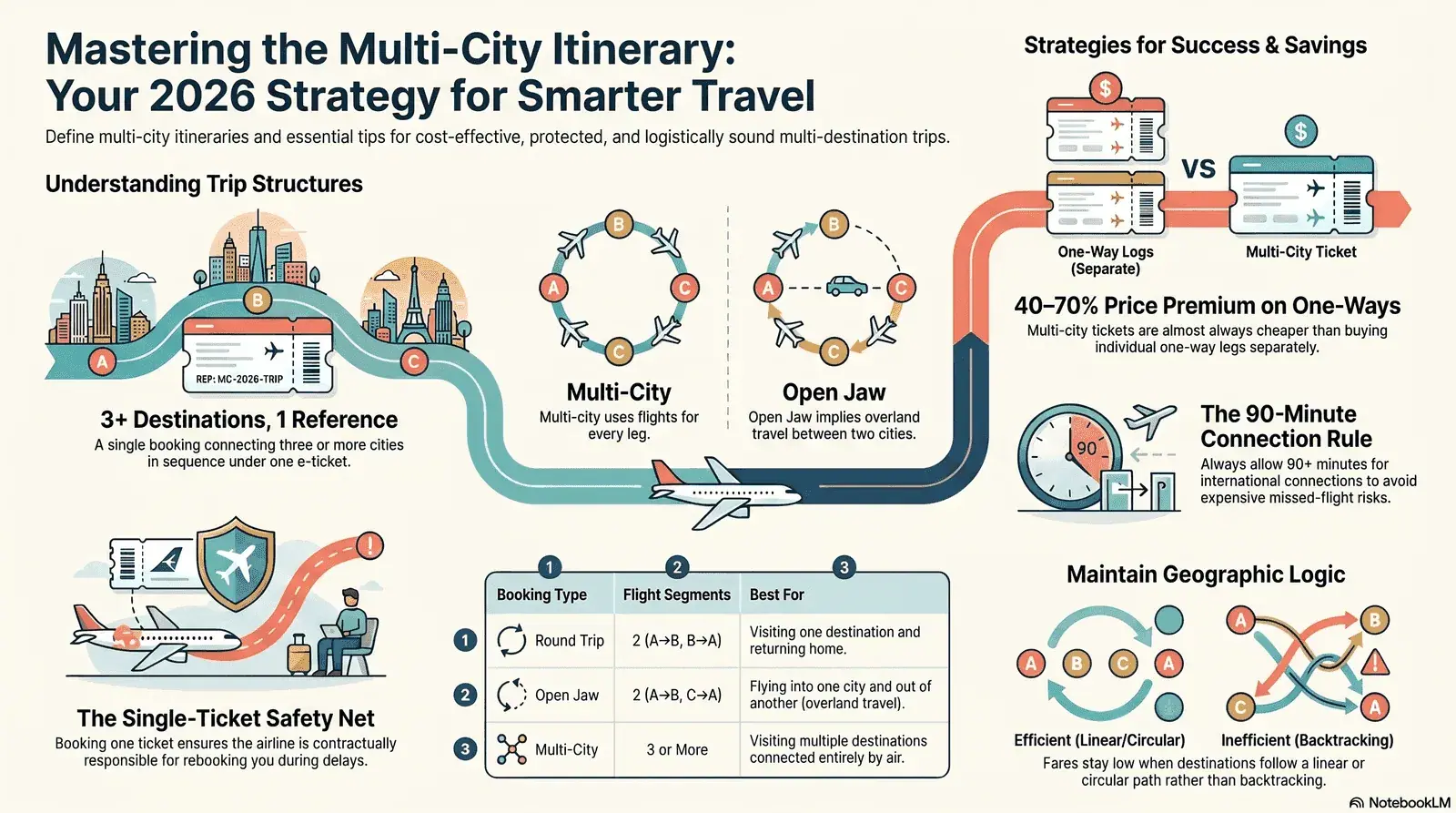
- A multi-city itinerary covers three or more destinations on one ticket. This is fundamentally different from booking separate one-ways and is often cheaper — especially for long-haul routes with multiple stops.
- It differs from a round trip and an open-jaw ticket. A round trip returns you to origin; an open-jaw departs from a different city than you arrived in; a multi-city lets you chain entirely different departure and arrival cities at each stop.
- The biggest booking mistake is using a round-trip search. Multi-city journeys require the dedicated multi-city search mode — the guide walks through the correct step-by-step approach on Google Flights, Skyscanner, and airline sites.
You have seen the term on booking websites, travel blogs, and flight search engines. Multi-city itinerary. But what does it actually mean, and when should you use one instead of a straightforward round trip? The short answer: a multi-city itinerary lets you visit three or more destinations on a single ticket — flying Dublin to Dubai to Bangkok to Singapore, for example, without ever retracing your steps. Done right, a multi-city booking is one of the most efficient and often one of the most cost-effective ways to travel. Done wrong, it can leave you in a connecting airport with your bag on the wrong carousel, a visa you forgot to apply for, and a connection window that was always too tight.
This guide covers everything from first principles: the exact definition, how multi-city compares to round trips and open jaw tickets, step-by-step booking instructions, cost comparisons, popular routes from Dublin and India, baggage rules, visa requirements, and the mistakes that cost travelers hundreds of euros every year.
✈ What it is
Three or more destinations on one ticket
Each stop is a separate flight leg under one booking
reference
🔄 vs Round trip
Multi-city adds stops; round trip returns to origin
Open jaw is 2 segments; multi-city is 3 or more
💶 Cost
Often cheaper than separate one-way tickets
Booking as one ticket also protects you against
delays
🔍 Best booking tool
Google Flights (free, up to 5 legs)
ITA Matrix for advanced fare research
15 questions answered in this guide
- What exactly is a multi-city itinerary?
- How is multi-city different from a round trip and an open jaw?
- When does booking multi-city make financial sense?
- How much does a multi-city itinerary cost?
- How do I book a multi-city itinerary — step by step?
- Which search tools support multi-city flight bookings?
- What are the most popular multi-city routes from Dublin and Ireland?
- What are the best multi-city routes for Indian travellers?
- How do airline alliances affect multi-city pricing and protection?
- What are the baggage rules on a multi-city booking?
- Do I need separate visas for each country on my route?
- How does a multi-city ticket compare to a round-the-world (RTW) ticket?
- Which type of traveller benefits most from multi-city?
- What are the biggest mistakes to avoid on a multi-city booking?
- Quick tips to plan the perfect multi-city itinerary
1 What Exactly Is a Multi-City Itinerary?
A multi-city itinerary is a single flight booking that connects three or more destinations in sequence. Each destination change is a separate flight leg, and all legs are collected under one booking reference and issued on one or more linked e-tickets. The critical distinction from a standard round trip is that you are not returning to your origin between each stop — you move progressively from city to city.
A concrete example: you want to visit Dubai, Bangkok, and Singapore on the same trip. A round-trip approach would require three separate bookings — Dublin to Dubai and back, Dubai to Bangkok and back, Bangkok to Singapore and back. A multi-city booking instead books all four flight legs on a single ticket:
The practical benefits of booking this way over separate tickets are meaningful: all legs share one booking reference; checked baggage typically transfers to your final destination automatically without collection and re-checking at each stop; if one leg is delayed, the airline is contractually responsible for getting you to your final destination on the same ticket; and in most pricing environments, the combined multi-city fare is cheaper than the sum of the individual legs bought as separate one-way tickets.
As long as your plans require. A multi-city itinerary is not an express transit — it is a planned trip with chosen destinations. You might spend a weekend in Dubai, five days in Bangkok, and four days in Singapore before flying home. Each leg has a confirmed date and time that you select at the time of booking. The only constraint is that all dates must be set when you purchase the ticket. Multi-city is a structured booking, not an open-ended pass.
2 How Is Multi-City Different from a Round Trip and an Open Jaw Ticket?
Three booking types confuse travelers most: round trip, open jaw, and multi-city. All three are distinct in structure, pricing, and when they are most useful.
| Booking Type | Flight Segments | Example Route | Surface Journey? | Best For |
|---|---|---|---|---|
| Round trip | 2 (A→B, B→A) | DUB → DXB → DUB | No | Visiting one destination and returning to origin |
| Open jaw | 2 (A→B, C→A) | DUB → CDG, FCO → DUB | Yes — implied (Paris to Rome by train) | Fly into one city, exit from another; overland travel between |
| Multi-city | 3 or more | DUB → DXB → BKK → SIN → DUB | No — every move is a flight | Three or more destinations, all connected by air |
The open jaw is the type most commonly confused with multi-city. An open jaw ticket has exactly two flight segments with a surface journey implied between them. The most common version: you fly into one city and fly home from a different city. For example, flying Dublin to Paris, taking the train through Italy, and flying home from Rome. The ticket covers DUB→CDG and FCO→DUB. The Paris-to-Rome overland journey is not on your ticket — it is your own arrangement. Open jaw fares are typically priced similarly to round trips.
The defining difference between open jaw and multi-city is the number of flight segments. An open jaw always has exactly two. A multi-city has three or more, with every destination change involving a flight. If you fly Dublin to Paris, then Paris to Rome, then Rome to Dublin — three separate flight legs — that is a multi-city booking. If you fly Dublin to Paris, take the train to Rome, and fly Rome to Dublin — two flight legs — that is open jaw.
Stopovers vs. Open-Jaws: Crucial Distinctions
It is common to confuse Open-Jaw and Stopover frameworks, but understanding their operational differences is key to optimizing your travel budget.
- Open-Jaw: An Open-Jaw routing involves flying from Point A to Point B, and then returning from Point C back to Point A. This requires you to arrange separate surface/ground transit (such as a train, rental car, or separate flight) to travel from B to C. Example Scenario: Flying from Dublin to Paris, taking a high-speed train to Rome, and then flying back from Rome to Dublin. Because you enter one city and exit another, it splits your airfare destination without adding flight legs to your ticket, keeping baseline fares very close to a standard round-trip price.
- Stopover: A Stopover is a planned stay of more than 24 hours in a connecting city along a single, continuous flight route managed by a single airline or alliance. Example Scenario: Flying from Dublin to Bangkok on Emirates with a planned 3-day stopover in Dubai before catching your second flight to Bangkok. The airline handles your transit under a single fare code, often allowing you to add the stopover for free or a nominal fee, which is a great way to visit two destinations for the price of one.
3 When Does Booking Multi-City Make Financial Sense?
Multi-city bookings deliver financial value in three specific situations. Outside of these, a round trip or open jaw may serve you equally well at lower complexity.
Situation 1: You are visiting multiple destinations anyway
If Dubai, Bangkok, and Singapore are all on your itinerary for the same trip, the question is not whether to visit them — it is how to connect them most efficiently. Buying three separate round trips (Dublin–Dubai return, Dubai–Bangkok return, Bangkok–Singapore return) almost always costs more than booking the full circuit as one multi-city ticket. One-way fares on most routes carry a significant premium over the same segment sold as part of a return or multi-city booking.
Situation 2: Your route is geographically logical
The strongest multi-city value emerges when your destinations follow a broadly linear or circular geographic path. Dublin to Dubai to Bangkok to Singapore to Dublin is an eastward arc — each stop is closer to the next than to the previous one, and the airlines serving this corridor price the circuit competitively. Contrast this with a geographically incoherent route that doubles back on itself: multi-city pricing benefits shrink sharply, and separate tickets may actually be cheaper.
Situation 3: You want single-ticket protection
This benefit has real monetary value even when fares are similar. If you book three separate tickets and your first flight is delayed causing you to miss the second, you are personally responsible for rebooking and paying for the missed leg. If all three legs are on one ticket, the operating carrier must rebook you at no additional cost. For complex itineraries with tight connections, this protection alone can justify choosing multi-city over three separate bookings.
4 How Much Does a Multi-City Itinerary Cost?
Multi-city fares are not priced on a simple formula. The total depends on the specific route, the airlines involved, travel dates, how far in advance you book, and whether the legs are priced as a unified circuit fare or as individual segments combined. Three reliable patterns apply.
Multi-city vs separate one-way tickets
Booking a multi-city itinerary on one ticket is almost always cheaper than buying each leg as a separate one-way. Airlines typically price one-way tickets at a premium on most routes — sometimes 40–70% more expensive than the same segment sold as part of a return or multi-city booking. A four-leg circuit booked as a single multi-city fare can deliver meaningful savings over the equivalent four individual one-way fares.
Multi-city vs a simple round trip
A multi-city ticket that adds destinations beyond a basic A-to-B round trip will naturally cost more than that round trip — but the marginal cost of each additional destination is often a fraction of what a separate return ticket to that city would cost. The test: if adding Bangkok and Singapore to a Dublin–Dubai round trip costs less than buying a separate Dubai–Bangkok–Singapore circuit, the multi-city route wins on value.
Seasonal variation
Multi-city pricing follows the same seasonal demand patterns as individual flights. Peak periods — Christmas, summer school holidays, Diwali for India-routed itineraries — push all fares up. The strongest pricing for multi-city circuits from Ireland typically appears in January, February, and shoulder-season months such as April, May, and October.
5 How Do I Book a Multi-City Itinerary — Step by Step?
Multi-city booking takes around ten minutes once you have your route planned. The process below uses Google Flights, the most accessible free tool for most travelers.
-
Plan your route on paper first. Write every destination you want to visit, in the order that makes geographic sense. Reducing backtracking reduces both total flying time and cost. Confirm approximate dates for each leg.
-
Open Google Flights and switch to Multi-city mode. On the homepage, click the dropdown that defaults to "Round trip" and select "Multi-city." You will see multiple rows where you enter origin, destination, and date for each leg.
-
Enter each leg in order. For a Dublin → Dubai → Bangkok → Singapore → Dublin circuit: Row 1 is Dublin to Dubai on your chosen departure date. Row 2 is Dubai to Bangkok. Row 3 is Bangkok to Singapore. Row 4 is Singapore to Dublin.
-
Review the results carefully. Google Flights returns available combinations with different airlines for each leg. Check total journey time, connection duration on each leg, number of stops within each leg, and the total fare. Flag any connections under 90 minutes on international legs — these are risky.
-
Cross-check against alternatives. In a separate browser tab, price the equivalent as separate tickets. Compare total cost including any baggage fees. If the multi-city single ticket is competitive, proceed.
-
Book on the airline website or a trusted OTA. Google Flights redirects you to complete the booking. Where possible, complete the purchase directly on the airline's website for easier post-booking changes and clearer baggage policy confirmation.
-
Verify every detail before paying. Check that all dates, cities, and names are correct. Confirm the baggage allowance for each leg. Check visa requirements for every country on the itinerary. Save or screenshot all confirmation numbers.
If your ideal multi-city route uses different airlines on different legs — Emirates for DUB–DXB–BKK and Singapore Airlines for BKK–SIN–DUB, for example — book everything through a single OTA that can issue a consolidated itinerary under an interline agreement. This ensures bag transfer and delay protection. If the OTA books them as two separate tickets (two separate confirmation numbers), you have lost those protections.
6 Which Search Tools Support Multi-City Flight Bookings?
| Tool | Multi-city support | Max legs | Best use case |
|---|---|---|---|
| Google Flights | ✓ Excellent | 5 legs | Primary search; price calendar; free alerts |
| ITA Matrix | ✓ Advanced | 5+ legs | Research only — no direct booking |
| Kayak | ✓ Good | 6 legs | Hotel and car bundling alongside flights |
| Momondo | ✓ Good | 6 legs | Cross-checking alternative routings |
| Skyscanner | ✓ Limited | 3 legs | Best for simple two-stop circuits |
| Expedia | ✓ Good | 6 legs | Package bundles; hotel + flight |
| Direct airline websites | Varies | Typically 6 | Single-airline or single-alliance bookings |
Google Flights is the recommended starting point for most travelers. It is free, updated in real time, covers the widest range of airlines for this route type, and offers a price tracking feature that notifies you when your saved multi-city combination drops in price.
ITA Matrix (matrix.itasoftware.com) is the professional-grade fare research tool that powers many travel agencies and frequent flyer communities. It surfaces complex alliance fare combinations and mixed-cabin options that simpler tools miss. Use it for research, then book the identified itinerary directly on the airline's website.
Kayak's multi-city tool is worth checking in parallel, particularly for circuits where bundling hotels reduces total trip cost. Kayak Hacker Fares — which combine tickets from two different airlines — can sometimes undercut single-airline multi-city fares, though they come with the separate-ticket risks described in Q14.
7 What Are the Most Popular Multi-City Routes from Dublin and Ireland?
Dublin's position at the western edge of Europe — connected to Gulf, Asian, and transatlantic hubs by Emirates, Qatar Airways, Etihad, Aer Lingus, and KLM — makes it a natural gateway for multi-city travel. The five circuits below are consistently among the most searched and most cost-effective from Irish departure airports.
8 What Are the Best Multi-City Routes for Indian Travellers?
Indian travelers — whether based in Ireland or booking from India — benefit from one of the densest long-haul network connections in the world, courtesy of the Gulf carriers. Emirates, Qatar Airways, and Etihad connect India's major metros (Delhi, Mumbai, Bangalore, Hyderabad, Chennai, Kochi) to virtually every long-haul destination via their Dubai, Doha, and Abu Dhabi hubs. This makes multi-city circuits from India naturally hub-friendly.
If you hold an HDFC Infinia, Axis Atlas, SBI Miles Elite, or ICICI Emeralde Private Metal card, booking a multi-city flight directly on the airline website or through a partner OTA may earn significantly more reward points or travel credits than booking via a generic platform. HDFC's SmartBuy, Axis Bank's Travel EDGE portal, and ICICI's iShop portal each offer accelerated earning on direct travel bookings. Read our Indian Payment Guides for card-specific earning rates and how to maximise them on international bookings.
9 How Do Airline Alliances Affect Multi-City Pricing and Protection?
The three global airline alliances — Star Alliance, oneworld, and SkyTeam — have a significant impact on how multi-city fares are structured, priced, and protected. Understanding them saves money and prevents bag-collection surprises.
The three major alliances and their key members
- Star Alliance (26 member airlines) — Lufthansa, United Airlines, Singapore Airlines, Air India, Turkish Airlines, Air Canada, Swiss, Austrian Airlines, Scandinavian Airlines, and others. For Dublin travelers, Lufthansa via Frankfurt or Munich and Turkish Airlines via Istanbul are the primary gateways into this network.
- oneworld (13 member airlines) — British Airways, American Airlines, Qatar Airways, Iberia, Finnair, Japan Airlines, Cathay Pacific, Royal Jordanian, and others. Aer Lingus is a oneworld affiliate. Qatar Airways is the primary oneworld gateway to long-haul Asia from Dublin.
- SkyTeam (19 member airlines) — Air France, KLM, Delta Air Lines, Korean Air, China Eastern, Vietnam Airlines, and others. KLM via Amsterdam is the key Dublin–Asia SkyTeam pathway.
What alliances mean for your multi-city booking
When all legs on your itinerary are operated by airlines within the same alliance, three benefits apply consistently: checked bags transfer automatically to your final destination under one check-in process; loyalty miles accrue to your chosen programme within that alliance; and fares are often combinable more cleanly under interline pricing rules, which can reduce the total fare.
When you mix airlines from different alliances on a single ticket, you are relying on bilateral interline agreements between specific carriers rather than alliance-wide rules. Bags may still transfer, but this must be confirmed for each airline pair before booking.
An interline agreement is a commercial arrangement between two airlines allowing them to sell each other's flights on a single ticket and co-ordinate baggage handling. A codeshare goes further — one airline operates the flight but another sells it under its own flight number. Codeshares offer stronger bag transfer guarantees than standard interline agreements. When booking a multi-city ticket mixing carriers, confirm whether an interline or codeshare agreement exists; without one, you have two separate tickets and none of the associated protection.
10 What Are the Baggage Rules on a Multi-City Booking?
Baggage is the most complex aspect of multi-city travel, and misunderstanding it is one of the most expensive mistakes travelers make. The rules depend on whether you are on one ticket or separate tickets, and which airlines are operating each leg.
| Scenario | Bags transfer automatically? | What you need to do |
|---|---|---|
| All legs on one airline, one ticket | Yes | Check in once at origin; bags go to final destination |
| Multiple airlines, one ticket, interline agreement confirmed | Yes | Check in once at origin; bags go to final destination |
| Multiple airlines, two separate tickets | No | Must collect bags and re-check at each connection point |
| Any connection through the USA | No | All passengers entering the US must clear US Customs and collect bags — then re-check for any onward domestic US flight |
| Overnight stopover (12+ hours) mid-circuit | Varies | Usually must collect bags at the stopover city; confirm with airline at check-in |
Allowance mismatches between carriers
A second baggage complication: different airlines on your itinerary carry different allowances. An economy fare on one leg may include 23 kg; the same fare class on another leg may include only 20 kg or one piece of 23 kg. On a single ticket, the most restrictive allowance on any leg technically applies to that leg. Always read the baggage terms for each individual airline on your multi-city itinerary, not just the headline fare description.
11 Do I Need Separate Visas for Each Country on My Route?
Yes. Every sovereign country you enter — including countries where you land to collect and re-check bags, or to transit if you must pass through immigration — may require a valid visa or transit permission. The rules vary significantly by your passport nationality and by the specific country.
Key entry rules for common multi-city routing countries
- Schengen Area (27 countries including France, Germany, Netherlands, Italy, and Spain): A single Schengen visa covers all 27 member states. Irish and EU/EEA citizens do not need a visa. Most Western passport holders can enter Schengen visa-free for up to 90 days in any 180-day period. Non-EU nationals should verify entitlement for their specific passport at the relevant embassy.
- United Kingdom: Since Brexit, the UK is no longer part of the EU or Schengen Area. Irish citizens can travel visa-free to the UK under the Common Travel Area (CTA). EU citizens currently travel visa-free to the UK. Most other nationalities should verify current UK visa requirements, as rules have changed since 2020.
- United Arab Emirates (Dubai / Abu Dhabi): Most EU, US, UK, Australian, and New Zealand passport holders receive a visa on arrival free of charge, typically valid for 30–90 days. Indian passport holders receive a visa on arrival valid for 14 days (as of 2025; verify current terms).
- Thailand: Irish and EU citizens receive a 60-day visa exemption stamp on arrival at Bangkok airports. Indian passport holders require either a Thailand e-visa or arrive visa-on-arrival (with a fee) as of 2026 — verify current terms before departure.
- Singapore: Irish and EU citizens receive a 30-day visa-free entry, extendable to 90 days in some cases. Indian passport holders require an electronic travel authorisation or visitor visa; check ICA Singapore's official portal before travel.
- Japan: Irish and most EU citizens receive a 90-day visa-free entry stamp. Indian passport holders require a Japan tourist visa, applied for in advance through the Japanese Embassy.
- South Korea: Irish and most EU citizens receive a 90-day visa-free entry. Indian passport holders can apply for a K-ETA (Korea Electronic Travel Authorization) online in advance.
- India: Most Western passport holders (including Irish and EU citizens) can enter on an e-Tourist Visa applied for online at indianvisaonline.gov.in. The e-visa is available for multiple durations. Apply at least 4–7 days before travel.
Nationals of certain countries, including India, Pakistan, Bangladesh, Ghana, Nigeria, and others, require a UK Direct Airside Transit Visa (DATV) even when their aircraft lands at Heathrow or Gatwick and they remain entirely airside — never passing through UK immigration. If your multi-city route involves a connection at any UK airport, check whether your passport requires a DATV at gov.uk/check-uk-visa before booking. Discovering this at check-in is not a recoverable situation.
12 How Does a Multi-City Ticket Compare to a Round-the-World (RTW) Ticket?
Round-the-world tickets are a specialist fare product offered by airline alliances. For travelers planning very long, multi-continent trips, they are worth understanding as an alternative to assembling multi-city legs individually.
What is an RTW ticket?
A round-the-world ticket is a single fare that allows you to travel across multiple continents on one booking — typically requiring that you travel in one consistent direction (always eastward or always westward) and return to your departure country within a set maximum number of months. RTW fares are sold directly by the oneworld and Star Alliance alliances, and by specialist ticket consolidators.
Alliance RTW pricing structures
- oneworld Explorer RTW: Priced by the number of continents visited (3 to 6 continents). Economy fares for 3 continents start from approximately £2,600–£3,500; prices rise significantly for more continents and premium cabins. All legs must be operated by oneworld member airlines.
- Star Alliance Round the World: Priced by total mileage used across all segments, structured in tiers typically starting at approximately 26,000 miles (economy). Economy fares for the lowest mileage tier start from approximately $3,000–$3,500 USD. Verify current pricing directly with the alliance at staralliance.com/roundtheworld before planning.
Note: Alliance RTW fares change periodically. The price ranges above are indicative based on published information; always confirm current pricing directly with the alliance.
| Factor | Alliance RTW Ticket | DIY Multi-City Booking |
|---|---|---|
| Price | Structured fare; competitive for 6+ destinations over months | Often cheaper for 3–5 destinations over weeks |
| Direction restriction | Must travel in one direction only | No restriction — choose any routing |
| Flexibility | Date changes allowed with a fee | Each leg has its own change terms |
| Alliance requirement | All legs must be on alliance carriers | Any airline combination, including mixed alliances |
| Loyalty earning | All miles accrue in one alliance programme | Depends on individual airlines used |
| Best for | Long trips of 6+ months with 6+ destinations across multiple continents | Shorter circuits of 3–5 destinations over 2–6 weeks |
13 Which Type of Traveller Benefits Most from a Multi-City Itinerary?
Multi-city bookings are not a niche product — they suit almost every category of traveler, but the value each category extracts differs.
Backpackers and long-term travellers
Multi-city is the natural structure for an extended trip. Rather than buying a round trip to Bangkok and scrambling to book onward tickets from Southeast Asia once you arrive, planning the whole circuit before departure locks in prices, simplifies logistics, and gives you a defined end date around which to plan the rest of your life. The risk of last-minute price spikes on popular routes — particularly around Chinese New Year or Christmas — is eliminated when you book months in advance.
Business travellers
Professionals attending meetings across multiple cities on a single trip gain significant cost efficiency from multi-city bookings. Flying Bangalore to London to Paris to Dublin on one ticket saves meaningfully over booking four separate flights, and the single booking reference simplifies expense claims and travel itinerary documentation.
Honeymoon and couples travel
The honeymoon multi-city circuit is one of the most popular use cases. A classic European honeymoon — fly into Paris, travel overland through Italy, fly home from Rome — is technically an open jaw booking. But for couples combining long-haul romance destinations, multi-city is ideal: Dublin to Maldives to Bali to Singapore to Dublin, for example, gives five to six nights at each destination on one ticket.
Students studying abroad
Students in Dublin flying home to India or elsewhere for summer can add a stopover in Dubai, Singapore, or another city as a deliberate leg at modest additional cost. Students planning their first international solo trip benefit from the structure of a pre-planned multi-city versus making up the route ad hoc — costs are controlled, dates are fixed, and the return ticket is already paid for.
Points and miles maximisers
Multi-city bookings create more earning opportunities than a simple round trip. More flight segments means more loyalty miles, more elite qualifying miles, and more chances to credit to your chosen programme. Planning a multi-city circuit around one alliance and crediting all miles to a single programme can accelerate status qualification meaningfully.
14 What Are the Biggest Mistakes to Avoid on a Multi-City Booking?
-
Too-short connection times. The single most common and expensive multi-city error. A 45-minute connection at Dubai, Heathrow, or Tokyo may show as available on a search engine — airlines are required to flag segments that fall below the airport's published Minimum Connecting Time (MCT), but MCT is a minimum under ideal conditions, not a comfortable target. Always allow at least 90 minutes for international connections and 2 or more hours at complex hub airports. If you miss a connection on a single ticket, the airline handles rebooking at no cost to you. If you are on separate tickets, you pay for the next available flight yourself.
-
Not checking visa requirements before booking. Every country on your route may require an advance application. Some — notably Japan and India — require applications weeks before departure. Others, such as the UK airside transit visa for certain nationalities, are not obvious and catch travelers by surprise at the check-in desk. Check every country before purchasing any non-refundable multi-city ticket.
-
Booking on separate tickets without understanding the risk. If your first flight is delayed and you miss the second — which is a separate ticket — you are personally liable for rebooking and for any additional hotel or meal costs while waiting. Airlines have no obligation to assist you with a missed flight on a different booking. This is the most significant operational risk in multi-city travel.
-
Ignoring baggage fee differences between carriers. A multi-city circuit that includes one leg on Basic Economy (no checked bag included) and another on a standard economy fare (23 kg included) will generate an unexpected charge at the check-in desk if you bring one bag for the whole trip. Read the baggage policy for each leg individually.
-
Booking non-flexible fares on a complex itinerary. Multi-city trips involve more moving parts than a simple return — meetings reschedule, visa processing times extend, travel companions change plans. The premium for flexible or changeable fares on a multi-city circuit is almost always worth paying, especially on the most expensive long-haul legs.
-
Overlooking local arrival times at each stop. A four-leg circuit that arrives at your penultimate destination at 11:30 pm after a long travel day requires a hotel near the airport, not optimistic assumptions about navigating an unfamiliar city at midnight. Plan each destination's arrival time realistically before confirming your itinerary.
-
Not comparing multi-city with an open jaw alternative. If you plan to travel overland between two of your destinations — by train, bus, or rental car — an open jaw booking may cost less than flying that segment and including it in a multi-city ticket. Always run both structures through a search engine before assuming multi-city is the cheaper option.
15 Quick Tips to Plan the Perfect Multi-City Itinerary
- Try multiple route orderings in Google Flights. Reversing the direction of a circuit sometimes reduces the total fare by 10–25%. If DUB→DXB→BKK→SIN→DUB is expensive, check DUB→SIN→BKK→DXB→DUB as well.
- Book all legs on a single ticket where possible. The delay protection and bag-transfer benefits of a single consolidated ticket are worth more than the marginal saving of split bookings — especially on a complex itinerary.
- Depart on Tuesday or Wednesday on each leg. Midweek fares are consistently cheaper than Friday and Sunday on most international routes. Shifting a departure by one or two days can reduce individual leg costs by 10–20%.
- Use ITA Matrix for fare research before booking. matrix.itasoftware.com surfaces airline-direct fare combinations and alliance pricing that simpler tools miss. Use it for research, then book directly on the airline website.
- Set a price alert on Google Flights for your circuit. Multi-city fares fluctuate. A saved alert can catch a significant drop — sometimes hundreds of euros — before you commit to a specific fare.
- Enable "Flexible dates" on every leg when searching. A one-day shift on a single leg can reduce the total circuit fare meaningfully on competitive hub-to-hub routes.
- Use loyalty points for the longest flight legs. Upgrading a 12+ hour leg from economy to premium economy or business class via points dramatically improves the travel experience at a fraction of the cash cost. ITA Matrix can help identify which legs in a multi-city circuit offer the most point-redemption value.
- Allow at least 90 minutes for international connections, and 2+ hours at complex hubs. Dubai (DXB), London Heathrow (LHR), Paris CDG, and Tokyo Narita (NRT) are large, complex airports where gate changes and security re-screening can consume 30–45 minutes even under normal conditions.
- Build a buffer day at your most remote destination. Travel delays are more disruptive in the middle of a multi-city than at the end of a round trip. A spare day at each major destination keeps the rest of the circuit intact if one leg is disrupted.
- If you hold an Indian credit card, check earn rates before booking your platform. Booking through your bank's preferred portal (HDFC SmartBuy, Axis Travel EDGE, ICICI iShop, or SBI Miles partners) may earn significantly more Travel Credits or reward points on a multi-city booking amount than booking through a generic OTA. See the Indian Payment Guides for the full comparison.
Quick-Reference FAQ
What is a multi-city itinerary?
A single flight booking connecting three or more destinations,
with each destination change as a separate flight segment. All
segments share one booking reference and one or more linked
e-tickets.
How is multi-city different from open jaw?
Open jaw has exactly two flight segments with an implied overland
journey between two of the cities. Multi-city has three or more
flight segments; every move between cities is a separate flight.
Is multi-city cheaper than separate one-way tickets?
In most cases, yes. Airlines price one-way tickets at a
significant premium versus the same segments sold as part of a
multi-city or return fare.
What is the best tool for multi-city flight search?
Google Flights for free real-time search (up to 5 legs). ITA
Matrix for advanced fare research (no booking). Kayak and Momondo
as cross-checks.
What are the most popular multi-city routes from
Dublin?
Southeast Asia circuit (DUB→DXB→BKK→SIN→DUB); East Asia circuit
(DUB→AMS→NRT→ICN→DUB); USA circuit (DUB→LHR→JFK→LAX→DUB);
Antipodean grand tour (DUB→DXB→SYD→AKL→SIN→DUB).
Do bags transfer automatically on multi-city?
If all legs are on a single ticket with an interline agreement
between operating airlines, yes. If you have separate tickets or
the airlines have no interline agreement, you must collect and
re-check at each connection. US connections always require bag
collection regardless.
Do I need visas for every country on my route?
Yes — including transit countries where you pass through
immigration. Schengen countries share one visa. The UK requires a
separate visa post-Brexit. Some nationalities need a UK airside
transit visa (DATV) even for a brief connection. Always verify
every country before booking.
What is the minimum connection time I should allow?
90 minutes minimum for international connections at most airports.
Two or more hours at large hub airports such as DXB, LHR, CDG, and
NRT. Never cut connections to the airport's minimum — that is the
floor, not a comfortable target.
How does multi-city compare to an RTW ticket?
Alliance RTW tickets are better for 6+ destinations over 6+ months
on a single-direction itinerary. DIY multi-city is more flexible
and often cheaper for 3–5 destinations over 2–6 weeks. RTW fares
typically start from approximately $3,000–$3,500 in economy
depending on the alliance and mileage tier.
What are the biggest mistakes on multi-city bookings?
Too-short connection times; no visa check before booking; separate
tickets without interline protection; ignoring per-leg baggage
policies; booking non-flexible fares; underestimating arrival
times at each stop.
The earning rates, portal discounts, and forex markups on international multi-city bookings vary significantly between Indian bank cards. Our Indian Payment Guides compare every major card for international flight bookings:
- What Is International Fare Routing? Complete 2026 Guide — understand the routing rules, married segments, and ticket construction logic that sit underneath multi-city pricing.
- Axis Bank Atlas & Magnus — EDGE Miles on International Flights 2026
- HDFC Bank Credit Cards for Flights & Travel 2026
- SBI Miles Elite & SBI ELITE for International Flights 2026
- ICICI Emeralde Private Metal & MakeMyTrip ICICI — Forex and Rewards 2026
- Airport Lounge Access in India — Complete Credit Card Guide 2026
- Ireland to USA Flights 2026: Budget Guide for Indian Students on Stamp 1G — the open-jaw strategy in action: DUB→JFK / BOS→DUB at standard return pricing, with StudentUniverse discounts and US B1/B2 visa guidance for Indian passport holders in Ireland.
Frequently Asked Questions
How is a multi-city ticket different from an open jaw ticket?
An open jaw ticket has exactly two flight segments with a surface journey implied between them - for example, flying Dublin to New York and returning from Los Angeles to Dublin, with overland travel between NYC and LA. A multi-city ticket has three or more flight segments; every destination change involves a flight, with no implied surface journey.
Is a multi-city ticket cheaper than booking separate one-way flights?
In most cases, yes. Booking a multi-city itinerary on a single ticket is generally cheaper than purchasing each leg as a separate one-way ticket. One-way fares are often priced at a significant premium on major routes. Multi-city fares on the same alliance also benefit from interline pricing, and a single ticket protects you if one leg is delayed.
Which search tool is best for finding multi-city flights?
Google Flights is the best free multi-city search tool, supporting up to five separate flight legs in a single search. ITA Matrix (matrix.itasoftware.com) is more powerful for advanced fare research but cannot be used for direct booking. Kayak and Momondo also support multi-city searches. Always cross-check results on at least two platforms before committing.
Do I need separate visas for every country on a multi-city itinerary?
Yes. Every country you enter - including transit countries where you pass through immigration to collect bags - may require a valid visa or transit permission. Schengen Area countries share a single visa. The United Kingdom requires a separate visa since Brexit. Always verify entry and transit requirements for every country on your route well before booking.
What is the minimum connection time I should allow on a multi-city booking?
For international connections at major hub airports, allow a minimum of 90 minutes between flights. At large or complex airports such as Dubai (DXB), London Heathrow (LHR), or Tokyo Narita (NRT), two hours or more is advisable. Each airport publishes a Minimum Connecting Time (MCT); building extra buffer protects you from delays cascading across your whole itinerary.
Do my checked bags transfer automatically on a multi-city trip?
If all segments are booked on a single ticket under an interline agreement between the operating airlines, your checked bags will typically transfer through to your final destination without you needing to collect and re-check them. If you have booked separate tickets, or if the airlines have no interline agreement, you must collect and re-check bags at each connecting airport.
How does a multi-city ticket differ from a round-the-world (RTW) ticket?
A round-the-world ticket is a structured fare product sold by airline alliances such as oneworld or Star Alliance, covering multiple continents on a single ticket priced by total mileage or number of continents visited. A DIY multi-city itinerary is assembled leg by leg through regular search tools. RTW tickets offer alliance-wide protection and structured pricing; DIY multi-city offers more flexibility and can be more cost-effective for three to five destinations.
Ready to build your multi-city itinerary?
Compare live fares on your specific route, check monthly fare trends, and find the cheapest window before you commit to your dates.
All information in this guide — including visa rules, airline alliance memberships, baggage policies, connection time guidance, RTW fare structures, and booking tool capabilities — is based on publicly available information from airline and alliance official websites, IATA guidance, and established travel reference sources as of May 2026. Airline policies, visa requirements, search tool features, and fare structures change regularly and without advance notice. Always verify visa requirements at the relevant embassy or official government portal, confirm baggage policies directly with each airline, and check current fare conditions on the airline's own website before booking. MyFlightOffers is not affiliated with any airline, alliance, OTA, or visa authority mentioned in this article. This article does not constitute financial or legal advice.