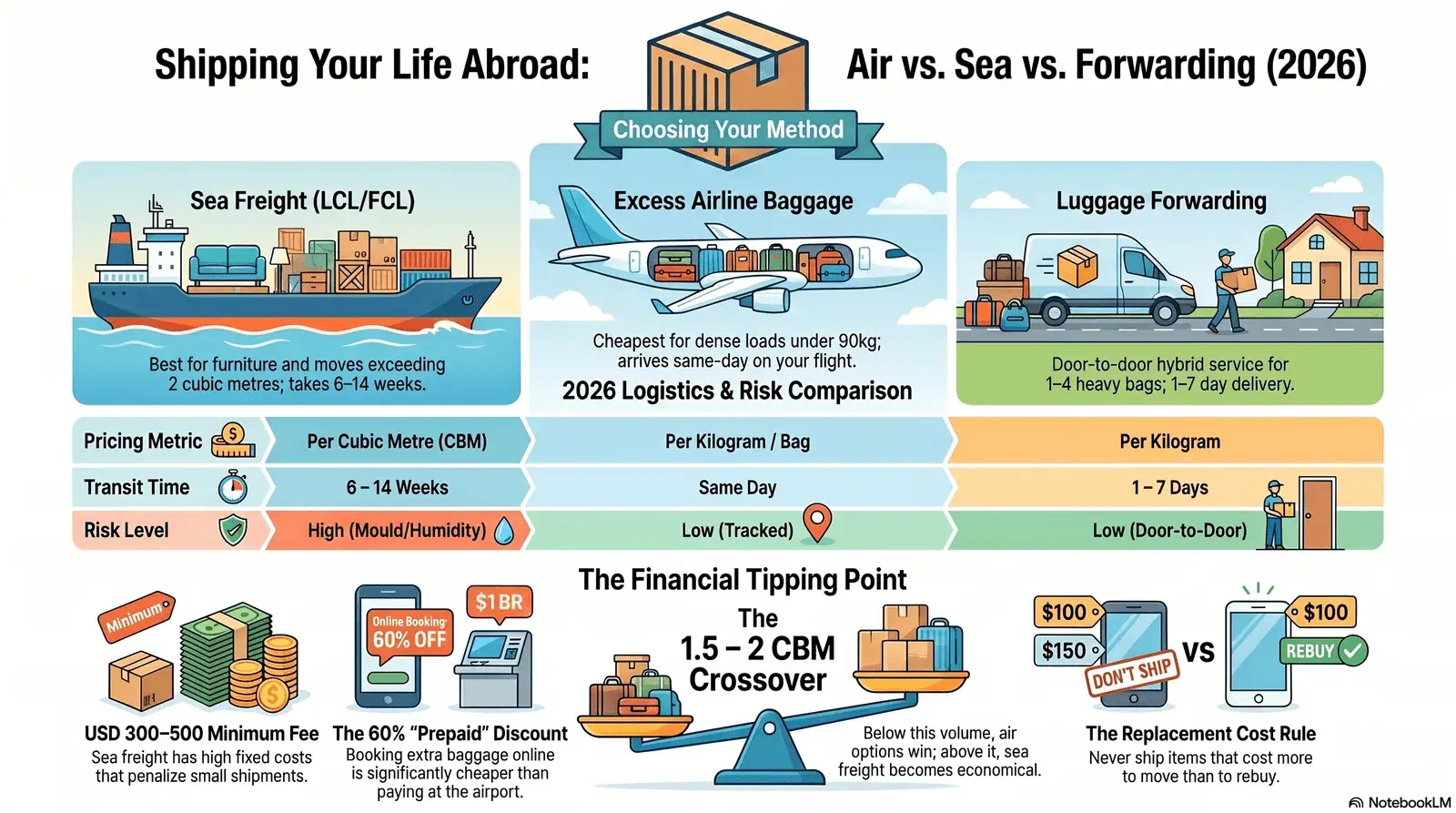
- Volume decides everything: excess airline baggage wins for small dense loads (under ~60–90 kg); sea freight wins once you exceed roughly 1.5–2 cubic metres; luggage forwarding fills the gap for a few heavy bags.
- The quote is never the final price: LCL sea freight adds CFS handling, bunker (fuel) and congestion surcharges plus a minimum charge of USD 300–500 that can double a small shipment.
- Time is the hidden cost: shared-container groupage runs 9–14 weeks in 2026, with schedule reliability near 27% – air baggage and forwarding deliver in days, not months.
Which type of mover are you, and why does it change the math?
Your ideal shipping method is dictated almost entirely by the volume and weight of what you are moving, so the first step is to honestly classify yourself as a Minimalist Expat, a Digital Nomad, or a Whole-House Relocator. The Minimalist Expat is moving clothes, a laptop, a few books and sentimental items – typically under 60 kg and well under a cubic metre. For this person, paying for an extra checked bag or two, or using a luggage forwarding service, is almost always cheaper and dramatically faster than any form of freight. The Digital Nomad travels even lighter and prioritises speed and tracking over price, making prepaid airline baggage or door-to-door forwarding the obvious fit. The Whole-House Relocator is shipping furniture, appliances and the contents of multiple rooms – several cubic metres of goods – where sea freight, whether a shared container or a full 20ft box, becomes the only economically sane option.
The reason this self-classification matters is that the two main options are priced on completely different units. Airlines and luggage couriers charge by weight (per kilogram). Ocean carriers charge by volume (per cubic metre, abbreviated CBM). A box of books is heavy but small; a duvet and a lampshade are light but bulky. Until you know whether your move is weight-dominated or volume-dominated, no price comparison is meaningful.
A CBM (cubic metre) is a box 1 m × 1 m × 1 m. LCL (Less than Container Load) means your goods share a container with other people's shipments and you pay only for the space you use. FCL (Full Container Load) means you book an entire 20ft or 40ft container for yourself.
How much does sea freight actually cost in 2026?
In 2026, shared LCL sea freight is priced at roughly USD 40–180 per cubic metre depending on the route, but the headline rate is only part of the story – handling fees, fuel and congestion surcharges, and a minimum charge of USD 300–500 routinely push the real cost far higher. According to 2026 trade-lane data compiled by freight platforms, India–EU LCL rates sit at around USD 95–150 per CBM, China–US West Coast around USD 45–160 per CBM, and Morocco–EU as low as USD 50–85 per CBM. Those are port-to-port base rates – they do not include collection from your home or delivery to your new door.
Where movers get caught out is the layer of add-ons stacked on top of the base rate. Container Freight Station (CFS) handling fees run USD 15–40 per CBM at each end. The Bunker Adjustment Factor (BAF), which is the carrier's fuel surcharge, can add 10–25%. Congestion surcharges – very real in 2026 – add a further 5–15%. Then there is customs brokerage, terminal handling and the door delivery leg. It is entirely normal for a quote that starts at "USD 120 per CBM" to land near double that once everything is invoiced.
For a whole-house move, the economics shift to a full container. UK removals data for 2026 puts a sole-use 20ft container for a typical three-bedroom home at around £4,805, with full international removal quotes generally ranging from £3,000 to £6,500 including packing, transport and delivery. A shared groupage slot for a smaller load can start from about £1,220. Those are large numbers, which is exactly why sea freight only makes sense above a meaningful volume threshold.
A sole-use 20ft container (FCL) typically takes 6–9 weeks door to door, while shared LCL groupage takes 9–14 weeks. In 2026 these timelines are stretching: Cape of Good Hope routing adds 10–14 days to Asia–Europe sailings, global schedule reliability has dropped to around 27%, and emergency fuel and congestion surcharges are being applied at short notice. If you ship by sea, plan to live without your belongings for the upper end of every quoted range.
What are the real risks of putting your life in a shared container?
Beyond cost and time, LCL sea freight carries genuine physical risk – humidity bloom, side-impact damage from neighbouring cargo, and the uncomfortable fact that mould and moisture damage are usually excluded from standard marine insurance. When your boxes share a container, they are loaded, unloaded and re-handled alongside strangers' freight, exposing them to unpredictable contact and crushing. Long sea transits through tropical humidity can cause "humidity bloom" – condensation inside the container that leads to mildew on fabric, paper and wood.
Marine cargo insurance for personal effects is typically priced around 3% of the declared value (USD 3 per USD 100 insured). That sounds reasonable until you read the exclusions: damage by mould, mildew, moth or vermin is commonly not covered. In practice this means the single most likely form of damage to clothes and soft furnishings on a long ocean voyage is the one your policy may refuse to pay for. The mitigation is practical – pack with desiccant sachets, use vacuum-sealed bags for textiles, avoid shipping anything irreplaceable by sea – but the residual risk never reaches zero.
How do you slash the cost of excess airline baggage?
The single most effective baggage tactic is to buy extra weight or extra bags online through the airline's Manage My Booking page before you reach the airport, where prepaid rates are routinely 50–60% cheaper than the punitive walk-up counter price. Airlines design the airport excess-baggage rate to be deliberately painful so that you pre-purchase. The savings are real and large.
The numbers vary by carrier and route, but the pattern is consistent. For international flights generally, expect roughly USD 150–285 for an additional checked bag and USD 100–150 for an overweight bag (23–32 kg). Aer Lingus charges about €75 for an extra checked bag on transatlantic routes when booked online, and roughly double that at the airport. Emirates sells prepaid excess weight in 5 kg blocks (up to 50 kg) at around 50–60% off the airport rate, where weight-route charges can run USD 20–50 per kilogram. easyJet charges around £12 per kilogram for excess weight on European routes. The lesson is universal: never let an agent weigh an over-limit bag at the desk if you can add the weight online first.
On-the-ground insight: "I almost paid €160 in overweight charges at Dublin Airport for two bags going to Toronto. The check-in agent actually told me to step aside, open my phone, and add 10 kg through the airline app while standing at the desk – it cost me €55 instead of €160 for the same flight. Same plane, same bags, one-third of the price, just because I clicked 'add baggage' before she scanned it." — Priya R., relocated Dublin → Toronto, early 2026
The security advantage of air baggage is underrated. Your most valuable and irreplaceable items – electronics, documents, heirlooms – travel on the same aircraft as you, are tracked by the airline, and are in your hands within hours of landing. They never sit in a humid container or pass through a stranger's warehouse. For anything you cannot bear to lose, the aircraft hold beats the shipping vessel every single time.
Is a luggage forwarding service the hybrid sweet spot?
Luggage forwarding services such as Send My Bag and Luggage Forward collect your bags from your door and deliver them to your destination address for roughly USD 5–10 per kilogram, bridging the gap between airline baggage and full sea freight. They behave like a premium parcel courier for suitcases: you book online, they pick up, you track the shipment, and it arrives at the door – no airport queues, no weighing drama, no container wait.
The pricing is route-sensitive. According to Send My Bag, a 30 kg suitcase from the USA to the UK runs about USD 147 on the express 1–2 day service, while a 30 kg bag between the UK and France can cost as little as £29 on the standard service and as little as £18 within the UK. Luggage Forward and Eurosender offer comparable door-to-door luggage shipping. For one to four heavy bags that you want tracked and out of your hands, forwarding frequently beats both dragging them through airports and committing to a slow, surcharge-laden LCL shipment.
Sea freight vs. excess baggage vs. forwarding — the 2026 comparison
Use the matrix below to match your load profile to the right method before you request a single quote. All figures are indicative 2026 ranges; always confirm the exact price for your specific route and dates.
| Feature | Sea Freight (LCL / FCL) | Excess Airline Baggage | Luggage Forwarding |
|---|---|---|---|
| Pricing metric | Per cubic metre (CBM) | Per kilogram / per bag | Per kilogram (per bag) |
| Indicative 2026 cost | LCL USD 40–180/CBM (+ surcharges, min USD 300–500); 20ft FCL £3,000–6,500 | USD 150–285 per extra intl bag; USD 20–50/kg airport; ~50–60% less prepaid online | ~USD 5–10/kg door to door |
| Transit time | FCL 6–9 weeks; LCL groupage 9–14 weeks | Same flight (hours) | 1–7 days typical |
| Risk level | Moderate–high (humidity, side-impact, port delays; mould often uninsured) | Low (tracked by airline, travels with you) | Low (courier-tracked door to door) |
| Best for | Furniture, appliances, multi-room households | Clothes, essentials, high-value gear | 1–4 heavy bags, no airport hassle |
Where is the exact financial tipping point between air and sea?
The crossover happens at the point where the volume of your goods, priced per CBM by sea, becomes cheaper than the same goods priced per kilogram by air – in practice, below roughly 1.5–2 CBM air or forwarding almost always wins, and above it sea freight pulls ahead. Two forces drive this. First, the LCL minimum charge of USD 300–500 means a tiny sea shipment is wildly inefficient – you pay the minimum whether you ship one box or fifteen. Second, air baggage scales linearly with weight, so it gets relentlessly more expensive as your load grows, while sea freight's per-CBM rate makes large volumes comparatively cheap.
The second test is the Replacement Cost Rule. For every bulky, low-value item – flat-pack furniture, a basic mattress, a cheap microwave – ask whether shipping it across an ocean costs more than simply rebuying it at your destination. A flat-pack wardrobe that costs €80 new should almost never consume €150 of container volume plus surcharges. Ship the heirloom; rebuy the IKEA shelf. Apply this filter ruthlessly to every item before it goes near a container.
True Cost = Base Quote + Surcharges (CFS + BAF + Congestion) + Customs/Brokerage + Door Delivery + Insurance + Replacement of damaged/uninsured items
Worked example, in the spirit of a real London–Singapore comparison: a maxed-out air option of two travellers each carrying two checked bags plus prepaid extra weight might move roughly 120–140 kg for several hundred pounds, arriving the same day. A 20ft FCL container for the same household moves several cubic metres of furniture for around £4,805 but arrives in 6–9 weeks. If you only own the contents of two suitcases and a few boxes, the air route is both cheaper and faster; if you are moving a furnished three-bedroom home, the container is the only option that does not require rebuying an entire household.
Do you owe customs duty when you ship your belongings to Ireland?
If you are moving your normal residence to Ireland from outside the EU, you can usually claim full relief from Customs Duty and VAT on used personal and household effects under Transfer of Residence relief – but only if you meet the ownership and residency conditions and file the paperwork on time. According to Revenue, you must have lived outside Ireland for at least 12 consecutive months, have owned and used the goods for at least 6 months before the move, and intend to keep them for at least 1 year after arrival. You apply by emailing a completed C&E 1076 form to Revenue around 2 weeks before your goods arrive, supported by evidence of the move such as an Irish employment letter or a tenancy or property document.
Two caveats matter. Tobacco and alcohol above your normal duty-free allowance, and anything imported for commercial reasons, are excluded from the relief. And goods shipped from within the EU move in free circulation and do not require this procedure at all. For the full eligibility detail and document list, see Citizens Information. Build customs clearance time into your transit estimate – a delayed or incomplete C&E 1076 can leave your container accruing storage fees at the port.
How do you pack to maximise weight limits and minimise risk?
Smart packing is about density management: keep dense items in airline bags up to the weight limit, move bulky low-density items by sea or rebuy them, and protect everything against the specific failure modes of each transport method. For air baggage, distribute weight so no single bag tips into the overweight bracket, and use vacuum-seal bags to compress clothing and bedding so volume never becomes the constraint before weight does. For sea freight, the priority flips to moisture and impact protection: desiccant sachets in every box, double-walled cartons for anything fragile, and absolutely nothing irreplaceable in a shared container given the mould-exclusion gap in most policies.
Finally, run a 48-hour countdown before departure. Reconfirm your prepaid baggage allowance and any forwarding pickup window, reweigh every checked bag on a luggage scale at home, photograph high-value items for any insurance claim, and keep your customs paperwork and a packing inventory accessible rather than buried at the bottom of a shipped box. The single most common last-minute cost is an overweight bag discovered at the desk – eliminate it before you leave the house.
- The Legal Loophole: How Temporary Residency Lets You Bypass Massive International Import Taxes — Before you ship anything, read this guide on Transfer of Residence Relief, ATA Carnets and Carnet de Passages — legally importing duty-free can save you far more than any shipping discount.
- Best Practices for Booking One-Way Flights (2026 Complete Guide) — Most people move abroad on a one-way ticket; this guide covers fare rules, proof-of-onward-travel and baggage on one-way itineraries.
- How to Plan a Multi-City Family Trip Cheaply (2026 Complete Guide) — The same True Cost and baggage logic applied to families moving or travelling across multiple destinations.
- Study in Ireland 2026: Complete Guide for International Students — If you are shipping your life to Ireland to study, start here for visa, housing and arrival logistics.
- Lost, Delayed or Damaged Baggage on International Flights 2026: Montreal Convention Compensation Guide — Montreal Convention 2026: claim up to 1,519 SDR for lost, delayed or damaged bags. PIR filing, 7- and 21-day deadlines, and credit card cover explained.
- Hand Luggage Only on India-Ireland Flights 2026: Carry-On Rules for Emirates, Etihad, Qatar, Air India & BA — Carry-on rules for India-Ireland flights 2026: Emirates 7 kg, Etihad 7+5 kg, Qatar 7 kg, Air India 8 kg, BA 23 kg combined. Save €60–€150 flying bag-free.
Frequently Asked Questions
Is it cheaper to ship belongings by sea freight or to pay for excess airline baggage?
It depends on volume. Excess airline baggage is cheaper for small, dense loads up to roughly 60–90 kg because you pay per kilogram (around USD 20–50 per kg at the airport, far less if prepaid online). Sea freight becomes cheaper once you fill more than about 1.5–2 cubic metres, because LCL shipping is priced per cubic metre (USD 40–180 per CBM in 2026) and a shared-container minimum charge of USD 300–500 applies. Below that volume, the minimum charge makes sea freight uneconomical for a few boxes.
How long does sea freight take to move household goods in 2026?
A sole-use 20ft container (FCL) typically takes 6–9 weeks door to door, while a shared LCL groupage shipment takes around 9–14 weeks. In 2026, Cape of Good Hope routing continues to add 10–14 days to Asia–Europe transits, global schedule reliability has fallen to around 27%, and port congestion at hubs including Singapore, Shanghai and Nhava Sheva is adding further delays. Plan for the longer end of every quoted range.
What is a luggage forwarding service and is it worth it?
Luggage forwarding services such as Send My Bag and Luggage Forward collect your suitcases from your door and deliver them to your destination address, typically charging around USD 5–10 per kilogram. They sit between airline excess baggage and full sea freight: door-to-door and tracked like a courier, with no airport weighing queues, but more per kilogram than prepaid airline baggage. They are worth it when you have one to four heavy bags, want them tracked, and do not want to drag them through airports.
Do I have to pay customs duty when shipping my belongings to Ireland?
If you are moving your normal residence to Ireland from outside the EU, you can usually claim relief from Customs Duty and VAT on used personal and household effects under Transfer of Residence relief. You must have lived outside Ireland for at least 12 consecutive months, have owned the items for at least 6 months, and keep them for at least 1 year after arrival. You apply by emailing a completed C&E 1076 form to Revenue roughly 2 weeks before your goods arrive. Goods shipped from within the EU move freely and do not need this relief.
Why is buying prepaid excess baggage online cheaper than paying at the airport?
Airlines deliberately price airport excess baggage at a punitive walk-up rate to discourage last-minute add-ons. Emirates, for example, offers prepaid online excess baggage at roughly 50–60% less than the airport counter rate, sold in 5 kg blocks. Aer Lingus charges about €75 for an extra transatlantic bag booked online versus roughly double that at the airport. Always add weight or extra bags through Manage My Booking before you reach the terminal.
Booking your one-way move? Compare live fares first.
Find the cheapest month to fly your route, then budget your baggage and shipping using the framework in this guide to keep your total relocation cost under control.
All freight rates, per-CBM and per-kilogram figures, surcharge percentages, transit times, airline baggage fees, luggage forwarding prices, insurance percentages, and customs relief conditions in this article are based on publicly available information from freight industry sources, airline official websites, luggage forwarding providers, the Revenue Commissioners and Citizens Information as of June 2026. Freight rates, fuel and congestion surcharges, airline policies and customs thresholds change frequently and without notice. Always obtain a written quote and verify current terms directly with the relevant carrier, forwarder or authority before making any shipping or booking decision. MyFlightOffers is not affiliated with any shipping company, airline, forwarding service or authority mentioned. This article does not constitute financial, customs or legal advice.