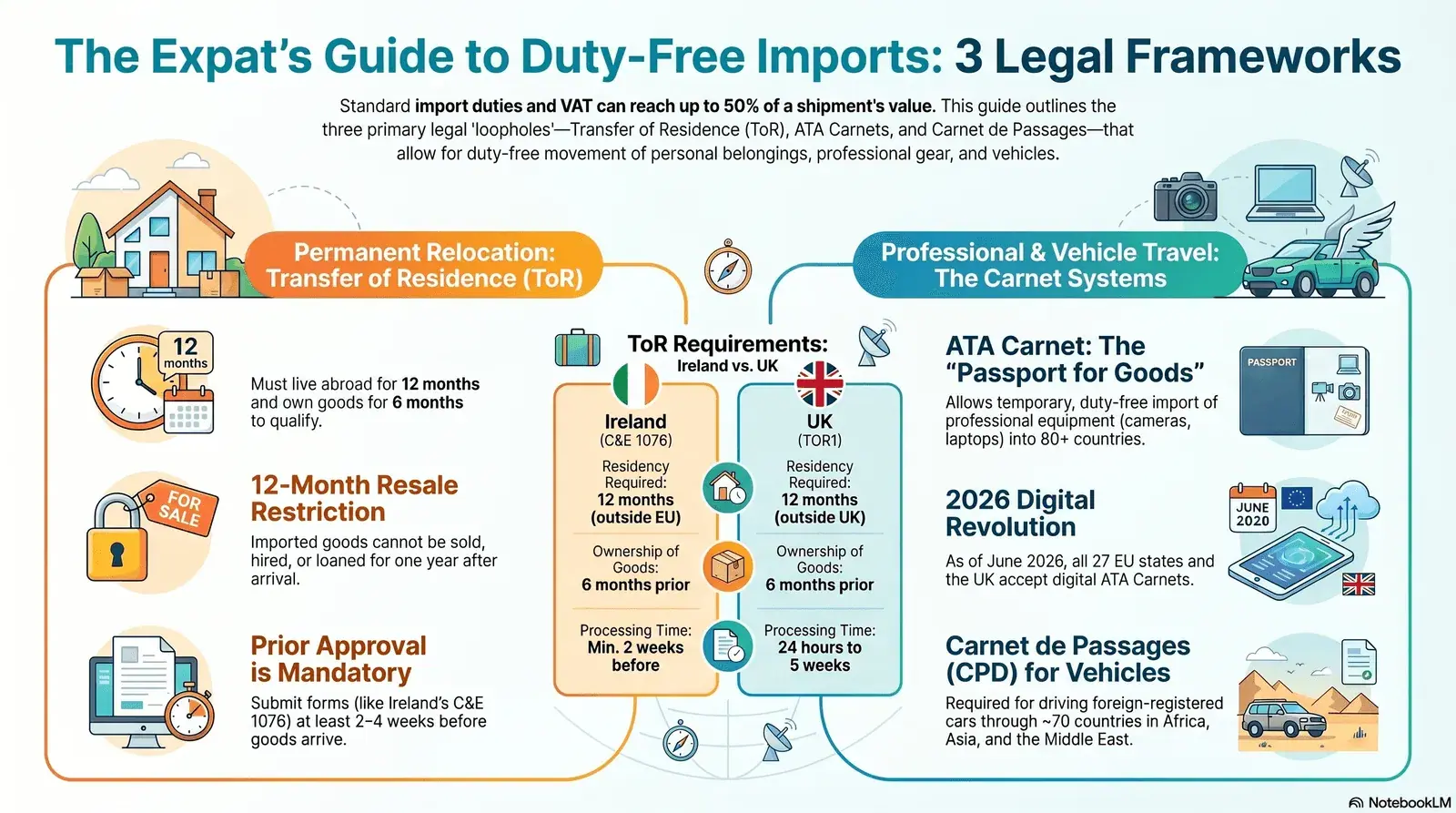
- Transfer of Residence (ToR) Relief lets you import personal belongings and household effects duty-free when permanently relocating, provided you've lived abroad for at least 12 months and owned the goods for at least 6 months.
- ATA Carnets allow professionals to temporarily import laptops, cameras and specialist equipment into 80+ countries without paying any customs duty — and from June 2026 the process is digital across all 27 EU member states plus the UK.
- Carnet de Passages (CPD) is the vehicle equivalent: it lets you drive your foreign-registered car through approximately 70 countries duty-free for up to 12 months without leaving a cash deposit at each border.
1. Why Customs Duties Are a Bigger Problem Than Most Expats Realise
Standard import duties on personal goods can range from 5% to 30% of the declared value, and in some markets import VAT adds a further 20–25% on top — meaning a €10,000 shipment of household electronics could attract a €5,000 tax bill before your belongings even clear the port. Most first-time relocators discover this only after their container has arrived, at which point their options are limited and expensive.
The scale of the problem is not marginal. The European Commission's Duty Relief framework explicitly acknowledges that in "certain well-defined circumstances such as when you move with your personal belongings," import duties should not apply. These well-defined circumstances are the focus of this guide.
The 2026 landscape has also shifted in ways that affect travellers. The EU eliminated its €150 duty-free de minimis threshold for e-commerce imports on 1 July 2026, meaning small parcels from outside the bloc are no longer automatically duty-free. However, this change applies specifically to commercial imports — the personal effects relief frameworks covered in this article remain intact and are, if anything, more valuable than before.
There are three primary legal frameworks you need to know: Transfer of Residence (ToR) Relief for permanent movers, the ATA Carnet system for professional equipment users, and the Carnet de Passages en Douane for vehicle owners. Each has different eligibility rules, documentation requirements, and validity windows.
2. Transfer of Residence Relief: The Framework for Permanent Movers
Transfer of Residence (ToR) Relief is a formal customs exemption that allows people permanently relocating their main home to a new country to import personal belongings, household effects and certain vehicles without paying import duty or VAT. It exists in some form in virtually every country that follows the World Customs Organization's Kyoto Convention guidelines, including Ireland, the UK, the US, Canada, Australia and all EU member states.
How Transfer of Residence Relief Works in Ireland
If you are moving to Ireland from outside the EU and have lived abroad for at least 12 consecutive months, you can import your personal property duty-free and VAT-free using Ireland's ToR Relief — but the goods must have been owned and used by you for at least six months before your move date.
The relief is administered by Irish Revenue and requires you to complete form C&E 1076, which must be submitted at least two weeks before your goods arrive in Ireland. Revenue assesses each application individually. Key conditions to satisfy:
- You must have resided outside the 27 EU member states for at least 12 consecutive months before your arrival in Ireland.
- All goods must have been in your possession and actively used for a minimum of six months prior to your arrival.
- Your goods must arrive within 12 months before or after your move date to qualify.
- You cannot sell, hire out or loan the imported goods for at least 12 months after arrival.
- Alcohol, tobacco and goods intended for business use are excluded from the relief.
The Citizens Information Ireland notes that the relief covers private cars, motorcycles, trailers, caravans and even pleasure craft, making it exceptionally broad for those relocating a full household. If you are shipping goods from within the EU, no duty or VAT applies at all since the goods have already been taxed in the originating member state.
UK Transfer of Residence Relief (TOR1) in 2026
The UK's equivalent programme — applied by filing form TOR1 with HMRC — allows people moving their normal place of residence to Great Britain to import personal belongings free of customs duty and the standard 20% UK import VAT, provided they have lived outside the UK for at least 12 consecutive months and owned the goods for at least six months.
Key features of the UK's Transfer of Residence to Great Britain relief:
- The TOR1 Unique Reference Number (URN) is valid for six months before you move and up to 12 months after your arrival — allowing multiple shipments under a single application.
- HMRC processing can take between 24 hours and five weeks, so apply early.
- The relief covers all personal property intended for your own use or household needs; alcohol and tobacco are excluded.
- Post-Brexit, Northern Ireland follows separate rules under the Windsor Framework — if you are moving to Northern Ireland, check the specific provisions at GOV.UK.
Comparison: Ireland vs UK Transfer of Residence Relief
| Feature | Ireland (C&E 1076) | UK (TOR1) |
|---|---|---|
| Minimum residency abroad | 12 consecutive months outside EU | 12 consecutive months outside UK |
| Minimum ownership of goods | 6 months before move date | 6 months before shipment |
| Import window | 6 months before to 12 months after | 6 months before to 12 months after |
| Resale restriction | 12 months | 12 months |
| Vehicles covered? | Yes (private cars, motorcycles, caravans) | Yes (subject to additional conditions) |
| Processing time | Submit at least 2 weeks before arrival | 24 hours to 5 weeks |
| Administering authority | Irish Revenue | HMRC |
| Excluded goods | Alcohol, tobacco, business goods | Alcohol, tobacco |
3. ATA Carnets: The Professional's Duty-Free Passport for Equipment
An ATA Carnet is an internationally standardised customs document — often called a "passport for goods" — that allows professionals to temporarily import equipment into over 80 countries without paying any customs duty or import taxes, for periods of up to 12 months at a time. It is the correct instrument for journalists, photographers, musicians, IT consultants, engineers, athletes, medical specialists and any other professional whose work requires specialist equipment across borders.
The types of equipment covered by an ATA Carnet include laptops, cameras, drones, audio-visual broadcast equipment, medical instruments, scientific apparatus, exhibition materials, commercial samples and sports equipment. The key distinction from commercial imports is that the goods must be re-exported — the carnet is a temporary admission document, not a permanent import mechanism.
The 2026 Digital ATA Carnet Revolution
From 1 June 2026, all 27 EU member states, Norway, Switzerland and the United Kingdom began accepting digital ATA Carnets — meaning the entire lifecycle from application to customs declaration can now be processed electronically without paper booklets. The transition is managed under the World Chambers Federation's eATA Carnet programme and represents a significant reduction in processing time and border friction for professionals moving equipment across Europe.
According to USCIB, the full global rollout to all participating countries is expected by 1 January 2028. For now, paper carnets remain valid alongside digital ones during the transition period.
In the United States, ATA Carnets are issued by the US Council for International Business (USCIB). In the UK, the London Chamber of Commerce issues carnets. In Ireland, the Dublin Chamber of Commerce is the issuing body. Most issuing organisations charge an annual administrative fee plus a security deposit or bond equivalent to the maximum potential duty on the goods listed.
How to Prove Your Equipment Is Yours (Not Commercial Import)
The most critical step when using an ATA Carnet is building a defensible ownership inventory before you travel — because if customs officers believe you are importing goods for resale rather than professional use, the duty exemption collapses.
Best practices for documenting professional equipment for ATA Carnet purposes:
- Serial number registry: Record the make, model and serial number of every device. Many professionals photograph the serial number plate with a timestamp before departure.
- Original purchase receipts: Receipts or invoices proving you purchased the item more than six months before travel are the strongest evidence of personal ownership.
- Insurance documentation: Professional equipment insurance policies tied to specific serial numbers carry significant weight at customs.
- Business licence or employer letter: A letter from your employer confirming the equipment is required for your professional role adds further credibility, particularly for journalists and broadcast technicians.
- Avoid brand-new packaging: Equipment still in retail packaging raises a "for resale" flag. Remove packaging before travel if the item is genuinely your working tool.
On-the-Ground Insight: "I was shooting a documentary series across four EU countries in 2025 and carried roughly €18,000 worth of camera and audio gear. The ATA Carnet meant zero duty at every border. The key was having a complete itemised list with serial numbers — customs in Germany checked every item against the list in about ten minutes. Without the carnet, the duty would have wiped out my entire production margin." — Declan F., documentary filmmaker, Dublin
4. Carnet de Passages: Crossing Borders with Your Vehicle for Free
The Carnet de Passages en Douane (CPD) is the vehicle-specific equivalent of the ATA Carnet — an internationally recognised customs document that allows private and commercial vehicles to enter approximately 70 countries without paying import duties, without leaving a cash deposit at each border, and without registering the vehicle locally.
The CPD functions as a financial guarantee backed by your national automobile association. When you enter a participating country, customs stamp the carnet in. When you exit, they stamp it out. If you fail to exit within the allowed period, the country claims the duties owed from the guaranteeing body, which then claims them from you — typically at 100% to 150% of the vehicle's assessed value.
Where Is the Carnet de Passages Required?
The CPD is required in approximately 70 countries across Africa, the Middle East, South Asia, Southeast Asia and parts of South America — but notably, it is NOT required for driving within Europe, where EU free movement rules apply. As of 2026, a Carnet de Passages is now the standard and easiest method for a foreign-registered vehicle to enter Japan, following updated bilateral customs arrangements.
Key regions where CPD is typically required include:
- Middle East: Jordan, Kuwait, Oman, Qatar, Saudi Arabia, UAE
- South Asia: India, Pakistan, Bangladesh, Nepal, Sri Lanka
- Africa: Egypt, Kenya, South Africa, Tanzania, Morocco (rules vary by country)
- Southeast Asia: Indonesia, Malaysia, Thailand (Japan from 2026)
- Latin America: Bolivia, Ecuador, Peru (some countries accept alternatives)
What Does a Carnet de Passages Cost and How Do You Get One?
The cost of a Carnet de Passages varies by country of registration and the assessed value of your vehicle — but the primary cost is a security deposit or surety bond rather than a direct fee, which is returned to you when the carnet is correctly completed and all stamps are accounted for.
Typical structure of CPD costs:
- Administrative fee: Charged by your national automobile association — typically ranges from €100 to €400 depending on the issuing country and vehicle value.
- Security deposit: Either a cash deposit (100–200% of vehicle value, depending on destination countries) or a bank bond/insurance policy. Most travellers opt for the insurance-backed bond, which costs a fraction of the cash deposit.
- Validity: A CPD is valid for 12 months from issue and can be renewed up to four times, giving a maximum of five years of continuous coverage.
Neither Ireland nor the UK currently has an official CPD issuer. According to the AIT/FIA Carnet de Passages network, there is no CPD-issuing organisation in Ireland, so a CPD for an Irish-registered vehicle must be obtained through an AIT/FIA automobile club or authorised distributor in another country. The UK has had no issuer since the RAC stopped issuing CPDs in 2015. In the US and Canada, CPDs are available through the ATA Carnet programme.
Driving Your Foreign Vehicle Within Europe
Within the European Union and EEA, no Carnet de Passages is required for private vehicles — EU free movement rules allow you to drive a foreign-registered vehicle freely, though there are time limits on how long you can keep a non-resident registered vehicle in a member state before it must be locally registered. Generally, EU member states allow a period of six to 12 months before re-registration becomes mandatory for long-term residents. For short visits or genuine transit, the foreign plate is fine indefinitely.
5. Timing the Clock: Grace Periods, Extensions and Renewals
Every customs exemption framework operates within a defined time window, and failing to exit your goods or complete the paperwork before that window closes converts a legal exemption into an immediate duty liability — often with penalties on top. Understanding the specific grace periods for each framework is non-negotiable.
| Framework | Validity Period | Extension Available? | Penalty for Overstay |
|---|---|---|---|
| Ireland ToR Relief (C&E 1076) | Goods must arrive within 12 months of move | Individual assessment by Revenue | Full customs duty + VAT applied retroactively |
| UK TOR1 Relief | URN valid 6 months before to 12 months after move | Limited — contact HMRC in advance | Full import duty + 20% VAT |
| ATA Carnet | Up to 12 months per country visit | Renewal via issuing body (up to 12 months) | Up to 110% of applicable duty + taxes |
| Carnet de Passages (CPD) | 12 months per issue; renewable up to 4 times | Yes — renewed annually, max 5 years total | 100–150% of vehicle's assessed value |
| US Household Effects (CBP) | Must be used abroad ≥1 year before re-import | Not applicable (permanent return basis) | Standard duty rates applied |
The most important practical rule: always track your entry stamps. For ATA Carnets and CPDs, each border crossing generates a dated stamp. If you lose the carnet or cannot produce the exit stamp, customs authorities assume the goods were sold in-country and will bill for duties accordingly. Always request a stamped exit document and photograph it immediately.
6. The Complete Documentation Blueprint
Customs exemptions are only as strong as the paperwork backing them — every framework described in this guide depends on organised, pre-prepared documentation submitted before your goods cross the border, not at the checkpoint.
Transfer of Residence Documentation
For both Ireland (C&E 1076) and UK (TOR1), prepare the following before submitting your application:
- Proof of residency abroad: Utility bills, bank statements or official correspondence showing your address outside the destination country for the past 12 months.
- Proof of ownership: Purchase receipts, bank records or insurance documents showing you have owned the items for at least six months.
- Itemised inventory: A comprehensive list of all goods being imported, including description, quantity and approximate value. Professional movers often prepare this on your behalf as a packing list.
- Visa or residency permit: Documentation confirming you are legally establishing residence in the destination country.
- Completed customs form: C&E 1076 for Ireland; TOR1 for the UK.
ATA Carnet Documentation
When applying for an ATA Carnet through your national chamber of commerce or issuing body, you will need:
- A complete itemised list of all goods to be covered, including description, make, model, serial number, country of manufacture and commercial value.
- Evidence of ownership (purchase receipts, insurance certificates).
- Business or professional justification explaining why you need the equipment in the destination country.
- Details of all countries you intend to visit — the carnet is issued covering specific destination countries listed at the time of application.
Carnet de Passages Documentation
- Vehicle registration certificate (logbook / V5C in the UK).
- Valid vehicle insurance policy covering international travel in the destination countries.
- Proof of vehicle ownership or lease agreement.
- Application to your national automobile association with vehicle details and proposed itinerary.
- Security deposit or surety bond documentation.
7. Common Pitfalls That Turn a Legal Exemption Into a Customs Bill
The exemptions are real and legally binding — but customs authorities worldwide are alert to misuse, and even innocent paperwork errors can result in duties being assessed at the full rate. These are the most frequent failure points.
Claiming Goods Are Older Than They Are
Both ToR Relief and professional equipment exemptions require minimum ownership periods. A brand-new laptop purchased two weeks before departure does not qualify for a personal effects exemption and will be assessed at standard duty rates. Customs officers are trained to identify goods that are clearly unused or still in retail packaging. If an item was purchased as a gift for someone at the destination, it is a dutiable commercial import regardless of what the applicant says.
Forgetting the "Re-Export Obligation" on Temporary Documents
The ATA Carnet and CPD are strictly temporary admission documents. This means the goods must leave the country. If you sell your equipment or vehicle while abroad — even at a loss — you have violated the terms of the carnet and the full duty becomes payable immediately plus a penalty. The issuing body that guaranteed the carnet is entitled to recover that amount from you.
Misidentifying the Route to the Exemption
A surprisingly common error is applying the wrong framework. Permanent movers using an ATA Carnet for household goods, or temporary professionals trying to use ToR Relief for equipment they intend to take back home — both create complications. Match the framework to the correct use case: ToR Relief for permanent relocation of personal property; ATA Carnet for temporary professional equipment that will be re-exported; CPD for vehicles being driven across borders temporarily.
Missing the Filing Deadline
Ireland's Revenue requires the C&E 1076 form at least two weeks before the goods arrive in the country. If your shipping container docks before the form is processed, your goods may be held in a bonded warehouse at daily storage rates while the application is reviewed. Plan the paperwork timeline backwards from the expected arrival date, not forwards from when you "get around to it".
On-the-Ground Insight: "I moved from the United States to Dublin in 2024 and shipped a container with furniture, a car and about €25,000 of IT and studio equipment. Because I'd been living in the US for over three years, I qualified for ToR Relief on everything. Irish Revenue processed my C&E 1076 in about 10 days. The total saving was somewhere north of €7,000 in duties and VAT that I would otherwise have owed. The whole process was genuinely straightforward once I knew it existed." — Aoife M., software engineer, relocated to Dublin from San Francisco
8. Real-World Scenarios: Which Framework Applies to You?
The right customs relief framework depends entirely on your specific situation — your residency status, whether the move is permanent or temporary, and whether the goods are personal effects or professional equipment. Use the scenarios below to self-identify your position.
| Scenario | Correct Framework | Key Document | Potential Saving |
|---|---|---|---|
| Moving to Ireland permanently from the US after 3 years there | Ireland ToR Relief | C&E 1076 (Revenue) | Up to 40%+ of goods value in duty + VAT |
| Moving to UK from Australia after 14 months there | UK TOR1 Relief | TOR1 form (HMRC) | Customs duty + 20% import VAT |
| Photographer doing editorial work across 5 EU countries for 3 months | ATA Carnet (digital from June 2026) | eATA Carnet (chamber of commerce) | Up to 110% of equipment value in duty |
| Software consultant travelling to India for 6 months with two laptops | ATA Carnet | ATA Carnet (paper or digital) | 28% basic customs duty on electronics in India |
| Overland traveller driving UK-registered car through East Africa | Carnet de Passages (CPD) | CPD (via an AIT/FIA club outside the UK) | 100–150% of vehicle value in import duty |
| Expat driving EU-registered car through France, Germany, Italy | No document needed (EU free movement) | Standard driving documents | N/A |
9. The Exit Strategy: Leaving Without Triggering Retroactive Duties
The end of your temporary stay is just as legally significant as the beginning — if you depart a country without correctly finalising your customs documents, you can face a retroactive duty claim months or even years after you've left.
For ATA Carnet holders: when you depart a country with the goods, you must present the carnet and the goods at the exit point and have the re-exportation section stamped by customs. Do not assume that passing through a departure terminal automatically counts as a customs exit. At many airports, especially smaller ones, you need to actively seek out the customs desk rather than wait for customs to find you.
For CPD holders: the same exit stamp principle applies. Every country entry has a corresponding required exit stamp. If you cannot produce the exit stamp — because you lost the carnet, the border post was unmanned, or you mailed the goods home without declaring their exit — the guaranteeing automobile association will be billed by the country's customs authority, and they will bill you.
For ToR Relief beneficiaries: the exit strategy here is about the resale restriction. You committed not to sell, hire or loan the imported goods for 12 months. Keep a basic record of when you imported each item so that if Revenue queries a subsequent sale you can demonstrate the 12-month period had elapsed.
Frequently Asked Questions
What is Transfer of Residence Relief and who qualifies?
Transfer of Residence (ToR) Relief is a customs exemption that allows people permanently relocating to a new country to import their personal belongings and household effects free of customs duty and import VAT. To qualify, you must have lived outside the destination country for at least 12 consecutive months, and the goods must have been owned and used for at least six months before your move.
How do I bring professional electronics like laptops and cameras abroad without paying import duty?
An ATA Carnet is the correct tool. It is an internationally recognised customs document accepted in over 80 countries that allows duty-free and tax-free temporary importation of professional equipment - including laptops, cameras, broadcast gear, and medical instruments - for up to one year. From June 2026, digital ATA Carnets are accepted across all 27 EU member states plus Norway, Switzerland and the UK.
Can I bring my vehicle to another country without paying import duty?
Yes, for temporary stays the Carnet de Passages en Douane (CPD) allows you to import your private vehicle into approximately 70 countries without paying customs duties. The CPD is valid for 12 months and can be renewed up to four times. A financial bond or deposit is required as a guarantee. Note that CPD is not required within Europe for private vehicles.
What happens if I don't re-export my vehicle or goods before the carnet expires?
If goods covered by an ATA Carnet or Carnet de Passages are not re-exported before the validity period expires, the customs authority of the host country will claim the full import duties plus a penalty, which for ATA Carnets can be up to 110% of the duty and import tax owed. You must always present the goods and carnet documents at each customs checkpoint during importation and exportation.
Does Ireland's Transfer of Residence Relief apply to vehicles?
Yes, Irish Transfer of Residence Relief covers private cars, motorcycles, trailers, caravans, pleasure craft and private aeroplanes, but specific additional conditions apply to vehicles and they must not be sold, hired out or loaned within 12 months of importation. You must submit form C&E 1076 to Irish Revenue at least two weeks before the goods arrive.
Planning an international move or trip? Search real-time fares first.
Whether you're shipping your life to a new country or travelling with professional equipment, the flight is your first step. Compare live fares across carriers and routes on MyFlightOffers before you book anything else.
- How to Ship Your Life Abroad: Freight vs. Extra Baggage Logistics Compared (2026) — Once your customs exemption paperwork is filed, this guide covers the cost maths of sea freight versus airline excess baggage for the actual move.
- Best Practices for Booking One-Way Flights (2026 Complete Guide) — Most international relocators fly on a one-way ticket — this guide covers fare rules, proof-of-onward-travel requirements and baggage on one-way itineraries.
- What Is International Fare Routing? Complete 2026 Guide — Understanding how fare routing rules affect your ticket price when moving between countries.
- Banking in Ireland: The Complete Guide for International Students 2026 — Settling finances when you arrive — complements the customs side of relocating to Ireland.
- Budget 2026 TCS on International Tour Packages: Flat 2% Rate Explained — Budget 2026 cut TCS on overseas tour packages to a flat 2% from April 2026. Learn the definition, old vs new rates, and how separate bookings avoid TCS entirely.
All information in this article is based on publicly available official sources as of June 2026, including Irish Revenue, HMRC GOV.UK guidance, USCIB, and the World Chambers Federation. Customs regulations, qualifying conditions and penalty structures can change without notice. Always verify current requirements directly with the relevant customs authority before shipping goods or applying for a carnet. MyFlightOffers is not affiliated with any customs body, automobile association or issuing organisation mentioned in this article. This article does not constitute legal, tax or customs compliance advice.