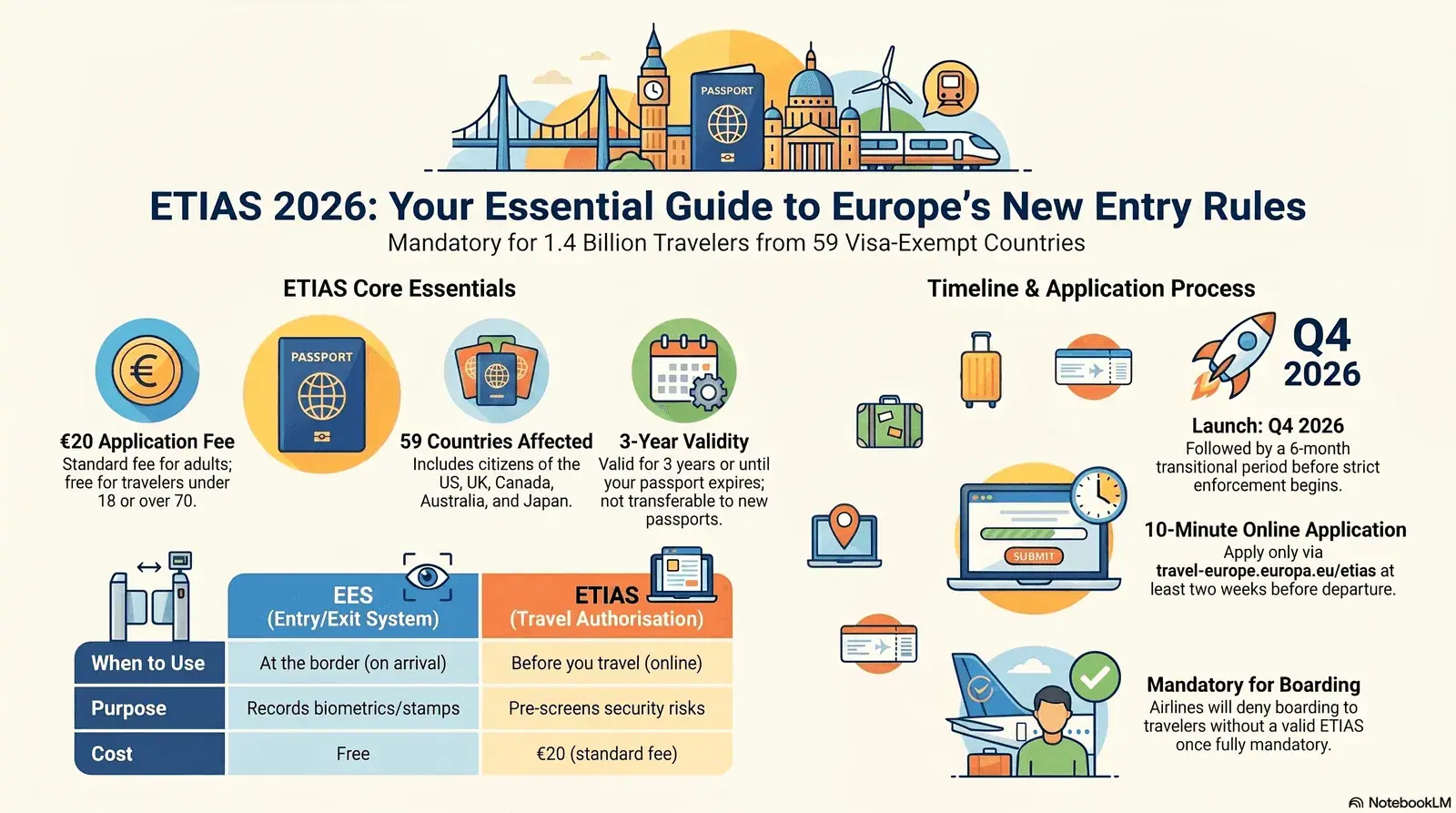
This guide originally reported a Q4 2026 ETIAS launch, which was the European Commission's published target at the time. In mid-July 2026 the Commission quietly removed that target from the official ETIAS website, following reports that eu-LISA had concluded a 2026 launch was no longer feasible. There is currently no confirmed ETIAS launch date; a revised timeline is expected after eu-LISA's September 2026 board meeting, and 2027 is now the most likely outcome. The €20 fee, three-year validity and phased enforcement structure described below are unchanged — only the start date is unknown. Nothing is required of travellers until the portal opens.
- ETIAS has no confirmed launch date. In mid-July 2026 the European Commission removed the Q4 2026 target from the official ETIAS website, after reporting that eu-LISA — the EU agency building the system — had concluded a 2026 launch was no longer feasible. A revised timeline is expected after eu-LISA's September 2026 board meeting, and a 2027 launch is now the most likely outcome. Nothing is required of travellers until it opens.
- The fee is €20, confirmed by the European Commission — under-18s and over-70s are exempt from payment but must still apply. Only apply via the official EU portal at travel-europe.europa.eu/etias.
- ETIAS is not transferable — it is linked to your specific passport. Renew your passport and you must apply again. One ETIAS covers all 30 ETIAS-participating countries for up to 90 days in any 180-day window, for 3 years.
1. What Is ETIAS and Why Does It Exist?
ETIAS (European Travel Information and Authorisation System) is the EU's mandatory pre-travel electronic authorisation for passport holders from 59 visa-exempt countries who want to visit 30 European countries for short stays of up to 90 days. It is not a visa — you do not visit an embassy, attend an interview, or receive a physical sticker in your passport. Instead, ETIAS is a digital screening tool that lets the EU evaluate security and immigration risks before travellers board a flight, not after they arrive at the border.
ETIAS cross-checks applicant data against EU security databases, Interpol alerts, the Schengen Information System (SIS), and the VIS (Visa Information System) before authorisation is granted. It is managed by Frontex in coordination with the European Commission's DG Home Affairs. ETIAS covers 30 countries — all 29 Schengen Area members plus Bulgaria, Romania, Cyprus, Croatia, Iceland, Norway, Switzerland, and Liechtenstein. Irish and EU citizens are fully exempt.
2. Who Needs ETIAS? The 59-Country List Explained
If you hold a passport from one of the 59 countries and territories currently exempt from Schengen visas, you will need ETIAS to enter Europe once the system becomes mandatory. The most significant nationalities affected include the United States, United Kingdom, Canada, Australia, New Zealand, Japan, South Korea, Brazil, Mexico, and the UAE.
If you are an Irish citizen or an EU/EEA national, you do not need ETIAS — it applies only to third-country nationals who currently enjoy visa-free access to the Schengen Area. If you currently need a Schengen visa to visit Europe, ETIAS does not apply to you either; you will continue to require a full visa.
UK nationals post-Brexit are third-country nationals for EU purposes, placing them squarely within the ETIAS requirement. With roughly 70 million British passport holders regularly travelling to Europe — including UK nationals living in Ireland who use Dublin as their gateway — this group represents one of the largest cohorts affected.
| Nationality | Need ETIAS? | Currently Needs Schengen Visa? | Notes |
|---|---|---|---|
| US, Canada, Australia, New Zealand | ✅ Yes | No | Visa-exempt; will need ETIAS once it launches (date TBC) |
| UK nationals (post-Brexit) | ✅ Yes | No | One of the largest groups affected; ~70 million passports |
| Japan, South Korea, Singapore | ✅ Yes | No | All high-frequency business and tourism travellers |
| Brazil, Mexico, Argentina | ✅ Yes | No | Visa-exempt Latin American countries fully covered |
| UAE nationals | ✅ Yes | No | High-value traveller segment; must apply in advance |
| Irish citizens | ❌ No | No | EU citizens are fully exempt |
| Indian nationals | ❌ No (for now) | Yes — full Schengen visa required | India is not on the 59-country visa-exempt list |
| Children under 18 / adults over 70 | ✅ Yes (apply, €0) | Depends on nationality | Must obtain ETIAS but fee is waived |
3. EES vs ETIAS — Two Different Systems, One New Reality at European Borders
EES and ETIAS are two entirely separate EU border systems that serve different purposes — but both affect the same travellers arriving at European borders in 2026. Many travellers confuse the two, and this confusion is understandable because they launched in the same year and both involve biometric or digital processing at European entry points.
Here is the fundamental difference:
| Feature | EES (Entry/Exit System) | ETIAS |
|---|---|---|
| What it does | Records biometric data (fingerprints, facial image) and logs every border crossing of non-EU nationals | Pre-screens visa-exempt travellers before they board a plane to Europe |
| When you interact with it | At the EU external border on arrival — automated kiosks or border officer | Before you travel — online application via EU portal |
| Who it applies to | All non-EU/EEA nationals, including those who need a full Schengen visa | Only visa-exempt non-EU/EEA nationals (the 59 countries) |
| Cost | Free — no charge to the traveller | €20 (free for under-18 and over-70) |
| Launch date | 10 April 2026 — already live | No confirmed date — 2026 target withdrawn July 2026; 2027 likely |
| Replaces | Passport stamps at EU borders | Nothing previously existed for visa-exempt travellers |
| Data stored | Fingerprints, facial image, entry/exit dates and locations | Personal and travel document data — linked digitally to passport |
In practical terms, if you are a UK, US, Canadian, or Australian passport holder travelling to Europe from late 2026 onwards, you will encounter both systems: you apply for ETIAS online before your trip, and then undergo EES biometric registration when you first arrive at a European border after its April 2026 launch. These are additive requirements, not alternatives.
Traveller Insight: "I read about the 'new EU border rules' and thought EES and ETIAS were the same thing. I nearly panicked thinking I needed to register fingerprints before flying. A friend at Dublin Airport clarified — EES is done when you land, ETIAS is done before you fly. Two separate systems." — Sarah M., Irish-based US passport holder, frequent Dublin–Barcelona traveller
4. ETIAS Cost, Validity, and What You Get for €20
The ETIAS application fee is €20 per person, confirmed by the European Commission following a fee adjustment announced in 2025 that raised it from the original €7. The increase reflects the expanded security screening infrastructure and database cross-checks the system performs on each application.
Fee exemptions apply to two groups regardless of nationality:
- Travellers under 18 years old — must still complete the ETIAS application, but pay €0
- Travellers aged 70 and over — same; exempt from the fee but must hold a valid ETIAS
Once approved, an ETIAS authorisation is valid for 3 years or until your passport expires, whichever comes first. Within that validity window, you can enter any of the 30 ETIAS-participating countries as many times as you wish, subject to the standard 90-day-in-any-180-day Schengen rule.
One critical point that many travellers miss: ETIAS is tied to your specific passport. If you renew your passport during your ETIAS validity period, your existing authorisation becomes invalid immediately. You will need to apply for a new ETIAS linked to the new passport — paying the €20 fee again. There is no transfer mechanism. This is particularly relevant for travellers whose passports are approaching expiry — it may be worth renewing your passport before applying for ETIAS to avoid paying twice within a short timeframe.
Additionally, your passport must be valid for at least three months beyond your intended departure from the Schengen Area. Passports issued more than 10 years ago may not be accepted even if they show a valid expiry date.
5. How to Apply for ETIAS — Step-by-Step Process
The ETIAS application is completed entirely online through the official EU portal at travel-europe.europa.eu/etias — no embassy visit, no paper forms, and no physical document is issued. The entire process typically takes 10–15 minutes to complete.
As of June 2026, the application portal is not yet open — the system has no confirmed launch date and the European Commission will announce the specific opening date several months in advance. Do not attempt to apply via any third-party website claiming to accept ETIAS applications now — these are scams (see Section 7 below).
When the portal opens, here is the process you will follow:
- Navigate to the official portal: Go to travel-europe.europa.eu/etias. This is the only legitimate ETIAS application website. A mobile app will also be available.
- Create your application: Fill in your full legal name (exactly as it appears in your passport), date of birth, nationality, passport number, passport expiry date, and issue date.
- Provide contact details: Current home address, email address, and phone number. Your approval notification will be sent to the email you provide.
- Answer background screening questions: These cover travel history to conflict zones, criminal convictions, prior deportations from any country, and current medical conditions that could pose a public health risk. Answer truthfully — the system cross-references answers against EU and international security databases.
- Pay the €20 fee: Payment is made online at the point of submission. Standard payment cards are accepted. The system will confirm your payment and generate a reference number.
- Wait for your decision: The overwhelming majority of ETIAS applications are approved automatically within minutes. However, some cases are flagged for manual review and can take up to 96 hours. In rare cases where additional verification is required — such as an interview or document submission — the process can take up to 30 days.
- Receive your approval by email: Your ETIAS authorisation is delivered electronically and linked digitally to your passport. You do not receive a physical sticker or card. Airlines verify your ETIAS status automatically when you check in using your passport number.
6. ETIAS Timeline — Launch, Grace Periods, and When It Becomes Mandatory
ETIAS does not yet have a launch date, but the phased enforcement structure below is already fixed in law — the sequence will run from whenever the portal opens, so the relative timings hold even though the start date does not. The phased implementation works as follows:
| Phase | Estimated Period | What Happens |
|---|---|---|
| ETIAS Launch | Not yet scheduled (2027 most likely) | Application portal opens; ETIAS system goes live; airlines begin checking |
| Transitional Period (6 months) | First 6 months after launch | Travellers should have ETIAS but those without one will not be refused entry at the border, provided they meet all other entry conditions |
| Grace Period (6 months) | ~April 2027 – ~October 2027 | First-time arrivals without ETIAS may still be admitted at borders, subject to border officer discretion |
| Full Mandatory Enforcement | ~October 2027 onwards | No ETIAS = no entry. Airlines must refuse boarding. Border officers must refuse entry. |
It is important to note a distinction between the transitional period (which primarily concerns border officers at EU entry points) and airline pre-boarding checks. Under EU Implementing Regulations 2022/1380 and 2022/1409, airlines are legally required to verify ETIAS status before passengers board. This means that even during the transitional grace period, an airline may still refuse to let you board if you lack a valid ETIAS, because the carrier faces financial penalties for transporting a passenger who is subsequently refused entry.
The safest approach: apply for your ETIAS as soon as the portal opens — whenever that is confirmed — and do not rely on grace periods to protect your booked travel.
7. ETIAS Scams — How to Spot Fraudulent Third-Party Sites
A significant number of fraudulent websites are already operating under ETIAS-branded names, charging fees of €40–€100 or more to process "applications" for a system that has not yet opened. Frontex has issued public warnings about these sites, and the European Commission has confirmed that all such third-party applications are invalid.
Red flags that identify a fraudulent ETIAS site:
- Any fee above €20 — sites charging €40–€100+ are adding illegal "service fees". The official fee is exactly €20.
- Claims of "fast-track" or "premium" processing — no such thing exists. Every application uses the same automated EU screening queue.
- URLs that are not travel-europe.europa.eu — any variation (etias-eu.com, etias-apply.org, eu-etias.net) is unofficial.
- Accepting applications now — the portal is not open as of June 2026. Any site accepting ETIAS applications today is a scam.
Report suspected scam sites to your national consumer protection authority. In Ireland: Competition and Consumer Protection Commission (CCPC).
8. What Happens If You Fly to Europe Without ETIAS?
After the transitional period ends and ETIAS is fully mandatory, attempting to fly to a participating European country without a valid authorisation will result in being denied boarding at the check-in gate — not at the European border, but before you even get on the plane.
Under EU law, airlines, ferry operators, and international coach companies operating routes to Europe are legally required to verify ETIAS status before allowing passengers to board. This is not optional for carriers — the regulations hold them financially and legally responsible for transporting passengers without proper documentation. Airlines that fail to check face significant fines from EU member states.
The practical consequences for a traveller without ETIAS are severe:
- Denied boarding — you will not be allowed to board your flight at the departure airport.
- No flight refund — airline refund policies generally treat denied boarding due to missing travel documents as the passenger's responsibility. Your ticket fare is typically non-refundable in these circumstances.
- No emergency ETIAS at the airport — there is no counter, no emergency processing, and no override. ETIAS must be obtained online before arriving at the airport.
- If you somehow reach an EU border without ETIAS — border officers are required to refuse entry. You would be placed on the next available return flight at your own expense.
If your ETIAS application is refused, you have the right to appeal. The appeal is handled under the national law of the EU member state responsible for the decision — typically the country you intended to enter first. You may also reapply after correcting any errors in your original application or providing additional documentation.
9. How ETIAS Affects Your European Flight Booking Strategy
ETIAS adds a new step to your Europe trip planning that should be built into your timeline before you lock in non-refundable accommodation or tours. Here is what to factor in:
- Apply before booking non-refundable add-ons. Confirm your ETIAS first, then commit to hotels and tours. Booking in the reverse order creates financial risk if your application is flagged for review.
- Check your passport expiry first. ETIAS is valid for 3 years or passport expiry, whichever is sooner. If your passport expires in 18 months, renew it before applying to avoid paying the €20 fee twice.
- One ETIAS covers all 30 countries. A multi-country itinerary across France, Spain, and Italy requires just one application — no per-country process.
- Family groups: Each family member needs their own ETIAS. Children and over-70s apply at no charge but the application is still mandatory.
- Transit passengers: If your Dublin-originating flight connects through a Schengen hub without clearing customs, you typically do not need ETIAS for transit. Confirm with your airline as transfer rules vary by terminal.
10. Common ETIAS Mistakes to Avoid
The most frequent traveller errors with new electronic authorisation systems centre on timing, passport issues, and third-party confusion. Here is the short list:
- Applying the night before departure. Most decisions are instant, but up to 96-hour (or 30-day) review windows are real. Apply at least two weeks out.
- Assuming ETIAS transfers to a new passport. It does not. Renew your passport and you pay the €20 fee again for a new application.
- Using a third-party website. Only travel-europe.europa.eu/etias is official. Third-party sites charge inflated fees and may mishandle your data.
- Passport detail errors for family members. A single digit wrong in a passport number or a name spelling mismatch will trigger a check-in denial. Double-check every field before submitting.
- Thinking children or elderly relatives are exempt from applying. The fee is waived, but every family member still needs their own ETIAS application on file.
11. Quick-Reference ETIAS Facts for 2026
Here is a condensed reference table covering every key ETIAS figure and rule confirmed as of June 2026.
| Parameter | Detail |
|---|---|
| Launch date | Not yet scheduled — the EU withdrew its 2026 target in July 2026 and will announce a new date several months ahead |
| Full mandatory enforcement | Estimated ~October 2027, after transitional + grace periods |
| Application fee | €20 (€0 for under-18 and over-70) |
| Validity | 3 years or until passport expiry, whichever is first |
| Countries covered | 30 (all Schengen + Bulgaria, Romania, Croatia, Cyprus + EEA associates) |
| Maximum stay | 90 days in any 180-day period (same as current Schengen rules) |
| Processing time | Minutes (most cases); up to 96 hours; up to 30 days in rare cases |
| How authorisation is delivered | By email; linked digitally to your passport — no physical document |
| Transferable to new passport? | No — new passport requires new application |
| Official portal | travel-europe.europa.eu/etias |
| Who is exempt | EU/EEA/Swiss citizens; those who require a Schengen visa (India, China, etc.) |
Frequently Asked Questions
What is ETIAS and when does it launch?
ETIAS (European Travel Information and Authorisation System) is the EU's new pre-travel electronic authorisation for visa-exempt visitors. It has no confirmed launch date, and once live it is followed by a 6-month transitional period before enforcement becomes strict.
Who needs ETIAS?
Nationals of 59 visa-exempt countries including the US, UK, Canada, Australia, Japan, and New Zealand need ETIAS to visit 30 European countries. Irish and EU citizens do not need it.
How much does ETIAS cost?
The ETIAS fee is €20, confirmed by the European Commission. Travellers under 18 and over 70 are exempt from the fee but still need to apply.
What is the difference between EES and ETIAS?
EES (Entry/Exit System) launched on 10 April 2026 and records biometric data at EU borders for all non-EU nationals. ETIAS is a separate pre-travel authorisation for visa-exempt nationals only, with no confirmed launch date. You must apply for ETIAS in advance; EES is processed at the border automatically.
What happens if I fly to Europe without ETIAS after it becomes mandatory?
Airlines are required by EU law to verify your ETIAS before boarding. Without a valid ETIAS, you will be denied boarding. There is no refund on your flight ticket if this happens.
Does ETIAS transfer to a new passport?
No. ETIAS is linked to the specific passport used during application. If you renew your passport, you must apply for a new ETIAS authorisation.
Plan your Europe trip — compare live fares before ETIAS goes live
Lock in your European flight fares now before the eventual ETIAS launch creates booking surges. Use MyFlightOffers to search and compare flights across all major routes from Ireland.
- Yesim eSIM Review 2026 — One eSIM for 200+ Countries, Virtual Numbers & Pay-As-You-Go Data — stay connected in Europe (and beyond) without roaming fees: Yesim covers all 30 Schengen countries plus the UK from a single eSIM profile
- REAL ID & the New TSA ConfirmID Fee: A 2026 Domestic Flyer's Guide — how to check if your US licence is REAL ID compliant, what the $45 ConfirmID fee means, and how to avoid paying it
- Best Practices for Booking One-Way Flights — strategic guide to booking flexibility, fare class rules, and when one-way beats return
- Exploring Europe: Cheap Flights from Dublin — best routes, airlines, and timing windows for European city breaks from Dublin
- Compare Fares Across Multiple Airlines — 2026 Guide — how to systematically compare prices across carriers for any European route
- What Is a Conditional Flight Booking? — how to protect your flight spend when travel document requirements are still in flux
All information in this article is based on publicly available official sources as of June 2026, including the European Commission's travel-europe.europa.eu/etias portal, DG Home Affairs publications, and Frontex announcements. ETIAS launch dates and enforcement timelines may change — always verify the current position directly with official EU sources before making travel commitments. MyFlightOffers is not affiliated with any government body or EU institution mentioned. This article does not constitute legal or immigration advice.