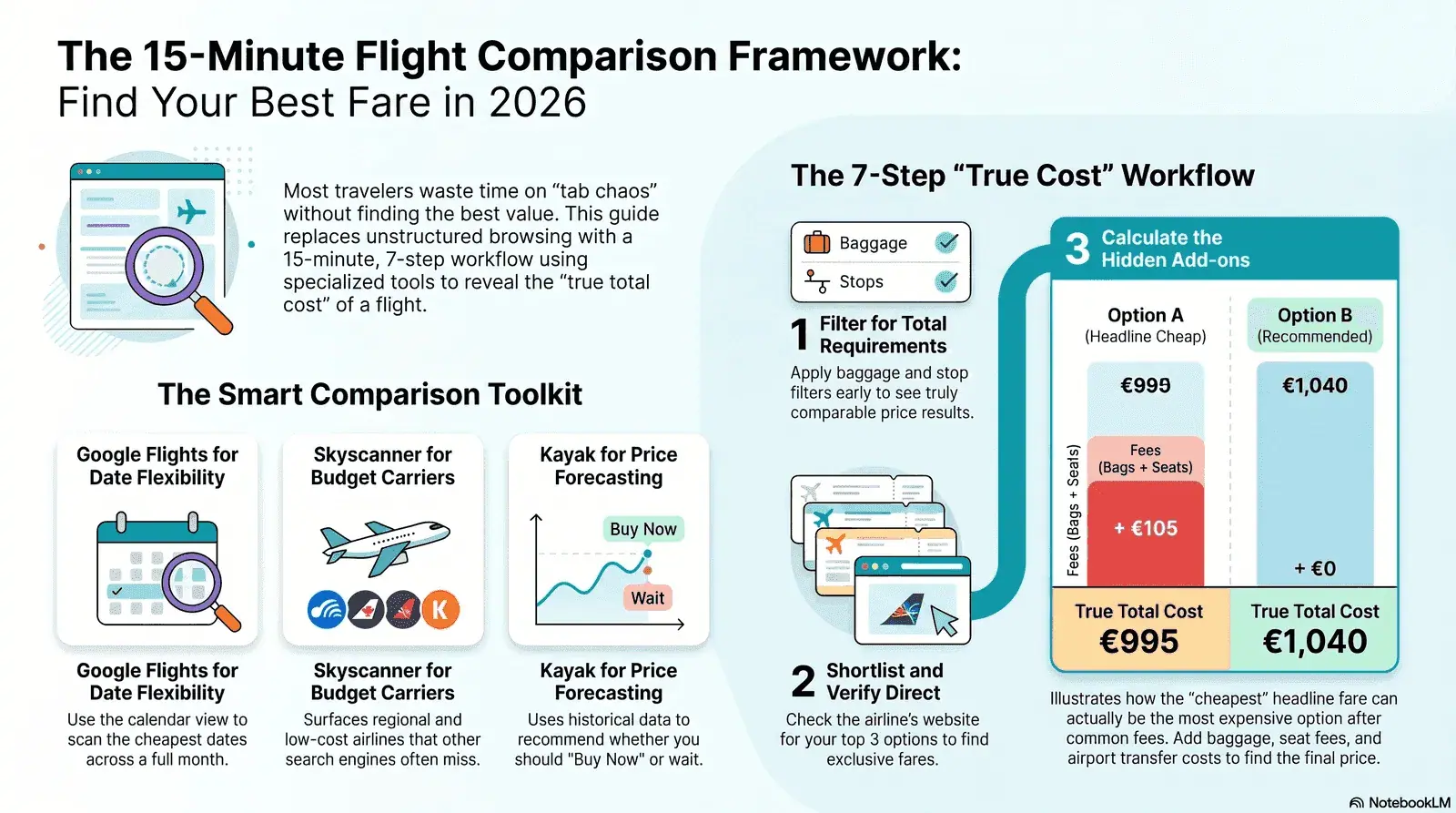
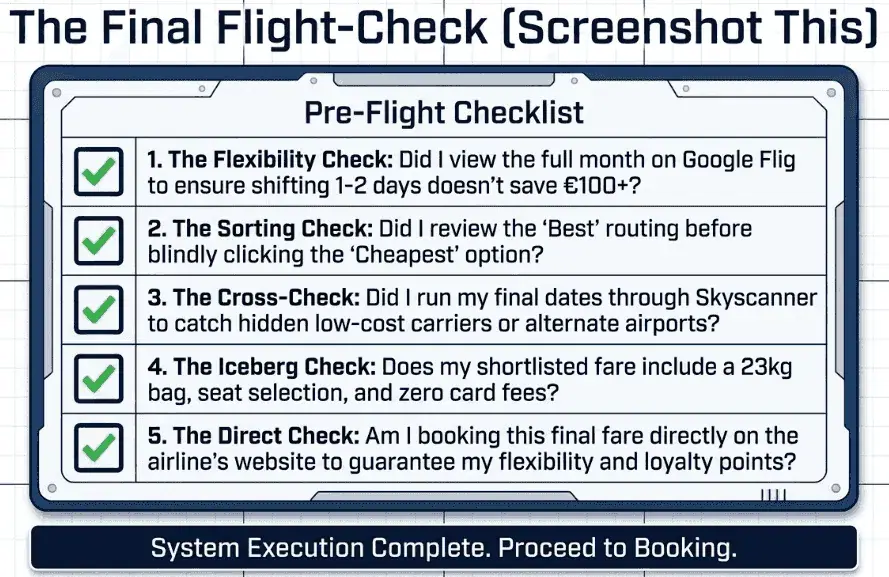
- Google Flights calendar view is the fastest starting point. It shows the cheapest available date across an entire month in a single view — no tab-switching required to find your cheapest travel window.
- Total cost always beats headline fare. Baggage fees, seat selection charges, and payment surcharges frequently flip the cheapest-looking option into the most expensive — always build in the extras before comparing.
- Fare alerts eliminate the need to check repeatedly. Setting a Google Flights or Skyscanner alert the moment you decide on a route means you catch price drops automatically without obsessing over the search.
✈ Best first-search tool
Google Flights calendar view
Shows cheapest date across full month at a glance
📅 Optimal booking window
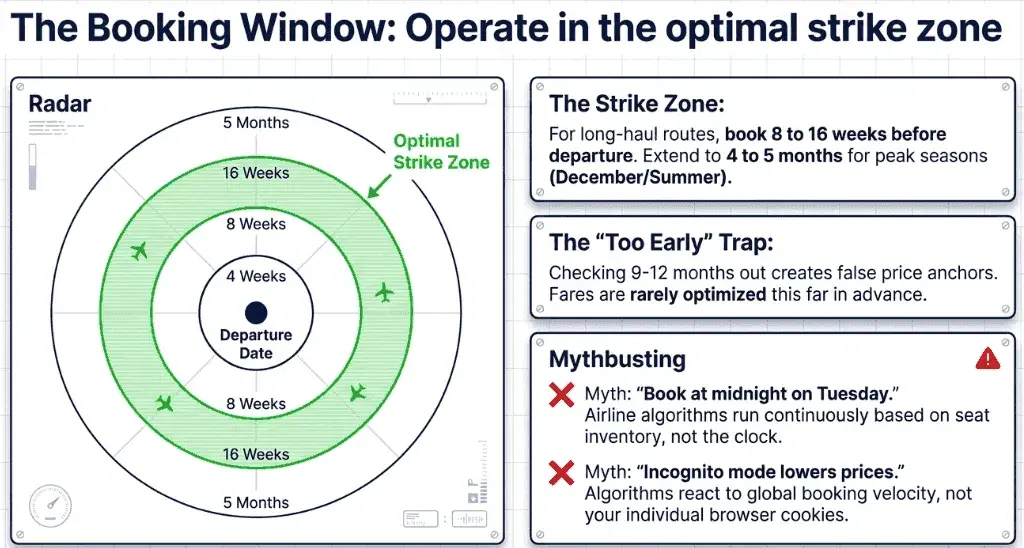
8–16 weeks before departure
Extend to 4–5 months for peak season travel
💸 Typical price spread
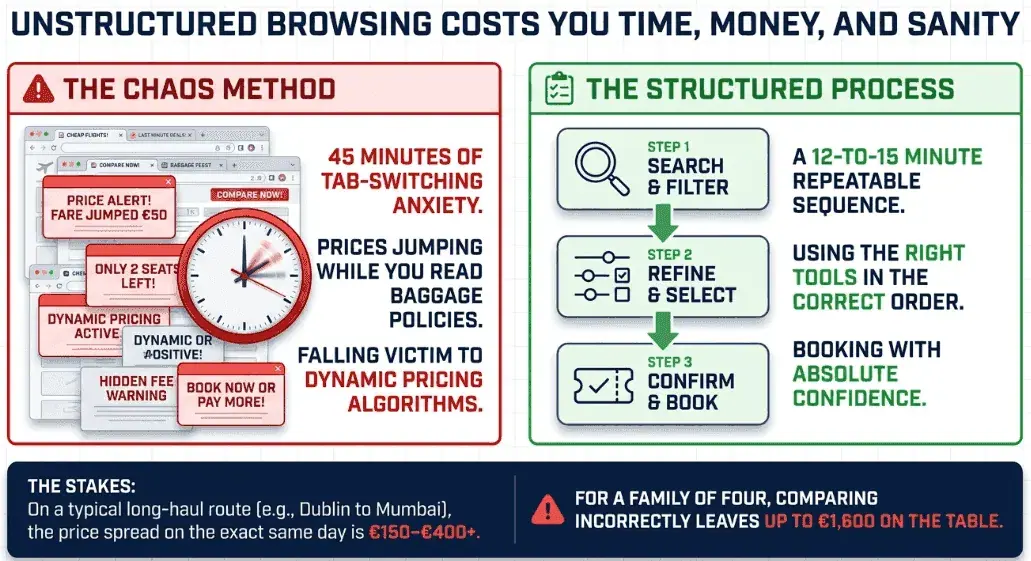
€150–€400+ on long-haul
Same route, same day, different airlines
⚡ Time to compare properly
10–15 minutes
With the right process — not 45 minutes of tab chaos
What this guide covers
- Why comparing multiple airlines matters
- The right tools for fast multi-airline comparison
- Step-by-step: from search to booking in under 15 minutes
- Best practices for faster, smarter comparisons
- How to compare total trip cost — not just the base fare
- Common mistakes when comparing fares
- A quick worked example
- FAQs about comparing airline fares
Why a Structured Process Changes Everything
You have been there: fourteen browser tabs open across three devices, a fare that jumped by €90 while you were reading the airline's baggage page, and the creeping suspicion that someone sitting next to you on the flight paid considerably less. Flight price comparison is genuinely confusing — not because it has to be, but because airlines and booking platforms have made it that way by design.
The good news is that the process becomes fast and reliable the moment you give it a structure. Most travellers who feel overwhelmed by flight comparison are not looking at more information than needed — they are looking at it in the wrong order. This guide gives you a clear sequence: the right tool first, the right filters next, the total cost check before committing, and fare alerts for every route you fly regularly.
Whether you are a student flying home to India from Dublin, a family planning a summer break in Europe, or a business traveller trying to get the most from a constrained travel budget, the core framework is the same. What once took 45 minutes of anxious tab-switching will take about 12 minutes — and you will have higher confidence that the fare you booked was genuinely the best available option for your requirements.
Why Comparing Multiple Airlines Matters
Same route, wildly different prices
Consider a Dublin to Mumbai route in a typical September. Emirates will often price this at a premium due to strong corporate demand via their Dubai hub. Qatar Airways might price it more aggressively via Doha to gain market share. Air India may offer the lowest base fare via London but with a different schedule and baggage structure. Turkish Airlines via Istanbul might undercut everyone on price but add two hours to the journey time. These are four distinct propositions — all serving the same city-pair, on the same travel date, with meaningfully different price points.
The spread between the cheapest and most expensive option on a single long-haul route can be €150 to €400 on the same departure date, and substantially more during peak travel periods. For a family of four travelling from Dublin to Delhi in December, that spread can translate to a difference of €600 to €1,600 in total outlay — money that serves you far better spent at your destination than handed over to an airline because you did not compare.
Airlines use dynamic pricing algorithms that respond continuously to remaining seat inventory, the time elapsed since the flight went on sale, current booking velocity on that route, and competitive pricing signals from other carriers. A fare that is €820 on Monday can be €940 on Thursday if a competitor sold out their low-fare allocation. This is why comparing on the day you intend to book — not the day you first got curious — is important.
Beyond the headline price: time, baggage, and comfort
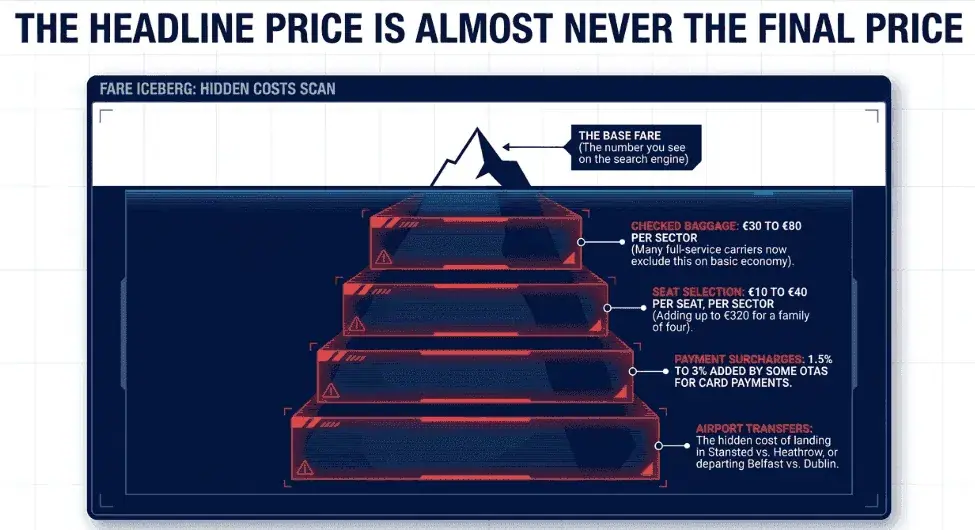
The price shown on the first results screen is almost never the final price, and it is almost never a complete picture of the journey's total value. Five additional factors routinely change which option is actually best:
-
Checked baggage: Basic economy fares on many full-service carriers — including Air India, Emirates, Qatar Airways, and Turkish Airlines on certain fare families — now carry reduced or zero checked baggage allowance on the cheapest tickets. Adding a 23 kg bag can cost €30 to €80 per sector, transforming a seemingly cheap fare into an expensive one.
-
Seat selection: Most airlines now charge for advance seat selection on economy fares — typically €10 to €40 per seat per sector on long-haul flights. For a family of four wanting to sit together, this adds €80 to €320 to any fare before you have even considered baggage.
-
Payment card surcharges: Some Online Travel Agencies (OTAs) and a small number of airlines still apply a card payment fee of 1.5 to 3%, which adds €15 to €45 to the cost of a €1,500 return ticket. Booking with a fee-free debit card or a credit card with no foreign transaction fees eliminates this entirely.
-
Layover and connection time: A 6-hour layover at a hub may mean an expensive airside hotel, an exhausting overnight wait, or a missed connection in peak season. A 45-minute layover at a congested hub carries its own risk of delay. Journey time is a real cost; it is just denominated in hours rather than euros.
-
Airport transfer costs: Arriving into London Stansted rather than Heathrow, or Frankfurt Hahn rather than Frankfurt Main, adds both transfer time and cost. On the departure side, flying from Dublin versus Belfast is a two-hour drive that may or may not be worth the fare difference.
The Right Tools for Fast Multi-Airline Comparison
Fare comparison engines — your starting point
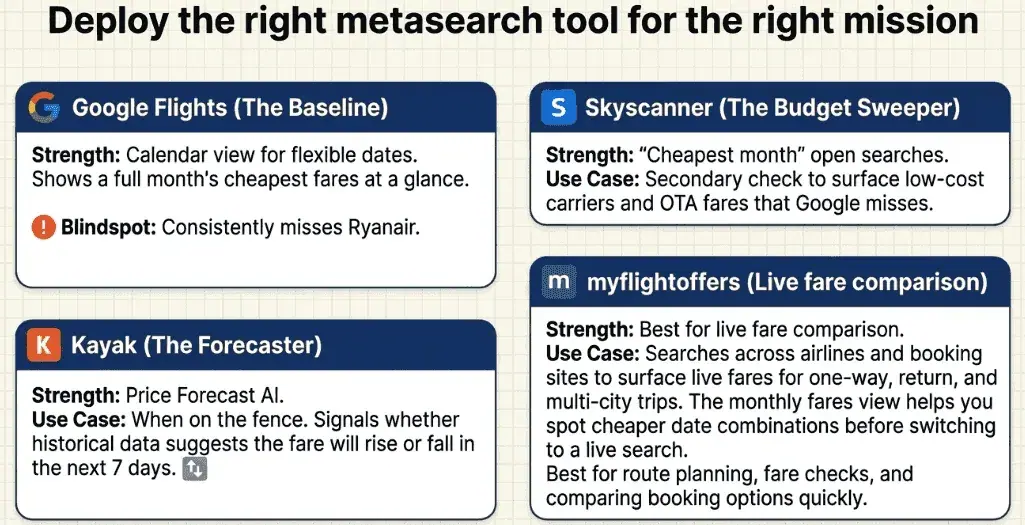
Comparison engines (also called metasearch tools) aggregate pricing from hundreds of airlines and booking platforms simultaneously. Instead of visiting seven airline websites individually, you see all their prices in one place, across every departure time and most available fare classes. The leading tools for travellers from Ireland in 2026:
Google Flights
The gold standard for date-flexible searches. The calendar grid shows the cheapest price for every date across a full month at a glance. The price history chart indicates whether current fares are historically high or low. Google Flights also supports "Explore" destination searches if your destination is open. Strong coverage of full-service international carriers. Does not consistently index Ryanair.
Skyscanner
Stronger than Google Flights for budget and regional carriers, including many low-cost airlines that Google under-indexes. The "cheapest month" view and "cheapest destination from here" search are powerful for open-ended trip planning. Skyscanner also surfaces nearby airport alternatives automatically. Use as a second check after Google Flights.
Kayak
Includes a "Price Forecast" feature that signals, based on historical data, whether the current fare is likely to rise or fall over the next 7 days — useful when you are on the fence about committing. Strong multi-city and hacker fare search. Good for complex itineraries involving more than one destination.
myflightoffers.com
Searches across airlines and booking sites to surface live fares for one-way, return, and multi-city trips. The monthly fares view helps you spot cheaper date combinations before switching to a live search. Best for route planning, fare checks, and comparing booking options quickly.
Airline websites — the essential final check
Comparison tools are the right starting point, but they do not replace the airline's own website. After shortlisting on a comparison tool, always check the airline's direct website for at least your top option for three specific reasons:
-
Exclusive direct fares and flash sales: Many airlines run promotions available only via their own app or website. Aer Lingus regularly runs seat sales exclusive to its own channels. Emirates and Qatar Airways have loyalty-member fares not visible on third-party platforms.
-
Transparent terms: Change and cancellation policies are always clearest on the airline's own booking page, not on an OTA. The cost of flexibility — and whether you need it — is visible only here.
-
Full loyalty credit: Booking directly with the airline almost always guarantees full accrual of frequent flyer miles and tier credit. Some OTA bookings generate reduced or no miles, depending on the fare class booked.
Metasearch tools vs Online Travel Agencies (OTAs) — the key difference
This distinction matters more than most travellers realise, and confusing the two leads to poor decisions. Metasearch tools (Google Flights, Skyscanner, Kayak, Momondo) show you prices and then redirect you to complete the booking elsewhere — they never take your money themselves. Online Travel Agencies (OTAs) — Expedia, Booking.com Flights, eDreams, Opodo, Lastminute.com — take your payment and manage the booking as an intermediary.
| Feature | Metasearch Tool | OTA Booking | Airline Direct |
|---|---|---|---|
| Breadth of airline coverage | Very broad | Broad (negotiated) | Single airline only |
| Price accuracy | Usually accurate, not guaranteed | Confirmed at checkout | Confirmed at checkout |
| Change and cancellation | Redirects to airline or OTA | Via OTA (quality varies) | Direct with airline |
| Loyalty points accrual | Depends on final booking source | Often reduced or zero | Full accrual |
| Best use case | Discovery and comparison | Package deals or specific OTA offers | Final booking after comparison |
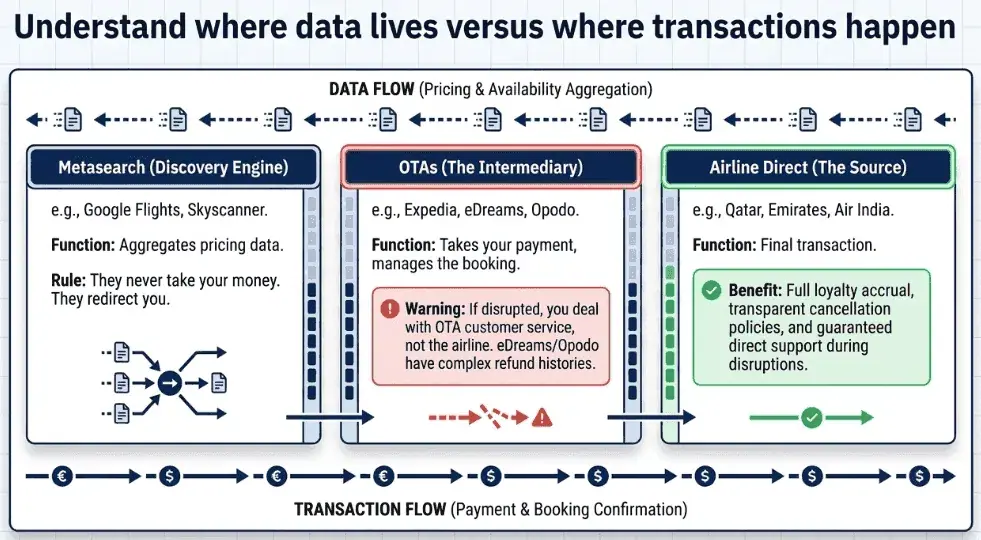
OTAs can offer genuinely lower prices through bulk-purchased fares, and are often the right choice for hotel and flight packages. However, if your flight is cancelled or significantly delayed, you will deal with the OTA first, not the airline directly — and OTA customer service quality varies enormously. eDreams and Opodo in particular have a track record of complicated refund processes. For long-haul international travel where delays and cancellations carry real cost, booking directly with the airline — even at a small premium — is a legitimate choice.
Step-by-Step: From Search to Booking in Under 15 Minutes
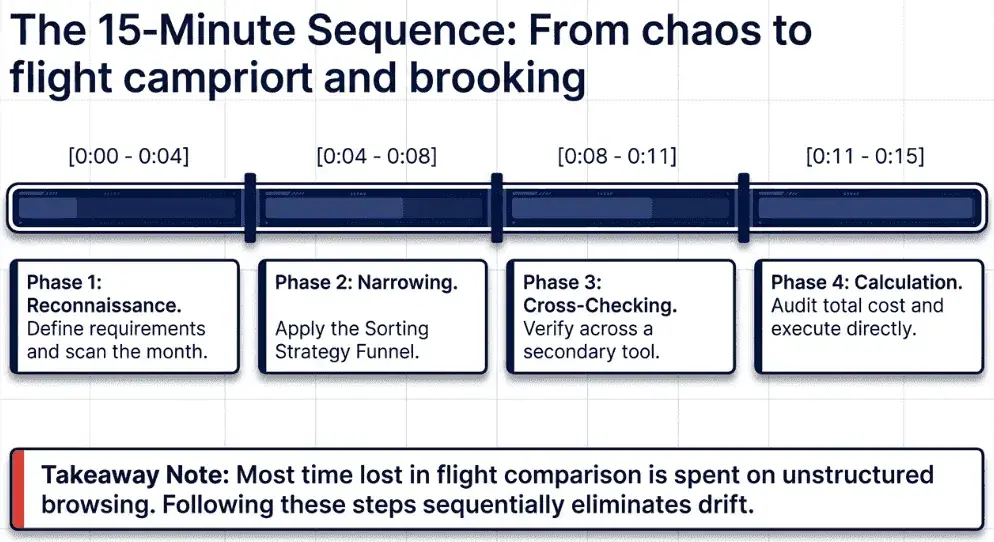
Most of the time lost in flight comparison is spent on unstructured browsing — opening tabs, closing them, returning to the same page, and getting distracted by options outside your actual requirements. The process below eliminates the drift. Follow it in sequence and the decision becomes both faster and more defensible.
- Define your requirements before you open any tool. Set your origin and destination, your preferred travel dates and flexibility window (e.g., "any day from the 14th to the 17th"), your stop tolerance (direct, 1 stop, or 2 stops acceptable), your checked baggage needs (none, 1 bag, 2 bags), and any firm departure or arrival time constraints. Knowing these before you search prevents you from being swayed by options that will not actually work for you.
- Run your initial search on Google Flights using the calendar view. Select your route, choose "flexible dates" or the monthly calendar view, and scan the full price landscape. Note the cheapest departure days and the airlines appearing at the lowest price points. This is reconnaissance — do not book yet. The goal is to understand the price range for your route before making any decisions.
- Apply smart filters to narrow the results to realistic options. Filter by your maximum number of stops. Filter by departure or arrival window if you have time constraints. If you need checked baggage, enable the "bags included" or "include bags" filter — this recalculates prices to show truly comparable totals. Sort by "Best" first, which balances price, duration, and stop quality, before switching to "Cheapest" to understand what trade-offs the lowest price involves.
- Run a second search on Skyscanner for the same dates. Look specifically for any airlines, routings, or pricing that differ from your Google Flights results. Skyscanner often surfaces lower-cost carrier options and OTA fares that Google Flights misses. Note any genuinely different options worth shortlisting.
- Shortlist 3 to 5 comparable options that cover the value range. Include your fastest routing option, your cheapest option, and the one that best balances price, schedule, and baggage terms. These are the candidates for a proper total-cost comparison — not just headline fare comparison.
- Open each shortlisted option on the airline's own website or the booking platform in separate tabs. For any airline shortlisted, check whether the direct website matches or betters the comparison tool price. Check the exact baggage allowance, the seat selection fee, and the full cancellation terms. For at least one option, complete a test booking through to the payment stage (without confirming) to see the final price including all fees.
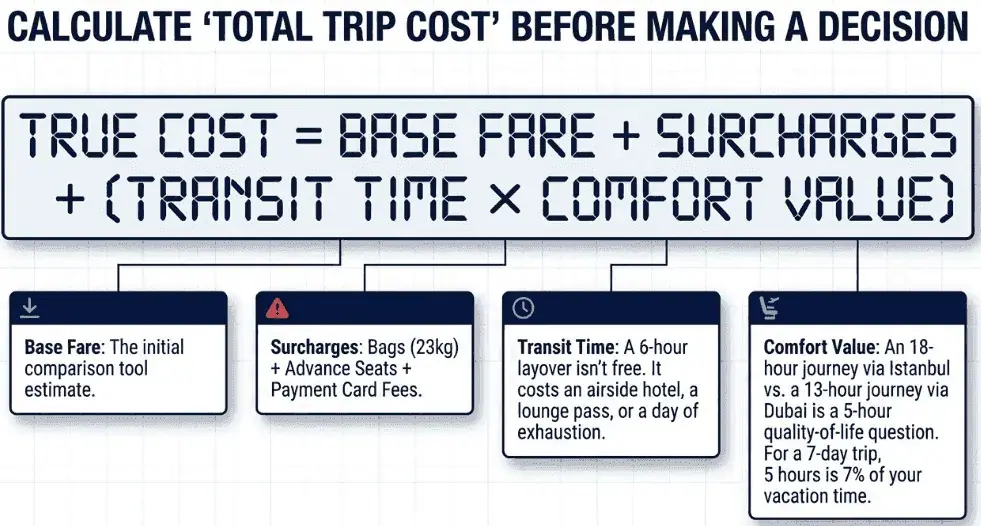
- Calculate the true total cost for each shortlisted option. Add checked baggage, seat selection if needed, any card payment surcharge, and any meaningful airport transfer cost difference. The option with the lowest total cost — not the lowest headline fare — is the one to book.
Best Practices for Faster, Smarter Fare Comparisons
Use flexible dates — the biggest single lever for savings
Shifting travel by even one or two days can reduce long-haul fares by €50 to €150 on many routes. Dublin to Delhi on a Wednesday evening can be 25 to 35% cheaper than the same routing on a Friday evening in November, purely because of corporate travel demand patterns. The Google Flights calendar view makes this visible in a single glance — you see the full month's cheapest fares without running separate searches for each date.
If your trip allows a 3 to 5 day flexibility window, always search with that window open rather than fixing the date before you look. You may discover that travelling on a Tuesday instead of a Saturday is worth the minor schedule adjustment for the saving it generates.
Try nearby airports — both on departure and arrival
Both on the outbound and inbound side, alternative airports can materially affect the fare while only modestly affecting the journey. From Ireland, Belfast International and Belfast City are relevant alternatives to Dublin for some routes — typically adding a 90-minute to two-hour drive but reducing fares by €80 to €150 per person on transatlantic connections, particularly via carriers with strong Belfast routes.
On the arrival side, if your final destination in India is anywhere in the south or west, Mumbai (CSIA) is often priced lower than Delhi and served by one fewer connection in some itineraries. For the Middle East, Abu Dhabi and Sharjah serve essentially the same destination area as Dubai, often at a lower fare. Most comparison tools have a "nearby airports" toggle — enabling it takes one click and occasionally reveals a significantly cheaper option.
Sort and filter with a clear strategy
The instinct to sort by "cheapest" first is understandable but counterproductive on long-haul routes. The cheapest result almost always involves the worst schedule, a very long or very short connection, missing baggage, or an inconvenient departure time. You should know what you are trading against a lower price, not discover it accidentally after booking.
- Start with "Best" sort — understand what the balanced recommendation looks like and why it scored well
- Switch to "Cheapest" sort — note exactly what changes: longer journey, worse connection, no baggage, unfavourable timing
- Switch to "Fastest" sort — check whether the fastest option costs significantly more or is competitive with the best
- Make a conscious trade-off decision rather than defaulting to the top result in any single sort order
Set fare alerts for routes you travel regularly
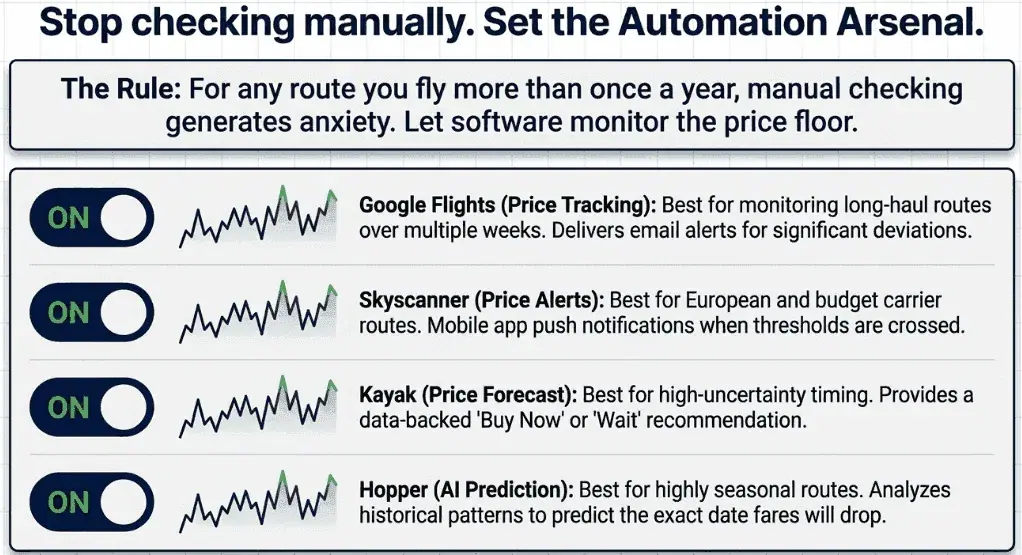
For routes you fly more than once a year — Dublin to a home city, Dublin to a European hub for business, or any regular destination — setting permanent fare alerts is far more effective than manual checking. Alerts notify you when fares move; you act when they do, rather than checking obsessively every few days when prices may not have changed at all.
| Tool | Alert Type | How It Works | Best For |
|---|---|---|---|
| Google Flights | Price tracking (email) | Track any searched route; notifies when price changes significantly | Long-haul routes monitored over weeks |
| Skyscanner | Price alerts (app + email) | Alerts when saved route price rises or falls above/below threshold | European and budget carrier routes |
| Kayak | Price alerts + forecast | Alerts plus "buy now or wait" recommendation based on trend data | Routes where timing uncertainty is high |
| Hopper | AI price prediction | Analyses historical data; predicts fare direction and optimal book date | Routes with predictable seasonal patterns |
How to Compare Total Trip Cost — Not Just the Base Fare
The true-cost checklist
A fair comparison between two or more flight options requires adding the same set of components to each headline fare. The full list of costs to check for every shortlisted option:
- Base fare (the number shown on the comparison tool)
- Checked baggage: is 23 kg included, or does it cost extra?
- Seat selection: is advance seat assignment free, or chargeable?
- Payment card fee: does the OTA or airline add a surcharge for card payments?
- Airport transfer difference: if one option uses a secondary airport, what is the ground cost and time?
- Long-layover costs: does a 7-hour overnight connection require a transit hotel or lounge fee?
- Flexibility premium: is the fare fully refundable, change-fee-free, or lock-in with no flexibility?
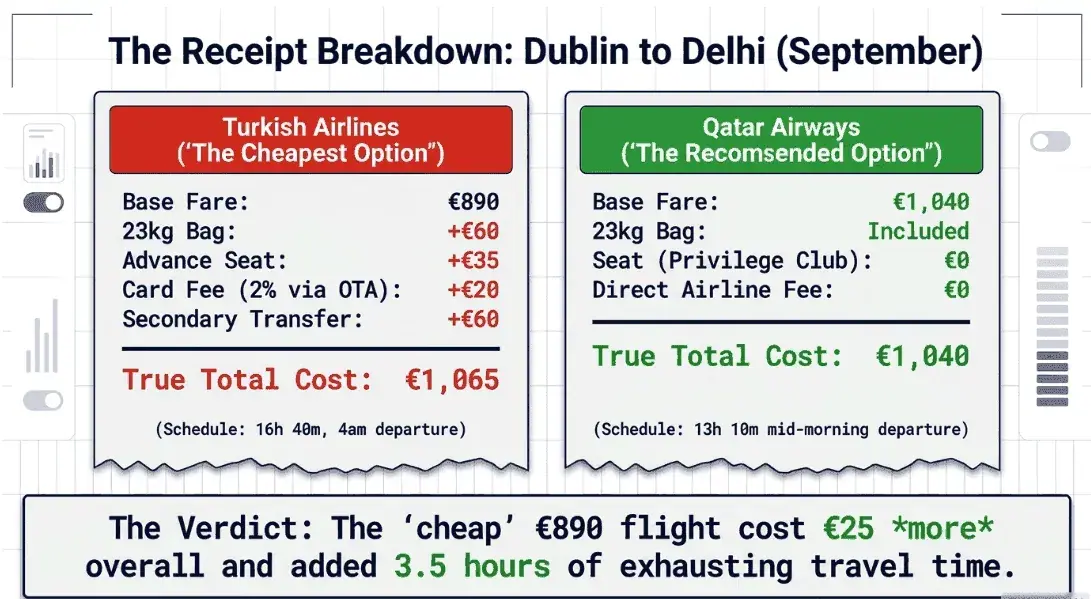
The following is a conceptual example illustrating how headline fare comparisons can be misleading. All figures are illustrative and not representative of any specific route or date.
| Cost Component | Option A — "Cheapest" | Option B — "Recommended" | Option C — "Premium" |
|---|---|---|---|
| Base fare | €890 | €1,040 | €1,150 |
| Checked baggage (23 kg) | + €70 | Included | Included |
| Advance seat selection | + €35 | + €0 | + €0 |
| Payment card fee (2%) | + €20 | + €0 | + €0 |
| Secondary airport transfer | + €50 | + €0 | + €0 |
| True total cost | €1,065 | €1,040 | €1,150 |
| Journey time (total) | 17h 30m (overnight) | 13h 10m | 12h 20m |
Airport transfers and journey time as real costs
An 18-hour journey via Istanbul at €900 versus a 13-hour journey via Dubai at €1,050 is not just a €150 question — it is also a 5-hour quality-of-life question. For a one-week holiday, five hours represents over 7% of your actual trip time. For a family with young children, a 4am departure and 17-hour journey can materially affect the first two days of a trip.
Assign a value to your time and your travel companions' comfort, and factor it in. This is not a luxury consideration — it is a legitimate part of the comparison. The cheapest fare is only the best choice if the total trip experience it delivers is acceptable.
Loyalty points as a legitimate tiebreaker
When two options are genuinely close in true total cost, loyalty programme membership is a valid differentiator. If you have an Emirates Skywards account and are building toward a business class redemption, choosing Emirates over a similarly-priced Qatar flight accelerates that goal meaningfully. If you hold an Aer Lingus AerClub Gold card, a routing through Dublin connections earns status credits that improve future travel at no additional cash cost.
Loyalty should never override a significant price difference — but in genuinely close calls (within €30 to €50 on a long-haul return ticket), it is a reasonable factor in the final decision. For Indian travellers using credit cards that earn airline miles (SBI Miles Elite, Axis Atlas, HDFC Infinia), the earning potential on the booking itself also varies by airline and booking method — see our Indian Payment Guides for full detail on which cards maximise miles on which airlines.
Common Mistakes When Comparing Fares Across Airlines
- Using only one comparison tool and treating its results as complete. Every aggregator has gaps. Google Flights misses Ryanair consistently. Skyscanner may lag on some airline-direct promotions. No single tool indexes every available fare on every route. Cross-referencing two tools takes less than five extra minutes and regularly reveals a €50 to €100 price difference.
- Booking on the first search without understanding the price range. First-search anchoring — comparing everything against the first price you encountered — produces worse decisions. Run a full comparison on two different tools before forming a view of what "normal" looks like for this route and season. A fare that looks good in isolation may be above average for the route.
- Comparing headline fares without calculating total cost. The baggage fee problem is well-documented but still catches experienced travellers constantly. A "cheap" fare that does not include a checked bag will frequently match or exceed the price of a fare with baggage included once you do the maths. Always build the total-cost comparison before committing.
- Not checking the airline website directly for at least one shortlisted option. The airline website is where you find exact change and cancellation terms, the real baggage rules (which may differ from what an OTA displayed), and any direct-booking-only promotions. Skipping this step means you often discover important conditions only after booking.
- Checking prices too early and anchoring to those figures. Fares checked 9 to 12 months before departure are rarely representative of what will be available at the time you want to book. Early check-ins create false price anchors that can lead to either premature booking or unrealistic expectations. The meaningful booking window for most long-haul routes starts 4 to 5 months before departure and peaks at 8 to 12 weeks out.
- Ignoring schedule quality in favour of the lowest number. A connection that gives you only 45 minutes at Istanbul or Dubai in peak summer is a missed connection risk, particularly if your inbound segment runs late. Airlines generally protect you if a connection is missed on a single booking, but the cost of disruption to your trip can be significant. Check minimum connection times at your hub airport before choosing a tight itinerary.
- Not setting fare alerts for regular routes and checking manually instead. Checking prices manually every day for a route you travel regularly is inefficient and generates unnecessary anxiety. Setting a Google Flights or Skyscanner alert takes 3 minutes, notifies you automatically when prices move, and eliminates the compulsion to refresh the same page daily.
A Quick Worked Example: From 20 Options to the Best One
To show how the process works in practice, here is a conceptual walk-through of a Dublin to Delhi search for a September departure, with 3 days of date flexibility.
Starting position: Google Flights calendar view returns 22 options ranging across the full month. Prices vary significantly mid-week versus weekend. The lowest price appears on a Tuesday departure.
After applying filters: 1 stop maximum, bags included, morning Dublin departure preferred. Results narrow to 8 options across 3 days either side of the preferred travel date.
Sorted by "Best": The top result is a mid-morning Dublin departure via Doha with a 2-hour 20-minute connection and 13-hour total journey (Qatar Airways). Second result is Emirates via Dubai at a 14-hour total with an evening departure. Third is Air India via London at a similar price to Emirates but with a longer connection requiring a UK airside check.
Sorted by "Cheapest": A new option appears — a Turkish Airlines routing via Istanbul at €120 less than the Qatar option. Total journey: 16 hours 40 minutes, 4am Dublin departure. The price saving is real; the experience trade-off is significant.
Cross-check on Skyscanner: The Qatar and Emirates options appear at consistent prices. Skyscanner shows one additional Air India routing not visible on Google Flights. Price is similar to the Emirates option. Checked: connection is tight at 55 minutes in London — excluded from shortlist.
True total cost comparison for the final 3 options: Qatar Airways — bags included, seat selection is free for Privilege Club members, no card surcharge on direct airline website. Emirates — bags included, seat selection charged at €18 per seat. Turkish Airlines — €120 cheaper headline but bags not included in cheapest fare class (€60 to add), 4am departure, and 16-hour journey.
FAQs About Comparing Airline Fares
Do flight comparison sites show all airlines?
No. Every comparison tool has meaningful gaps. Google Flights has inconsistent coverage of Ryanair and some budget carriers. Skyscanner includes more low-cost airlines but can lag on airline-direct web fares. No single tool indexes all airlines on all routes. The best practice is to run a primary search on one tool, cross-check on a second, and verify on the airline's own website for any shortlisted option before booking.
Is it always cheaper to book through a comparison site rather than the airline directly?
Not always. Comparison and metasearch tools are excellent for discovering which airlines and dates offer the best prices. But the final booking is sometimes cheaper or offers better terms directly on the airline's website. The recommended workflow: use a comparison tool to find the best option, then check the airline's own booking page for that specific fare before completing the purchase.
How often should I check prices before booking?
For most routes, checking every few days over a 2 to 3 week active search period gives a realistic view of the price floor. Setting fare alerts on Google Flights or Skyscanner is a better strategy than daily manual checking — alerts fire when prices move meaningfully, so you react when it matters rather than checking when nothing has changed.
Are flight prices shown on comparison tools in real time?
Most comparison tools refresh prices frequently but not at the exact moment you search. Prices are indexed from airline feeds at regular intervals and can change between the time a comparison tool displays a fare and when you click to book. Always treat comparison tool prices as accurate guides rather than guaranteed final prices. The confirmed price is shown only on the airline or OTA's own checkout page.
Does searching for the same flight multiple times cause prices to rise?
No. The widely held belief that airlines track your search history via cookies or IP addresses to inflate prices is a travel myth. Airline pricing is controlled by Global Distribution Systems (GDS) and Reservation Booking Designator (RBD) systems, which segment seats into distinct inventory buckets. When a price increases during a route refresh, it is almost always because the remaining seats in a low-cost bucket have been purchased by other buyers worldwide, or because of a caching delay between the airline database and the comparison engine.
Instead of relying on incognito mode, focus on tangible cost-saving measures: set up automated price alerts to track fare trends, remain flexible with departure dates (mid-week travel is usually cheaper), and evaluate alternative airport parameters.
What is the cheapest day of the week to fly?
Tuesday and Wednesday departures are consistently cheaper than Friday, Saturday, and Sunday on most routes, including long-haul international flights. This reflects demand patterns: business travellers drive up Monday and Friday prices, while leisure travellers push up weekend fares. Shifting your travel by even one day can reduce long-haul fares by €50 to €150 on competitive routes.
When is the best time of day to book a flight?
The idea that there is a universally "best time of day" — such as midnight on a Tuesday — is largely a myth sustained by outdated data. Airline pricing algorithms run continuously and do not reset at midnight. Airline promotional fares are sometimes released early in the working week, so checking mid-morning on a Tuesday or Wednesday after a weekend is a reasonable habit for routes you are actively monitoring. Subscribing to airline sale newsletters (Aer Lingus, Emirates, Qatar) ensures you receive promotional fare announcements at the moment they go live.
How do I compare total trip cost across different airlines?
For each shortlisted option, add these components to the headline fare: checked baggage (if not included), advance seat selection (if needed), any payment card surcharge, and any meaningful airport transfer cost difference if the options use different airports. Building a simple side-by-side for 3 to 4 options takes under 10 minutes and regularly reveals that the "cheapest" headline fare is not the lowest true cost.
Conclusion: Smarter Comparison Starts With a Process
Comparing fares across multiple airlines is not about finding the single lowest number on a list — it is about finding the best total value proposition for your specific journey. The process becomes fast and reliable when you start with the right tools, apply smart filters consistently, calculate true total cost before committing, and set fare alerts for any route you fly more than once a year.
For most international routes from Ireland, the combination of Google Flights for its calendar view and Skyscanner for its breadth of coverage — each taking about 5 minutes — plus a final check on the airline website for your top shortlisted option, will consistently deliver better outcomes than the old method of searching frantically across seven tabs and booking in panic. Ten focused minutes beats forty scattered ones, every time.
Use the MyFlightOffers monthly fare calendar to check the cheapest months on your most travelled routes before you begin comparing airlines — knowing the seasonal price floor puts everything that follows in proper context.
Ready to compare live fares on your route?
Put the process from this guide into action. Search flights, check the monthly fare calendar, and find the best available option before committing.
Once you have found the best fare, make sure you are booking with the right payment method and maximising your card rewards:
- Best Time to Book Flights in 2026: What the Data Actually Shows — the data on optimal booking windows (15–45 days out), why Friday beats Tuesday, and when to stop waiting and book now.
- What Is International Fare Routing? Complete 2026 Guide — understand why two similar-looking itineraries can price very differently once routing rules, fare buckets, and married segments are applied.
- How to Plan a Multi-City Family Trip Cheaply (2026 Complete Guide) — use this family-focused guide to translate fare comparisons into a full multi-city itinerary without hidden cost shocks.
- Finding Affordable Flights from Dublin to Delhi — 2026 Complete Guide — airlines, stopover hubs, visa requirements, and seasonal booking windows for the most popular long-haul route from Ireland
- Study in Ireland 2026: Complete Guide for International Students — universities, scholarships, cost of living, and flights from India and China to Dublin
- Airport Lounge Access in India: Complete Credit Card Guide 2026 — maximise your lounge benefits while comparing and booking
- Axis Bank Credit Cards for Flights 2026 — EDGE Miles, Atlas vs Magnus, Travel EDGE portal booking tips
- Best SBI Credit Cards for Flights & Travel 2026 — Miles Elite, KrisFlyer SBI, forex markup, and transfer partners
- Best ICICI Bank Credit Cards for Flights & Travel 2026 — iShop acceleration, Emeralde Private Metal, and MakeMyTrip ICICI
- All Indian Payment Guides →
- Hand Luggage Only on India-Ireland Flights 2026: Carry-On Rules for Emirates, Etihad, Qatar Airways, Air India and British Airways — once you have found your cheapest fare, check whether skipping the checked bag saves €60–€150 more: exact 2026 cabin-bag limits, the BCAS one-bag rule, and a savings calculator.
Frequently Asked Questions
How far in advance should I book international flights for the best price?
For long-haul international routes (such as Dublin to India, the Middle East, or North America), the sweet spot is typically 8 to 16 weeks before departure. Booking more than 6 months out usually gives access to the full seat inventory but not always the best fares. Waiting until 2 to 3 weeks before departure almost always means significantly higher prices as remaining low-fare seats have been sold. For popular periods like summer, Diwali, or Christmas, extend that window to 4 to 5 months.
How do I compare the true total cost of two different flights?
To compare the genuine total cost of two or more flights, add all mandatory and likely costs to the base fare: checked baggage (if not included), advance seat selection, any payment card surcharges, and any additional airport transfer costs if the flights use different airports. The option with the lowest headline fare is frequently not the lowest total cost once baggage and fees are included. Building a simple side-by-side comparison of 3 to 5 shortlisted options takes under 10 minutes and routinely changes the final decision.
What are fare alerts and how do I set them up?
Fare alerts notify you automatically when the price for a specific route changes significantly. Google Flights offers free price tracking for any searched route, sending email notifications when fares drop or rise. Skyscanner's app sends push notifications for saved routes. Hopper predicts whether fares are likely to rise or fall over the next 7 days and alerts you accordingly. Setting alerts for your regular routes takes about 3 minutes per route and eliminates the need for manual daily checking.
All tool descriptions, airline coverage information, pricing examples, booking window recommendations, OTA comparisons, fare alert feature descriptions, and general travel guidance in this article are based on publicly available information from airline and OTA platforms as of June 2026. Flight prices, airline policies, baggage allowances, tool features, and OTA terms change frequently and without notice. All price examples in this article are illustrative and conceptual — they do not represent guaranteed or current fares on any specific route or date. Always verify current fares, baggage terms, and booking conditions directly on the relevant airline or booking platform before completing any purchase. MyFlightOffers is not affiliated with any airline, OTA, or fare comparison tool mentioned in this article. This article does not constitute financial or travel advice.