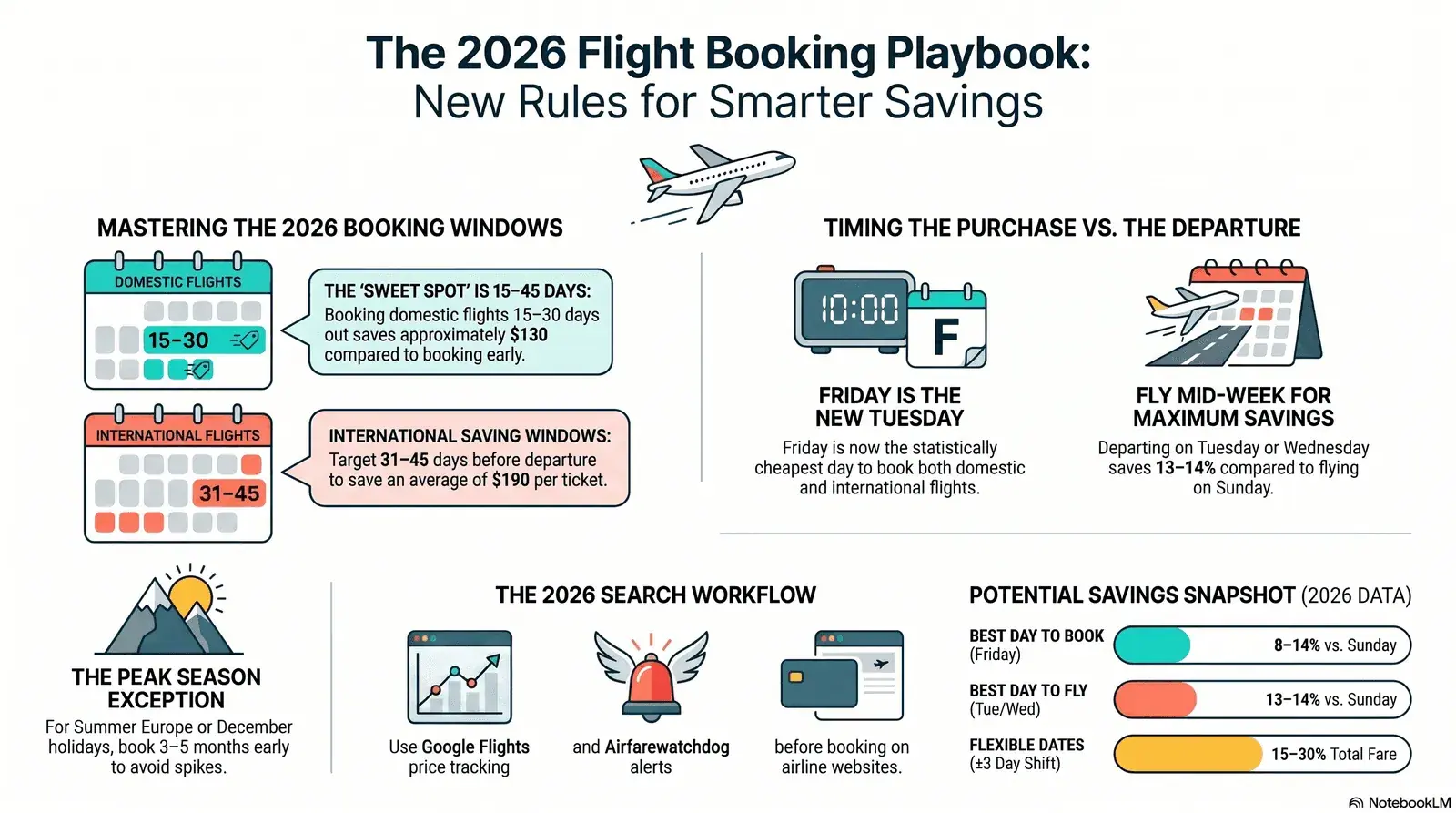
- Booking windows beat days of the week. The advance purchase window (how many weeks out you book) matters far more than which day of the week you book. Focus on 15–45 days out for most routes.
- The Tuesday myth is dead — Friday is now the data winner. Expedia's 2026 Air Hacks Report finds Friday is the cheapest day to book, not Tuesday. But the day you fly matters even more than the day you book.
- Summer and holiday fares are the exception: book early or pay more. For peak-season travel (June–August Europe, Christmas), waiting for a price drop rarely works — fares trend up, not down, inside 90 days of departure.
✈ Domestic / short-haul routes
Book 15–30 days out.
Very early bookings often cost
more, not less.
🌍 International / long-haul routes
Book 31–45 days out.
Summer Europe: book 3–5 months
ahead.
📅 Cheapest day to fly
Tuesday or Wednesday.
Flying Sunday costs 13–18% more on
most routes.
🛒 Cheapest day to book
Friday (Expedia 2026 data).
But booking window matters
far more than booking day.
What this guide covers
- How airline pricing actually works in 2026
- Optimal booking windows — what the 2026 data shows
- Does day of week still matter?
- Seasonal booking strategy: route by route
- When NOT to wait for a price drop
- Fare tracking tools that actually work in 2026
- Book direct or through an OTA?
- The flexible date advantage
- Budget carriers vs. legacy carriers
- Dublin Airport: route-specific booking windows
- Why some routes never get cheap
- Frequently asked questions
- 2026 booking framework
1. How Airline Pricing Actually Works in 2026
Modern airline Revenue Management Systems (RMS) price seats dynamically using machine learning — not fixed calendars — which is why the old "book on a Tuesday" logic no longer holds. Airlines use reinforcement-learning engines and continuous pricing algorithms that can update fares hundreds of times per day based on real-time demand signals, competitor moves, seat load factors, and external events like school holidays or major sporting fixtures.
The shift from rule-based "fare buckets" (where a flight had fixed tiers — a set number of economy seats at each price point) to continuous pricing has been the most significant architectural change in airline revenue management in decades. According to research published in dynamic aviation pricing studies, early adopters of continuous pricing models are seeing 10–15% revenue increases — meaning airlines capture more money per seat, but also create more fare volatility that informed travellers can exploit.
What this means practically: there is no longer a "magic moment" when airlines release cheap seats at a predictable time each week. Instead, fares drop when a specific flight's load forecast softens — when fewer people than expected are booking a particular route on particular dates. Your job as a traveller is to identify those windows, not to guess the calendar day.
On a high-demand route like Dublin–New York in late July, a Revenue Management System may update fares 200+ times in a single day. A fare you see at 9am may not exist by 11am. This makes fare tracking tools (see Section 6) far more valuable than any day-of-week strategy.
Global air passenger demand is also rising: IATA reports demand growth of 3.8% in January 2026 year-on-year, with February showing 6.1% growth. More passengers competing for seats means dynamic pricing engines face stronger demand signals — and fares respond accordingly.
When Airlines Actually Release Their Cheapest Inventory
Most airlines open bookings 330 days (approximately 11 months) before departure — but the cheapest seats are released in small tranches as the airline builds its demand forecast, not all at once.
Understanding this release cycle explains why booking 14 months out is often worse value than booking 8 weeks out:
| Time Before Departure | Typical Fare Level | Recommended Strategy |
|---|---|---|
| 10–11 months | Premium — launch fares test the market | Generally not worth booking. Set an alert instead. |
| 6–9 months | Moderate — varies widely by route | Monitor with alerts. Sporadic deals on some routes. Correct window for peak-season summer if buying early. |
| 3–5 months | Often cheapest for peak-season travel | Optimal window for summer Europe and Christmas travel. |
| 6–10 weeks | Lowest fares for most non-peak routes | Sweet spot for most off-peak bookings — airlines adjust inventory to build load. |
| 3–5 weeks | Fares rising as remaining seats fill | Still bookable, but window is closing on most routes. |
| Under 2 weeks | High — last-minute premium on most routes | Only viable for thin-load routes with unsold inventory. |
Budget carriers like Ryanair and Wizz Air follow a fundamentally different pattern: their lowest promotional fares (the headline €9.99–€19.99 fares you see advertised) are released at schedule launch, 6–12 months out. After those initial seats sell, pricing rises in defined tiers as the flight fills — unlike legacy carriers, there is generally no second "dip" back to launch-level prices on Ryanair routes.
2. Optimal Booking Windows: What the 2026 Data Shows
The single most impactful variable in flight pricing is how far in advance you book — and the optimal window is shorter than most travellers assume. According to Expedia's 2026 Air Hacks Report, based on analysis of millions of bookings:
| Route Type | Optimal Booking Window | Average Saving vs. 6 Months Out | Notes |
|---|---|---|---|
| Domestic / short-haul economy | 15–30 days before departure | ~€120 / ~$130 less than 6+ months out | Ultra-early booking prices in a premium; airlines release lower fares as load factor builds |
| International long-haul economy | 31–45 days before departure | ~€175 / ~$190 less than 6+ months out | Transatlantic and long-haul routes have different yield dynamics to short domestic hops |
| Bold / last-minute | 8–15 days before departure | ~€205 / ~$225 less than 6+ months out | Works only on routes with flexible inventory; carries real risk of no availability |
| Summer Europe (peak) | 3–5 months before departure | Up to €350–€400 more vs. waiting | Supply tightens faster than demand — the window inverts for peak season |
These figures counter the intuition many travellers have that booking very early (6–12 months out) delivers the best price. For most routes, airlines open inventory at a premium and gradually release discounted seats as they build load forecasts. The exception is peak-season travel where genuine capacity constraints push prices up as departure approaches.
On-the-Ground Insight: "I booked a Dublin–Barcelona return 14 months in advance for €340. My colleague booked the same route 6 weeks out for €195. I was convinced early booking was safer, but the data is clear — I over-paid significantly on a route with strong year-round demand." — Priya M., Dublin, Aer Lingus frequent flyer
3. Does Day of Week Still Matter? The Expedia 2026 Verdict
The Tuesday booking advantage has largely collapsed — Expedia's 2026 Air Hacks data shows Friday has emerged as the statistically cheapest day to book both domestic (14% cheaper than Sunday) and international (8% cheaper than Sunday) flights.
This is a meaningful reversal of the old conventional wisdom, which held that airlines released Monday-night sales that were cheapest to snap up on Tuesday. That pattern existed in an era when airline pricing was more rule-based. With continuous dynamic pricing now standard across major carriers, there is no longer a predictable "sale reload" day.
However, experts correctly caution against over-indexing on any single day. Expedia's data reflects bookings made on their platform — not the entire airfare ecosystem — and fares shift constantly. The practical takeaway is:
- Friday is a marginally better day to book than Sunday, based on current large-scale data.
- The difference between the best and worst booking day is typically 8–14% — meaningful but far smaller than the difference a better booking window (weeks out) delivers.
- Mid-week departures (flying on Tuesday or Wednesday) consistently save 13–14% versus flying on Sunday — the day you fly matters more than the day you book.
Cheapest day to fly ≠ cheapest day to book. Flying on Tuesday saves 13–14% versus Sunday departures. Booking on Friday may save 8–14% versus booking on Sunday. Both matter — but optimising departure day typically delivers a larger saving than optimising booking day.
4. Seasonal Booking Strategy: Route by Route
Seasonal demand patterns create predictable pricing cycles that reward travellers who plan around them — and punish those who book reactively. Here is what 2026 data shows for the most common travel seasons:
Summer Europe Travel (June–August)
For summer 2026 Europe travel departing June–August, the optimal booking window opened in February–April — and prices have been climbing since mid-May. According to SmarterTravel's summer booking analysis, the gap between February and April bookings on popular transatlantic and European routes has been running €180–€360 per ticket in 2026. If summer travel is still unbooked as of June, book now rather than waiting — fares rarely drop inside 8 weeks on high-demand summer routes.
Shoulder dates offer a practical alternative: early June or late August is typically 15–25% cheaper than peak mid-July, with comparable weather across most European destinations. Flying into secondary airports (e.g., Düsseldorf instead of Frankfurt, or Brussels instead of Amsterdam) can cut fares further on flexible itineraries.
Winter Holidays (Christmas and New Year)
For Christmas and New Year travel from Ireland, the optimal booking window is 35–60 days before departure — meaning October–November for December flights. Inside 21 days of departure, fares jump sharply and almost never drop back. Going.com's holiday fare research confirms that waiting past Halloween for Christmas bookings consistently results in overpayment of €130–€275 per ticket on popular routes.
The specific departure days also matter: December 22–23 outbound and January 2–3 return are the most expensive. Flying on Christmas Eve itself or December 26 can save €100–€180 on many routes — if the timing suits your plans.
Off-Peak and Cheapest Months from Ireland
January, February, and October–November are consistently the cheapest months to fly from Dublin Airport, with mid-week October often producing the lowest average one-way fares of the year. Expedia's 2026 fare data also identifies August as the most affordable month internationally for some non-European destinations (Tokyo, Mexico, Honduras) — a counterintuitive window where transatlantic summer demand has peaked but off-peak global routes are cheap.
For Ireland-based travellers, late January through March is the cheapest window to fly from Dublin on most European routes — with one-way fares to Dublin Airport's top destinations running roughly 30–40% below peak-summer prices. October through early November is a strong second window before Christmas demand builds.
5. When NOT to Wait: Fares That Only Go Up
Waiting for a price drop is the wrong strategy for a specific category of routes and travel dates — understanding these exceptions prevents expensive mistakes.
The general "book earlier to save" principle inverts for:
- Peak holiday departures (December 22–26 outbound; January 1–3 return; school half-term weeks): these dates sell at or near their maximum price months in advance and rarely see meaningful drops.
- Thin-inventory routes (small aircraft, limited frequency, or monopoly carrier): when a route has only 1–2 departures per day on a small aircraft, the airline doesn't need to discount because competition is absent.
- After a major sale ends: airlines periodically run promotional fare sales. Once a sale ends, fares very rarely return to sale-price levels before the travel date. If you see a sale price on a route you're planning, book it.
- Budget carrier flash sales: Ryanair and Aer Lingus occasionally release 24–48 hour seat sales that are genuinely time-limited. These are not candidates for "wait and see" — the fare is gone when the sale ends.
- Dublin–India during NRI peak periods: Diwali, Onam (August–September), Christmas, and the June–July NRI summer travel rush all push Dublin–India fares sharply upward. Book 2–3 months ahead for these windows without exception.
Last-minute deals do exist on some routes — specifically lightly-booked mid-week departures where airlines have dropped fares inside 7 days to fill seats. But this is not a reliable strategy. For every last-minute deal, there are many more routes where prices only go up in the final two weeks. Do not plan a trip around the hope of a last-minute drop unless your travel dates are fully flexible and you are comfortable with the possibility of not travelling at all.
6. Fare Tracking Tools That Actually Work in 2026
The most effective fare strategy in 2026 combines route search tools with dedicated price alert engines — not manual checking — because fares move faster than any individual can track.
| Tool | Best For | Key Feature | Limitation |
|---|---|---|---|
| Google Flights | Route exploration, flexible date search | Date grid, Explore map, "Track prices" toggle with email alerts; flags when fares are likely to rise | Checks once daily; alerts are broad ("prices are low"), not route-specific fare-drop notifications |
| Hopper | Price prediction and mobile users | ~95% accuracy on price change predictions; "Price Freeze" locks in a fare for a fee; buy/wait recommendation | Mobile app only; predictions are based on historical patterns and can miss sudden demand shifts |
| KAYAK | Multi-source price comparison | Price forecast (up/down/wait indicator); flexible date calendars; compare across 100+ booking sources | Occasionally directs to third-party OTAs with higher final prices at checkout |
| Going (formerly Scott's Cheap Flights) | Error fares and curated deal alerts | Human-curated mistake fares and genuine deals pushed by email; covers routes from 50+ origin cities | Premium tier required for full access; deals are time-limited and may not match your specific dates |
| Airfarewatchdog | Set-and-forget fare alerts | Email alerts for specific routes; monitors multiple carriers and OTAs; free to use | Interface less polished than Google Flights; no mobile app |
| Skyscanner | Flexible destination/month search | "Everywhere" destination search; "Whole month" view; strong coverage of Dublin routes including Ryanair | Price alerts less sophisticated than Google Flights; some results link to OTAs with added fees |
The recommended 2026 workflow for most travellers:
- Use Google Flights' date grid and Explore map to identify the cheapest travel dates and airport combinations in your target window.
- Enable the "Track prices" toggle on Google Flights for your specific route and dates.
- If the route is high-priority, additionally set an alert on Airfarewatchdog for the same route for redundancy.
- Use Skyscanner's "Whole month" view to identify the cheapest departure dates across an entire month at a glance — particularly useful for Dublin–Europe routes.
- When an alert fires showing a fare at or below your target price, book immediately — on the airline's own website where possible (see Section 7).
Expert Insight: "Fare alerts changed how I book. I set an alert for Dublin–New York at €350 return in January. Eight weeks later I got a notification for €289 on Aer Lingus. I booked within the hour. The fare was gone to €340 by the next morning." — Cormac D., Dublin, frequent transatlantic traveller
7. Book Direct or Through an OTA — Which Saves More in 2026?
Neither direct nor OTA booking is universally cheaper — but booking directly with the airline gives you significantly more control over changes, refunds, and seat selection, with identical consumer rights under EU Regulation 261/2004.
The case for booking directly with the airline:
- Changes and refunds are faster: When a flight is cancelled or significantly delayed, airlines deal with their own direct customers first. OTA bookings require you to claim through the OTA, which can add days or weeks to the resolution timeline — and some OTAs have poor track records on refunds.
- Seat selection flexibility: Some airlines block seat selection on OTA bookings entirely, or charge extra for seats that are free when booking direct.
- Budget carriers — always book direct: Ryanair and Wizz Air actively penalise OTA bookings with additional handling fees at check-in. For these carriers specifically, booking through an OTA can cost more than booking direct, not less.
- Price match policies: Aer Lingus and many other carriers offer best-price guarantees on their own websites — if you find cheaper elsewhere, they match it.
When an OTA is genuinely useful:
- Multi-carrier comparison: OTAs like Google Flights, KAYAK, and Skyscanner show fares across 100+ airlines simultaneously — essential for finding the best Gulf carrier connection for Dublin–India routes where Emirates, Etihad, and Qatar Airways all compete.
- Complex self-connected itineraries: If you are booking two separate tickets (e.g., Ryanair DUB→LHR connecting to an Emirates LHR→DEL booking), no single airline website can sell this as a unit — OTAs or direct booking on each carrier separately are your only options.
Always click through to the airline's own website to verify the final price before completing an OTA booking. Some OTAs add "convenience fees" or "service fees" at the final checkout step that eliminate any apparent price advantage. Use OTAs for price discovery — but complete the actual booking directly with the airline wherever possible.
Under EU Regulation 261/2004, your right to compensation for delays of 3+ hours, cancellations with under 14 days notice, and denied boarding applies regardless of whether you booked direct or through an OTA. The airline is responsible for paying the compensation — not the OTA. However, claiming through an OTA when the booking is in their name can slow down the process significantly.
8. The Flexible Date Advantage: Savings Hidden in Adjacent Days
Shifting a departure by one or two days is one of the highest-leverage tactics available to flexible travellers — often saving 15–30% without changing the destination or airline.
On most routes, fare variation across a 7-day window is larger than fare variation across the entire year. A Dublin–Amsterdam return departing Saturday and returning the following Sunday may be €120 more expensive than the same itinerary shifted by 48 hours to a Monday–Friday pattern — even on the same carrier, the same aircraft, and the same booking class.
Tactics for exploiting flexible-date pricing:
- Use the date grid on Google Flights or Skyscanner: These show a ±3–7 day grid of prices, letting you immediately see the cheapest departure/return combination without searching individually.
- Check ±2 days from your ideal date: Even if your ideal departure is Thursday, checking Tuesday and Wednesday may reveal fares 10–20% lower on the same flight schedule.
- Compare secondary airports: For Dublin-based travellers, comparing fares out of Cork or Shannon versus Dublin Airport occasionally reveals significant differences, especially for routes served by regional carriers. London-bound travellers should compare Heathrow (LHR), Stansted (STN), Luton (LTN), and Gatwick (LGW) fare combinations.
- Consider stopovers on long-haul: On routes like Dublin–India or Dublin–Southeast Asia, a strategically chosen layover via Doha, Dubai, or Abu Dhabi can save €200–€400 versus comparable alternatives — while also allowing extra baggage under the connecting carrier's allowance (often 30–35kg on Gulf carriers vs. 23kg on European carriers).
Searching flights in incognito mode does not reliably lower prices. Airlines and OTAs use server-side pricing driven by demand signals and inventory levels — not your browser cookies or search history. In controlled tests, incognito and standard browser windows return identical fares for the same route at the same time. Your booking window and departure day selection matter infinitely more than your browser's privacy mode.
According to Skyscanner and KAYAK fare data for routes ex-Dublin in 2026: October, January, and March are consistently the cheapest departure months. November is typically the least busy and produces the lowest average one-way fares — roughly 14% below the annual average on European routes. The cheapest booking window for Dublin routes is approximately 40 days in advance for most European destinations.
9. Budget Carriers vs. Legacy Carriers: Different Pricing Clocks
Budget airlines like Ryanair and Aer Lingus operate a fundamentally different pricing model than legacy carriers — and the optimal booking window is different for each.
Legacy carriers (British Airways, Emirates, Lufthansa, Air France) use sophisticated continuous pricing engines that respond to demand in real time. Their fares can genuinely drop or rise dramatically in a short period, which is why fare alerts are most valuable for legacy carrier bookings.
Ultra-low-cost carriers (Ryanair, Wizz Air, easyJet) use a simpler model: fares start very low when schedules open (often 6–12 months out for popular routes) and rise in defined steps as seats fill. This means:
- For peak-season Ryanair routes (e.g., Dublin–Málaga in July, Dublin–Ibiza in August), booking as early as possible when the schedule opens genuinely does deliver the lowest price. The €9.99 promotional fares are real — but only available in the first tranche of seats sold, months in advance.
- For off-peak Ryanair routes, prices are often flat or actually lower 4–8 weeks out as the airline drops fares to fill remaining capacity. The "wait for off-peak" tactic works better here than on legacy carriers.
- Always calculate the true fare: Ryanair's and Wizz Air's base prices exclude checked bags, seat selection, and priority boarding. A €29 base fare with a €25 checked bag + €6 seat = €60 effective cost — often comparable to a full-fare Aer Lingus ticket with a bag included.
True Fare = Base Fare + Checked Bag Fee + Seat Selection + Priority Boarding
Always calculate this before comparing a budget fare to a legacy carrier quote. On routes where you need a checked bag, the final budget fare is often within €15–30 of the legacy alternative — and the legacy option may include greater flexibility for changes or cancellations.
10. Dublin Airport: Route-Specific Booking Windows
Ireland-based travellers face specific route economics at Dublin Airport — dominated by Ryanair and Aer Lingus for short-haul, Gulf carriers for India connections, and Aer Lingus as the primary trans-Atlantic operator. Generic global booking-window data doesn't fully capture the dynamics of ex-Dublin routes, so here is route-specific guidance.
| Route from Dublin | Optimal Booking Window | Peak Periods — Book Early | Cheapest Months |
|---|---|---|---|
|
Dublin–London Heathrow, Stansted, Gatwick, City |
3–6 weeks for off-peak; 8–10 weeks for bank holiday weekends |
Bank holiday weekends, June–August, Christmas | Jan, Feb, Oct, Nov |
|
Dublin–New York / USA Aer Lingus (JFK, BOS, ORD, SFO) |
6–10 weeks off-peak; 3–5 months for summer |
June–Aug, Dec 20–Jan 3, March (St. Patrick's Week) | Jan–Feb, Oct–Nov |
|
Dublin–India DEL, BOM, COK, HYD, MAA via Gulf hubs |
45–90 days | Diwali, Onam (Aug–Sept), Christmas, June–July NRI summer | Feb–Mar, Oct |
|
Dublin–Europe (short-haul) Ryanair, Aer Lingus (Spain, France, Italy, Portugal, Greece) |
4–8 weeks off-peak; 3–4 months for peak summer |
June–Aug, Easter week, bank holiday weekends | Jan, Feb, Oct, Nov |
|
Dublin–Dubai / Abu Dhabi Emirates (DXB), Etihad (AUH) |
6–10 weeks | Dec–Jan (winter sun), major events | Feb–Apr, Sept–Oct |
|
Dublin–Canada Aer Lingus (YYZ, YYC), Air Transat |
6–10 weeks off-peak; 3–4 months for summer |
July–Aug, Christmas | Jan–Mar, Oct–Nov |
Dublin–India Routes: What You Need to Know
Dublin–India is one of the most demand-sensitive long-haul routes from Ireland — price swings of 40–80% between peak and off-peak windows are common. The route is served almost exclusively via Gulf hubs (Emirates via DXB, Etihad via AUH, Qatar Airways via DOH, and Air India via LHR/FRA). There are no direct Dublin–India flights as of 2026.
Key considerations for this route:
- Gulf carrier baggage advantage: Emirates, Etihad, and Qatar Airways typically offer 30–35kg checked allowance in economy — critical for travellers carrying excess luggage. Factor this into your true cost calculation before choosing a cheaper European carrier connecting via London (usually 23kg checked).
- UK transit visa warning: Indian passport holders transiting through UK airports (London Heathrow, Gatwick) require a Direct Airside Transit Visa (DATV) even if not leaving the transit zone. Avoid UK connections unless you hold a DATV or a valid UK visa. Gulf hub connections (Dubai, Abu Dhabi, Doha) do not require a transit visa for Indian passport holders.
- NRI summer surge: June–July sees a significant demand spike from Irish-based Indian professionals returning home for summer. Book 3–4 months ahead for this window.
Use MyFlightOffers flight search or compare directly on Emirates, Etihad, and Qatar Airways to find the best connection timing and bag allowance for your Indian destination.
Dublin–USA: The Aer Lingus Pre-Clearance Advantage
Aer Lingus's US Preclearance facility at Dublin Airport is a unique structural advantage that isn't captured in raw fare comparison. Travellers clear US immigration and customs at Dublin before boarding, meaning you arrive in the US as a domestic passenger — no immigration queues on arrival, direct access to connecting domestic flights without re-clearing security. For Dublin–Chicago or Dublin–New York travellers with onward US connections, this saves 45–90 minutes on arrival and eliminates the risk of missing a tight domestic connection. The implicit value of this is real but not priced into raw fare comparisons.
11. Structural Fare Logic: Why Some Routes Never Get "Cheap"
Not every route responds to the booking-window strategies above — structural fare logic determines a minimum price floor that no amount of timing optimisation can overcome.
Married Segment Logic: Airlines protect their hub-and-spoke revenue by pricing origin-to-destination pairs (O&D) as a unit. A Dublin–Sydney fare booked as a single ticket through Emirates or Qatar Airways may be significantly cheaper than booking Dublin–Dubai + Dubai–Sydney separately — not because the itinerary is cheaper, but because the airline's RMS yields differently on connected versus disconnected inventory.
Thin Route Premium: Routes served by only one carrier, or with fewer than 4 flights per day, carry a structural premium because the airline has no pricing incentive to discount. Knowing this prevents wasted time waiting for a deal that will never arrive. On Dublin's domestic and UK routes, some thin-frequency routes (Dublin–Knock, Dublin–Derry, certain regional UK airports) consistently price at a premium relative to seat quality because alternatives are limited.
Fuel Surcharges in 2026: Jet fuel costs rose sharply from late February 2026 onwards, and this cost floor means that the historically cheapest fare levels on some routes may simply not be available in 2026 at any booking window. Fare alerts comparing against a realistic 2026 baseline — not a 2023 or 2024 price — are essential for setting sensible expectations.
Group fare pricing on low-cost carriers: On systems like Ryanair, selecting a large group of seats (typically 5+) at once can automatically price all seats at the highest available fare bucket within the inventory available for that group size. Families of 5 or more may find cheaper total fares by booking in sub-groups (2+3 or 1+2+2) across separate transactions and comparing against a single group booking. This is worth checking on your specific dates before confirming, as the saving depends on current inventory levels.
Frequently Asked Questions
Does using incognito mode find cheaper flights?
No — incognito mode has no meaningful impact on flight prices. Airlines and OTAs price on the server side, based on current demand signals and load factors for your specific route and dates. Browser cookies and search history play no part in fare calculation. In repeated controlled tests, identical searches in incognito and standard browser windows return the same prices at the same time. Your booking window and departure day flexibility are the only levers that materially affect what you pay.
When do airlines actually release their cheapest seats?
Airlines open schedules approximately 11 months in advance but release cheap inventory in tranches — the 6–10 week window before departure is typically the most affordable for non-peak routes. Budget carriers like Ryanair release their headline cheap fares at schedule launch (6–12 months out) and prices rise in defined steps as seats fill. For those carriers, the lowest prices are genuinely at the very beginning — not 6 weeks out. See the pricing lifecycle table in Section 1 for a full breakdown.
Should I book directly with the airline or through an OTA?
Book directly with the airline for all single-carrier itineraries — especially budget carriers like Ryanair and Wizz Air, which charge OTA handling fees. Use OTAs like Google Flights or KAYAK for price discovery and comparison across carriers, but complete the actual booking on the airline's own website for maximum flexibility on changes, refunds, and seat selection. Your EC261 passenger rights (delay/cancellation compensation) are identical regardless of how you booked.
What is the best time to book flights in 2026?
For domestic flights, the sweet spot is 15–30 days before departure. For international flights, booking 31–45 days ahead saves an average of €175–€190 versus booking 6+ months out. Summer travel to Europe is the exception — book 3–5 months out to avoid peak-season surges.
What is the best time to book Dublin to India flights?
Book Dublin–India flights 45–90 days in advance via Gulf carrier connections (Emirates, Etihad, Qatar Airways) for the best prices. Avoid booking within 3–4 weeks of Diwali (October–November), Onam (August–September), Christmas (December 20–January 3), or NRI summer travel (June–July) — these periods see price spikes of 40–80%. The cheapest months from Dublin to Indian cities are February–March and October. Remember that Indian passport holders require a Direct Airside Transit Visa (DATV) for UK connections — opt for Gulf hub routings to avoid this.
Do Ryanair prices drop close to departure?
Ryanair fares occasionally drop in the final 4–8 weeks on lightly-booked routes — but this is unreliable and not a strategy to plan around. On popular routes (Dublin–Málaga, Dublin–Barcelona, Dublin–Alicante) in peak season, Ryanair prices consistently rise as departure approaches. The exceptions are specific off-peak routes with low demand. Do not book a trip banking on a last-minute Ryanair price drop unless your dates are genuinely flexible and missing out would be acceptable.
How should I book flights for a family or group?
On low-cost carriers like Ryanair, booking large groups all at once can trigger higher-tier pricing for the entire party. Consider booking in sub-groups (2+2 or 2+3) across separate transactions and comparing the total cost against a single group booking before confirming. On legacy carriers (Aer Lingus, British Airways, Emirates), this effect is far less pronounced. Always check seat availability after booking sub-groups to ensure you can still be seated together using seat selection, especially if travelling with young children.
What is the cheapest month to fly from Dublin?
November and January are consistently the cheapest months to depart from Dublin Airport across most routes. Both fall in low-demand shoulder seasons with no major school holidays or Irish public holidays. October and February are close seconds. The most expensive months are July, August, and December 20–January 3. For Dublin–Europe routes specifically, mid-week October flights often represent the year's lowest fares on both Ryanair and Aer Lingus.
How do I read Google Flights' fare indicators?
Google Flights' "prices are low," "prices are typical," and "prices are high" signals compare the current fare against historical prices for the same route and travel dates — not against fares on other routes. A "prices are low" signal means the current fare is below the historical average for that specific route and departure window. This is a genuine signal worth acting on, especially when combined with your target booking window being in the 15–45 day range. "Prices are high" means fares are above historical norms — consider shifting dates or using the flexible date grid.
Is it still cheaper to book flights on a Tuesday?
The Tuesday booking myth is effectively dead. Modern airline Revenue Management Systems update fares hundreds of times per day. Expedia's 2026 data shows Friday is now the cheapest day to book (14% cheaper than Sunday for domestic, 8% cheaper for international). However, the day you fly matters more than the day you book - flying on Tuesday or Wednesday saves 13-14% versus Sunday departures on most routes.
When should I book summer 2026 flights to Europe?
For June-August 2026 Europe travel, the optimal window was February-April. If you have missed that, book immediately rather than waiting - fares typically climb 15-25% as summer departure dates come within 12 weeks. Flying in early June or late August instead of peak July saves 15-25% compared to peak mid-summer fares.
When is the worst time to book flights?
Avoid booking within 7 days of departure on most routes - fares almost always spike sharply. For holiday travel, the worst time to book is October or November for Christmas trips. Peak departures like December 22-26 rarely drop in price after the 60-day mark.
What tools should I use to track flight prices?
Google Flights offers a free Track prices toggle with daily monitoring and email alerts. Hopper predicts price changes with approximately 95% accuracy and includes a Price Freeze feature. For hourly monitoring on specific routes, combine Google Flights for search with a dedicated tracker like Airfarewatchdog.
Conclusion: A 2026 Booking Framework That Works
Timing a flight booking in 2026 is less about any single rule and more about matching the right strategy to the right route type.
The actionable framework:
- Determine your route type — peak-season international, domestic, budget carrier, or thin route — before deciding when to book. The Section 10 Dublin route table is your quick reference for ex-Dublin bookings.
- Set fare alerts immediately rather than waiting to start watching prices. Use Google Flights "Track prices" plus Airfarewatchdog as a minimum; add Skyscanner for Dublin–Europe routes.
- Target 15–45 days out for most bookings; shift to 3–5 months out for summer Europe and 35–60 days for Christmas travel.
- Optimise departure day, not booking day: flying Tuesday or Wednesday saves 13–14% versus Sunday on most routes.
- Use flexible date tools to compare ±3 days from your ideal dates before committing — a one-day shift often saves €50–€120.
- Book directly with the airline after using OTAs for price discovery. This gives you maximum control and eliminates OTA convenience fees.
- Always calculate total cost — base fare plus bags, seat selection, and any currency conversion fee — before comparing carriers, especially on budget routes.
- Book when you see a fare you're comfortable with, not while chasing a potentially lower price that may not materialise. The travellers who consistently pay less aren't lucky — they have alerts set, they understand the type of route they're booking, and they act on data rather than myth.
Set a fare alert and search live fares now.
Use MyFlightOffers to search live fares, compare monthly fare trends, and find the right booking window for your route before prices move.
- Flight Price Tracking and AI Fare Prediction Tools 2026: Google Flights, Hopper and Beyond — how Google Flights alerts, Hopper Price Freeze, Skyscanner Everywhere search, and AI chatbots compare for tracking Dublin-India and Ireland-Europe fares in 2026.
- Dublin to Ahmedabad (AMD) Flights 2026 — Route Guide, Best Airlines & Booking Tips — applies the 40-day booking window and Thursday-fare advantage to the Dublin–Ahmedabad route with verified April fare benchmarks.
- Best Day to Buy Airline Tickets: 2026 Guide — a companion deep-dive into day-of-week booking patterns and when mid-week advantages still apply.
- Compare Fares Across Multiple Airlines Quickly — 2026 Complete Guide — how to build a true total-cost comparison workflow across carriers before committing.
- What Is a Fare Comparison Engine? Complete Guide 2026 — how GDS systems, metasearch engines, and direct airline channels differ and which to use when.
- Why Booking Currency Affects Fare Price — how choosing the wrong payment currency adds 3–8% to your fare without you realising it.
- Ireland to USA Flights 2026: Budget Guide for Indian Students on Stamp 1G — applies the same seasonal booking-window logic to transatlantic Dublin–New York/Boston/Chicago routes, with fare benchmarks by month and student discount platforms.
- EU261 Flight Delay & Cancellation Compensation Guide 2026: Claim Up to €600 on Ireland-India Routes — once you've booked at the optimal window, know your rights: €600 per passenger if your Dublin-India departure is delayed 4+ hours or cancelled with under 14 days notice.
- Airline Loyalty Programs for Ireland-India Flyers 2026: Avios vs Skywards vs Privilege Club vs Maharaja Club — once you've picked the optimal booking window, make every flight count by crediting to the right loyalty programme.
- Best Travel Insurance for Indian Students & NRIs in Ireland 2026: Plans, Costs and Coverage Compared — before you book, make sure you're insured: compare Tata AIG, HDFC ERGO and Niva Bupa plans for Ireland, annual premiums from ₹12,000, and the €25,000 Irish visa insurance requirement explained.
All fare data, booking window statistics, and pricing patterns cited in this article are based on publicly available research from Expedia, IATA, Google Flights, KAYAK, Going.com, and SmarterTravel as of June 2026. Airline pricing algorithms, booking windows, and fare behaviour change frequently. Always verify current fares and policies directly with the relevant airline or booking platform. MyFlightOffers is not affiliated with any airline, OTA, or booking tool mentioned. This article does not constitute financial or travel advice.