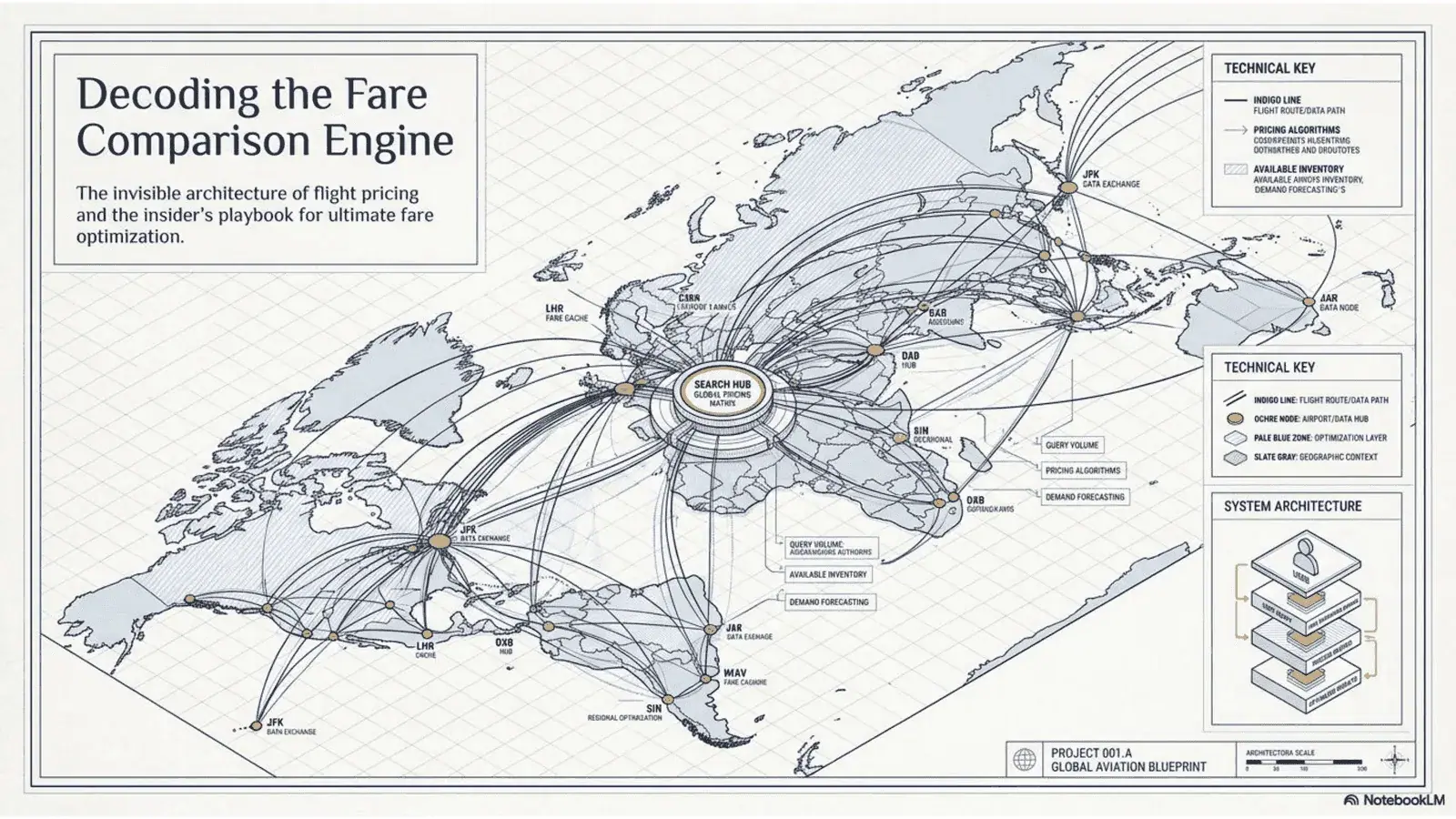
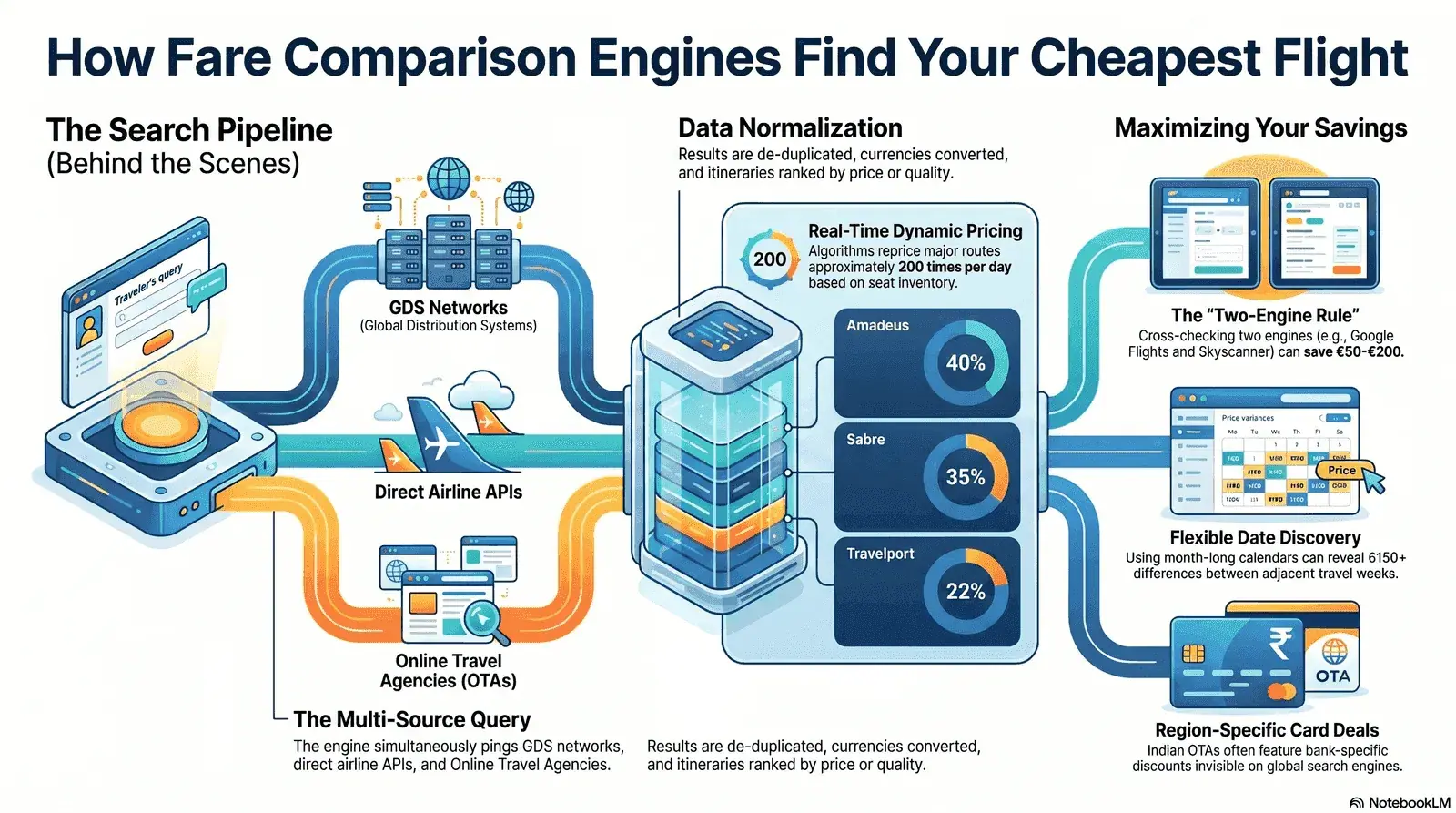
- A fare comparison engine queries airlines, OTAs, and GDS systems simultaneously. You see all available prices in one view instead of opening five browser tabs — the guide explains which platforms cover which carriers.
- Prices differ between sites due to mark-ups, caching, and fare class differences. Not every price gap is a real deal — the guide shows you how to tell which differences are genuine savings versus display artefacts.
- Use a comparison engine to find the fare, then verify total cost on the airline site. Baggage fees and payment surcharges are often not reflected in comparison engine results — always confirm before booking.
🔍 What it is
A metasearch tool that queries airlines, OTAs, and GDS systems simultaneously and shows results in one place.
💸 Cost to you
Free. Comparison engines earn referral fees from airlines and OTAs — never from travellers.
📍 Regional leader (India)
MakeMyTrip dominates with 50%+ market share. ixigo, Cleartrip, EaseMyTrip, and Yatra each hold 7–9%.
🌍 Global leaders
Skyscanner leads on traffic (~40M monthly visits). Google Flights leads on speed and fare accuracy.
What this guide covers
- What is a fare comparison engine? (plain-language definition)
- How a fare comparison engine works — behind the scenes
- Global Distribution Systems (GDS): the invisible backbone
- Dynamic pricing: why fares change constantly
- Benefits for travellers: money, time, and transparency
- Key features to look for in a good fare comparison engine
- Regional differences: India, Europe, North America, Asia-Pacific
- Common misconceptions and limitations
- How to use a fare comparison engine step-by-step
- FAQ
- Conclusion
What Is a Fare Comparison Engine?
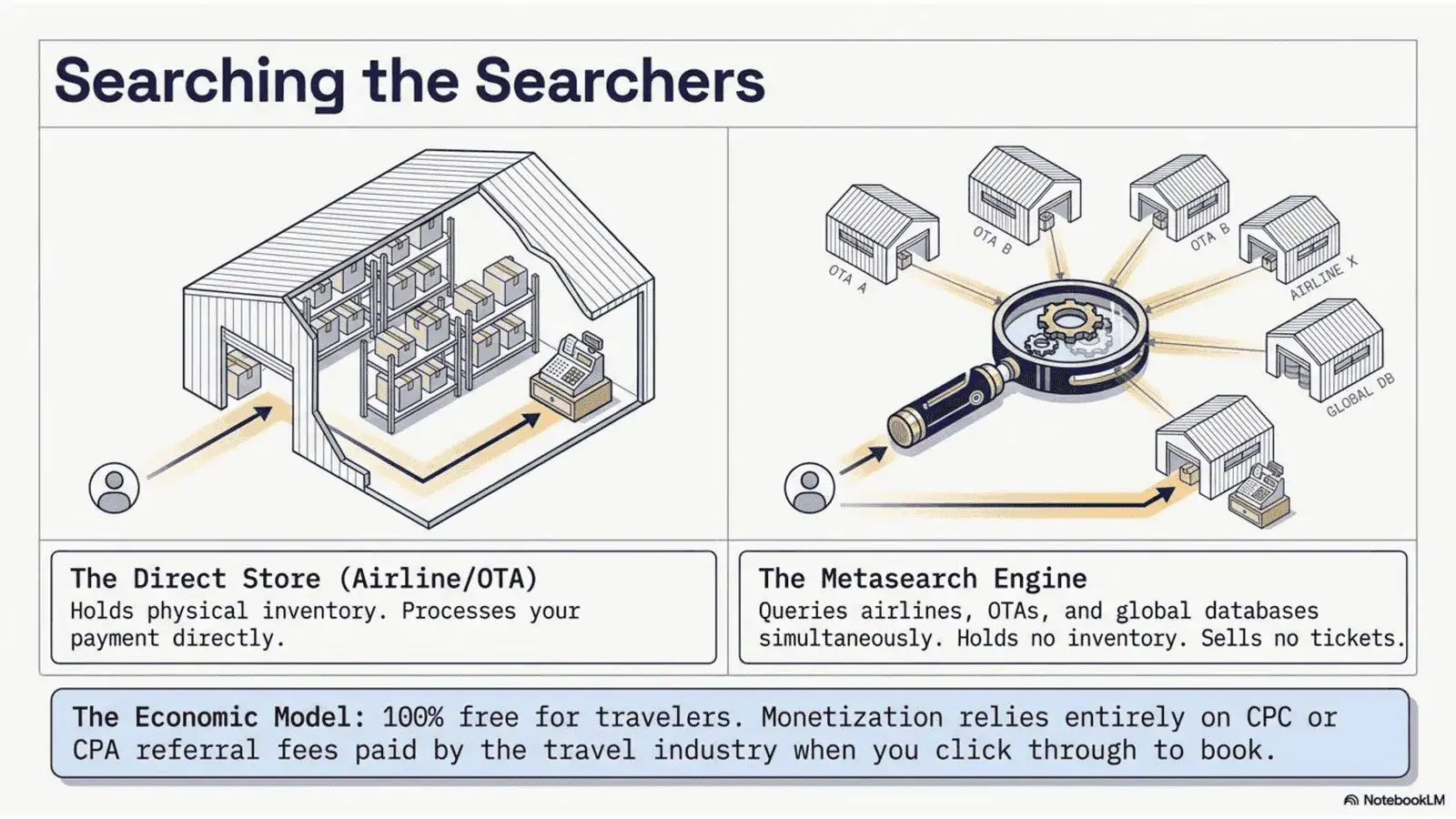
A fare comparison engine — also called a flight comparison website, flight search engine, or metasearch engine — is a technology platform that simultaneously queries dozens of airlines, online travel agencies (OTAs), and travel data systems and presents the results side by side in a single interface. The key word is metasearch: it searches the searchers. Rather than holding flight inventory itself, a fare comparison engine reads from the systems that do hold it, aggregates that data, and lets you compare options in one place.
This is the core distinction that confuses most first-time users. A fare comparison engine does not sell you a ticket. It shows you where the ticket is available and at what price, then directs you to the airline's own website or an OTA to complete the purchase. Think of it as a very fast, very thorough research assistant — one that checks every shelf in the travel shop simultaneously instead of you having to walk down each aisle individually.
"Metasearch" describes any engine that queries multiple external data sources rather than its own database. In travel, the distinction matters because the engine that finds your fare and the platform that processes your payment are usually different entities. Your contract of carriage is always with the airline; your payment is processed by whichever booking site you land on; the comparison engine simply connected the dots.
The outputs of a fare comparison engine typically include the total price for your journey (including taxes), the airline or combination of airlines operating the route, flight duration and number of stops, cabin class, baggage allowance (where the data is available), and a link or button to proceed to booking. Premium engines also show price history, whether the current fare is typical or unusually high or low, and predictions about whether fares are likely to rise or fall before your travel date.
How a Fare Comparison Engine Works — Behind the Scenes
When you type a route and date into a fare comparison engine and press search, a complex sequence of events happens in a matter of seconds. Understanding the pipeline explains why prices can differ between engines, why a fare quoted on a comparison site sometimes does not match what you find on the airline's checkout page, and why certain airlines may not appear in results at all.
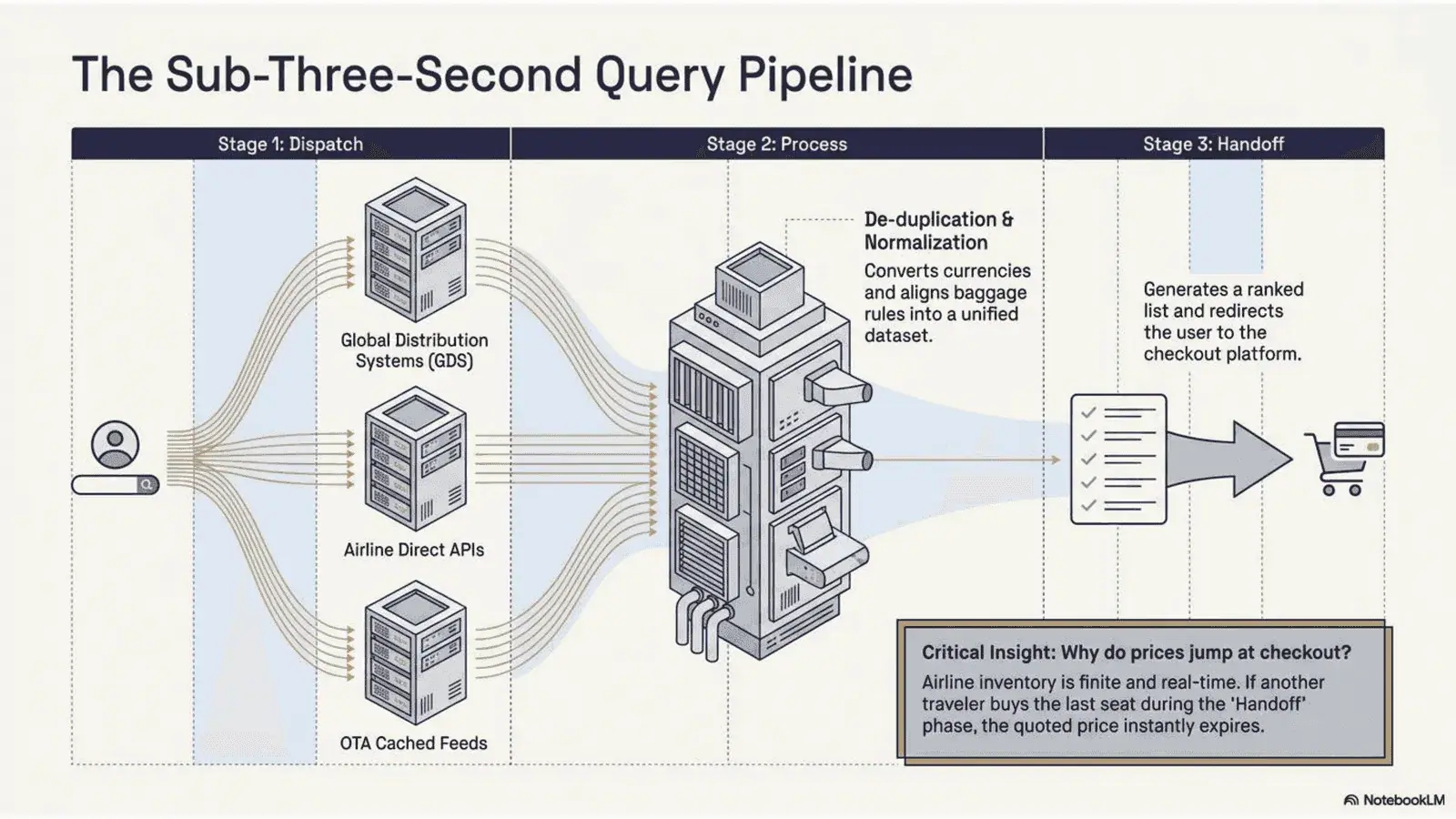
Step 1: The search query is dispatched to multiple data sources
The comparison engine sends your search parameters — origin, destination, date, number of passengers, cabin class — to several data sources simultaneously:
- Global Distribution Systems (GDS): The major wholesale networks that connect airlines to the travel trade. Amadeus, Sabre, and Travelport collectively process the majority of global flight bookings. The engine queries these systems for fare availability in real time or near-real time.
- Airline direct APIs: Many airlines now provide Application Programming Interfaces (APIs) that allow approved partners to query their reservation systems directly, bypassing the GDS. This is how airlines distribute fares that are exclusive to their own channels, or fares built using the newer IATA NDC (New Distribution Capability) standard.
- OTA feeds: Major OTAs — Expedia, Booking.com, MakeMyTrip, Cleartrip — maintain their own aggregated inventories, often pre-loaded with fare combinations that require complex multi-leg routing logic. The comparison engine queries these databases too.
- Cached fare databases: For performance reasons, some engines store a snapshot of fares from the last search cycle (ranging from minutes to hours). Results flagged as "cached" may not reflect the absolute current price.
Step 2: Results are filtered, ranked, and de-duplicated
The raw data returned from all sources contains duplicates, different pricing formats, and varying levels of completeness. The engine's processing layer cleans and normalises this data: converting all currencies, aligning fare rules and baggage descriptions, removing duplicate itineraries from multiple sources, and applying the user's filters (number of stops, departure time window, preferred airlines). The result is a ranked list of itineraries, typically sorted by price or by a combination of price, duration, and quality score.
Step 3: The user clicks through to book
When you select a fare, the engine generates a redirect link that carries your search parameters to the airline's website or the OTA that holds the booking capability for that fare. This handoff is where the comparison engine earns its revenue: a cost-per-click (CPC) or cost-per-acquisition (CPA) fee paid by the airline or OTA for the referral. You pay nothing to the comparison engine. Your contract of carriage, payment processing, and customer service all happen on the destination site.
Airline fares exist in real-time inventory systems with a finite number of seats at each price point. If another traveller purchases the last seat at the displayed fare in the time between your search and your click-through, the next available fare will be higher. This is not a comparison engine error — it is a feature of how airline seat inventory works. Always proceed to checkout promptly once you have identified your target fare.
Global Distribution Systems (GDS): The Invisible Backbone
To understand why fare comparison engines can access so many airlines at once, you need to understand the Global Distribution System — the infrastructure layer that the entire commercial aviation industry has been built on since the 1960s.
A Global Distribution System (GDS) is a computerised network that acts as the central marketplace between airlines (who upload their available seats and prices) and travel sellers (airlines' direct websites, OTAs, travel agents, and comparison engines that query those prices). When an airline updates a fare, that update propagates through the GDS to every connected travel agent and booking system in the world within minutes.
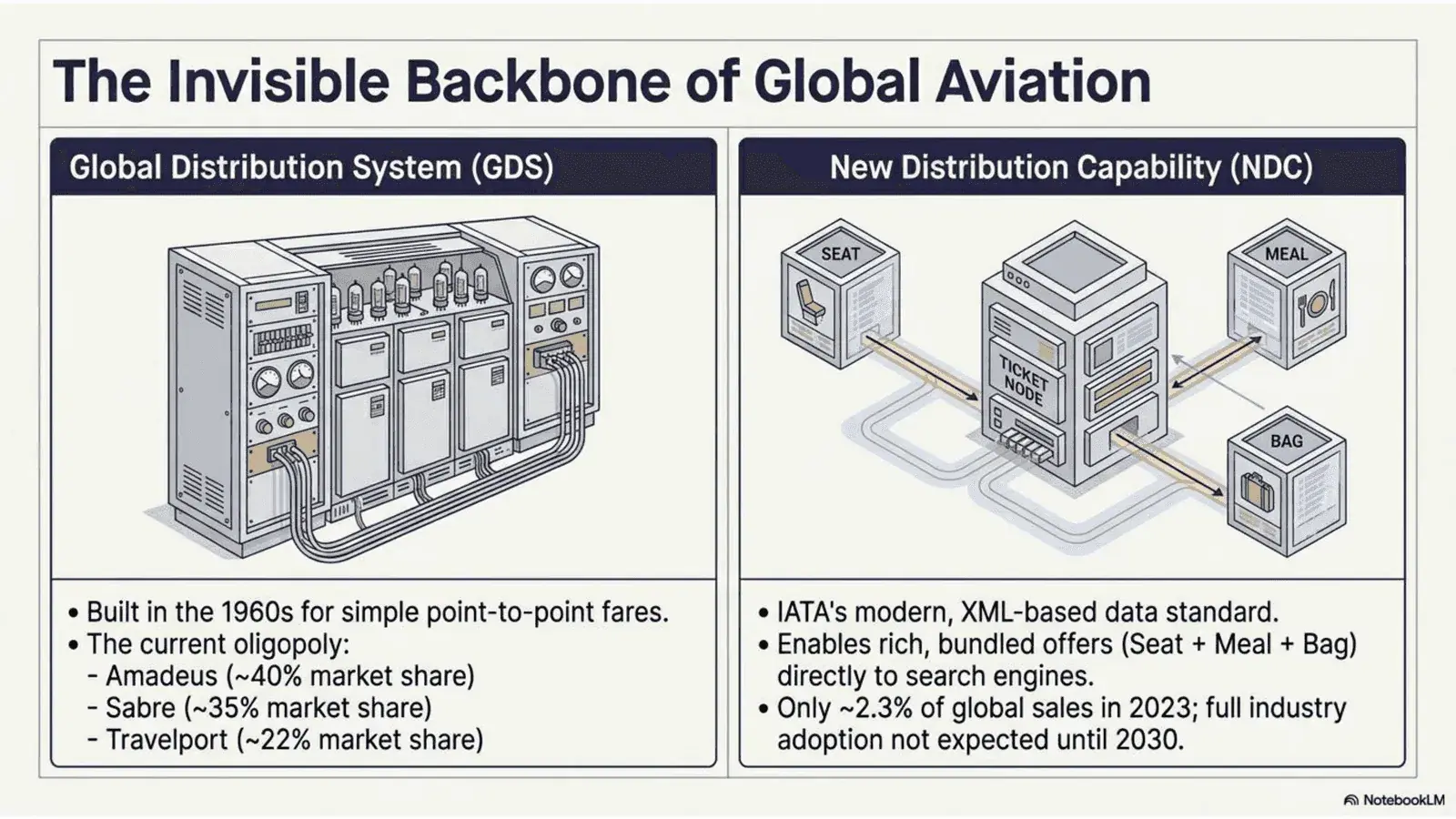
Amadeus, Sabre, and Travelport collectively control the vast majority of global flight distribution. According to multiple industry sources, Amadeus holds approximately 40% of the global GDS market, Sabre approximately 35%, and Travelport approximately 22%. The GDS market was valued at approximately US$6.78 billion in 2024 and is projected to exceed US$16 billion by 2032 as post-pandemic travel volumes recover and new distribution technology adoption accelerates.
| GDS | Global Market Share | Geographic Strength | Connected Airlines | Key Fact |
|---|---|---|---|---|
| Amadeus | ~40% | Europe, Asia-Pacific | 480+ | Founded 1987 by Air France, Lufthansa, SAS, Iberia; 90,000+ travel agencies worldwide |
| Sabre | ~35% | North America, Asia (via Abacus) | 400+ | Originally developed by American Airlines in the 1960s; largest in US corporate travel |
| Travelport | ~22% | UK, Europe, Australia | 350+ | Incorporates Apollo, Galileo, and Worldspan; connects 68,000 agencies in 180 countries |
What about NDC? The new distribution standard changing everything
The GDS model has a significant limitation: it was designed in an era of simple point-to-point fares and cannot easily carry the rich product information (seat selection, lounge access, meal upgrades, baggage tiers) that modern airlines want to sell alongside their tickets.
In 2012, the International Air Transport Association (IATA) launched NDC — New Distribution Capability, an XML-based data standard that allows airlines to create and distribute richer, more personalised offers through all distribution channels, including third-party comparison engines, without the information limitations of the legacy GDS. Under NDC, an airline can show a comparison engine not just a price but a full bundled offer — including the specific seat, meal, and baggage policy — and update it dynamically based on the individual traveller's loyalty status or browsing history.
According to IATA's 2025 Annual Review, even leading airlines remain in the early stages of their NDC journey, and full industry-wide adoption is not expected before 2030. NDC bookings reached approximately 34 million globally in 2023 — roughly 2.3% of total global air ticket sales. The transition is underway but gradual: some airlines like British Airways, Air Canada, and Lufthansa have made substantial progress, while many others will not begin their full transition until 2028–2029. For now, GDS remains the dominant channel for most comparison engine data.
Low-cost carriers and why they are different
Most low-cost carriers (LCCs) — Ryanair, easyJet, IndiGo, AirAsia — were not originally designed to distribute through GDS networks, which historically charged per-booking fees that eroded LCC margins. Many LCCs built their own reservation systems (Navitaire is popular) and distributed exclusively through their own websites. Comparison engines that want LCC content must build direct API integrations with each carrier or use specialist aggregators like Kiwi.com, which has built its own self-transfer connection logic for routes that no single carrier operates end-to-end.
Dynamic Pricing: Why Fares Change Constantly
One of the most common frustrations with flight searching is watching a fare you found disappear or increase by the time you reach the booking page. Understanding airline dynamic pricing explains this behaviour and helps you time your searches better.
Airlines do not have fixed prices for seats the way a supermarket has a fixed price for a tin of beans. Every seat on every flight is divided into a series of fare buckets — coded with letters (Y, B, M, H, Q, K, L, and many others depending on the airline) — each with a different price and a finite number of seats. When the cheapest bucket sells out, the next bucket's price becomes available. When the second-cheapest sells out, the third-cheapest becomes visible, and so on. On a busy route in peak season, an airline's revenue management algorithm may reprice fares literally hundreds of times per day in response to booking pace, competitor activity, and remaining inventory.
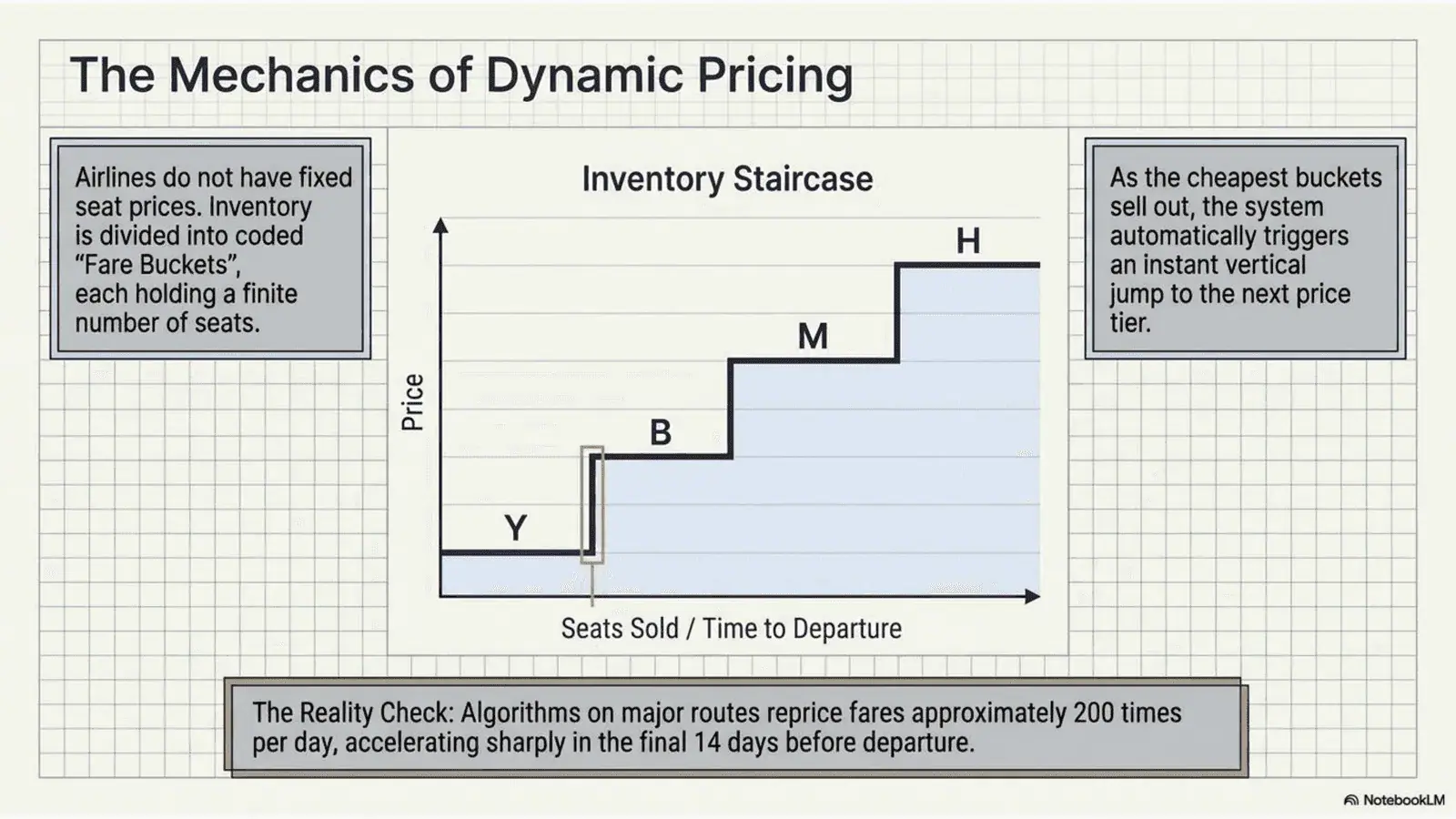
Research published by travel analytics platforms in 2026 indicates that algorithms on major international routes reprice fares approximately 200 times per day on average, with the pace of repricing accelerating significantly in the final 14 days before departure. Fares on the most competitive routes — such as major hub-to-hub transatlantic or India–Gulf City pairs — can change within minutes of a large booking event, such as a corporate travel manager placing a bulk order.
What this means practically for comparison engine users: the price you see on a search result is accurate at the moment the engine retrieved that data, but may not be accurate by the time you complete checkout. This is not dishonesty — it is the inherent nature of real-time inventory. The best comparison engines flag fares as "live" or "cached" to help you understand how fresh the data is, and many now offer a price-lock feature that freezes a fare for a few hours while you decide.
Benefits for Travellers: Money, Time, and Transparency
Saving money
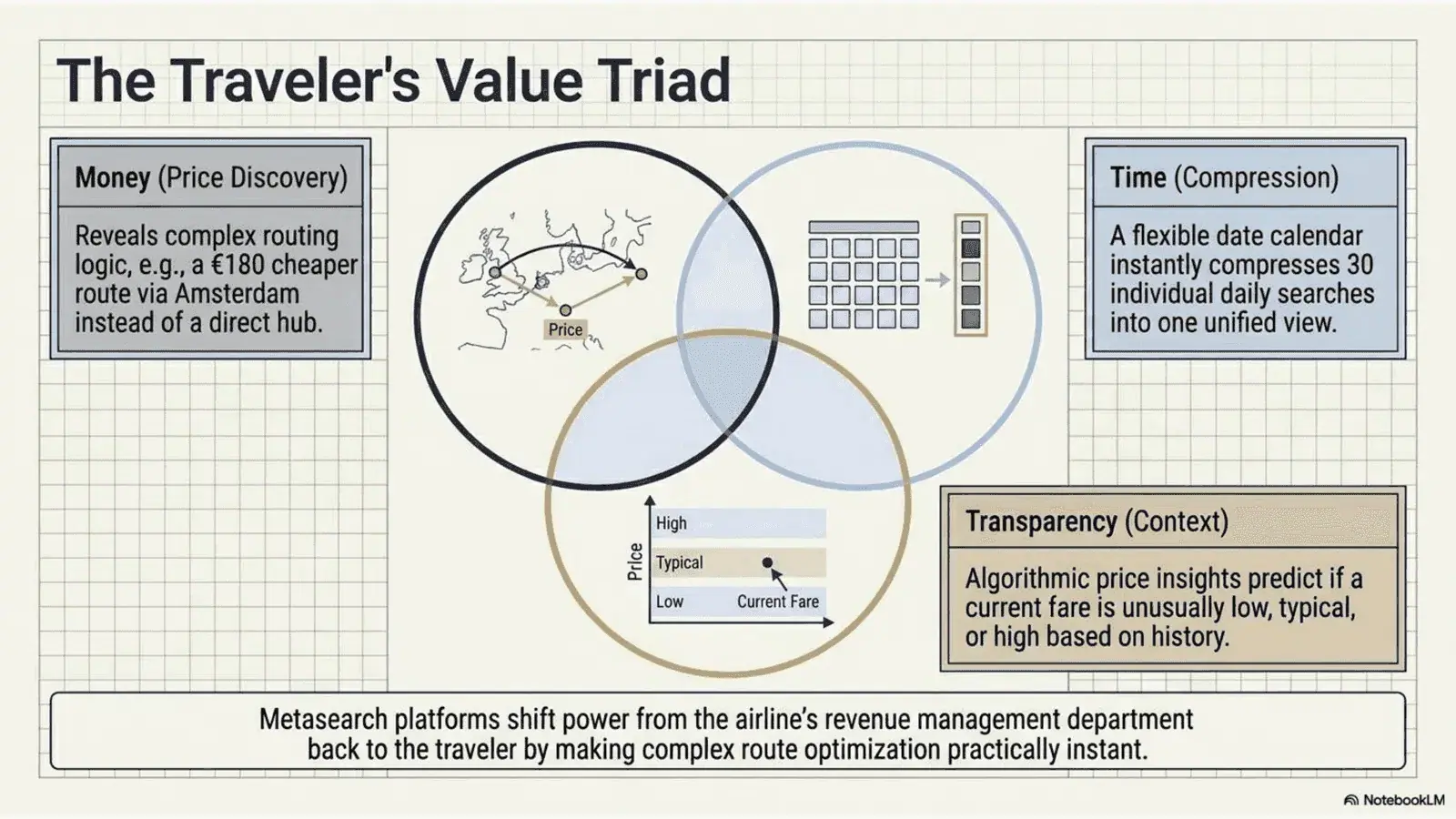
The headline benefit is price discovery. A traveller searching manually across ten airline websites and five OTAs for a Dublin–Delhi route might spend 30–45 minutes and still miss options. A fare comparison engine performs this same search in under 3 seconds. Crucially, it surfaces route combinations and airlines you might not have considered: a flight via Amsterdam that costs €180 less than the direct-hub option, or a Tuesday departure that is €95 cheaper than the Friday you originally planned.
Saving time
Time saving compounds with trip frequency. For travellers who fly four or more times per year — Indian diaspora families visiting home, business travellers, students studying abroad — the hours saved per search, multiplied across a year, become substantial. Fare comparison engines with flexible date calendars show you the cheapest day within a month-long window at a glance, compressing what would otherwise be dozens of individual date searches into a single view.
Transparency and informed decision-making
A good fare comparison engine shows you not just the price but the context: is this fare low, typical, or high compared to historical data for this route? Google Flights pioneered "price insights" that explicitly label fares as "low", "typical", or "high" based on historical data. Skyscanner's price calendar shows the cheapest available day across an entire month. These transparency features shift power from the airline's revenue management department to the traveller.
Route optimisation
Comparison engines make it practical to search and compare alternative routing strategies that most travellers would never explore manually. Flying into a different arrival airport in the same city, combining two low-cost carriers on a self-transfer itinerary, or booking a one-way outbound and one-way return on different airlines — all of these strategies can produce significant savings on the right routes, and a comparison engine makes them visible.
Key Features to Look For in a Good Fare Comparison Engine
Not all comparison engines are equal. Here are the features that differentiate genuinely useful tools from basic search boxes:
Flexible date search
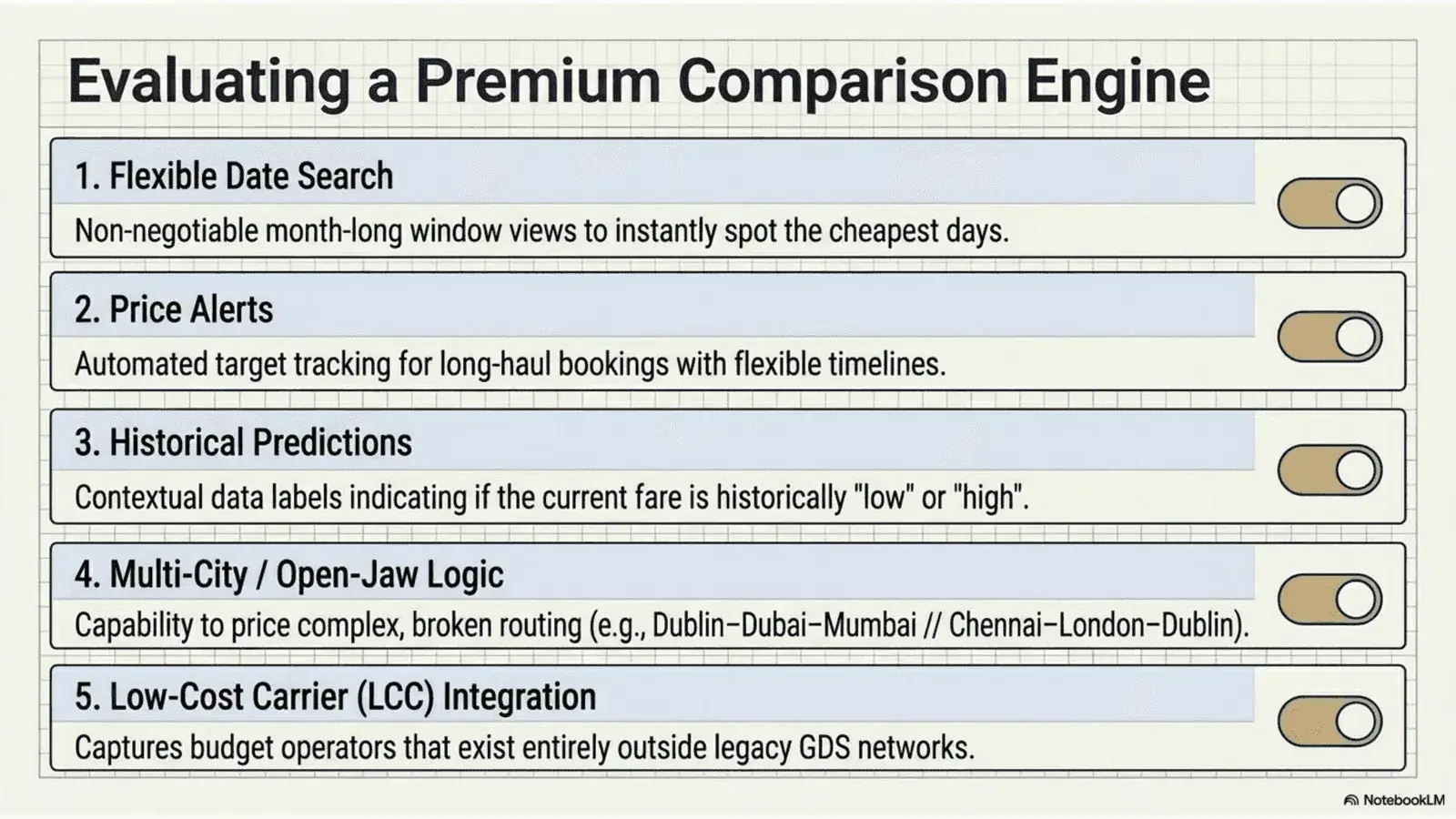
The single most valuable feature for budget-conscious travellers. A flexible date calendar shows you every fare in a month-long window simultaneously, so you can see at a glance that flying on Tuesday saves €120 compared with Saturday. Engines that only show point-in-time results for the exact date you enter are materially less useful for fare optimisation.
Price alerts
If you are not ready to book immediately, a price alert lets you register your route and preferred date and receive a notification when the fare reaches your target. This is particularly valuable for long-haul bookings where you have several months before departure and want to buy at the optimal moment without checking manually every day.
Price history and predictions
Some engines (Google Flights, Hopper) show historical price data and algorithmic predictions about whether fares are likely to rise or fall. These predictions are probabilistic, not guaranteed, but they give useful context. Google Flights' Price Guarantee — which moved out of pilot phase in late 2025 and is now available in select markets — automatically refunds the difference (up to $500 per year) if a fare drops after you book through Google.
Multi-city and open-jaw search
A multi-city builder lets you book a complex itinerary — for example, Dublin–Dubai–Mumbai, then Chennai–London–Dublin — as a single search, comparing the total price against booking separate one-way tickets. An open-jaw search (flying into one city and out of another) is standard on most quality engines and often produces significantly cheaper results than a round-trip to a single airport.
Comprehensive filters
High-quality filters let you narrow results by number of stops, departure and arrival time windows, specific airlines, layover duration, and in some engines, by baggage inclusion or cancellation policy. The ability to filter for "refundable fares only" or "fares that include one checked bag" is increasingly important now that airlines have unbundled these features from their base fares.
Coverage of budget and low-cost carriers
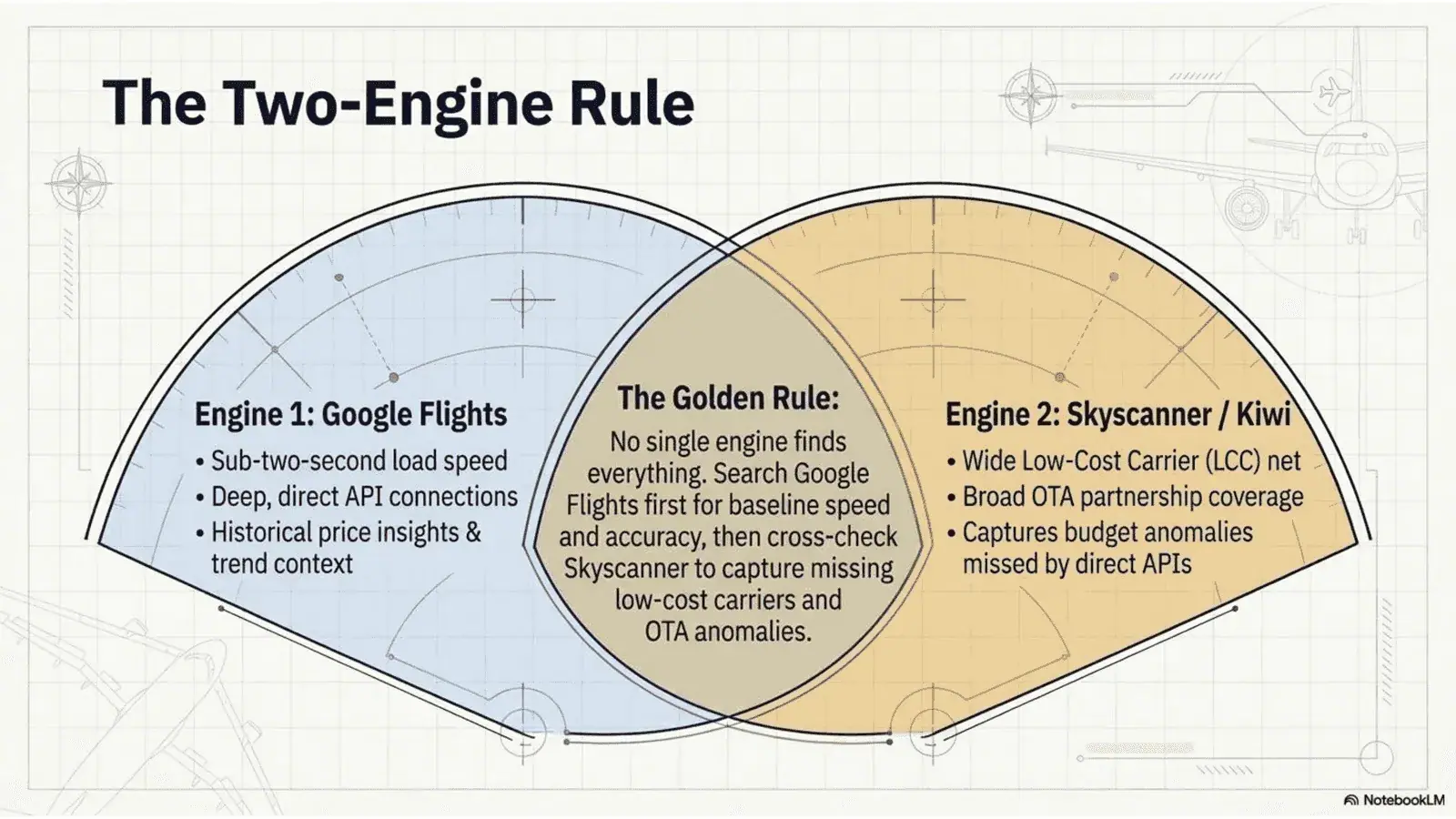
Engines that include LCC content alongside full-service carriers give a genuinely complete market picture. Skyscanner and Kiwi.com have historically been stronger than Google Flights at including smaller regional and budget carriers. Check which airlines are listed in the results for your specific route — if you know a budget carrier operates it and it is not appearing, search that carrier's website directly.
Regional Differences: The Landscape Varies Significantly by Country
Fare comparison technology is global, but its application varies considerably by region. The dominant platforms, the airlines that appear in results, the payment methods available, and even the regulatory context differ between markets. If you are booking flights in or from India, your comparison landscape looks very different from a traveller in the United States or Germany.
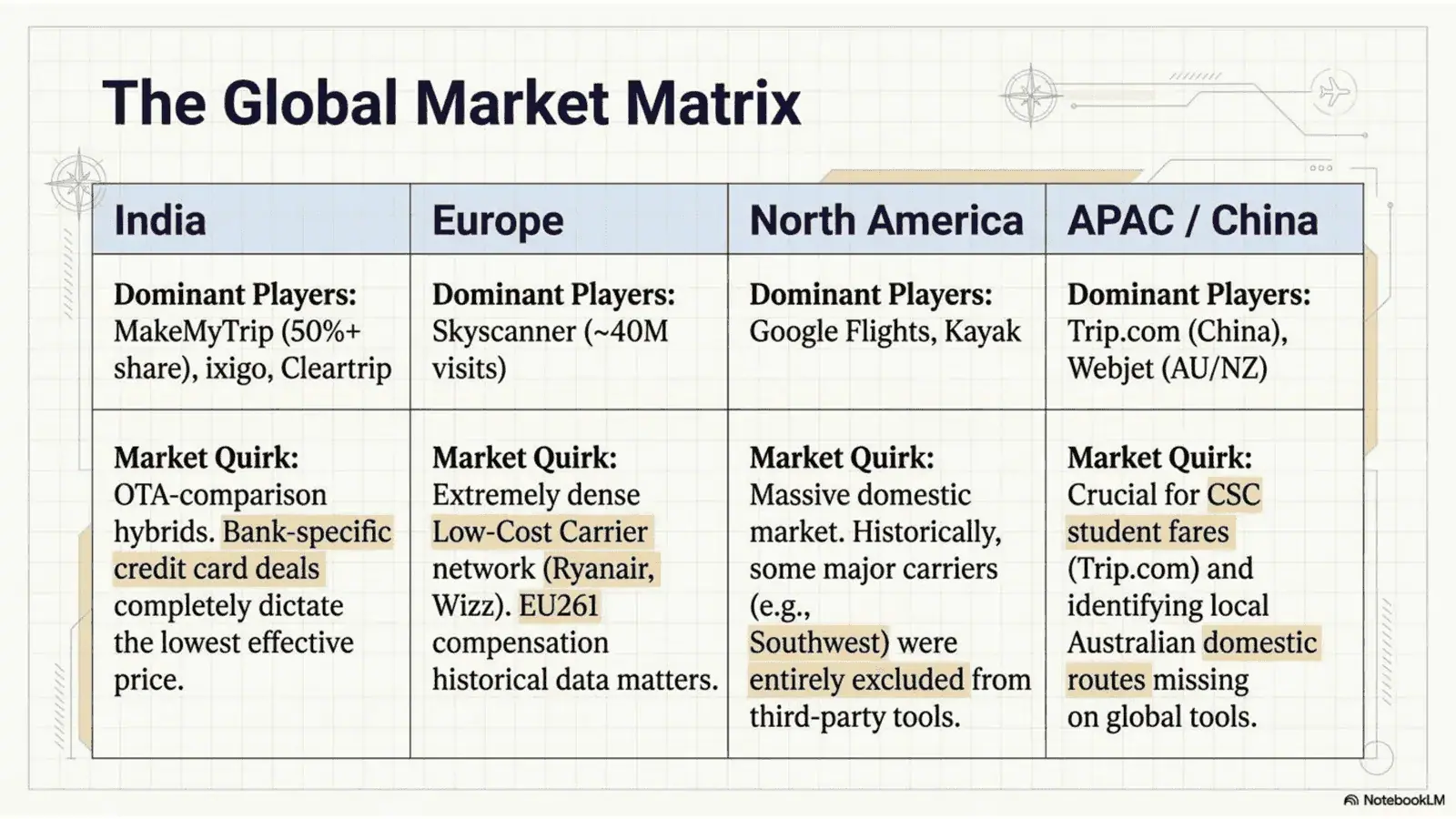
India: a hybrid OTA-comparison market
India's online travel market reached approximately US$23.34 billion in 2025 and is projected to grow to US$25.38 billion in 2026, according to Mordor Intelligence. The distinctive characteristic of India's market is that the dominant platforms function as both comparison engines and OTAs — they show you fares from multiple airlines and also complete the booking themselves, rather than redirecting you to the airline's site.
MakeMyTrip India leader
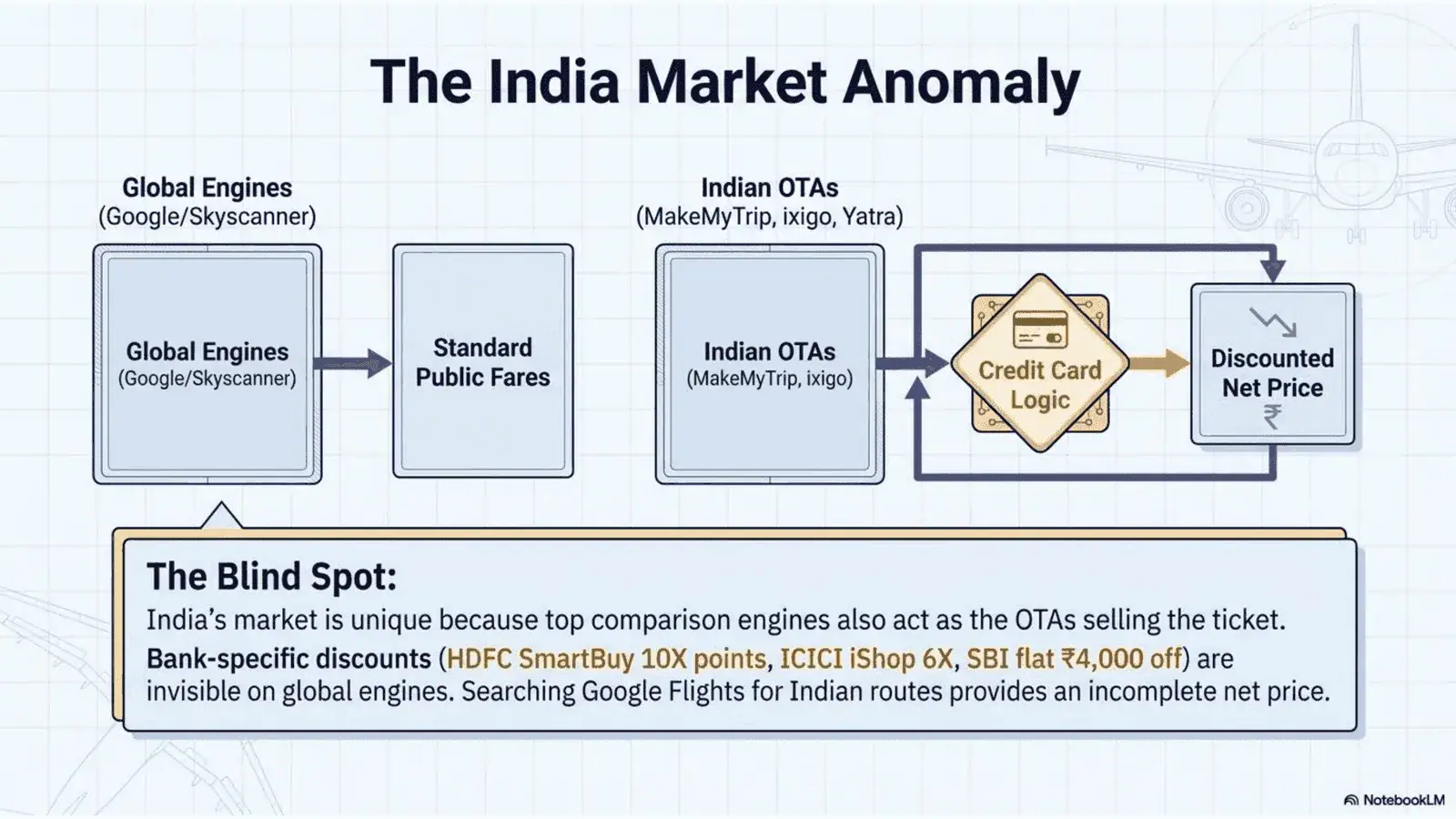
India's largest OTA with over 50% market share and gross bookings approaching US$10 billion in FY2025. Operates Goibibo and redBus alongside the core brand. Covers domestic and international flights, hotels, trains, and buses. Offers bank-specific credit card deals that are often the cheapest available fares on specific routes. HDFC SmartBuy and ICICI iShop accelerated earning is available on MakeMyTrip bookings — making it integral to Indian credit card reward strategies as well as flight comparison.
ixigo India #2
India's second-largest OTA by market share (7–9%), with particular strength in train bookings (via ConfirmTkt and AbhiBus acquisitions) and the mass market outside major metros. Reported 500 million+ annual active users in FY2025 and revenue of ₹914 crore. ixigo's AI-powered price prediction alerts are a standout feature for domestic flight searches.
Cleartrip, EaseMyTrip, Yatra India tier 2
Each holds approximately 7–9% of India's online travel market. Cleartrip (owned by Flipkart) is focused on the mid-market. EaseMyTrip competes strongly on hotel + flight bundle offers. Yatra is the only one with a co-branded SBI credit card that offers a flat ₹4,000 discount on international flight bookings. All three function as OTAs that also serve as comparison platforms within their own network.
Skyscanner & Google Flights Global
Both operate in India but have smaller market share than the domestic OTAs. Skyscanner launched a Hindi-language version in August 2023 to deepen penetration. Google Flights' strength in India is primarily for international route research, where its speed advantage and broad airline coverage are most useful. For domestic Indian flights, the bank-linked deals available through MakeMyTrip and ixigo can produce prices that Google Flights does not show.
Unlike Western markets where fare comparison engines typically show the same price regardless of payment method, Indian OTA fares frequently include bank-specific discounts that only apply when paying with a particular credit card. HDFC Bank SmartBuy offers 10X reward points on MakeMyTrip. ICICI iShop offers up to 6X on flight bookings. SBI card offers on Cleartrip and Yatra. These deals are never visible on Google Flights or Skyscanner and require checking the OTA directly with your specific card to see the full net price.
Europe: Skyscanner leads, Google Flights accelerates
Europe is Skyscanner's home market — the company was founded in Edinburgh in 2001 — and it remains the most trafficked flight comparison engine on the continent. Skyscanner draws approximately 40 million monthly visits globally, the majority from European markets. Google Flights draws around 8.9 million monthly visits but its growth rate has accelerated sharply since the introduction of its Price Guarantee feature.
Two factors unique to Europe affect how comparison results look. First, EU Regulation 261/2004 mandates compensation for delayed and cancelled flights — European comparison engines increasingly surface information about which flights have historically been delayed, adding a reliability dimension to price comparison. Second, Europe has by far the densest network of low-cost carriers (Ryanair, easyJet, Wizz Air, Vueling, Transavia), and an engine's LCC coverage quality materially affects how useful it is for intra-European travel.
EU261 Compensation & Extraordinary Circumstances Exclusions
When a flight is delayed or cancelled, travelers often seek cash compensation under the EU261 framework. However, a common source of confusion is the distinction between internal airline operational failures and external factors. Cash compensation (ranging from €250 to €600) is only legally mandated if the disruption is within the airline's control—such as mechanical failures, aircraft maintenance issues, or crew scheduling shortages.
Under European case law, disruptions caused by "extraordinary circumstances" are legally exempt from cash payouts. These include general national air traffic control (ATC) strikes, severe weather, and airport closures. While the airline's "duty of care" (providing food, drinks, and hotel stays) remains active during these events, cash compensation is not required. For official guidance and lists of National Enforcement Bodies (NEBs), consult the UK Civil Aviation Authority (CAA) or the relevant EU enforcement body.
North America: Google Flights and Kayak dominate
The US market is the world's largest domestic aviation market, and comparison engine dynamics reflect its particular characteristics. Google Flights and Kayak lead for most consumer searches. Priceline (Kayak's parent company) and Expedia remain important OTA-comparison hybrids. The key market quirk historically has been Southwest Airlines — the second-largest US carrier by domestic passenger volume — which did not distribute fares through any third-party comparison engine for most of its history, requiring separate direct checks on southwest.com. This exclusion made any US domestic comparison search inherently incomplete without a direct Southwest search.
US Domestic Travel: The REAL ID Mandate
For travelers using these comparison tools to book domestic flights within the United States, keeping track of federal identification rules is important. The US Department of Homeland Security (DHS) has officially extended the final REAL ID enforcement deadline to May 7, 2027. Standard, non-compliant state driver's licenses remain fully valid at all TSA airport checkpoints throughout 2026, but travelers are recommended to upgrade to a REAL ID-compliant credential during their next renewal cycle.
Asia-Pacific: a fragmented but fast-growing market
Trip.com (Ctrip) China / Asia
The dominant platform for Chinese travellers, processing hundreds of millions of bookings annually. Trip.com operates in over 200 countries and is one of the world's largest online travel companies by gross bookings. Within mainland China, Ctrip is the dominant brand. For Chinese students booking flights to Ireland, Trip.com and its youth-fare offerings are the primary starting point.
Webjet Australia / NZ
Australia's leading local comparison engine and OTA. Strong coverage of Qantas, Jetstar, Virgin Australia, and Rex — the domestic airlines that can be underrepresented on global engines. For travellers within the Australia-New Zealand region, Webjet surfaces domestic options that Skyscanner may miss.
Wego Middle East / Southeast Asia
Strong in Middle Eastern and Southeast Asian markets, with Arabic and regional language support. Particularly useful for routes between India and Gulf city airports, or Southeast Asian itineraries involving multiple budget carriers.
| Region | Leading Platforms | Key Characteristic | Watch For |
|---|---|---|---|
| India | MakeMyTrip, ixigo, Cleartrip, EaseMyTrip, Yatra | OTA-comparison hybrids; bank card deals are critical | Card-specific discounts invisible on global engines |
| Europe | Skyscanner, Google Flights, Kayak, Momondo | Dense LCC network; EU261 compensation data matters | LCC coverage varies — check Ryanair direct too |
| North America | Google Flights, Kayak, Expedia, Priceline | Large domestic market; some major carriers not listed | Always check Southwest directly |
| China / Asia | Trip.com/Ctrip, Skyscanner | Trip.com dominates in China; Skyscanner for outbound | CSC scholarship holders: use Trip.com for student fares |
| Australia / NZ | Webjet, Skyscanner, Google Flights | Strong local carriers often missing from global engines | Check Webjet alongside Skyscanner for domestic AU |
| Middle East / SE Asia | Wego, Almosafer, Skyscanner | Multi-language; many Gulf and LCC carriers | Almosafer for Saudi-origin bookings; Wego for regional |
Common Misconceptions and Limitations
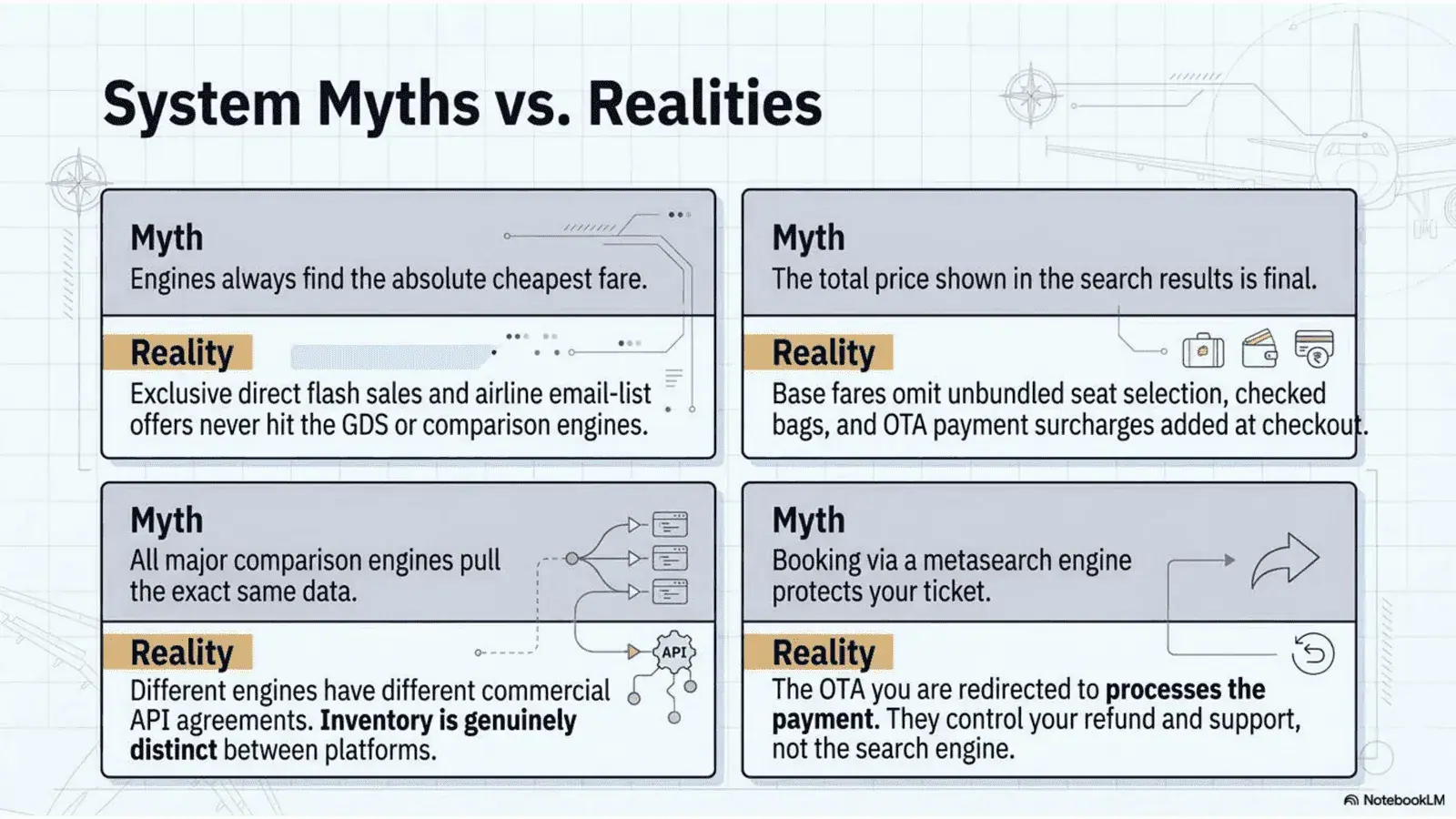
Misconception 1: The comparison engine always shows you the cheapest possible fare
Comparison engines show you the cheapest fare they have access to — which is not necessarily the cheapest fare that exists. Airlines that distribute exclusively through their own websites (or through limited NDC channels) may offer fares that never appear on any comparison engine. Airlines sometimes launch flash sales directly to their email subscriber lists before releasing fares to GDS. And some deep discount fares sold at airline counters or through specific bank tie-ups are simply never published on comparison platforms.
Misconception 2: The total price is the final price
Comparison engines display the base fare and taxes, but many additional costs are added at checkout by the airline or OTA: seat selection fees, checked baggage charges (if not included in the base fare), payment method surcharges (particularly for credit cards on some budget carriers), and booking service fees levied by OTAs. The "total" shown on a comparison engine is often the minimum possible cost of that itinerary, not the cost you will actually pay if you add a normal bag and choose a specific seat. Always review the itemised breakdown at checkout before confirming.
Misconception 3: All fare comparison engines pull from the same data
Different engines have different commercial agreements with different airlines and OTAs. One engine may have a direct API integration with a particular budget carrier; another may not. This means the cheapest fare on Skyscanner for a specific route may genuinely be lower than on Google Flights — not because Google Flights is withholding information, but because they do not have access to that particular inventory source. The practical implication: cross-check on at least two engines for any significant booking.
Misconception 4: Booking through a comparison engine gives you the same protections as booking direct
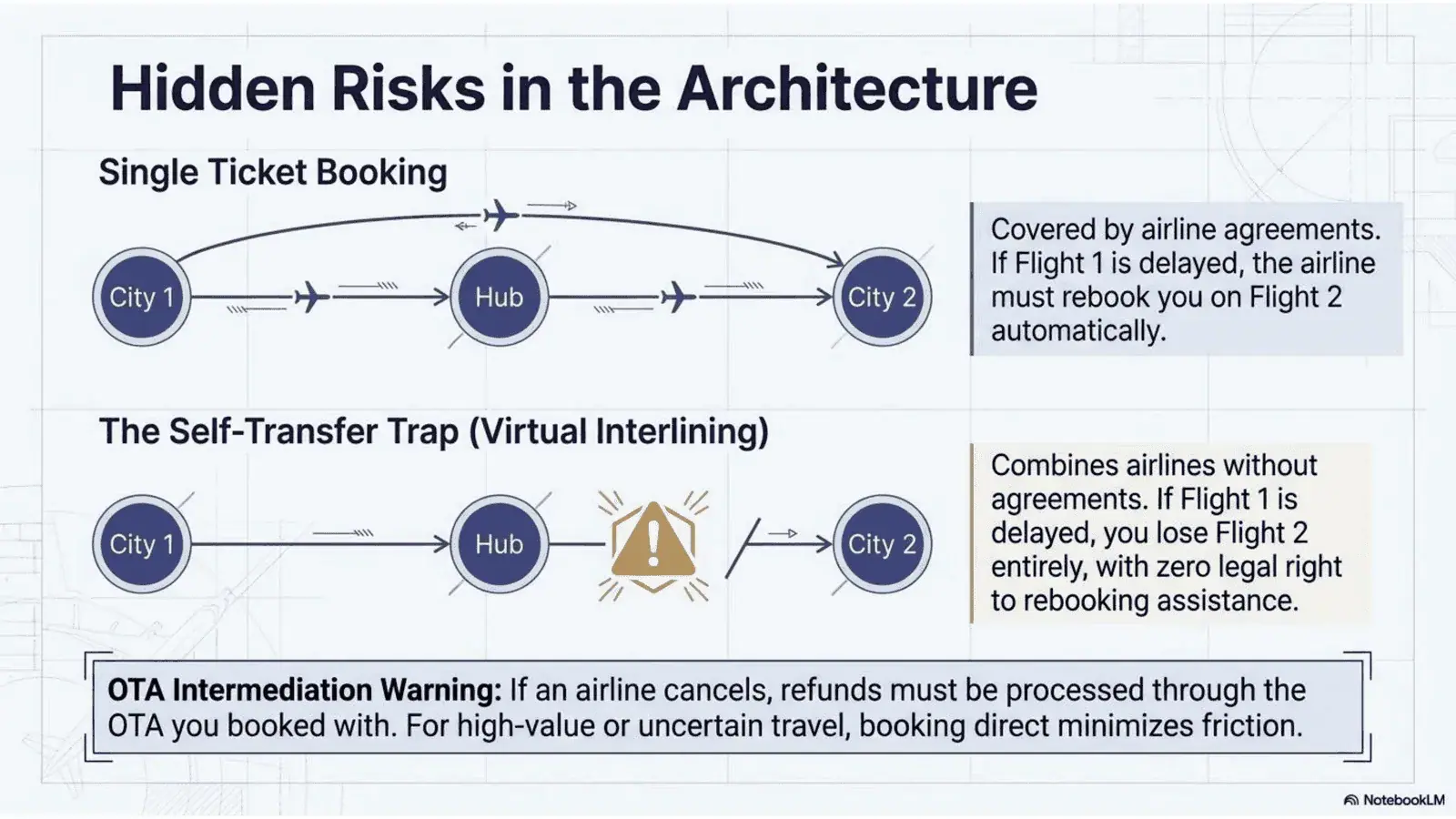
If you book through an OTA reached via a comparison engine, and the airline cancels your flight, your first point of contact for refunds and rebooking is the OTA — not the airline. Some OTAs have made this process smooth; others have a poor track record. For high-value tickets or travel during periods of uncertainty, many experienced travellers prefer to pay the same price directly on the airline's website to avoid OTA intermediation in the event of disruption. The comparison engine helps you find the price; the decision of where to book is yours.
Limitation: self-transfer bookings carry real risk
Some comparison engines — most prominently Kiwi.com — combine flights from different airlines that do not have an interline agreement, creating a "virtual interlining" or "self-transfer" itinerary. These can be significantly cheaper than any single carrier's through-ticket, but they carry important risks: if the first flight is delayed and you miss the second (which is a completely separate booking), you have no legal right to rebooking assistance and no automatic protection under consumer regulations. Always read whether an itinerary is a single-ticket booking or a self-transfer before purchasing.
How to Use a Fare Comparison Engine: Step-by-Step
Here is a practical workflow that consistently produces better results than opening a single comparison engine and booking the first fare you see.
- Start with flexible dates if possible. Before entering any specific date, use the engine's calendar or flexible month view to identify the cheapest travel window. On a route like Dublin to Delhi, this step alone can reveal a €150–€300 difference between adjacent weeks.
- Set Google Flights as your first search. Its speed and direct airline API connections mean results load in under 2 seconds and are as close to real-time as any engine. Note the fare, airline, and routing that produces the cheapest result.
- Cross-check on Skyscanner. Repeat the same search. Skyscanner's broader coverage of OTAs and budget carriers sometimes surfaces an alternative — a different airline combination, or the same fare bookable via a cheaper OTA source — that Google Flights did not show.
- For India-specific routes, add MakeMyTrip or ixigo. Indian OTAs aggregate bank-specific credit card deals that no global engine displays. If you hold an HDFC, SBI, ICICI, Axis, or Kotak card with travel rewards, this step can reveal a net price after discount that is materially lower than anything on Google Flights or Skyscanner.
- Check the airline direct before booking. Once you have identified your best fare, visit the airline's own website and search the same route. Some airlines publish "web exclusive" fares not distributed through any third party. The direct site also gives you cleaner access to customer service and loyalty credit.
- Read the fare conditions before clicking "Book". Check: Is baggage included? Is the fare refundable or changeable? Are there payment surcharges? What is the check-in baggage allowance? Most comparison engines display a summary, but always verify the full fare rules on the booking page.
- Complete checkout promptly. Once you are on the airline or OTA booking page, do not leave the tab idle for more than 10–15 minutes. Fare inventory is real-time. The seat at the displayed price is only held temporarily while you are in the checkout session.
- Save confirmation documents immediately. Screenshot or save your booking confirmation, price breakdown, and baggage policy. In the event of a disruption, having your full fare conditions documentation speeds up any dispute resolution with the airline or OTA.
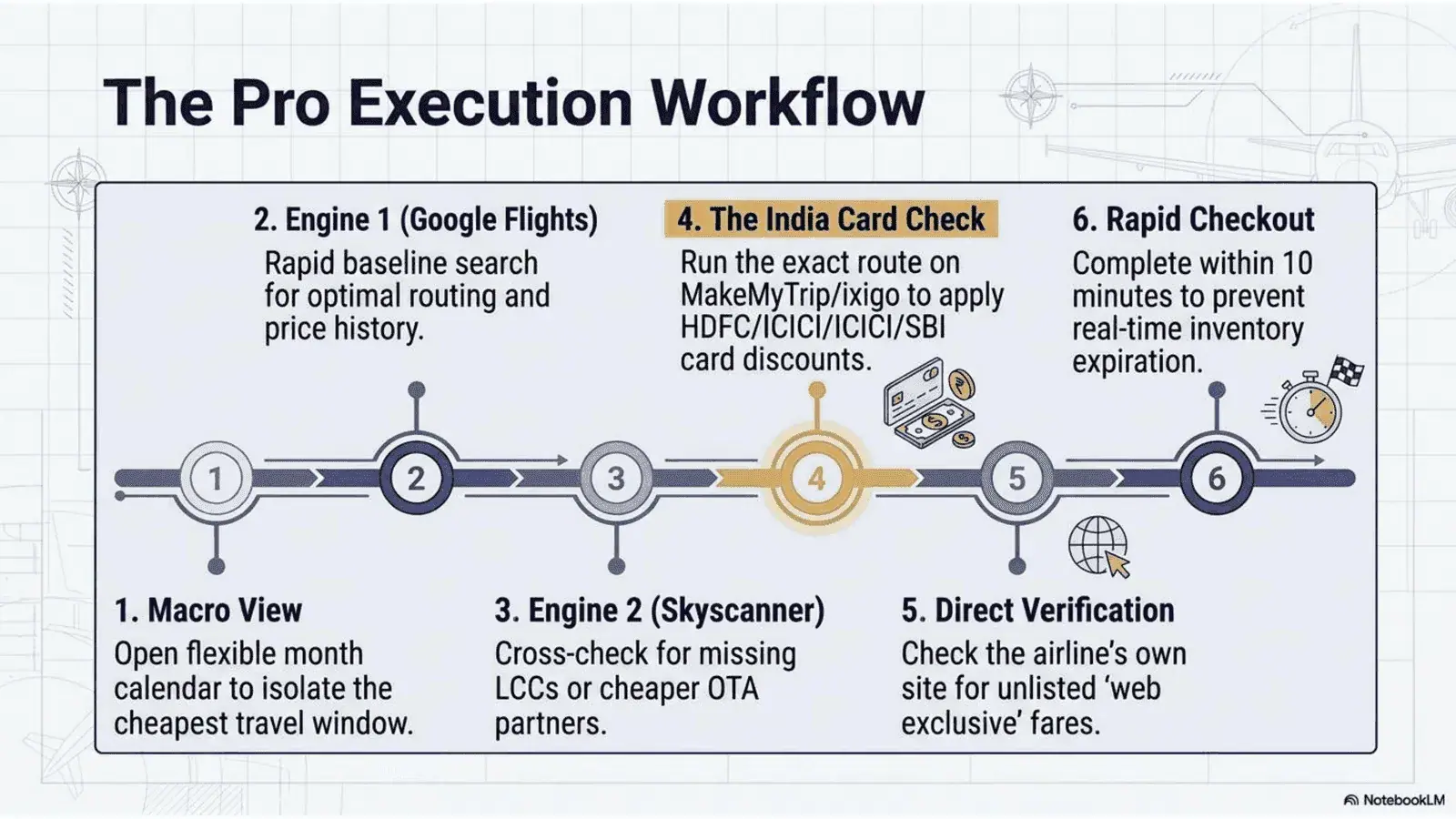
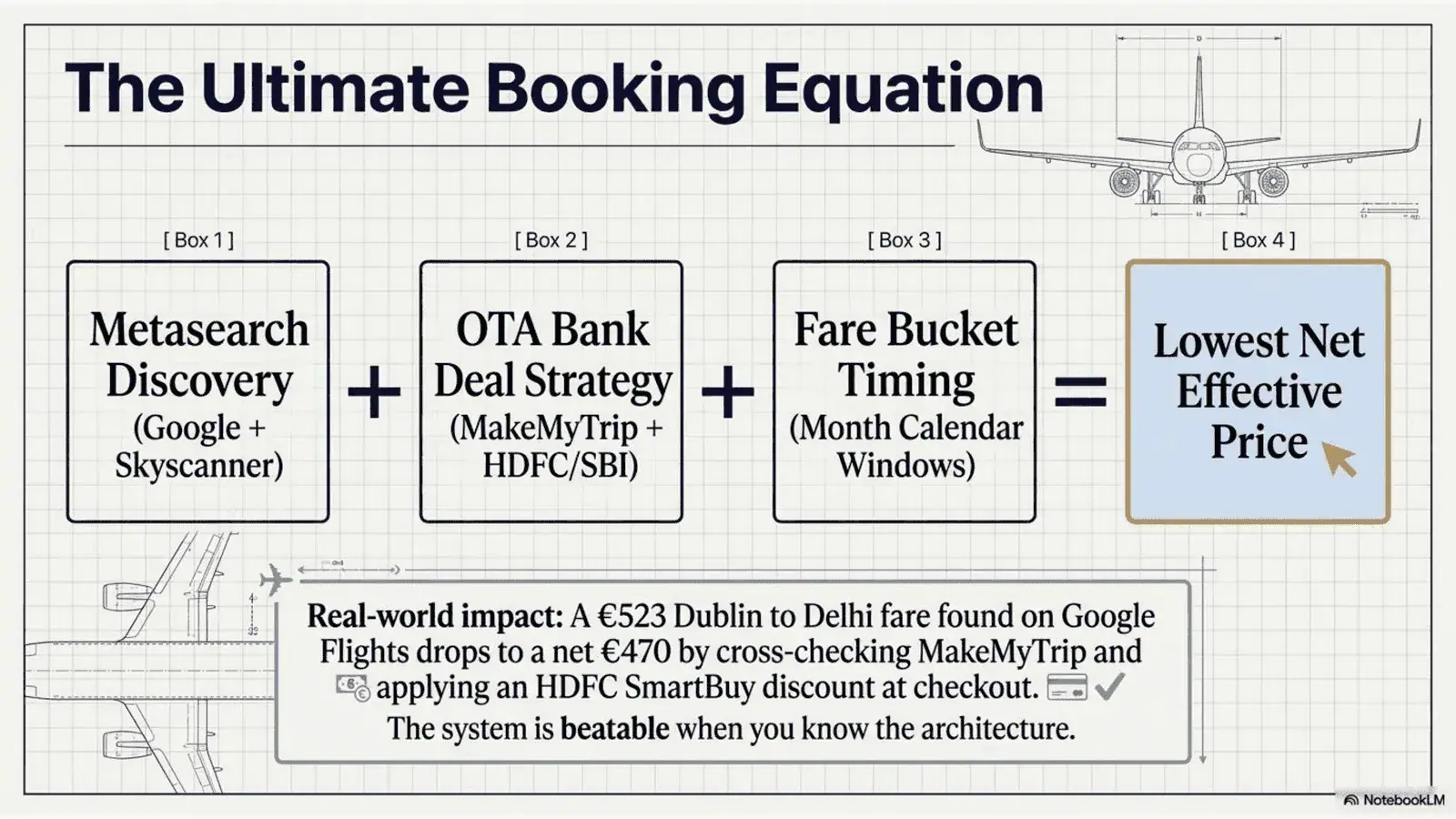
Search on Google Flights: Cheapest round-trip found is €523 via Doha on Qatar Airways, departing Tuesday. Cross-check on Skyscanner: Same route on the same dates shows €507 via one OTA partner. Check MakeMyTrip with HDFC Infinia card: the ₹5,000 SmartBuy discount (applied at checkout) is not visible on Google Flights or Skyscanner. For an Indian cardholder, the MakeMyTrip price with card benefit applied is the effective cheapest — a detail only visible by searching the Indian OTA with your specific card.
Frequently Asked Questions
What is the difference between a fare comparison engine and an OTA?
A fare comparison engine (metasearch engine) aggregates prices from many sources and redirects you elsewhere to book. An OTA (Online Travel Agency) like Expedia, MakeMyTrip, or Booking.com actually sells the ticket and processes your payment. Some platforms blend both functions — MakeMyTrip, ixigo, and Kayak all compare fares and also sell tickets directly — which is why the distinction can be blurry in practice. The key test: who processes your payment and issues your booking reference?
Is a fare comparison engine free to use?
Yes, entirely free for travellers. Comparison engines earn revenue through cost-per-click (CPC) or cost-per-acquisition (CPA) referral fees paid by airlines and OTAs when a user clicks through and completes a booking. This commercial model means the engine has an incentive to surface the fares that generate clicks — which aligns well with traveller interests in finding attractive fares.
Why does the price on the comparison engine sometimes differ from the airline website?
Several factors create price differences: the comparison engine's data may be a few minutes old (cached) while the airline's site is fully real-time; the airline may offer exclusive web fares not distributed through GDS; the GDS fare may include booking fees that the airline's direct site does not charge; or seats at the displayed price may have sold out between your comparison search and your click-through. Always verify the final price on the booking page before entering payment details.
Do I book directly through the fare comparison engine?
Usually no. Most engines — Google Flights, Skyscanner, Momondo — redirect you to the airline's website or an OTA to complete the booking. Some engines like Kayak offer an on-platform booking option for select itineraries. Indian OTAs like MakeMyTrip and ixigo complete the booking themselves rather than redirecting. The booking confirmation you receive comes from whoever processed the payment, not the comparison engine.
Are all airlines listed on fare comparison engines?
No. Some airlines have historically excluded their fares from comparison engines to force direct bookings. Coverage also varies by region: an engine strong in Europe may have poor coverage of Gulf and Southeast Asian budget carriers. As a rule, check any budget carrier operating your specific route directly on its own website alongside your comparison engine search.
Is my payment secure when booking through a fare comparison engine?
Fare comparison engines do not process your payment — they redirect you to the airline or OTA where payment happens. Your security depends on the site where you enter your card details. Before paying, confirm you are on the official airline or a recognised OTA site: check for https:// in the address bar, look for a known brand name in the URL, and be cautious of any booking site that asks for payment via bank transfer or gift cards.
Which fare comparison engine is best for Indian travellers booking international flights?
For pure fare research, Google Flights and Skyscanner provide the most complete view of international fares from India. For identifying bank-card specific discounts (which can be the cheapest option for HDFC, ICICI, SBI, Axis, or Kotak cardholders), search MakeMyTrip and ixigo directly with your card to see the net price after applicable offers. The optimal workflow uses Google Flights first for route and date research, then cross-checks MakeMyTrip with your credit card to find the net effective price including all card benefits.
Can I use a fare comparison engine to book with miles or points?
Most fare comparison engines do not integrate with loyalty programme award availability. Google Flights is an exception for select programmes in some markets. For award ticket searches, you need to go directly to the airline's loyalty programme website, or use specialist award search tools like AwardHacker or Seats.aero. Comparison engines are best used for finding the cheapest cash fare — and then deciding whether that route is worth paying cash for or redeeming miles on based on the value comparison.
Why are prices on fare comparison engines sometimes different from the airline's own website?
Several factors create price differences: (1) Fare comparison engines cache search results for speed, so the displayed price may be a few minutes old. (2) The airline's direct site may offer exclusive web fares not distributed through third parties. (3) Some airlines add surcharges for GDS-distributed bookings. (4) Dynamic pricing means fares can change many times per day - sometimes hundreds of times. Always check the airline's direct site for the final bookable price.
Which fare comparison engine is most popular in India?
India's online travel market is dominated by OTAs that also serve as comparison platforms. MakeMyTrip is the clear market leader with over 50% market share. Ixigo, Cleartrip, EaseMyTrip, and Yatra each hold approximately 7-9% of the market. Global engines like Google Flights and Skyscanner (which launched a Hindi-language version in 2023) also operate in India but have a smaller share than in Western markets.
Conclusion: The Smartest Travellers Use Comparison Engines Strategically
A fare comparison engine is the most powerful tool available to any traveller searching for a flight — and the most misunderstood. It is not a guarantee of the lowest price, nor a booking platform, nor a substitute for understanding how airline pricing works. Used correctly, it is a research accelerator that compresses hours of manual searching into seconds and surfaces options you would never have found on your own.
The key principles to carry forward: no single engine covers everything, so cross-checking two is always worthwhile; prices are real-time and will change between your search and your checkout; Indian travellers need to check OTA-specific bank card deals that global engines never display; and the total price at checkout always includes charges the comparison engine did not show you upfront. Understanding these dynamics turns a comparison engine from a blunt instrument into a precision tool.
MyFlightOffers is built around the same principle that underlies every good comparison engine: transparent access to real fare data, with the context (monthly trends, cheapest travel windows, route comparisons) that lets you make genuinely informed booking decisions rather than guessing. Use the flight search to find your route, the monthly fare calendar to identify the cheapest travel window, and combine with the Indian Payment Guides to apply the right credit card offer at checkout. That combination — comparison plus credit card strategy — consistently delivers the lowest effective price for India-connected routes.
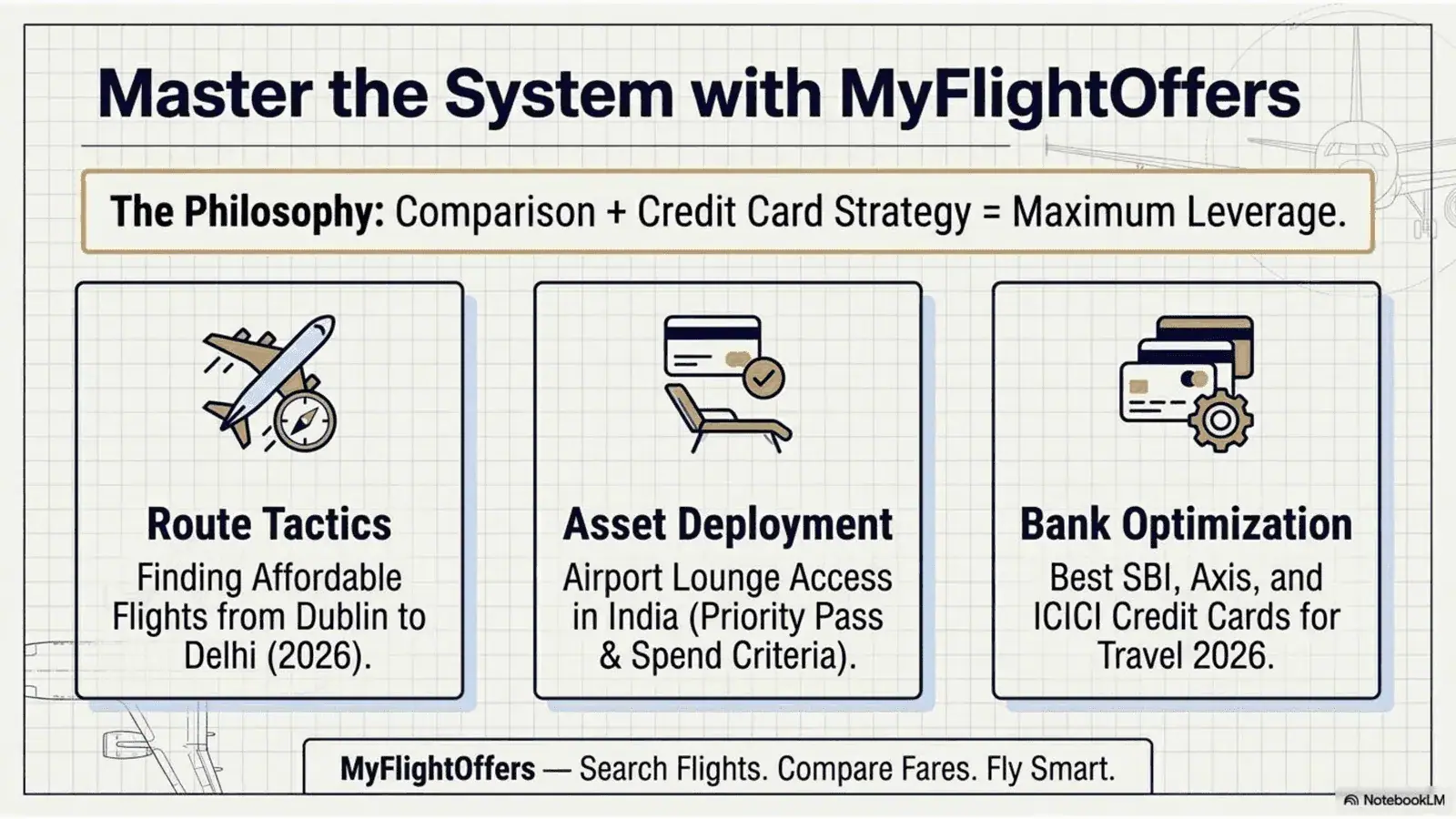
Now that you understand how fare comparison engines work, these guides help you maximise every booking:
- Hidden City Ticketing and Skiplagged in 2026: How It Works and Why It Can Backfire — fare comparison engines sometimes surface hidden city fares automatically; understand the real risks before acting on them, especially for Indian passport holders on international routes.
- Compare Fares Across Multiple Airlines Quickly - 2026 Complete Guide — a fast, repeatable workflow to shortlist flights, compare true total cost, and avoid common booking errors.
- What Is International Fare Routing? Complete 2026 Guide — learn how routing rules, married segments, and point of sale pricing decide which itinerary qualifies for the cheapest fare.
- Finding Affordable Flights from Dublin to Delhi 2026 — step-by-step guide to finding the cheapest fares on one of the most popular Ireland–India routes.
- Study in Ireland 2026: Complete Guide for International Students — flights, universities, costs, and scholarships for Indian and Chinese students.
- Airport Lounge Access in India: Complete Credit Card Guide 2026 — how to use your credit card to access lounges at Indian airports, including DreamFolks, Priority Pass, and spend-based criteria.
- Axis Bank Credit Cards for Flight Bookings 2026 — EDGE Miles, Atlas vs Magnus, Travel EDGE portal, and April 2026 partner changes.
- Best SBI Credit Cards for Flights & Travel 2026 — Miles Elite, KrisFlyer SBI, IRCTC SBI, and forex markup guide.
- Best ICICI Bank Credit Cards for Flights & Travel 2026 — Emeralde Private Metal, MakeMyTrip ICICI, iShop acceleration, and 0.99% forex.
- Best Time to Book Flights in 2026: What the Data Actually Shows — 2026 data on the best time to book flights: optimal booking windows, when the Tuesday myth breaks down, Dublin route-specific timing, and fare tracking tools.
Ready to put this to work?
You now understand how fare comparison engines work, what to watch out for, and how to use them strategically. Start searching for your next route.
Market share data, GDS statistics, and platform user figures cited in this article are sourced from Mordor Intelligence, Fingent, Future Market Insights, AltexSoft, IATA official publications (iata.org), Similarweb, Semrush, and published industry research as cited throughout. Market data is approximated and changes continuously; figures cited represent best available estimates at time of publication. GDS market share data comes from multiple industry sources that use differing methodologies. Platform features, pricing, and availability change regularly — always verify current terms and features directly on each platform. MyFlightOffers is not affiliated with any GDS provider, comparison engine, OTA, or airline mentioned in this article. This article is for informational purposes and does not constitute financial or travel advice.