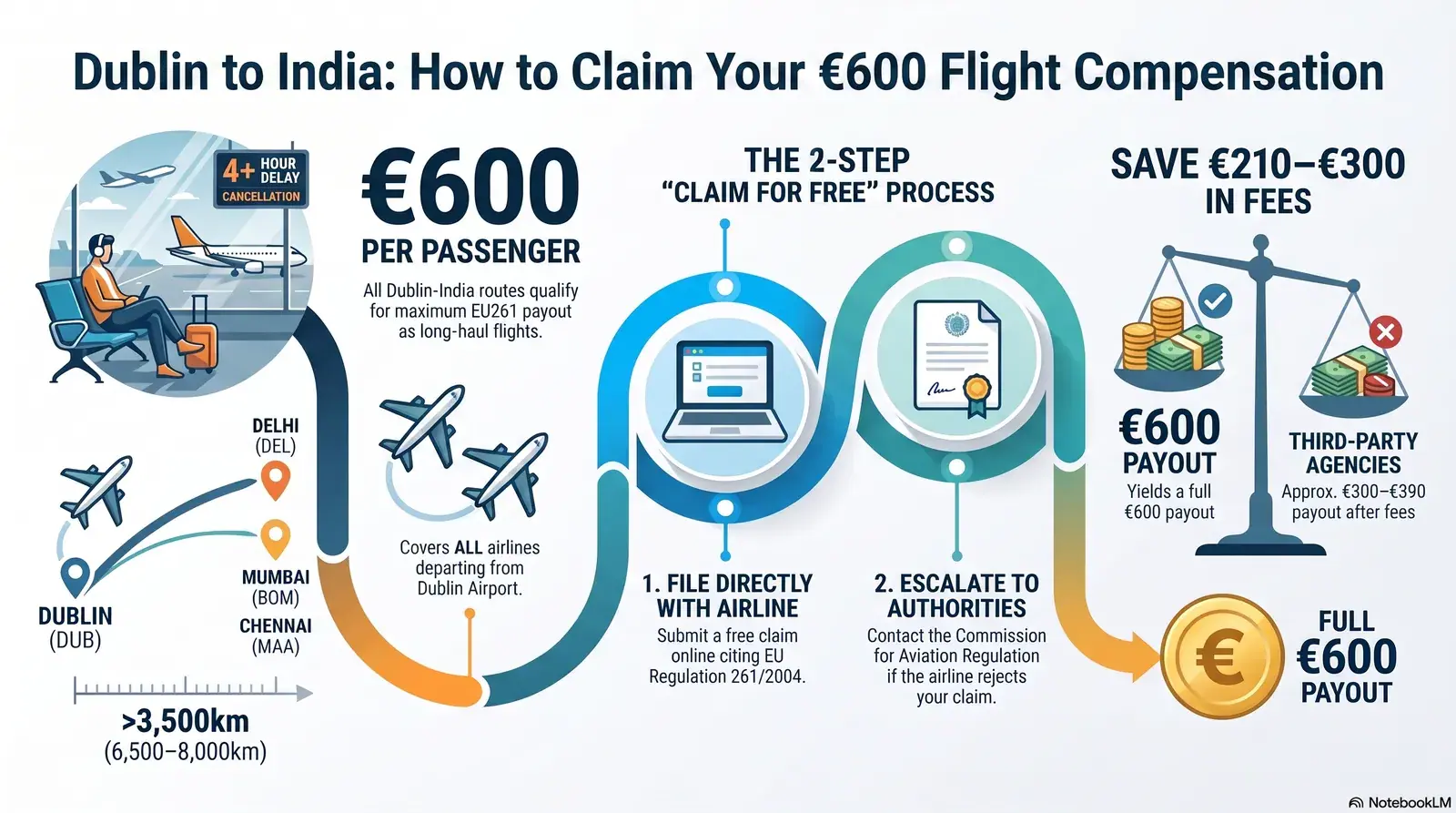
- €600 for Dublin-India disruptions: Any Dublin departure to an Indian city qualifies for the top €600 band (flights over 3,500 km) when delayed 4+ hours or cancelled with under 14 days notice — applicable to Emirates, Qatar Airways, and Etihad departing from Dublin.
- June 2026 reform kept the money intact: The EU reached a provisional deal on 15 June 2026 that preserved the €250/€400/€600 compensation bands and the three-hour delay threshold unchanged; new passenger-notification and rerouting rules are expected in 2027.
- Self-claiming is free: AirHelp and SkyRefund charge 35–50% of your payout. Filing directly with the airline and escalating to Ireland's Commission for Aviation Regulation costs nothing and works just as well in most cases.
€250 — flights up to 1,500 km
€400 — flights 1,500–3,500 km
€600 — flights over 3,500 km (all Dublin–India routes)
3+ hours arrival delay (4+ hours for long-haul); cancellation <14 days; denied boarding
What Is EU261 and What Changed in the June 2026 Reform?
EU Regulation 261/2004 (commonly called EU261 or EC261) is the European law that entitles air passengers to fixed statutory compensation — between €250 and €600 — when a flight departs from an EU airport and arrives more than three hours late, is cancelled with fewer than 14 days notice, or the passenger is involuntarily denied boarding. The regulation has been in force since February 2005 and applies to all airlines on routes from EU and EEA airports, regardless of where the airline is headquartered.
After 13 years of failed attempts to modernise the rules, the European Parliament and the Council of the EU reached a provisional political agreement on 15 June 2026. The headline outcome for passengers is good: the airlines' proposal to stretch the compensation-triggering delay threshold from three hours to as many as nine hours was rejected outright. The €250/€400/€600 compensation tiers and the three-hour delay trigger remain in place.
The June 2026 deal is provisional — it still requires formal adoption through the EU's legislative process and a transition period. The new rules are expected to enter into force in 2027 at the earliest. Until then, the original 2004 regulation governs every flight this summer. The new provisions most relevant to Ireland-India travellers include:
- Mandatory notification within four days: Airlines must proactively tell passengers they may be owed compensation and provide clear instructions on how to file a claim, within four days of the passenger's arrival at their destination.
- Self-rerouting right: If the airline fails to offer an alternative flight within three hours of the original departure, the passenger may book their own rerouting and claim up to 400% of the original ticket price back from the airline.
- Cabin bag inclusion: The price displayed at booking must include at least one standard cabin bag allowance — ending the practice of showing a fare and then adding bag fees at checkout.
- Child seating: Airlines must seat children under 14 next to their parent or guardian at no additional charge.
EU261 Compensation Bands: How Much Can You Claim?
EU261 sets three fixed compensation bands based on the great-circle distance of the disrupted route, and these amounts have not changed since 2005 — the June 2026 reform explicitly preserved them. The distance is measured between the first departure airport and the final destination airport, not the layover hub.
| Flight Distance | Compensation Amount | Minimum Delay for Cash Comp | Example Dublin Routes |
|---|---|---|---|
| Up to 1,500 km | €250 | 3 hours arrival delay | Dublin to London, Dublin to Edinburgh, Dublin to Amsterdam |
| 1,500–3,500 km | €400 | 3 hours arrival delay | Dublin to Marrakech, Dublin to Lisbon, Dublin to Athens |
| Over 3,500 km | €600 | 4 hours arrival delay | Dublin to Delhi (~6,500 km), Dublin to Mumbai (~7,000 km), Dublin to Chennai (~8,000 km), Dublin to Hyderabad (~7,200 km) |
Dublin to India and Long-Haul: The €600 Tier Explained
Every Dublin-to-India route comfortably exceeds 3,500 km, so all Ireland-India passengers qualify for the €600 compensation tier when their flight meets the disruption thresholds. Dublin (DUB) to Delhi (DEL) is approximately 6,500 km great-circle; Dublin to Mumbai (BOM) is approximately 7,000 km; Dublin to Chennai (MAA) is approximately 8,000 km. The intermediary hub — whether Dubai, Doha, or Abu Dhabi — does not reduce the calculated distance, because EU261 measures the distance from origin to final ticketed destination.
Note that the compensation is per passenger, per disrupted journey. A family of four on a cancelled Dublin-Delhi flight is each entitled to €600 independently, for a combined claim of €2,400.
When Does EU261 Protect You? Delays, Cancellations, and Denied Boarding
EU261 applies in three clearly defined disruption scenarios, each with its own threshold. The critical measurement is always arrival time at your final destination — not departure delay.
Delays of 3+ Hours (4+ Hours on Long-Haul)
You are entitled to compensation if your flight arrives at least three hours after the originally scheduled arrival time. For flights over 3,500 km (all Dublin-India routes), the threshold is effectively four hours because the regulation reduces the €600 by 50% if the delay is between three and four hours — a €300 partial payment that courts in several EU member states have challenged. To receive the full €600 on a long-haul route, the arrival delay should be four or more hours.
Importantly, the clock stops at the moment the aircraft doors open at your final destination — not when you touch down. Experienced passengers note the actual wheel-on time in the flight app immediately upon landing as supporting evidence.
Cancellation with Less Than 14 Days Notice
If your airline cancels your flight and notifies you fewer than 14 days before the scheduled departure date, you are entitled to compensation unless the airline offered an acceptable reroute arriving close to the original schedule. Specifically:
- If notified 7–13 days before departure and the offered reroute departs no more than 2 hours earlier and arrives no more than 4 hours later: no compensation.
- If notified fewer than 7 days before departure and the offered reroute departs no more than 1 hour earlier and arrives no more than 2 hours later: no compensation.
- Any cancellation where the reroute falls outside those windows, or where no reroute is offered: full compensation applies.
Cancellations notified more than 14 days in advance carry no compensation obligation, though the airline must still offer you a full refund or reroute.
Denied Boarding Due to Overbooking
If you hold a confirmed reservation, checked in on time, and the airline denies you boarding because the flight is oversold, you are immediately entitled to compensation at the full rate for your route distance, plus care rights and a choice of refund or rerouting. The airline must first seek volunteers willing to give up their seat in exchange for negotiated benefits (typically vouchers or miles). Only if insufficient volunteers come forward may the airline involuntarily bump passengers — and those passengers receive the full statutory amounts, not the negotiated volunteer deal.
Does EU261 Apply to Emirates, Qatar Airways, and Etihad Flights from Dublin?
Yes — EU261 applies to all flights departing from Dublin Airport, regardless of the airline's country of registration. The regulation's geographic scope is defined by the departure airport, not the airline's nationality. Since Dublin is in an EU member state, any flight leaving Dublin on any airline — including Emirates, Qatar Airways, and Etihad Airways — is fully covered.
However, there is a critical asymmetry on return journeys that every India-Ireland traveller must understand:
| Flight Leg | Airline | EU261 Covered? | Reason |
|---|---|---|---|
| Dublin → Delhi (outbound) | Emirates / Qatar / Etihad | ✅ Yes — full €600 rights | Flight departs from EU airport (DUB) |
| Delhi → Dublin (return) | Emirates / Qatar / Etihad | ❌ No — not covered | Non-EU airline departing from non-EU airport |
| Delhi → Dublin (return) | Aer Lingus / Lufthansa / KLM | ✅ Yes — full €600 rights | EU-registered airline, so covered regardless of departure point |
| Dublin → London Heathrow (positioning leg) | British Airways / Ryanair | ✅ Yes — €250 rights | Departs from EU airport |
The practical implication: if your Emirates ticket from Dublin to Delhi is disrupted at the outbound stage, you have a strong €600 claim. If the same Emirates flight is disrupted on the Delhi-to-Dubai leg or the Dubai-to-Dublin return, EU261 does not apply — you would need to pursue the airline under its own conditions of carriage or Montreal Convention rules.
On-the-Ground Insight: "My Emirates flight from Dublin to Dubai was delayed five hours before we even boarded. I had no idea I could claim €600 under EU261 — I assumed it only applied to European airlines. When I finally submitted my claim directly on the Emirates website, I had the payment in my account within six weeks. I nearly used AirHelp, which would have taken €210 of it. File it yourself." — Priya M., UCD Dublin, Graduated 2025
Care Rights During Disruption: What Airlines Must Provide
Separate from cash compensation, EU261 requires airlines to provide immediate care and assistance the moment a disruption kicks in — regardless of whether an extraordinary circumstance applies. Care rights are not conditional on compensation eligibility; airlines must provide them even in genuine weather events.
The specific entitlements depend on the delay length and route distance:
| Delay Trigger | Route Type | What the Airline Must Provide |
|---|---|---|
| 2+ hours | Flights ≤1,500 km | Meals and refreshments in reasonable proportion to waiting time; 2 free phone calls, emails, or faxes |
| 3+ hours | Intra-EU flights >1,500 km; all flights 1,500–3,500 km | Meals, refreshments, 2 free communications |
| 4+ hours | All flights >3,500 km (Dublin-India) | Meals, refreshments, 2 free communications |
| Overnight delay | Any route | Hotel accommodation (up to 3 nights) + transport to and from the hotel |
| Any cancellation or denied boarding | Any route | Choice of: full ticket refund within 7 days, or rerouting to final destination at earliest opportunity, or rerouting at a later date of passenger's choice |
If an airline fails to provide meals or accommodation during the delay and you pay out of pocket, you can claim those out-of-pocket expenses back later — keep all receipts. "Reasonable" is the operative word in the regulation; a €15 meal at an airport restaurant is reasonable; a €200 Michelin-starred dinner is not.
Step-by-Step: How to Claim EU261 Compensation
The claim process has four stages, and most straightforward cases are resolved at Stage 1 or 2 with no fee and no third-party involved.
Step 1 — File Directly with the Airline
Every major airline operating from Dublin has an online disruption claim form. Navigate to the airline's official website, find the passenger rights or claims section, and submit your claim citing EU Regulation 261/2004. You will need: your booking reference, passport or travel document details, the scheduled and actual arrival times, and your bank details for the payment transfer. The airline has six to eight weeks to respond under the regulation. Document the submission date and keep a copy of your claim.
Step 2 — Escalate to the Commission for Aviation Regulation (CAR) or Irish Aviation Authority (IAA)
If the airline does not respond within six to eight weeks, or rejects your claim without a satisfactory explanation, escalate to Ireland's national enforcement body. For flights disrupted at Dublin Airport, the relevant body depends on the airline: for most non-Irish carriers, escalate to the Irish Aviation Authority (IAA). For Irish-registered carriers (including Ryanair and Aer Lingus), escalate to the Commission for Aviation Regulation (CAR) at [email protected]. Both bodies have official EU complaint forms, and the IAA's is available at iaa.ie (EU complaint form PDF). Expect a response in 8 to 12 weeks.
Step 3 — Alternative Dispute Resolution (ADR)
If the national enforcement body's decision does not resolve your case, you can refer to an approved Alternative Dispute Resolution (ADR) body. ADR is a neutral mediation service and is generally faster and cheaper than courts. The European Consumer Centre Ireland (ECC Ireland) can direct you to the appropriate ADR body for your airline.
Step 4 — European Small Claims Procedure
As a last resort, you can file through the European Small Claims Procedure (ESCP) for claims up to €5,000. The ESCP operates across EU member states, is relatively low-cost, and does not require a solicitor. This route is rarely necessary — the vast majority of legitimate EU261 claims are settled at Stage 1 or 2.
- Screenshot or photograph of the departure board showing the delayed or cancelled status.
- Note the exact time the aircraft doors opened at your final destination (check the flight tracker app).
- Keep all meal and hotel receipts if you paid out of pocket for care the airline should have provided.
- Retain any written communication from the airline (SMS, email, airport notice) about the reason for the disruption.
- If denied boarding: request a written statement from the check-in or gate agent explaining why you were denied.
Claim Companies vs. Claiming Yourself: The Fee Comparison
Third-party claims companies charge 35% of your compensation on a no-win, no-fee basis, rising to 50% if legal action is required — on a €600 payout, that means handing over €210 to €300 in fees for work you can do yourself for free.
| Approach | Cost | Your Net Payout (on €600 claim) | Best For |
|---|---|---|---|
| Self-claiming (airline → CAR/IAA) | Free | €600 | Major carrier, recent disruption, clear-cut case |
| AirHelp | 35% standard; 50% if legal action | €390 (standard) or €300 (legal) | Complex cases; airline stonewalling; older claims |
| SkyRefund | 35% standard; 50% if legal action | €390 (standard) or €300 (legal) | Complex cases; airline stonewalling; older claims |
| Solicitor / EU Small Claims | Court fees + possible solicitor costs | Varies; potentially full €600 minus court fees | Airline refuses after CAR/IAA decision |
Claims companies make sense in a narrow set of situations: when a claim is older than two years and involves a small or uncooperative low-cost airline, when the airline has already rejected your claim once and you do not want to manage the escalation, or when you genuinely believe legal action will be needed. For a delayed Emirates or Qatar Airways flight from Dublin — one of the most common scenarios — the claim is typically straightforward enough to handle without intermediaries.
🧮 EU261 Claim Value Estimator
See your group's total statutory entitlement under EU261 — and how much you keep depending on whether you self-claim or use a claims company.
Common Airline Rejection Excuses and How to Counter Them
Airlines commonly cite "extraordinary circumstances" to avoid paying compensation, but the definition of what qualifies is narrower than most airlines imply — many routine disruptions are not extraordinary, and courts across the EU have consistently ruled against airlines that over-use the term.
Under EU261, extraordinary circumstances are external events beyond the airline's control that could not have been avoided even if all reasonable measures had been taken. The key word is "external". EU case law has established the following distinctions:
| Airline Excuse | Is It Extraordinary? (EU261) | How to Counter |
|---|---|---|
| Severe weather (freak storm, airport closure) | ✅ Yes — if it directly affected your flight | Check if other flights on the same route departed on time. If they did, the weather was not the actual cause. |
| Air traffic control (ATC) restrictions | ✅ Yes — ATC decisions are external to the airline | Request ATC delay confirmation. If the delay was caused by aircraft arriving late from another route (knock-on delay), that is usually NOT extraordinary. |
| Technical fault / engine defect | ❌ No — airlines must maintain aircraft | Cite the European Court of Justice ruling in Wallentin-Hermann v Alitalia (C-549/07): technical problems are inherent in airline operations and do not qualify. Only a hidden manufacturing defect discovered by the airline for the first time may qualify. |
| Strike by airline staff (pilots, cabin crew) | ❌ No — internal labour disputes are the airline's responsibility | The CJEU ruled in Transportes Aéreos Portugueses (C-74/19): internal strikes are foreseeable and within the airline's sphere of control. Claim in full. |
| Strike by airport workers or ATC staff | ✅ Yes — external strike beyond airline control | Accept the rejection if the airline provides documented evidence of the external strike. |
| Bird strike | ⚠️ Sometimes — depends on how the court views it | Bird strikes are borderline; they may qualify if the airline can show the strike directly caused the delay and the subsequent inspection was mandatory. Challenge it and let the CAR/IAA decide. |
| Previous flight arriving late (knock-on delay) | ❌ No — airlines must manage their own scheduling | Cite Flightright GmbH v Iberia (C-188/20): a delay caused by a knock-on effect from a previous flight disruption is not extraordinary unless the previous disruption itself was extraordinary. |
Frequently Asked Questions
Does EU261 apply to Emirates, Qatar Airways, and Etihad flights from Dublin?
Yes. EU Regulation 261/2004 applies to all flights departing from Dublin Airport, regardless of the airline's nationality. Emirates, Qatar Airways, and Etihad are fully covered for outbound flights from Dublin. However, the return leg from India on these non-EU carriers is not covered, as EU261 only protects inbound flights on non-EU airlines if the airline is EU-registered.
How much EU261 compensation can I claim on a Dublin to India flight?
Dublin to any Indian city is well over 3,500 km, so you are entitled to €600 in statutory compensation when your flight arrives 4 or more hours late (or is cancelled with under 14 days notice), provided no extraordinary circumstance applies. This is the highest compensation band under EU261 and applies per passenger on the disrupted booking.
What changed in the EU261 reform of June 2026?
A provisional deal was reached on 15 June 2026. The core compensation amounts (€250/€400/€600) and the three-hour delay threshold were both preserved unchanged. New protections expected in 2027 include: airlines must notify passengers of their rights within four days of arrival; if the airline does not reroute you within three hours you can book your own alternative and claim up to 400% of your ticket price; cabin bags must be included in the advertised ticket price; and children under 14 must be seated next to their guardian at no extra charge.
Should I use AirHelp or SkyRefund, or claim EU261 myself?
AirHelp and SkyRefund both charge 35% of the compensation, rising to 50% if legal action is needed. On a €600 claim, that is €210–€300 in fees. Self-claiming is free and works well for straightforward cases where the airline is a major carrier, the disruption was recent, and you can document the delay. Use a claim company only if the airline is unresponsive and legal escalation is likely.
What counts as extraordinary circumstances under EU261?
Genuine extraordinary circumstances that remove the airline's compensation obligation include severe weather directly affecting your flight, air traffic control restrictions, political instability, security threats, and external (non-airline) strikes. Technical faults — including engine defects and software failures — are NOT extraordinary circumstances; airlines are responsible for maintaining their aircraft. Internal airline strikes also do not qualify as extraordinary.
Compare live Dublin-India fares before you book
Use our fare search to compare Emirates, Qatar Airways, and Etihad on Dublin-India routes — check prices, layover times, and baggage allowances side by side before committing to a fare.
- Lost, Delayed or Damaged Baggage on International Flights 2026: Montreal Convention Compensation Guide — claim up to 1,519 SDR (≈€1,880) for lost or damaged luggage; PIR filing, 7-day and 21-day deadlines explained
- Dublin to Delhi Flight Guide 2026 — best airlines, fare benchmarks, and hub comparison for the DUB-DEL route
- Best Time to Book Flights 2026 — data-backed booking windows by route and season
- Compare Fares Across Multiple Airlines — how to use fare search tools effectively on complex itineraries
- Direct Dublin to India Flight: Is It Coming? — the realistic outlook for non-stop Dublin-India routes
- What Is International Fare Routing? — how fare rules affect your rights when a connection is disrupted
All information in this guide is based on publicly available official sources as of July 2026, including EU Regulation 261/2004, the provisional June 2026 reform agreement, and the Irish Aviation Authority. The June 2026 reform is a provisional political deal; its specific provisions may be amended before formal adoption. Always verify your rights directly with the Irish Aviation Authority, the Commission for Aviation Regulation, or Europa.eu Air Passenger Rights. MyFlightOffers is not affiliated with any airline, claims company, or regulatory body. This article does not constitute legal advice.