
- It's point-of-sale pricing, not just exchange rates. Airlines file different fares for different countries of purchase — switching your currency selector to INR, AED, or a local market currency can unlock a genuinely lower base fare on the same seat.
- The price gap can be hundreds of euros. The same routing from USD to INR can show a difference far larger than simple currency conversion explains — because the underlying filed fare is different, not just converted.
- Payment processor fees then stack on top. Booking in a cheaper currency may add a foreign transaction fee from your bank — the guide walks you through the net calculation to identify which currency wins after all fees.
You search the same flight twice. You change the currency selector from USD to INR. The price jumps by the equivalent of $95. You assume it is just the exchange rate doing the maths — but it is not. Understanding why booking currency affects fare price goes well beyond simple exchange rate arithmetic. The real explanation involves airline point-of-sale pricing, fare inventory buckets, and payment processing fees working together in ways most travellers never see. Once you understand how these layers interact, you can make smarter decisions and stop leaving money on the table.
🔑 Core driver
Point-of-sale (POS) market — not just exchange rate maths
💸 Hidden cost to avoid
Dynamic Currency Conversion — adds 3–5% for zero benefit
✈ Fare bucket risk
Currency switch can move you to a more expensive inventory class
✅ Best practice
Pay in the merchant's local currency; match card to booking currency
What this guide covers
- Key takeaways at a glance
- Why booking currency affects fare price: the POS factor
- How payment fees quietly inflate your total cost
- Fare buckets, dynamic pricing, and currency switching
- Practical strategies to optimise your booking currency
- What travellers consistently get wrong
- Find better fares with MyFlightOffers
- FAQ
Key Takeaways at a Glance
| Point | Details |
|---|---|
| POS market drives fare differences | Airlines price tickets by point-of-sale country, not just currency, changing which fare buckets are available. |
| DCC adds hidden costs | Dynamic Currency Conversion rates set by merchants are nearly always worse than your bank's exchange rate. |
| Fare buckets shift with currency | Switching booking currency can trigger a higher fare class, raising the price beyond what conversion explains. |
| Pay in local currency | Paying in the merchant's local currency lets your bank handle conversion at a better rate. |
| Match card to booking currency | Using a local card for local-currency bookings avoids double FX penalties on the same transaction. |
Why Booking Currency Affects Fare Price: The POS Factor
Most travellers assume that when they switch from USD to INR on an airline's website, the price difference is just the exchange rate applied to the same base fare. That assumption is wrong, and it costs people real money.
Airlines price tickets using a concept called point of sale (POS) pricing. The POS is the market where the ticket is sold, defined by the country and currency of the booking. Fare prices vary by sale country — not just because of currency conversion, but because airlines allocate different fare buckets, taxes, and promotional offers to each POS market independently.
Think of it this way. An airline might offer 10 seats in its cheapest fare class to the US market and 6 seats in that same class to the Indian market. If those cheap seats sell out in one market, travellers booking there see a higher price, while the other market still shows the lower fare. Currency conversion has nothing to do with it.
Here is a practical illustration of how POS pricing can affect the same route:
| Booking Origin | Currency | Approximate Fare (Economy) | Notes |
|---|---|---|---|
| United States | USD | $720 | US POS fare bucket available |
| India | INR | ₹68,000 (~$815) | Different fare bucket, local taxes |
| United Kingdom | GBP | £610 (~$770) | UK POS with regional pricing |
The differences above are not explained by exchange rates alone. Booking from the country of origin often gives cheaper fares because the airline's fare bucket allocation favours that market.
- POS pricing means airlines can charge different base fares in different markets for the same seat.
- Local taxes and government-mandated fees vary by country and are bundled into the POS price.
- Promotional fares may only appear in specific POS markets and are invisible from other regions.
- Round-trip fares are often cheapest when booked from the departure country's POS market.
How Payment Fees Quietly Inflate Your Total Cost
Understanding the impact of currency on fares is only half the picture. The other half is what happens at the payment stage — and this is where many travellers unknowingly pay extra.

When you pay for a flight priced in a foreign currency, two things can happen. Your bank applies its own foreign exchange markup, typically between 1.5% and 3.5% of the transaction. Or the airline's payment system triggers Dynamic Currency Conversion (DCC), which converts the fare into your home currency at a rate the merchant controls. DCC rates set by merchants are almost always worse than your bank's rate — sometimes by 3% to 5%.
Here is how payment fees stack up on a typical international booking:
| Cost layer | What happens | Typical impact |
|---|---|---|
| Base fare in foreign currency | The airline prices the ticket in its local market currency (for example, €500). | Starting price before payment-related charges. |
| FX markup by your bank or card | Card issuer applies a foreign transaction fee on non-local-currency payments. | Usually 1.5% to 3.5%. |
| DCC at checkout | Merchant converts fare to your home currency at its own exchange rate. | Often adds another 3% to 5%. |
| Double-penalty scenario | Higher POS fare bucket plus DCC acceptance on payment. | Compounded avoidable overpayment. |
Paying in the merchant's local currency lets your bank handle the FX conversion, which consistently produces better rates than merchant-controlled DCC. This single habit can save you between 3% and 8% on every international booking.
🧮 Booking Currency & POS Savings Optimizer
See how dynamic currency conversion (DCC), card FX fees, and point-of-sale (POS) fare bucket variations impact your total flight ticket cost.
The base fare of 800 is an illustrative long-haul ticket price in the selected currency — enter your own quote.
💵 Total Cost & Net Savings Breakdown
Fare Buckets, Dynamic Pricing, and Currency Switching
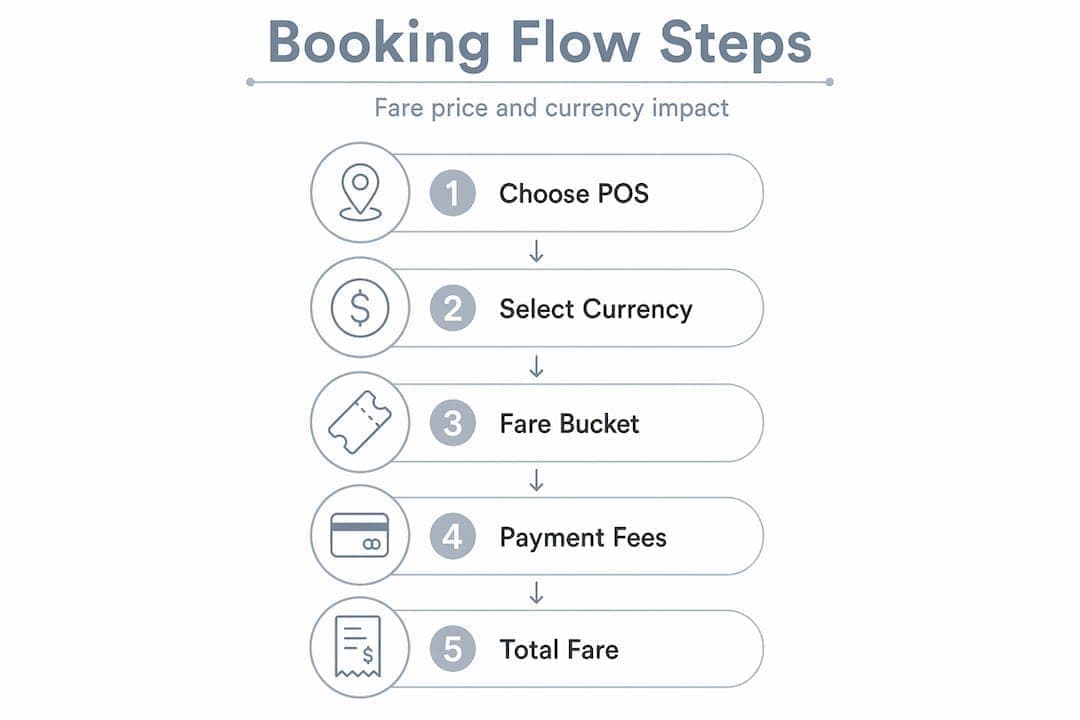
Fare buckets are the internal pricing classes airlines use to manage seat inventory. Each flight might have 8 to 12 distinct fare classes — labelled with letters like Y, B, M, or Q — each with its own price, rules, and availability count. The cheapest buckets have the fewest seats and sell out first.
Here is why this matters for the booking currency versus fare price question. When you switch the currency or region on a booking platform, you are not just changing the display currency. You are often switching the POS context entirely. That switch can move you from a market where bucket M (a mid-range economy class) still has seats, to a market where bucket M is sold out and bucket B (a more expensive class) is the next available option.
- Bucket availability varies by POS market. An airline may hold back certain fare classes for its home market or high-demand regions.
- Dynamic pricing algorithms reprice in real time. When a cheap bucket sells out in one market, the algorithm instantly surfaces the next available bucket at a higher price.
- Currency switching can trigger bucket shifts. Changing booking currency can select higher or lower fare classes, creating price jumps that look like currency conversion but are actually inventory changes.
- Base fares set in one currency with daily recalculation create further volatility — travellers see fluctuating prices even without changing their booking currency.
Practical Strategies to Optimise Your Booking Currency
Knowing how currency affects ticket prices is useful. Knowing what to do about it is what saves you money. Here are the strategies that consistently produce better outcomes for international travellers.
-
Book from the departure country's POS market. Round trips are often cheapest when booked from the origin country because fare bucket allocation favours that market. If you are flying from Delhi to Dublin, check the airline's Indian site before defaulting to the Irish or UK version.
-
Always pay in the airline's local currency. Decline DCC when offered at checkout. Let your bank handle the conversion. This single step avoids the merchant's inflated exchange rate.
-
Use the right payment card. Match your card to the booking currency where possible — an Indian card for INR bookings, a European card for EUR bookings. This eliminates double FX conversion. Indian travellers can review SBI travel card options and ICICI Bank travel cards that reduce FX-related costs on international bookings.
-
Compare fares across multiple currencies manually. On some booking platforms, you can manually select a different display currency. Run the search in two or three currencies and convert the results yourself using a live rate. The differences can reveal which POS market has cheaper fare buckets open.
-
Be cautious with VPN-based currency switching. Some travellers use VPNs to simulate booking from a cheaper market. This can work, but airlines increasingly detect and block it. Payment issues also arise when your card's billing country does not match the POS market you are simulating.
-
Account for taxes on bundled packages. Some countries impose additional taxes or surcharges on flight packages booked locally. India's Tax Collected at Source (TCS) rules, for example, apply to international travel packages above certain thresholds. Factor these in before assuming a local booking is always cheaper.
What Travellers Consistently Get Wrong
The pattern that appears most consistently across international bookings is this: travellers focus entirely on the currency display and miss the fare bucket story underneath it.
When someone switches from USD to EUR on a booking page and sees a lower number, they assume they found a hack. What they may have actually done is accessed a POS market where a cheaper fare bucket happens to still be open. The next traveller who tries the same thing an hour later finds the bucket is gone, and the price is now higher in EUR than in USD. It looks inconsistent because the underlying inventory is dynamic.
What actually matters is the combination of POS market selection and payment method discipline. Travellers who book from the right POS market and pay in local currency without DCC consistently pay less than those who chase currency arbitrage without understanding the inventory layer.
Travellers who use premium travel cards correctly save more over a year than those who spend hours hunting for currency loopholes. A no-foreign-transaction-fee card applied consistently across every booking is a guaranteed saving. A currency switch that works once is not a strategy.
The 24-Hour Cancellation Rule: Geographical Boundaries & Limits
When booking international travel, many consumers rely on the belief that they can cancel any online flight reservation within 24 hours for a full cash refund. However, this rule is not universal. The strict 24-hour free cancellation mandate is a US Department of Transportation (DOT) regulation. It only applies to commercial flights touching US airspace, booked directly with the airline, and booked at least seven days prior to the departure date.
Outside of routes touching US airspace (such as flights within Europe, the UK, or Asia), there is no statutory 24-hour cooling-off period. In these jurisdictions, cancellation policies are determined solely by the airline's individual fare terms or the third-party Online Travel Agency's (OTA) conditions. Booking a last-minute non-refundable ticket on non-US routes carries significant financial risk, as you may lose the entire fare immediately upon booking if your plans change. Always review the specific airline ticket cancellation terms before completing payment.
Find Better Fares with MyFlightOffers
Understanding fare price and booking currency is the foundation of smarter travel spending. MyFlightOffers puts that knowledge to work by aggregating live fare data from multiple airlines and booking platforms, so you can compare real prices across markets without switching between dozens of tabs.
MyFlightOffers is free to use and requires no account setup. You can search flights worldwide across one-way, round-trip, and multi-city itineraries and see how fares shift across booking options in real time. The platform also offers travel tips and guides covering payment methods, credit card strategies, and booking timing — giving you the full picture before you commit to a fare.
Frequently Asked Questions
Why does the same flight cost more in one currency?
Airlines price tickets by point-of-sale market, meaning different fare buckets and taxes apply depending on where and in what currency you book — not just the exchange rate.
What is Dynamic Currency Conversion and should I avoid it?
Dynamic Currency Conversion (DCC) lets a merchant convert your payment into your home currency at their own exchange rate. DCC rates are almost always worse than your bank's rate, so you should decline it and pay in the merchant's local currency instead.
Does currency influence travel costs beyond the ticket price?
Yes. Foreign transaction fees from your bank or card issuer typically add 1.5% to 3.5% to any payment made in a foreign currency, and many travellers are unaware of these fees until they appear on their statement.
Is it cheaper to book flights in the local currency of the destination?
Not always. Booking from the departure country's POS market is generally cheaper because fare bucket allocation favours origin markets. The destination country's currency may reflect a different — sometimes more expensive — fare class.
Can switching booking currency help me find cheaper fares?
It can, but not reliably. Switching currency changes the POS context, which may reveal cheaper fare buckets. However, those buckets are inventory-dependent and can sell out quickly, so the savings are not guaranteed or repeatable.
- What Is International Fare Routing? Complete 2026 Guide — see how routing rules and point of sale logic combine to change which fare bucket you see before currency conversion is even applied.
- What Is a Fare Comparison Engine? Complete Guide 2026
- Compare Fares Across Multiple Airlines Quickly - 2026 Complete Guide
- Best Day to Buy Airline Tickets: 2026 Guide
- Best HDFC Bank Cards for Flights & Travel 2026
- Best SBI Credit Cards for Flights & Travel 2026
- Best ICICI Bank Credit Cards for Flights & Travel 2026
- Axis Bank Credit Cards for Flights 2026
- Airport Lounge Access in India: Complete Credit Card Guide 2026
- Niyo Global vs Wise vs Bank Forex Cards 2026: Best Zero-Markup Card for Indian Students Abroad — Niyo Global vs Wise vs bank forex cards 2026: real fee comparison on ₹1.5 lakh spend, TCS rules, ATM costs, and the two-card strategy for Indian students in Ireland.
- Forex Card vs Credit Card vs UPI: The Complete Cost Comparison for Indian Students and NRIs in 2026 — Forex card, credit card or UPI abroad? Compare real 2026 markup fees, TCS rules and true costs for Indian students and NRIs — with a live savings calculator.
- NRE and NRO Accounts for International Flight Bookings: Indian NRIs in Ireland (2026) — NRE vs NRO accounts for booking Dublin-India flights 2026: repatriation rules, OCI access, LRS/TCS, blocked card fixes and zero-forex card options.
Ready to compare live fares?
Apply what you have learned. Search flights now and check our monthly fare calendar to find the cheapest window for your route.
All information regarding airline point-of-sale pricing, fare bucket mechanics, Dynamic Currency Conversion, foreign transaction fees, and booking currency strategies in this article is based on publicly available information from airline industry sources, consumer finance publications, and travel research as of May 2026. Airline pricing systems, fare rules, and payment processing terms change frequently and without notice. Always verify current terms directly with your airline, bank, and card issuer before making any booking or payment decision. MyFlightOffers is not affiliated with any airline, bank, or payment processor mentioned in this article. This article does not constitute financial advice.