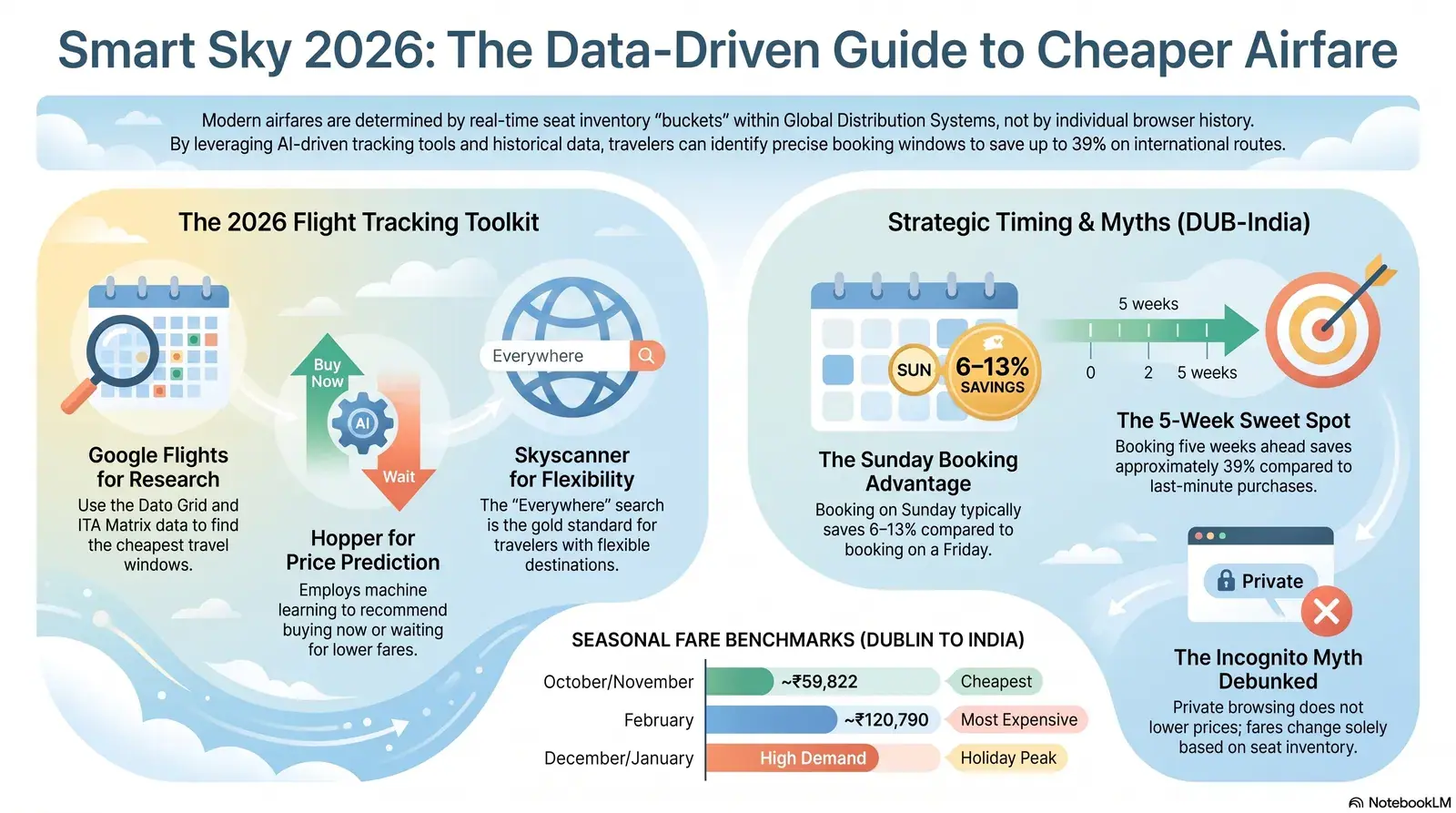
- Best free tracking combo: Use Google Flights price alerts for free email notifications and the date grid, plus Skyscanner “Everywhere” search if your destination is flexible.
- When to book Dublin-India: Book around 5–7 weeks ahead for below-average fares; October and November are cheapest for the India-to-Dublin direction. Sunday is typically the cheapest booking day (6–13% less than Friday).
- The incognito myth is false: Searching in private mode does not affect prices — fares change because inventory moves between fare buckets, not because airlines track your searches.
Google Flights — alerts, date grid, price history, ITA Matrix data
Hopper (app) — watch fare, Price Freeze for high-demand dates
Skyscanner “Everywhere” + Cheapest Month view
Sunday — saves 6–13% vs. Friday (KAYAK data, 2026)
How does flight price tracking actually work in 2026?
Fare tracking tools monitor airline seat inventory in near real-time: when a cheaper fare bucket empties, the displayed price jumps to the next bucket — and when a higher bucket opens, prices can briefly drop. No tool reads your mind or your cookies.
Airlines load fares into Global Distribution Systems (GDS platforms such as Amadeus, Sabre, and Travelport) in distinct fare buckets, each labelled with a booking class code (Y, B, M, K, and so on). Each bucket holds a fixed number of seats at a given price. When all seats in a cheap bucket sell, the system automatically moves remaining bookings into the next, more expensive bucket. This explains why you searched a fare at 08:00 and it was €580, but by 11:00 it had risen to €640 — the cheap bucket sold out in between.
Fare tracking tools work by crawling these GDS feeds (or airline APIs) on a continuous or near-continuous basis, caching the results, and comparing new prices against historical observations for the same route-date combination. When the observed price dips below a threshold you set, the tool sends an alert. The quality of the tool is therefore determined by how frequently it polls for updates and how rich its historical dataset is.
AI and machine learning prediction adds a forward-looking layer. Tools such as Hopper and AirHint train models (commonly Random Forest, XGBoost, or Gradient Boosting) on years of historical fare data to predict whether a price is likely to rise or fall over the next few days or weeks. Commercial tools claim 80% or higher prediction accuracy, compared to an industry baseline of around 60–70%. Academic benchmarks from 2025 peer-reviewed work show that ensemble methods such as XGBoost can achieve an R² of approximately 0.71 on held-out test data, while Random Forest models achieve accuracy around 88% for well-defined domestic routes. International long-haul routes — including Dublin-India segments — are harder to predict accurately because they involve multiple airlines, hub connections, and intercontinental demand drivers.
One misconception worth clearing up: fare tracking tools do not use a single “live” price feed. Some aggregators cache fares for up to 20 minutes before refreshing, which means you may see a price on one site that no longer exists when you click through to book. Always verify the final fare on the airline’s own booking page before entering payment details.
How does Google Flights price tracking work, and what is the Price Guarantee?
Google Flights is powered by ITA Matrix technology (Google acquired ITA Software in 2011) and offers free email price alerts, a date grid showing the cheapest travel dates, an explore map for flexible destinations, and — on select US-departing itineraries — a Price Guarantee that refunds the difference if fares drop after you book.
To set a price alert on Google Flights, search for your route, then click the bell icon or the “Track prices” toggle. You can track a specific set of dates or the cheapest dates across an entire month. Alerts arrive by email and, if you use the app on a signed-in Google account, as push notifications. There is no cap on how many routes you can track simultaneously.
The Explore map is particularly useful for flexible travellers: type your departure airport (for example, Dublin DUB), leave the destination blank, and Google returns a world map with prices overlaid on every reachable destination for the dates you select. Combine this with the Date Grid, which displays a matrix of fares across multiple departure and return dates so you can visually spot the cheapest combination at a glance.
The Price Guarantee is a pilot programme that marks select itineraries with a shield icon. Google’s algorithm is confident these fares are the lowest available before departure. If the price drops after you book, Google refunds the difference into your Google Pay balance, provided the drop exceeds $5 USD. The maximum payout is $500 USD per Google account per calendar year across up to three simultaneously guaranteed bookings. Critical limitation for Irish travellers: the Price Guarantee only applies to one-way and round-trip flights departing from the United States, priced in USD. Dublin departures are not eligible as of July 2026.
Is Hopper’s price prediction accurate, and is the Price Freeze fee worth paying?
Hopper claims 95% prediction accuracy for flights booked up to 12 months in advance, but independent assessments consistently find accuracy is lower for long-haul international routes — and the Price Freeze is only worth its fee if fares are likely to spike on your specific route.
Hopper uses machine learning trained on billions of historical airfare data points. The app shows a colour-coded recommendation (green = buy now, yellow = wait, red = prices are at a peak) alongside a predicted price range over the next 1–2 weeks. For well-trodden US domestic routes, this guidance is generally reliable. For Dublin-India itineraries routed via Gulf hubs (Emirates via Dubai, Etihad via Abu Dhabi, Qatar Airways via Doha), prediction accuracy is less dependable because these fares are influenced by regional Middle Eastern demand, oil price movements, and multi-airline codeshare dynamics that Hopper’s model may not capture as cleanly.
The Price Freeze feature lets you lock in a displayed fare for a fee, usually between $5 and $30 depending on route length and demand. Here is how the economics work:
- If the fare rises before you book, Hopper covers the difference up to a stated cap (typically $100–$300 per booking).
- If the fare drops, you pay the lower price — but you have already paid the freeze fee and cannot recover it.
- If you decide not to book the flight at all, you lose the fee.
Price Freeze is most logical for high-demand dates where a sharp fare spike is plausible within your freeze window — for example, a Dublin-Mumbai return around Diwali (October-November) or around Christmas. It is hard to justify on off-peak shoulder-season routes where fares are unlikely to surge significantly within a week.
On-the-Ground Insight: “I tracked a Dublin-Delhi fare for six weeks using both Google Flights and Hopper. Google’s date grid found me the cheapest departure day combination immediately. Hopper told me to wait, the fare then jumped €90, and I ended up booking at a higher price than when I started watching. For our route, Google was far more useful for spotting the cheap window.” — Priya M., UCD Dublin, Autumn 2025 intake
How do Skyscanner and Kayak price alerts work for Ireland-Europe trips?
Skyscanner excels at flexible destination and date search through its “Everywhere” and “Cheapest Month” features, while Kayak adds a “buy now or wait” price forecast and a continuously updated airfare trends dashboard — both free to use from Ireland.
Skyscanner’s “Everywhere” search is uniquely powerful for travellers who know they want to fly somewhere but have not fixed a destination. Enter Dublin as the origin, choose “Everywhere” as the destination, and Skyscanner returns a map or list of the cheapest available fares to every reachable city for your selected dates. The “Cheapest Month” view shows the average price by month, allowing you to immediately see that, for example, flying to London in February costs half what it does in late July. To set a price alert, search a specific route, then toggle “Get price alerts” in the search header; you receive email notifications whenever the price changes significantly.
Kayak’s price alert system is activated by the “Track prices” toggle on the left-hand side of any search results page. Kayak also provides a Price Forecast indicator that analyses recent fare movement and tells you whether current prices are typical, low, or high relative to historical data for that route and period — giving you a “buy now” or “wait” recommendation backed by trend data. The Kayak Airfare Trends Dashboard publishes weekly average fare data by major route, which is particularly useful for benchmarking whether a Dublin-India fare you are watching is genuinely cheap for the time of year.
Fare tracking tool comparison: features at a glance
No single tool does everything well — the strongest approach in 2026 is to combine two or three complementary platforms depending on whether you are flexible or committed to specific dates.
| Tool | Free Price Alerts | AI/ML Fare Prediction | Irish Departures | Unique Strength | Key Limitation |
|---|---|---|---|---|---|
| Google Flights | ✓ Email / push | Historical trend only | ✓ Full support | Date grid, Explore map, ITA routing intelligence | Price Guarantee limited to US departures |
| Hopper | ✓ In-app push | ✓ Buy/wait prediction + Price Freeze | ✓ Full support | Price Freeze for locking a fare before booking | Lower accuracy on long-haul international routes |
| Skyscanner | Trend indicators only | ✓ Full support | “Everywhere” and “Cheapest Month” flexible search | No Price Freeze; prediction less precise than Hopper | |
| Kayak | ✓ “Buy now / wait” forecast | ✓ Full support | Price Forecast + Airfare Trends Dashboard | Forecast accuracy varies; cannot book directly on airline | |
| AirHint | ✓ Email (registered) | ✓ 80%+ claimed accuracy | ✓ Supported | ML-focused fare prediction tool | Smaller dataset than Google or Kayak |
| Google Price Guarantee | N/A (passive refund) | ✓ AI-confirmed low price | ✗ US departures only | Post-booking refund if price drops | Not available from Ireland; USD only; max €500/year |
How do I set up a price tracking system specifically for Dublin to India routes?
Because there are no direct Dublin-India flights, you must track fares via multiple competing hub connections — Emirates via Dubai, Etihad via Abu Dhabi, Qatar Airways via Doha, and Air India via London or Frankfurt — and benchmark any fare you see against the seasonal price range before deciding to book.
The first step is to decide which city pair you are actually tracking. Dublin DUB serves Delhi DEL, Mumbai BOM, Bangalore BLR, Chennai MAA, Hyderabad HYD, and Amritsar ATQ most commonly, each via different hub combinations. Set up a separate Google Flights alert for each serious option rather than relying on a single catch-all search. Then add a Skyscanner alert for the same route as a cross-check, since the two platforms occasionally surface fares through different booking channels.
Seasonal benchmarks for Dublin-India routes (KAYAK data, 2026): the cheapest average fares on the India-to-Dublin direction appear in October (around ₹59,822 return) and November. The most expensive months are February (₹120,790 average) and December-January during the Christmas and New Year peak. On the Dublin-to-India direction, September and October are typically cheaper than July and August, which carry the summer holiday premium. For the Dublin to Delhi route, fares below €550 return are historically a good opportunity; anything below €480 return during non-peak months is exceptional and should be booked promptly.
Set up your alerts to notify you of any price change, not just drops. An alert that a price rose tells you a cheap bucket has sold — useful intelligence that competition for the fare is active. When you see a price in your target zone, cross-check it on the MyFlightOffers Fare Calendar to confirm it is genuinely below the seasonal average before booking.
Among Gulf hub carriers, Etihad Airways is the most popular choice among KAYAK users for the Dublin-India route, followed by Emirates and British Airways for those routing via London Heathrow. Setting alerts for all three hub connections simultaneously means you capture fare drops on whichever carrier discounts first, rather than missing a window by watching only one airline.
What can AI chatbots like ChatGPT and Gemini actually do for finding cheap flights in 2026?
In 2026, AI chatbots such as ChatGPT, Gemini, Perplexity, and Claude can help you plan and research flight options, but none can reliably replace a dedicated fare-tracking tool because they cannot complete a booking transaction, and their live fare data ranges from good to completely phantom.
A 2026 test published by HappyFares compared four major AI chatbots on flight search accuracy from India. Perplexity led on citation accuracy at 84%, Gemini showed the freshest flight data overall (though it sometimes returned generic travel advice rather than live prices), ChatGPT scored best for conversational multi-city itinerary planning, and Claude provided the most depth in itinerary structuring but lacks native fare-browsing capability.
ChatGPT gained live travel integrations via Expedia, Kayak, and Booking.com APIs. These plugins allow it to surface real-time fare data within the chat interface. However, the same HappyFares test found that ChatGPT returned a Delhi-to-London search result that included two airlines that do not operate that route, with one cited fare being a phantom from a discontinued 2024 promotion. Always verify any specific fare a chatbot quotes by opening the actual booking page before drawing conclusions.
Gemini integrates natively with Google Flights data, which gives it the advantage of ITA Matrix-quality routing intelligence. Its weakness is that it sometimes defaults to general travel advice (“Book in advance and fly via a hub”) rather than surfacing a specific live fare. It is most useful when you prompt it with a very specific route and date range and ask it to check Google Flights for you.
The strongest 2026 workflow is sequential: use a chatbot to quickly narrow down routing options, hub comparisons, and seasonal timing, then hand the specific route and date to Google Flights or Kayak for verified live pricing, and book directly through the airline or a well-established OTA to avoid phantom-fare disappointments.
Do not trust a specific fare price quoted by a chatbot without opening the actual airline or booking site to verify. AI models can return outdated promotional fares, fares on airlines that do not operate a route, or prices that only exist for a specific narrow booking class that is already sold out. Use chatbots for routing and timing strategy; use dedicated tracking tools for actual price verification.
When should I stop tracking and actually book my flight?
Data from KAYAK shows that booking approximately 5 weeks before departure saves around 39% compared to booking last-minute; the absolute cheapest prices tend to appear around 25 weeks (roughly 6 months) ahead, but holding out that long for a Dublin-India flight is only practical if your travel dates are fixed and the fare you see is in your historical low zone.
The practical booking strategy differs by season. For summer departures (July-August) and the Christmas peak (mid-December to early January), fares begin rising steeply by February and March respectively. On these routes, booking 4–6 months ahead is advisable because the “cheapest bucket” seats sell out early. For shoulder-season travel (October-November or February-March from Dublin), tracking for 3–4 weeks after you first spot a fare is usually sufficient to capture a brief dip below the seasonal average.
Best day to book: KAYAK data for Dublin-India routes consistently shows Sunday as the cheapest day to make a reservation, saving between 6% and 13% compared to Friday, which is the most expensive booking day. The price difference typically results from airlines releasing unsold inventory at the end of the sales week and resetting for the following Monday. If you are watching a fare and it hits your target, and it happens to be a Friday, consider waiting until Sunday morning to book — though be aware that cheap buckets can sell out over the weekend before you return.
The clearest signal to stop tracking and book is when the fare you are watching falls into the historically low zone for that route and season, confirmed by at least one independent data source (the Kayak Airfare Trends Dashboard or the MyFlightOffers Fare Calendar). A second signal is when the number of seats visible in your preferred cabin drops below three or four — though most booking sites no longer display exact remaining seat counts, Hopper’s urgency indicator sometimes surfaces this information. If you have set a Price Freeze on the fare, the decision is simpler: book before the freeze expires if the current price is at or below your ceiling.
What are the most common flight price tracking mistakes to avoid?
The most damaging tracking mistakes are not technical — they are strategic: tracking basic-economy fares that look cheap but carry hidden costs, searching in the wrong currency, and believing that browser privacy modes have any effect on the prices shown.
Mistake 1: Believing incognito mode shows cheaper flights
Multiple independent investigations confirm that searching in private or incognito mode makes no difference to the flight prices you see. Airlines use AI-driven revenue management systems that change fares constantly based on seat inventory, booking patterns, and competitor pricing — not based on your individual browser session or cookie history. The apparent mystery of a price rising between your first and second search is almost always a fare bucket selling out in that time window, not the airline penalising your interest. Travel experts at Going.com, Business Insider, and Thrifty Traveler have all confirmed this through controlled tests.
Mistake 2: Tracking basic-economy fares without accounting for hidden costs
A basic-economy fare can look 20–30% cheaper than a standard economy seat but frequently becomes more expensive once you add a checked bag and account for the complete loss of flexibility. Basic economy fares on most major airlines are fully non-refundable and cannot be changed after the 24-hour grace period. On a Dublin-India route where the base fare difference might be €80–120, a single 23 kg checked bag can cost €60–100 on top of the basic-economy ticket, erasing most of the apparent saving. The standard economy fare often includes one checked bag and allows changes (for a fee difference only, not a flat change fee, on most carriers since the post-COVID reform). Always compare the true total cost — base fare plus checked bag, not just the headline price in search results.
Mistake 3: Searching and tracking in the wrong currency
The currency you use when searching a route can produce different displayed prices on some airline websites, and booking with an Indian card in foreign currency without a zero-forex card adds a further 2–3.5% markup. Some airlines (Air India in particular, and several Gulf carriers’ Indian booking portals) display lower fares in INR on their India-facing websites compared to their EUR or GBP versions, reflecting Point of Sale pricing differences. Conversely, some booking platforms apply Dynamic Currency Conversion (DCC), offering to display the fare in INR at a rate 4–8% above mid-market — always pay in the airline’s local currency (EUR for Dublin-based purchases) to avoid this markup. Set your tracking tools to the currency you will actually pay in to ensure your alert thresholds are meaningful.
Mistake 4: Setting too many alerts and creating noise
Tracking more routes and dates than you are genuinely willing to book creates alert fatigue, and alert fatigue causes you to miss the one that matters. A well-designed tracking system should contain no more than three or four active route-date combinations at any one time, each with a clearly defined price threshold at which you will actually book. Treat fare alerts like buy-limit orders in investing: set the price at which you commit, and when the alert fires, book rather than re-evaluating.
Ready to act on what you have tracked? Search live fares now
Put these tracking strategies into practice. Search live Dublin departure fares, check seasonal fare calendars, and compare routes before you book.
Frequently asked questions
Does Google Flights price tracking work for flights departing from Ireland?
Yes. Google Flights price alerts and the date grid work fully for Dublin and other Irish airports. The one exception is the Price Guarantee feature, which is limited to flights departing from the United States and priced in USD, so Irish residents cannot use it. For Irish travellers, Google Flights is still the most comprehensive free tool available for route research and price alerts.
Is Hopper accurate for Dublin to India flights?
Hopper claims 95% prediction accuracy for flights booked up to a year ahead, but independent reviews suggest accuracy is lower for long-haul international routes compared to domestic US flights. Hopper is most useful for watching a specific fare and using its Price Freeze on high-demand dates where a surge is likely. For Dublin-India routes, treat Hopper’s buy/wait recommendation as one data point rather than a definitive signal, and cross-reference with Google Flights date grid and Kayak historical data.
Does searching in incognito mode show cheaper flights?
No. Multiple independent studies and expert consensus from Going.com, Business Insider, and Thrifty Traveler confirm that searching in private or incognito mode does not affect the flight prices shown. Prices change because airline seat inventory moves between fare buckets, not because of your browser history or cookies. The appearance of a price rise between two searches reflects a cheaper fare bucket selling out, not surveillance pricing aimed at you personally.
When should I book Dublin to India flights to get the cheapest price?
Data from KAYAK shows that booking approximately 5 weeks before departure saves around 39% compared to last-minute fares. For the absolute lowest prices, booking around 25 weeks (about 6 months) ahead tends to yield the cheapest fares. October and November are the cheapest months on the India-to-Dublin direction, with average return fares around ₹59,822. February is typically the most expensive month at around ₹120,790. Sunday is the cheapest booking day, saving 6–13% versus Friday.
- GUIDE Best Time to Book Flights in 2026 — Season-by-season booking windows with data on the cheapest advance-purchase lead times for Irish travellers
- GUIDE Best Day to Buy Airline Tickets — Day-of-week patterns for Dublin route fares and whether the Tuesday myth holds up in 2026
- GUIDE Dublin to Delhi Flight Guide 2026 — Route breakdown, airline comparison, and fare benchmarks for the most popular Irish-Indian city pair
- GUIDE Compare Fares Across Multiple Airlines — How to run a meaningful fare comparison across Gulf carriers and European hub options from Dublin
- GUIDE What Is a Fare Comparison Engine? — How aggregators like Skyscanner and Kayak source their data and why prices differ across platforms
All tool features, price data, and booking-window figures cited in this article are based on publicly available information as of July 2026. Fare tracking tool features, AI integrations, and airline pricing policies change frequently. Always verify current prices and tool capabilities directly on the platforms referenced. MyFlightOffers is not affiliated with Google, Hopper, Skyscanner, Kayak, or any airline mentioned. This article does not constitute financial advice.