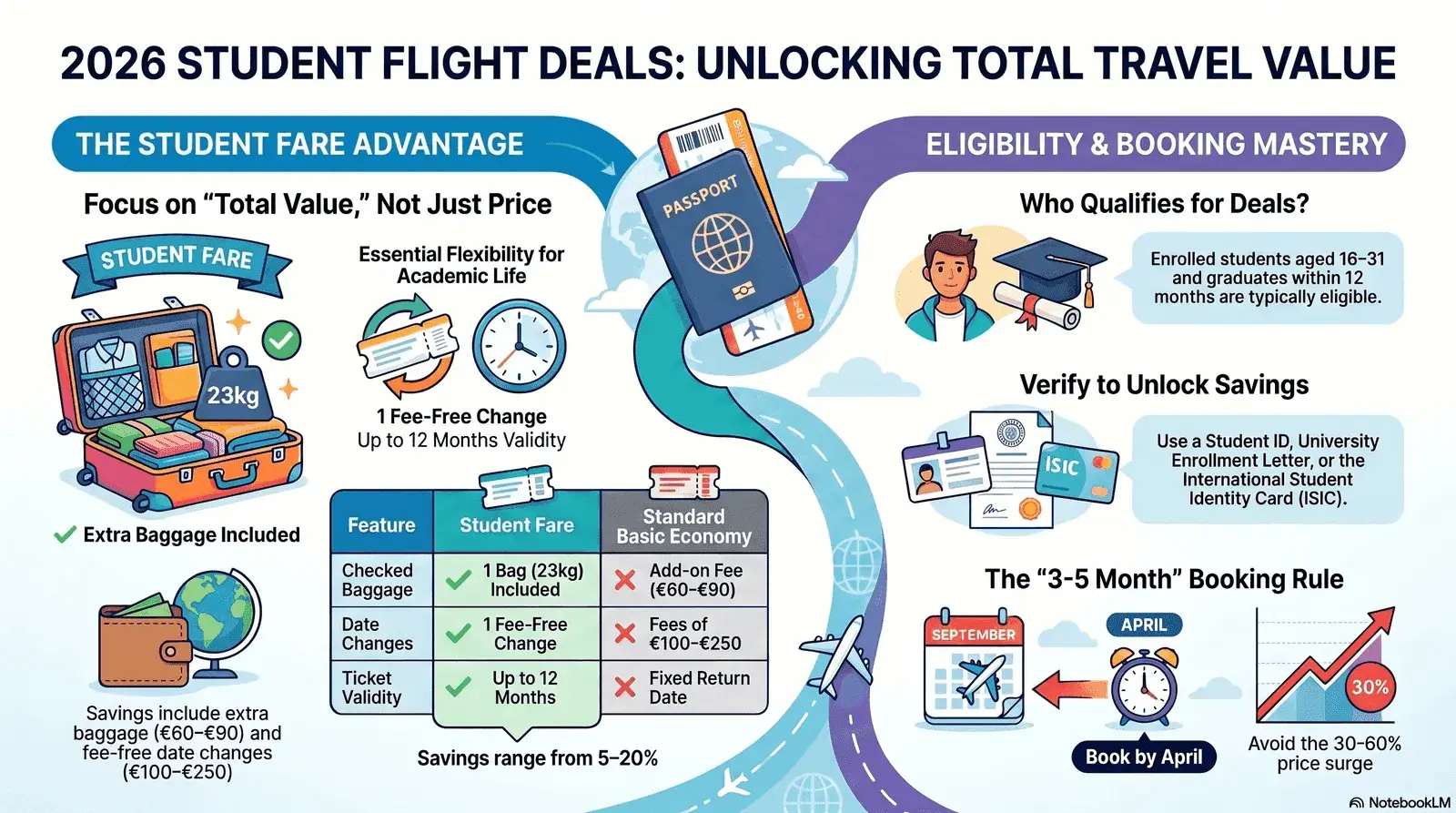
- Student fares are negotiated rates — not coupons. Airlines pre-sell seat blocks to student travel agencies, so prices are lower than airline.com and typically include extra baggage plus fee-free date changes.
- Not all "student deal" platforms offer real student fares. Some sites simply label standard fares as student deals; genuine discounts require verified student status via ISIC card or .edu email.
- Booking window matters. Student fares often hold their price closer to departure than regular economy, but the best availability opens 3–6 months out.
✈ What it is
Negotiated fares for verified students, typically with extra
baggage and fee-free date changes included
Not always the cheapest headline price — value is in total
package
👤 Who qualifies
Enrolled students aged 16–31 (most platforms)
Under 25–26 on airline-direct youth fares; recent graduates
may qualify within 12 months
💰 Potential savings
5–20% off headline price on many routes
Plus baggage (€60–€90) and date-change savings (€100–€250)
included in student fare
📍 Where to book
StudentUniverse, USIT, select airline youth pages
Not visible on Google Flights or Skyscanner — must visit
platforms directly
What this guide covers — 11 topics answered
- What is a student airfare discount?
- Student fares vs regular tickets — the real differences
- Who qualifies? Eligibility criteria
- What benefits are actually included?
- Limitations and fine print you must read
- Top platforms for student flight deals (2026)
- Airlines with notable student and youth programmes
- For Indian students flying to Ireland and Europe
- Step-by-step: how to book a student airfare
- Combining student fares with other savings strategies
- Frequently asked questions
Every year, millions of students worldwide book international flights for study abroad programmes, exchange semesters, internships, and trips home during academic breaks. For a student planning to study in Ireland from India, or heading to North America for a summer programme, the outbound flight often represents the single largest upfront expense of the entire academic journey — sometimes exceeding a full month's rent in the destination city.
What many students do not realise is that a parallel pricing world exists specifically for them. Student airfare discounts are negotiated or specially structured flight tickets available exclusively to enrolled students and qualifying young travellers. They are not always cheaper in absolute headline price — but they frequently offer benefits that make them better overall value in practice: an extra checked bag worth €60–€90 at time of booking, a fee-free date change that would otherwise cost €150–€250, or an open-return validity of twelve months when the cheapest standard economy ticket locks you to a single fixed date.
This guide explains exactly what student airfare discounts are, how they work, who qualifies, where to find them, and how to combine them with other money-saving strategies to reduce the total cost of your next international trip.
1 What Is a Student Airfare Discount?
A student airfare discount is a specially negotiated flight fare — or a reduced-price ticket category — made available exclusively to verified students and qualifying young travellers. Unlike standard discount fares, which anyone can purchase when prices dip during a general sale, student fares are gated by eligibility verification. You cannot purchase a student fare without confirming your student status through a student ID, a university enrollment letter, or a recognised international credential such as the ISIC (International Student Identity Card).
This verification step is precisely what allows airlines and travel platforms to offer pricing and conditions unavailable to the general public. By ring-fencing the inventory to verified students, platforms can negotiate with airlines based on a guaranteed, student-specific demand profile that is separate from the leisure and business traveller market.
The concept of discounted student travel traces to the 1960s, when student travel organisations — most notably the International Student Travel Confederation (ISTC) — began negotiating bulk fares with airlines for educational and cultural travel. Today, the ISTC continues to manage the ISIC card programme globally, while the commercial booking side has evolved into specialist digital platforms (StudentUniverse, USIT) and airline-direct youth fare categories. Together, these channels form a structured parallel market to standard commercial airfare pricing, operating independently of what appears on Google Flights or Skyscanner.
The value of a student fare is frequently not in the headline ticket price alone. The most significant differences are often in what the ticket includes: an additional checked baggage allowance, a one-time fee-free date change, or a ticket validity of up to twelve months. On long-haul routes — where extra baggage fees run €50–€90 per additional bag and date-change penalties reach €150–€250 — these inclusions can represent savings that materially exceed any price reduction achieved on the ticket itself.
2 Student Fares vs Regular Tickets — The Real Differences
The comparison between a student fare and a standard ticket is more nuanced than a simple price check suggests. Here is a breakdown of the key structural differences across the dimensions that matter most for student travellers:
Baggage allowance
Most student fares include one checked bag (23 kg) as standard. The cheapest published fare on the same airline — often labelled "Basic Economy", "Light", or "Saver" — typically includes no checked baggage at all. On a long-haul route from Delhi to Dublin, an extra 23 kg bag added to a basic fare at the time of booking costs approximately €60–€90 depending on the carrier. A student fare that includes this from the outset effectively absorbs that cost within the ticket price.
Date change flexibility
Standard "Basic Economy" fares on major long-haul carriers are non-changeable, or incur penalties of €100–€250 for a date modification. Most student fares on platforms like StudentUniverse include a one-time fee-free date change — a benefit that is particularly valuable when exam results, visa decisions, or semester-end dates make the exact travel date uncertain at the time of booking.
Ticket validity and open returns
Many student platform fares carry an open-return validity of six to twelve months, compared with the fixed-date returns that characterise the cheapest economy tickets. This matters practically: a student who books an outbound flight to Dublin in September may not know their return date until their thesis is submitted or examinations are complete.
Open-jaw itineraries
Student fares frequently include competitive pricing on open-jaw itineraries — flying into one city and returning from another. For a student spending a semester in Dublin who plans to travel within Europe before flying home, an open-jaw itinerary is priced more competitively on student platforms than on standard booking engines.
Frequent flyer mile accrual
Most student fares do earn frequent flyer miles, though the earning rate depends on the fare class the ticket is issued in. Student fares may be issued in discounted classes (Q, L, G, or similar) that earn at reduced rates compared to full economy classes (Y, B, M). If miles accrual is a priority, verify the expected fare class with the booking platform before purchasing.
| Feature | Student Fare (via platform) | Standard Basic Economy |
|---|---|---|
| Checked baggage (23 kg) | Usually included (1 bag) | Not included — add-on €60–€90 |
| Date change | 1 fee-free change (most platforms) | Non-changeable or €100–€250 fee |
| Ticket validity | Up to 12 months (open return) | Fixed return date |
| Open-jaw option | Competitively priced | Often significantly higher |
| Headline price saving | 5–20% off on many routes | Often the lowest listed price |
| Miles accrual | Yes (may be lower fare class) | Yes (lowest accrual class) |
3 Who Qualifies? Eligibility Criteria Explained
Eligibility for student airfare discounts is set independently by each platform and airline. The following criteria apply broadly across the main providers in the Irish, UK, and Indian markets:
Age limits
The most common upper age threshold on specialist student travel platforms is 31. StudentUniverse, the largest global student fare platform, accepts travellers aged 16 to 31. Airline-issued youth fares — which often overlap with student fares — typically carry a lower ceiling, usually under 25 or under 26, regardless of whether the traveller is actively enrolled. Always check the specific provider's terms for your booking.
Enrollment requirements
You must generally be enrolled as a full-time or part-time student at an accredited institution — a secondary school, university, college, or recognised vocational or language training programme. Most platforms also accept doctoral and postdoctoral researchers as eligible students.
Recent graduates
Some platforms extend eligibility to students who graduated within the past twelve months. StudentUniverse, for example, accepts recent graduates who can provide a degree certificate and documentation of the graduation date. After that twelve-month window closes, standard pricing applies.
Verification methods
Eligibility is confirmed at the point of booking through one of the following:
- Student ID card from your university or college, clearly showing your name and enrollment status
- Enrollment letter from your institution on official letterhead, dated within the past three months
- ISIC Card — the International Student Identity Card, issued by the ISIC Association and recognised across 130+ countries; available in Ireland through USIT at isic.ie for approximately €15 annually
- Platform digital verification — StudentUniverse uses a third-party service that cross-references institutional enrollment records via your university email address, removing the need to upload documents manually
Gap year travellers without active enrollment are not eligible for most student airfare programmes. Students enrolled in language schools vary by platform — some providers accept enrollment in accredited English-language programmes (for example, students in language preparation courses in Dublin before main university entry), while others require enrollment at a degree-granting institution. Check the specific provider's eligibility terms before assuming this applies to your situation.
An Indian student enrolled at the University of Limerick qualifies for student airfare discounts in exactly the same way as an Irish or EU student at the same institution. Your enrollment letter from the Irish university and your ISIC card — if held — are sufficient verification on StudentUniverse and USIT. Nationality and country of origin are irrelevant to eligibility.
4 What Benefits Are Actually Included?
The benefits of student airfares fall into four distinct categories. The relative importance of each depends on your individual travel situation:
1. Extra checked baggage
The additional checked bag is often the most financially significant benefit for students relocating internationally. Students moving to Ireland for a semester or a full academic year typically carry 35–50 kg of luggage — winter clothing (a significant consideration for students arriving from warmer climates), books, kitchen items, and personal goods that may be difficult or expensive to source affordably on arrival. A student fare that includes one extra 23 kg bag saves €60–€90 at time of booking — and significantly more if adding baggage later through the airline website, or at airport-counter rates.
2. Date change flexibility
A one-time fee-free date change has concrete monetary value in scenarios that are common specifically for student travellers:
- Exam results arrive later than expected, pushing back departure
- A visa decision takes longer than standard processing time
- A course extension or thesis revision shifts the end date
- An internship or work placement offer changes the return window
On a full-fare non-changeable standard economy ticket on most long-haul carriers, each of these scenarios triggers a rebooking fee of €100–€250. Student fare platforms typically waive this fee once per booking. Always read the specific terms — free changes may apply only up to a certain number of days before departure.
3. Extended ticket validity and open returns
Student fare tickets frequently carry a validity of six to twelve months. This allows you to book your outbound flight before your return date is known, and confirm the return leg later without paying the premium that standard flexible tickets charge for the same privilege.
4. Headline price reduction
The price discount, when present, typically ranges from 5% to 20% below the standard economy fare on the same route and date. This varies significantly by route and season: during peak travel periods (August–September for student arrivals in Ireland, December–January for holidays, October–November for Diwali on India-origin routes), student fare discounts narrow to 0–5% or may disappear entirely as general demand elevates all prices. During off-peak periods, the discount is more substantial.
🧮 Student Fare vs Standard Fare True Value Calculator
See whether a student fare is genuinely cheaper than a standard fare once you factor in your checked baggage and date-change needs.
Defaults are illustrative mid-range airline charges — €75 per checked bag and a €175 date-change fee — not fixed industry rates.
5 Limitations and Fine Print You Must Read
The most important thing to understand about student airfare discounts is that they are not guaranteed to be cheaper than the best publicly available fare on a given date. During flash sales, off-peak periods, or on routes with strong airline competition, the standard published fare can undercut the student fare. The student fare's advantage lies in the total package — what it includes — not just the ticket price. Always compare total cost including all ancillary fees before booking.
Limited seat availability
Airlines allocate a fixed number of seats per flight to student fare inventory. This allocation sells out, particularly during August–September (the main incoming student travel window for European university arrivals) and over Christmas and Diwali. Book at least 3–5 months ahead for September arrivals in Ireland to secure student fare availability on your preferred route and date.
Proof required at check-in
Some airlines reserve the right to verify student status at check-in or boarding. Passengers unable to provide valid proof — a current student ID, enrollment letter, or ISIC card — may be re-fared at the standard economy ticket price and asked to pay the difference at the gate. Always carry your student documentation physically when flying on a student fare. Saving it on your phone is useful as a backup, but a physical copy is the safest option.
Booking channel restrictions
Student fares negotiated through platforms like StudentUniverse or USIT are not visible on Google Flights, Skyscanner, Kayak, or the airline's own website at the same price. They exist only within the specific platform that negotiated the inventory. This means you cannot verify student fare pricing without visiting those platforms directly.
Blackout dates and peak seasons
Student fare discounts frequently do not apply — or are minimal — during peak travel periods. For India–Ireland routes specifically, the August–September incoming student surge and the December–January holiday period are the windows where student fare pricing advantages narrow most significantly.
Age limits are strictly enforced
A traveller who is 32 and enrolled in a doctoral programme will not qualify on StudentUniverse, which imposes a strict upper age limit of 31 regardless of enrollment status. An airline's direct youth fare for "under 25" may also exclude a 25-year-old who has already reached that birthday. Read the age terms of the specific platform and fare carefully before booking.
Free change conditions apply
Even platforms advertising "fee-free date changes" may impose restrictions: changes may only be possible up to a certain number of days before departure, may be limited to routes served by specific carrier partners, or may require that the new booking be made in the same or a higher fare class. The free change is a meaningful benefit, but it is not unconditional — read the platform's terms for your specific booking.
6 Top Platforms for Student Flight Deals (2026)
The main platforms for booking verified student airfares in the Ireland, UK, and Indian markets are listed below. Note that pricing and availability differ between platforms — always compare both for your specific route and date.
StudentUniverse
studentuniverse.ie / studentuniverse.comThe world's largest student travel booking platform, acquired by Flight Centre Travel Group in 2015. Operates market-specific sites including a dedicated Irish platform (studentuniverse.ie). Partners with major carriers — Emirates, Qatar Airways, British Airways, KLM, Lufthansa, Air India, Turkish Airlines. Student verification via student ID, enrollment letter, or institutional email. Offers one-way, round-trip, and open-jaw student fares with baggage and date-change benefits included.
USIT
usit.ieIreland's longest-established student and youth travel company, operating since the 1960s and Ireland's official ISIC card issuer. Strong for outbound bookings from Ireland — including return trips for international students based in Ireland going home for Christmas, Diwali, or summer. Also covers visa advice, travel insurance, and working holiday packages tailored to students.
ISIC Shop
isic.org / isic.ieThe International Student Identity Card (ISIC) platform. The card — approximately €15 annually in Ireland, purchased through USIT — functions as universally recognised proof of student status and unlocks discounts from ISIC-partner airlines, rail operators, hotels, and services across 130+ countries. Useful both as a verification tool for student fares on other platforms, and as a standalone discount card for travel and lifestyle benefits throughout your studies.
Direct Airline Youth Pages
See airlines section below ↓Some airlines offer youth or student fares bookable directly on their own website without requiring a third-party platform. Lufthansa and Air France-KLM maintain documented youth fare categories. Availability, age limits, and conditions vary significantly by carrier and route — always verify on the airline's official website before assuming a direct student fare exists on your specific route.
STA Travel was formerly one of the world's largest student travel agencies, with offices in over 80 countries. It permanently ceased trading in August 2020 following the financial impact of the COVID-19 pandemic. The global STA Travel network does not exist. Some successor businesses in individual markets have used similar branding, but students searching for "STA Travel" will find a mix of outdated information and unrelated successor entities. StudentUniverse and USIT are the current, verified alternatives operating in the Ireland market.
7 Airlines with Notable Student and Youth Programmes
Not all airlines market student fares under their own brand, but several have documented youth or student pricing that is either bookable directly or available through partner platforms. Below are the most relevant airlines for students flying between India, Ireland, and Europe:
| Airline | Programme type | Age / eligibility | Where to book | India–Ireland relevance |
|---|---|---|---|---|
| Lufthansa | Youth Tariff | Under 26 (select routes) | lufthansa.com directly | Frankfurt hub; India–Dublin via FRA |
| Air France | Young Traveler fares | Under 25 (select routes) | airfrance.com directly | Paris CDG hub; India–Dublin via CDG |
| KLM | Youth fares via platforms | Under 25 (varies) | StudentUniverse / direct | Amsterdam hub — fastest India–DUB routing (~11.5 h) |
| Emirates | Student fares via platforms | 16–31 (via StudentUniverse) | StudentUniverse | Dubai hub; widest Indian city coverage to Dublin |
| Qatar Airways | Student fares via platforms | 16–31 (via StudentUniverse) | StudentUniverse / USIT | Doha hub; competitive India–Ireland pricing |
| Turkish Airlines | Youth promotions + platform | 16–31 (via StudentUniverse) | StudentUniverse | Istanbul hub; often lowest base fares |
| Air India | Student concession (select routes) | Enrolled students (verify) | airindia.in (verify current terms) | India national carrier; London hub for Dublin |
Airline student and youth programmes change more frequently than standard published fares. Age limits, route eligibility, booking conditions, and platform partnerships can all be updated between seasons. The details above reflect documented programmes as of May 2026 but should be confirmed at the airline's official website or through StudentUniverse/USIT before purchasing. A standard economy flash sale fare may undercut the student fare on a specific date — always compare both options before committing.
8 For Indian Students Flying to Ireland and Europe
Indian students represent the single largest international student group in Ireland, accounting for a significant share of the approximately 35,000 non-EU international students studying in the country each year. The India–Dublin corridor is one of the most heavily trafficked student flight routes globally, which means specific tactical considerations apply.
No direct flights — plan your connections
There are no direct flights between any Indian city and Dublin Airport (DUB). All itineraries require at least one connection, with the main hubs being Dubai (Emirates), Doha (Qatar Airways), Abu Dhabi (Etihad), Amsterdam (KLM), London (Air India, British Airways), Frankfurt (Lufthansa), and Istanbul (Turkish Airlines). The fastest total journey time is approximately 11.5–12 hours via Amsterdam; Middle East hub routings typically run 13–16 hours total, including the layover.
Book early for September arrivals — this cannot be overstated
If you are commencing an Irish academic year in September, book your flight by April — and ideally in March or earlier. The August–September window is the highest-demand period for India–Ireland routes as the global student population converges on this corridor simultaneously. Student fare inventory on popular airline and date combinations can sell out 3–4 months before departure. Fares on remaining seats — both student and standard — rise 30–60% in the final six weeks before August departures.
Using studentuniverse.ie from India
StudentUniverse's Irish-facing site (studentuniverse.ie) is specifically positioned for Ireland-market bookings. If you are already based in Ireland and booking a return home, this is the primary platform to check first. If you are booking from India for your first arrival in Ireland, studentuniverse.com (global) accepts Indian student credentials — your enrollment letter from an Indian institution or a confirmed offer letter from your Irish university, combined with a student ID, is sufficient verification.
Payment and forex markup — a cost most students overlook
When booking student fares from India for international routes, transactions are typically priced in EUR, USD, or GBP depending on the platform. Using an Indian credit card with a low forex markup materially reduces the total cost — the difference between a 1.99% and a 3.5% markup card on a ₹65,000 booking is approximately ₹975.
| Card | Forex markup | Saving vs 3.5% on ₹65,000 booking |
|---|---|---|
| MakeMyTrip ICICI | 0.99% | ~₹1,625 saved |
| SBI Card Miles Elite / SBI Card ELITE | 1.99% | ~₹975 saved |
| HDFC Infinia / Regalia Gold | 2% | ~₹975 saved |
| Axis Bank Magnus | 2% | ~₹975 saved |
| Most standard Indian cards | 3.5% | Baseline — no saving |
For detailed earn rates, transfer partners, and lounge access on Indian travel cards, see our Indian Payment Guides.
Extra baggage is essential to plan for
Students moving to Ireland for the first time typically carry 35–50 kg of luggage — including winter clothing for Ireland's damp Atlantic climate, which catches many students from warmer countries off guard. Add any extra baggage allowance at the time of booking through the student platform, not at the airport. Airport excess baggage fees can reach €15–€20 per kilogram above the allowance, compared with €30–€50 per additional pre-booked bag when added through the airline's website before departure.
9 Step-by-Step: How to Book a Student Airfare
Following a structured booking process avoids costly mistakes and ensures you capture the best available student fare before inventory sells out:
-
Establish your route and a travel window of at least two to three weeks. Flexibility on specific travel dates is one of the most powerful tools for reducing airfare on any route. Identify the hard constraints (course start date, visa appointment deadline) and the flexibility window around them.
-
Check baseline prices on a general comparison engine first. Use Google Flights with the flexible date view turned on. This gives you a market-rate range for your route — you need this baseline before you can assess whether a student fare is offering genuine value or whether the standard market price is already lower.
-
Search global platforms (like StudentUniverse) or direct airline clubs for inbound routes, or usit.ie if you are booking outbound travel from Ireland. Compare the student fare against the baseline from step two. Specifically assess: Is the headline price meaningfully lower? Does the student fare include checked baggage that the cheapest alternative excludes? Does it include a free date change? What is the validity period?
-
Calculate total cost — not just ticket price. Add the real cost of baggage and the risk-adjusted cost of potential date changes to the cheapest standard fare. The student fare should be evaluated on total delivered value, not the headline price alone.
-
Prepare your eligibility documents before starting the booking process. Gather your student ID and enrollment letter in advance. Some platforms require verification before completing payment — if you are unprepared, the session may time out and the selected fare can be lost before you locate your documents.
-
Book with a low-forex-markup card if paying in foreign currency. Save your student ID and enrollment letter on your phone and in physical form in your travel folder — some airlines request proof of student status at check-in, even months after booking.
10 Combining Student Fares with Other Savings Strategies
Student fares are most effective when combined with these complementary approaches:
- Use the flexible date grid on Google Flights before visiting any student platform. Identify the cheapest travel dates within your window on a general comparison engine first. Student platform pricing also varies by date — a Tuesday departure vs a Saturday on the same route can be €50–€120 cheaper. Once you have the optimal date, check the student platform specifically for that date.
- Set fare alerts on at least two platforms simultaneously. Set price alerts on Google Flights and Skyscanner for your route. Long-haul fares on India–Ireland routes can drop significantly after a flash sale is announced. Alerts capture these drops without requiring daily manual checking — when your target fare appears, act immediately, as long-haul fares at their floor can recover within 48–72 hours.
- Consider nearby departure airports for Indian routes. Students based in cities other than Delhi or Mumbai may find that connecting internationally via Delhi or Mumbai is cheaper than booking an international itinerary directly from a regional airport. Compare total journey cost, including the domestic connection, across both options.
- Book one-way tickets separately when your return date is uncertain. If you do not yet know your return date, booking a one-way outbound on a student fare and adding the return separately — also on a student fare — when your end-of-term dates are confirmed can avoid the premium built into open-return tickets. Compare total costs both ways before deciding.
- Combine with credit card travel rewards for accumulating miles. Booking an international student fare on an Axis Bank Atlas card earns 5 EDGE Miles per ₹100 on direct airline bookings — on a ₹65,000 fare, that is 3,250 EDGE Miles, redeemable for approximately ₹3,250 toward a future flight. Over an academic year with two or three trips home, these credits accumulate into a meaningful discount on subsequent bookings. See our Indian Payment Guides for card-specific earn rates on international bookings.
- Subscribe to airline newsletters for flash sale announcements. Emirates, Qatar Airways, Turkish Airlines, and Air India all run periodic flash sales announced via email newsletter before they appear on comparison engines. Cross-referencing a flash sale price against the student platform pricing on the same date occasionally surfaces combinations well below both the standard and student fare.
- For Dublin arrivals: avoid the final four weeks before September term. The India–Ireland corridor experiences its highest pricing in the final four weeks before Irish universities begin their autumn semester (typically early to mid-September). Booking within this window means competing for the smallest remaining inventory at the highest prices of the year. The optimal window is 3–5 months ahead — book in April or May for a September arrival.
11 Frequently Asked Questions
Are student airfares always cheaper than regular economy tickets?
No. During airline flash sales, off-peak periods, or on routes with strong competition between carriers, the publicly available lowest fare can be cheaper than the student fare on the same airline. The student fare's advantage is often in what it includes — extra checked baggage, a fee-free date change, and extended ticket validity — rather than the headline price. Always calculate total cost across both options including all ancillary fees before deciding.
What age limit applies to student airfare discounts?
The most widely applicable range is 16 to 31, as used by StudentUniverse. Airline-direct youth fares typically set the ceiling at under 25 or under 26, irrespective of whether the traveller is currently enrolled in an institution. The specific limit depends on the platform and the route — always check the provider's eligibility terms for your specific booking.
Can I book a student fare if I have just graduated?
Some platforms extend eligibility to recent graduates within twelve months of their graduation date. StudentUniverse, for example, accepts recent graduates who can provide a degree certificate and documentation confirming the graduation date. After that twelve-month window closes, standard pricing applies. Verify the specific terms on the platform you intend to use.
Can I earn frequent flyer miles on student ticket bookings?
In most cases, yes. Student fares are issued in specific fare classes and miles are credited to the relevant airline loyalty programme. The earning rate depends on the fare class — discounted classes (Q, L, G) earn fewer miles per segment than full economy classes (Y, B, M). If miles accrual is a priority, ask the booking platform which fare class the student ticket is issued in before completing the purchase.
What documents do I need to book a student airfare?
Typically a valid student ID from your university or college, or a current enrollment letter on official institution letterhead dated within the past three months. An ISIC card is also widely accepted as verification across all major platforms. Some platforms use digital verification via your institutional email address, removing the need to upload documents. Always carry physical copies of your student documentation when flying — some airlines spot-check student status at check-in or boarding.
Do student airfares apply to one-way tickets?
Yes. Both StudentUniverse and USIT offer student pricing on one-way as well as round-trip tickets. This is particularly useful for students booking an outbound flight before the return date is confirmed — you can book the one-way outbound on a student fare and add the return later when your end-of-term date is clear, provided you still meet the age limit at the time of the second booking.
Which platforms are best for Indian students booking flights to Ireland?
For incoming international students from Asian markets (such as India, China, or Nigeria), USIT Ireland is not suitable for booking the initial inbound flight, as USIT focuses on outbound travel for residents leaving Ireland. Instead, incoming students should use global distribution networks like StudentUniverse or book directly through international airline student clubs (such as Emirates Student Play, Qatar Airways Student Club, Etihad Student Club, or Turkish Airlines Student Scheme). Save USIT for booking weekend European travel or working holiday packages once you are settled in Ireland.
Ready to compare fares on your route?
Establish your baseline fare before visiting any student platform — then compare the total value of each option. Check our monthly fare calendar to find the cheapest travel window first.
If you are an Indian student booking flights to Ireland, or looking to get the best return on international flight spend with an Indian bank card, these guides cover everything you need:
- Types of One-Way Student Flight Tickets: Complete 2026 Guide — compare one-way student fare models and choose the best ticket type by route, baggage needs, and flexibility.
- Study in Ireland 2026 — Universities, Costs, Scholarships & Flights (Complete Guide)
- Finding Affordable Flights from Dublin to Delhi: Complete Guide 2026
- What Is a Fare Comparison Engine? Complete Guide 2026 — use this workflow to benchmark normal fares before comparing student-only platforms.
- Best SBI Credit Cards for Flights & Travel 2026 — Miles Elite (1.99% forex), KrisFlyer SBI, IndiGo SBI
- Best ICICI Bank Credit Cards for Flights & Travel 2026 — MakeMyTrip ICICI (0.99% forex), Emeralde Private Metal
- Axis Bank Credit Cards for Flight Bookings 2026 — EDGE Miles, Atlas, Magnus, April 2026 partner changes
- Airport Lounge Access in India: Complete Credit Card Guide 2026 — DreamFolks vs Priority Pass, spend-based criteria, guest access
All platform details, eligibility criteria, age limits, benefit descriptions, airline youth fare programme information, and booking processes described in this article are based on publicly available information from StudentUniverse (studentuniverse.ie, studentuniverse.com), USIT (usit.ie), the ISIC Association (isic.org), individual airline official websites (lufthansa.com, airfrance.com, airindia.in, emirates.com, qatarairways.com), and published third-party sources as of May 2026. Student fare programmes, platform terms, airline youth fare availability, age limits, booking conditions, and benefit inclusions change regularly and without advance notice. Always verify current eligibility, pricing, and terms directly with the relevant platform or airline before booking. The closure of STA Travel's global operations in August 2020 is a verified historical fact sourced from publicly reported news. MyFlightOffers is not affiliated with StudentUniverse, USIT, the ISIC Association, or any airline referenced in this article. This article does not constitute financial or travel advice.