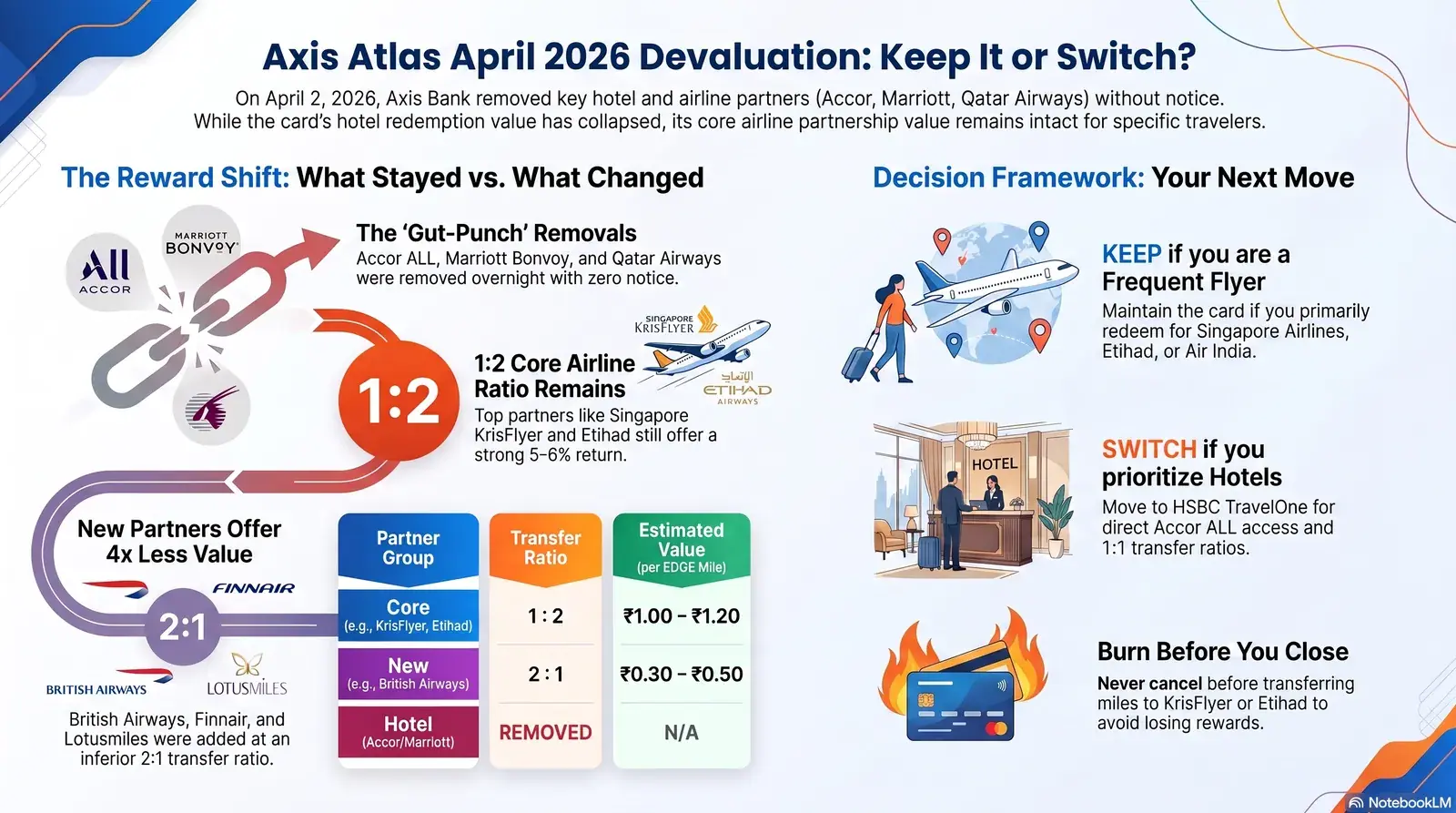
- What happened: Axis Bank removed Accor ALL, Marriott Bonvoy and Qatar Airways Privilege Club from the EDGE Miles programme on 2 April 2026 with zero advance notice — a violation of its own MITC.
- What's still worth it: Core partners (Singapore KrisFlyer, Air India Maharaja Club, Etihad, United MileagePlus, Turkish Airlines) still transfer at 1:2. At ~₹0.50–0.60 per KrisFlyer mile in economy, each EDGE Mile is worth roughly ₹1.00–1.20 when transferred — a ~5–6% return on travel spends.
- What to do: If hotels were your primary redemption target, the HSBC TravelOne (₹4,999/year) is now the strongest replacement. Atlas cardholders who fly Singapore Airlines, Etihad or Air India should hold — the airline partners remain strong.
₹5,000 + GST
5 EDGE Miles per ₹100
Singapore KrisFlyer (1:2)
British Airways / Finnair / Lotusmiles (2:1)
In this guide
- What changed on 2 April 2026
- What EDGE Miles are worth today
- Is the ₹5,000 annual fee still justified?
- Who is hurt most
- Keep, downgrade or cancel: a decision framework
- Best alternatives: HSBC TravelOne, Axis Horizon, HDFC Regalia Gold
- How to burn your EDGE Miles before further changes
- Lessons for Indian cardholders: devaluation risk and diversifying points
- Frequently asked questions
1. What changed on 2 April 2026 — and why it matters
Axis Bank removed Accor Live Limitless (ALL), Marriott Bonvoy and Qatar Airways Privilege Club from its EDGE Miles transfer programme effective 2 April 2026 — with zero advance notice to cardholders. Simultaneously, three new partners were added — British Airways Executive Club (Avios), Finnair Plus and Vietnam Airlines Lotusmiles — but at conversion ratios that are far inferior to the existing lineup.
The change went live overnight on 1–2 April 2026. There was no email to cardholders, no banner in the Axis Bank app, and no press release. This matters legally: Axis Bank's own MITC states that material changes to cardholder features require 30 days' prior written intimation, as mandated under the Reserve Bank of India's Master Direction — Credit Card and Debit Card Issuance and Conduct, 2022. Removing transfer partners with immediate effect almost certainly violates this provision, though RBI has not issued a formal response as of August 2026.
- Accor Live Limitless (ALL) — the most-used hotel partner for Indian cardholders in Europe, the Middle East and Asia-Pacific
- Marriott Bonvoy — removed simultaneously, eliminating the top global hotel loyalty programme from the EDGE ecosystem
- Qatar Airways Privilege Club — widely used for India–Gulf–Europe flights via Doha
What replaced them matters too. British Airways Executive Club, Finnair Plus and Vietnam Airlines Lotusmiles were added — but for Axis Atlas cardholders specifically, these transfer at 2:1 (you need 2 EDGE Miles to get 1 Avios or Finnair point). Compare that to the standard 1:2 for core partners like Singapore KrisFlyer (where 1 EDGE Mile becomes 2 KrisFlyer miles). The effective value from the new partners is roughly 4 times worse than the core group for Atlas holders.
On-the-Ground Insight: "I had 2,40,000 EDGE Miles earmarked for an Accor stay in Paris during a Europe trip. I woke up on 2 April to find Accor gone from the portal without a single notification. I had to pivot entirely — I transferred to Singapore KrisFlyer instead, but the hotel redemption value I was expecting is simply not available anymore." — Karthik R., Software Engineer, Bengaluru
2. What are EDGE Miles worth today?
After the April 2026 changes, EDGE Miles on the Axis Atlas still deliver strong value when transferred to core airline partners — specifically those in the 1:2 transfer group — but hotel redemption value has collapsed. Here is the complete picture for August 2026.
Core partners — still at 1:2 for Axis Atlas
For the Axis Atlas, the 1:2 ratio means every 1 EDGE Mile becomes 2 partner miles. The partners in this group include Singapore Airlines KrisFlyer, Air India Maharaja Club, Flying Blue (Air France/KLM), Etihad Guest, United MileagePlus, Turkish Airlines Miles&Smiles, Qantas Frequent Flyer, Japan Airlines (JAL) Mileage Bank, Aeroplan (Air Canada), IHG One Rewards, Wyndham Rewards and SpiceJet SpiceClub.
At an economy cabin redemption value of approximately ₹0.50–0.60 per Singapore KrisFlyer mile (based on redemptions verified in mid-2026 for Indian departures), each EDGE Mile transferred to KrisFlyer is worth roughly ₹1.00–1.20. The Atlas earns 5 EDGE Miles per ₹100 on travel and dining spends — meaning for every ₹100 charged to the card, you earn 10 KrisFlyer miles worth approximately ₹5.00–6.00. That is a 5–6% effective return on travel, which remains highly competitive at the ₹5,000 annual fee level.
New inferior partners — 2:1 for Axis Atlas
British Airways Executive Club (Avios), Finnair Plus and Vietnam Airlines Lotusmiles convert at 2:1 for Atlas cardholders — meaning 2 EDGE Miles become only 1 Avios or Finnair point. The effective travel earning rate on these partners drops to roughly 1.25–1.5%, barely ahead of cashback cards. These three partners are not worth targeting for Atlas holders.
| Transfer Partner | Group | Atlas Ratio | EDGE Miles → Partner Miles (per 10,000) | Estimated Value per EDGE Mile | Verdict |
|---|---|---|---|---|---|
| Singapore KrisFlyer | Group B | 1:2 | 20,000 KrisFlyer miles | ~₹1.00–1.20 | Best |
| Air India Maharaja Club | Group B | 1:2 | 20,000 Maharaja miles | ~₹0.70–1.00 | Strong |
| Etihad Guest | Group B | 1:2 | 20,000 Etihad miles | ~₹0.80–1.10 | Strong |
| Turkish Airlines Miles&Smiles | Group B | 1:2 | 20,000 M&S miles | ~₹0.70–1.00 | Good |
| Flying Blue (Air France/KLM) | Group B | 1:2 | 20,000 Flying Blue miles | ~₹0.70–0.90 | Good |
| United MileagePlus | Group B | 1:2 | 20,000 MileagePlus miles | ~₹0.70–1.00 | Good |
| British Airways Club (Avios) | Group A | 2:1 | 5,000 Avios | ~₹0.30–0.50 | Avoid |
| Finnair Plus | Group A | 2:1 | 5,000 Finnair points | ~₹0.25–0.40 | Avoid |
| Lotusmiles (Vietnam Airlines) | Group A | 2:1 | 5,000 Lotusmiles | ~₹0.20–0.35 | Avoid |
Source: Axis Bank TravelEdge portal ratios, verified August 2026. Value estimates based on typical economy-class award redemptions for Indian departures.
Annual transfer cap for Axis Atlas
The Axis Atlas carries an annual cap of 1,50,000 EDGE Miles — of which only 30,000 can go to Group A partners (including British Airways, Finnair, Lotusmiles), and up to 1,20,000 can go to Group B partners (the core airline and hotel group). This cap is lower than the Axis Horizon (5,00,000) and Magnus (5,00,000), which limits very high-volume users. At 5 EDGE Miles per ₹100 on travel, hitting the 1,50,000 cap requires approximately ₹30 lakh in total tracked travel spends — comfortably above the card's typical user profile.
3. Is the ₹5,000 annual fee still justified?
For cardholders who fly Singapore Airlines, Etihad, Air India or Turkish Airlines regularly, the Axis Atlas ₹5,000 annual fee still breaks even in under four months of moderate travel spend — the core airline partners remain strong. For hotel-first redeemers, the value proposition has been severely damaged.
What the fee actually gets you
The Axis Atlas charges ₹5,000 (plus 18% GST = ₹5,900 effective) per year. In return, cardholders receive welcome and renewal EDGE Miles (2,500 EDGE Miles for Gold tier; 5,000 EDGE Miles for Platinum tier members), lounge access at 8 domestic and 4 international lounges per quarter, and an accelerated 5 EDGE Miles per ₹100 on travel and dining.
At the Gold renewal benefit of 2,500 EDGE Miles, transferred to Singapore KrisFlyer at 1:2, you receive 5,000 KrisFlyer miles worth approximately ₹2,500–₹3,000 at economy rates — not enough on its own to cover the fee. But the milestone reward changes the picture: at ₹15 lakh annual spend, cardholders receive an additional 10,000 EDGE Miles, bringing the renewal picture to 12,500 EDGE Miles (25,000 KrisFlyer miles) — worth roughly ₹12,500–₹15,000. That is three times the annual fee in raw travel value.
Tier structure
| Tier | Spend Required | Renewal EDGE Miles | Milestone Bonus | KrisFlyer Miles Equivalent |
|---|---|---|---|---|
| Gold | Below ₹7.5 lakh | 2,500 | — | 5,000 |
| Platinum | ₹7.5 lakh and above | 5,000 | 10,000 (at ₹15L spend) | Up to 30,000 |
The verdict: the Atlas annual fee is justified if you spend ₹7.5 lakh or more annually on the card and primarily redeem through airline partners. At Gold tier, value extraction depends heavily on actual spend velocity and your chosen transfer partner.
4. Who is hurt most by the April 2026 devaluation?
Hotel-redemption cardholders who built their reward strategy around Accor ALL or Marriott Bonvoy have taken the single largest blow — these partners offered 3–4× better hotel value than any remaining option. The impact on airline-focused users is comparatively minor.
Hotel-first redeemers: the biggest losers
Before April 2026, transferring EDGE Miles to Accor ALL allowed cardholders to book hotels across 5,700+ properties in the Accor network — including Novotel, Ibis, Mercure, Pullman and Fairmont brands. Typical redemptions in Ireland, France and the UAE offered 1 Accor ALL point = ₹1.50–₹2.50 of hotel value, making Accor the highest-value redemption in the EDGE ecosystem. With the removal, there is no equivalent hotel partner remaining on the Axis Atlas at favourable ratios.
Marriott Bonvoy removal is similarly damaging. Marriott properties in Dublin, London and Singapore were popular with Indian business travellers and students' visiting families. IHG One Rewards remains on the Atlas at 1:2, but IHG's footprint in India and Ireland is significantly smaller than Marriott's, and award availability is tighter.
Qatar Airways Privilege Club users: partially mitigated
Qatar Airways Privilege Club (now operating in the Avios ecosystem alongside British Airways) was removed alongside Accor and Marriott. However, British Airways Avios was added as a replacement. The catch: British Airways converts at 2:1 for Atlas cardholders — making it materially worse than Qatar was. For India-Gulf-Europe routing via Doha, there is no clean Atlas replacement at favourable rates.
Pure airline-mile collectors: limited impact
If your strategy was always to transfer to Singapore KrisFlyer, Etihad Guest, Air India Maharaja Club, Turkish Airlines or Flying Blue, the April 2026 changes have minimal effect. All these partners retain their 1:2 ratio and remain active on the Axis Atlas platform. Annual transfer caps are unchanged.
5. Keep, downgrade or cancel: a decision framework
Whether to keep your Axis Atlas, downgrade to the Axis Horizon, or exit the card entirely depends primarily on three factors: whether you primarily redeem for hotels or flights, your annual spend, and whether you have an existing EDGE Miles balance to protect.
| Your Profile | Recommendation | Reason |
|---|---|---|
| Fly Singapore Airlines / Etihad / Air India regularly | Keep Atlas | 1:2 ratio still gives 5–6% return on travel; the card earns well |
| Hotel redemptions were your primary goal (Accor / Marriott) | Move to HSBC TravelOne | TravelOne is the only Indian card with live Accor ALL 1:1 transfer |
| Want to stay with Axis at lower fee | Downgrade to Axis Horizon | ₹3,000 fee, same base earn rate, 5L annual transfer cap (3× Atlas) |
| High spender (₹10L+ annually), premium travel focus | Upgrade to Axis Magnus | Higher milestone bonuses, better earn rates, can be LTF with Burgundy account |
| Large idle EDGE Miles balance | Keep Atlas, burn miles first | Burn via KrisFlyer / Etihad / Maharaja Club before any further changes |
If you close the Atlas, do not do so before burning every EDGE Mile. A long-standing credit line also contributes positively to your CIBIL score — closing it reduces your total available credit and can dent your score in the short term.
🧮 EDGE Miles Value Calculator
Enter your current EDGE Miles balance and select a transfer partner to see the equivalent partner miles and estimated redemption value. Ratios are sourced from the Axis Bank TravelEdge portal (verified August 2026): core partners transfer at 1 EDGE Mile = 2 partner miles (1:2); British Airways, Finnair and Lotusmiles transfer at 2 EDGE Miles = 1 partner mile (2:1).
6. Best alternatives in 2026: HSBC TravelOne, Axis Horizon, HDFC Regalia Gold
The HSBC TravelOne is the standout replacement for hotel-redemption users, offering 20 transfer partners including Accor ALL at 1:1 — the only Indian credit card with direct Accor access after Axis removed it. For existing Axis ecosystem users, the Horizon is a solid downgrade path.
| Card | Annual Fee | Travel Earn Rate | Transfer Partners | Accor Access | Forex Markup | Annual Cap | Best For |
|---|---|---|---|---|---|---|---|
| Axis Atlas | ₹5,000 | 5 EDGE Miles/₹100 | ~22 partners | Removed | 3.5% + GST | 1,50,000 EDGE Miles | Existing holders on airline redemptions |
| HSBC TravelOne | ₹4,999 (waived at ₹8L spend) | 4 points/₹100 on travel | 20 partners at mostly 1:1 | Yes, 1:1 | ~2% | None | Hotel-first redeemers, Accor users |
| Axis Horizon | ₹3,000 | 2 EDGE Miles/₹100 (base) | Same as Axis ecosystem | Removed | 3.5% + GST | 5,00,000 EDGE Miles | Budget-conscious Axis users |
| HDFC Regalia Gold | ₹2,500 (waived at ₹4L spend) | 4 Reward Points/₹150 | Limited; no miles transfer | No | 2% | N/A | Low-fee, lounge access, forex savings |
| Axis Magnus | ₹12,500 (waivable with Burgundy) | 5 EDGE Miles/₹200 (higher milestones) | Same as Axis ecosystem | Removed | 3.5% + GST | 5,00,000 EDGE Miles | High spenders (₹10L+ annually) |
HSBC TravelOne: the Accor replacement
At ₹4,999 per year (waived if you spend ₹8 lakh or more in the preceding 12 months), the HSBC TravelOne earns 4 points per ₹100 on flights and travel aggregators, up to 50,000 accelerated points per month, reverting to 2 points per ₹100 above that. More importantly, it offers 20 transfer partners — 15 airlines and 5 hotel programmes — at mostly 1:1 transfer ratios, transferred instantly in-app with no annual cap. After Axis dropped Accor in April 2026, TravelOne became India's only credit card with direct Accor ALL transfers at 1:1. If hotel redemptions matter to you, this is the most important card change to consider in 2026. Con: the card's lounge access is limited (10 visits per year via LoungeKey and the HSBC TravelOne Lounge Program) and slightly lower than what heavy Atlas users enjoyed.
Axis Horizon: the downgrade path
The Axis Horizon costs ₹3,000 per year and earns 2 EDGE Miles per ₹100 on base spends — which seems lower than Atlas's 5 EDGE Miles on travel until you account for the fact that the Horizon receives the same accelerated travel earn rate through the TravelEdge portal. Its annual transfer cap is 5,00,000 EDGE Miles (more than 3× the Atlas's 1,50,000), which is a genuine advantage for high-volume users. The Horizon carries a 3.5% + GST forex markup, identical to the Atlas. One downside: the Horizon's lounge visits are capped differently and its milestone structure is less generous than the Atlas. The Horizon is the right choice if you want to remain in the Axis ecosystem, want a lower fee, and primarily redeem for flights rather than hotels.
HDFC Regalia Gold: the forex-efficient backup
The HDFC Regalia Gold carries a ₹2,500 annual fee (waived if you spend ₹4 lakh in the year). It offers 2% foreign currency markup — 1.5 percentage points lower than the Atlas — plus 3 domestic lounge visits per quarter (on ₹60,000 quarterly spend) and 6 international Priority Pass visits per year. It is not a miles card in the traditional sense, but for cardholders who book international flights regularly and value forex savings over transferable points, it fills a gap. Con: reward points cannot be transferred to airline miles directly; they redeem via the SmartBuy portal, which offers lower flexibility than a pure miles programme.
7. How to burn your EDGE Miles before further devaluations
Do not let a large EDGE Miles balance sit idle on the Axis Atlas — redeem proactively through the strongest 1:2 partners while those ratios remain. Based on current valuations (August 2026), Singapore KrisFlyer, Etihad Guest and Air India Maharaja Club offer the best returns.
The strongest burn partners (in order of value)
Singapore KrisFlyer offers the highest and most consistent economy-class value for Indian travellers — particularly for routes via Singapore to Australia, Japan, North America and Europe. Transferring 60,000 EDGE Miles yields 1,20,000 KrisFlyer miles: enough for a one-way Business Class award on Singapore Airlines from Mumbai to Singapore (around 70,000–85,000 KrisFlyer miles), representing exceptional value. At economy rates, 1,20,000 KrisFlyer miles can cover a round-trip from India to Southeast Asia or a one-way to Europe in Economy.
Etihad Guest is particularly useful for Ireland-India routing. A one-way Business Class award from Dublin to Mumbai via Abu Dhabi on Etihad typically costs 50,000–60,000 Etihad Guest miles, redeemable by transferring 25,000–30,000 EDGE Miles at 1:2. That is excellent value at the Atlas's annual fee level.
Air India Maharaja Club has expanded significantly post the Vistara merger, with Star Alliance earning and 2026 tier progression changes making it easier to accrue status. The 1:2 transfer ratio from Atlas to Maharaja Club works well for India-Europe redemptions on Air India or Star Alliance partners.
Partners to avoid when burning
British Airways Avios, Finnair Plus and Vietnam Airlines Lotusmiles all convert at the inferior 2:1 ratio for Atlas cardholders. Avoid burning into these unless you have no alternative — the per-mile value you receive is roughly one-quarter of what the core partners offer.
EDGE Miles on Axis Bank cards typically expire three years from the date of earning. Check your Axis Bank app or Axis Bank credit card portal for exact expiry dates on each tranche of miles. Redeem well before expiry — expired miles cannot be reinstated.
LRS and TCS context for international redemptions
For Indian cardholders using international credit cards for foreign spend, the Liberalised Remittance Scheme (LRS) TCS framework applies. Under the Finance Act 2025, the LRS TCS-free threshold is ₹10 lakh per financial year — meaning the first ₹10 lakh of foreign credit card spend in a year attracts no TCS. Above ₹10 lakh, 20% TCS applies. For most Atlas cardholders spending on travel within India or booking through Indian OTAs, TCS is not triggered on standalone air ticket purchases (TCS has never applied to domestic airline ticket bookings). However, international spending — hotels abroad, foreign OTAs — counts toward the ₹10 lakh LRS limit and can trigger TCS above the threshold.
8. Lessons for Indian cardholders: devaluation risk and diversifying points
The Axis Atlas April 2026 devaluation is the latest in a series of sweeping changes that have redefined India's premium travel card landscape — and it carries a clear lesson: concentrating all reward spend on a single card's ecosystem is high-risk when banks can change the rules overnight.
On-the-Ground Insight: "I moved half my spends to the HSBC TravelOne after the Atlas devaluation. I had 1.8 lakh EDGE Miles sitting there with no hotel partner worth redeeming into. The lesson is to never keep all your points in one ecosystem — diversify across two programmes so a single devaluation does not wipe your strategy." — Priya M., Finance Professional, Mumbai
The pattern behind the devaluation
The Atlas discontinuation and devaluation fit a clear pattern in Indian banking. Cards that offered outsized value — particularly in the travel rewards space — are being rationalised as RBI scrutiny over reward program profitability has increased. The RBI Master Direction on Credit Card and Debit Card Issuance and Conduct (2022, updated) tightened standards for co-brand arrangements, reward disclosures and benefit modification notices. Banks are responding by shrinking their most generous reward structures.
Axis Bank's timeline with the Atlas card tells the whole story: accelerated earn rates launched in 2021–22, business spend crackdowns and reward suspensions in 2024, category exclusions (gold, jewellery, rent) in April 2024, the April 2026 partner removal, and then the quiet discontinuation for new applicants in early 2026. Each step reduced the card's cost to the bank. Further changes to existing cardholders' benefits cannot be ruled out.
Practical diversification strategy
Hold no more than 60–70% of your annual travel card spend on a single programme. A two-card strategy — one Axis ecosystem card (Atlas or Magnus) for core airline miles plus one flexible card (HSBC TravelOne or Amex Platinum Travel) for hotel transfers — provides resilience against programme-specific devaluations. Avoid concentrating large idle mile balances in any one programme; redeem quarterly rather than accumulating year-round.
Frequently asked questions
What changed on the Axis Atlas card in April 2026?
On 2 April 2026, Axis Bank removed Accor Live Limitless, Marriott Bonvoy and Qatar Airways Privilege Club from the EDGE Miles transfer programme with zero advance notice. Three new partners were added — British Airways Executive Club, Finnair Plus and Vietnam Airlines Lotusmiles — but at an inferior 2:1 ratio (2 EDGE Miles = 1 partner mile) versus the standard 1:2 for core partners.
What are EDGE Miles worth after the April 2026 devaluation?
On core partners like Singapore KrisFlyer, Air India Maharaja Club and Etihad Guest, Axis Atlas still transfers at 1:2 (1 EDGE Mile = 2 partner miles). At an economy redemption value of roughly ₹0.50–0.60 per KrisFlyer mile, each EDGE Mile is worth approximately ₹1.00–1.20 when transferred to Singapore Airlines — giving the Atlas a ~5–6% return on travel spends (5 EDGE Miles per ₹100). On the new inferior partners (British Airways, Finnair, Lotusmiles) the 2:1 ratio delivers roughly 0.5–0.7%, making those partners unviable.
Should I keep, downgrade or cancel my Axis Atlas card?
Keep the Atlas if you regularly transfer to Singapore KrisFlyer, Air India Maharaja Club, Etihad or Turkish Airlines (all still at 1:2), and if your annual spend generates enough value to justify the ₹5,000 fee. Downgrade to the Axis Horizon (₹3,000/year) if you want to stay in the Axis ecosystem at a lower fee. Cancel or switch if hotel transfers (Accor/Marriott) were your primary use case; the HSBC TravelOne now offers superior hotel transfer options.
Is the Axis Atlas credit card discontinued?
Yes. Axis Bank stopped accepting new Atlas credit card applications in early 2026 without any announcement. Existing cardholders continue to hold and use their cards with full benefits. Some cardholders are being offered an upgrade path to the Axis Horizon on renewal.
Which is the best alternative to the Axis Atlas after the devaluation?
The HSBC TravelOne (₹4,999/year) is the strongest like-for-like alternative in 2026: it earns 4 points per ₹100 on travel, offers 20 transfer partners at mostly 1:1 ratios including Accor ALL (the only Indian card with direct Accor access after Axis removed it), and has no annual transfer cap. For budget-conscious holders, the HDFC Regalia Gold (₹2,500/year, waived at ₹4L spend) provides 2% forex markup and 6 international Priority Pass visits.
Compare live Dublin–India fares before you book
Use the right card for the right booking. Check live fare calendars and compare airline options for India routes from Dublin — then apply your EDGE Miles or TravelOne points at checkout.
All information about Axis Bank EDGE Miles transfer ratios, partner availability, annual caps, fees and card benefits is based on publicly available official Axis Bank documentation and independent industry sources verified as of August 2026. Credit card terms change frequently; always verify current benefits, ratios and annual fees directly on the Axis Bank Atlas card page before making any decision. EDGE Miles value estimates are indicative and depend on your specific redemption choice. This article does not constitute financial advice. MyFlightOffers is not affiliated with Axis Bank, HSBC India, HDFC Bank or any card issuer mentioned.
- NEW Air India Maharaja Club Guide 2026 — Star Alliance miles, tier thresholds, April 2026 award chart changes, and which Indian cards transfer to Maharaja Points
- NEW HSBC TravelOne Credit Card Review 2026 — the Accor ALL replacement card, 20 partners, 1:1 transfers explained
- Axis Bank Credit Cards for Flight Bookings 2026 — full guide to EDGE Miles, Magnus, Horizon and Atlas for India-Europe routes
- HDFC Credit Card Flight Offers 2026 — SmartBuy maximisation, Infinia vs Regalia Gold, and OTA offers
- Transfer Credit Card Points to Airline Miles in India 2026 — which Indian cards feed which airline programmes and at what ratios
- NEW Emirates Skywards ICICI Credit Card Review 2026 — another airline co-brand that also cut earn rates in January 2026 and faces May 2026 award-price pressure — verdict on Emeralde vs Sapphiro and whether to keep it or switch to a flexible programme.