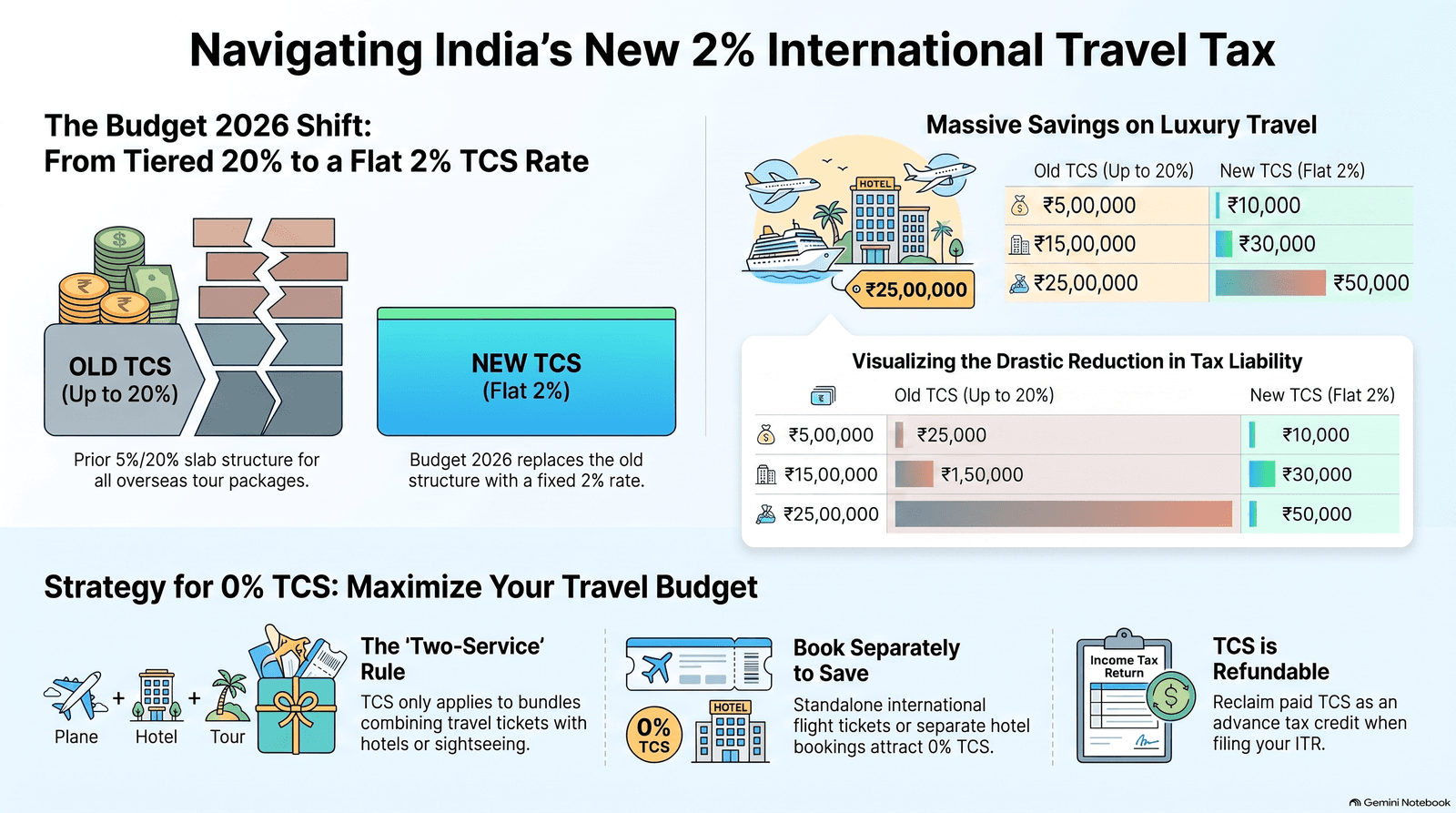
- New flat rate: Budget 2026 replaced the 5%/20% slab structure with a flat 2% TCS on all overseas tour packages from April 1, 2026 — a ₹5,00,000 package that previously attracted up to ₹25,000 TCS now incurs just ₹10,000.
- Flights are exempt: A standalone international flight ticket — booked without a bundled hotel or sightseeing — attracts zero TCS. Booking flights and hotels separately on different platforms completely avoids the package TCS.
- TCS is refundable: TCS is not a penalty — it is advance tax credit that you reclaim in full when filing your ITR for AY 2026-27, provided your tax liability is lower than TCS collected or you are a non-taxpayer.
Flat 2% on all overseas tour packages from April 1, 2026
5% on first ₹10 lakh of package cost; 20% on amount above ₹10 lakh
Zero — standalone flight tickets attract no TCS under Section 394(1)
Claim TCS credit in Schedule TCS when filing ITR for AY 2026-27
In this guide
- How Budget 2026 changed TCS on tour packages
- What counts as an overseas tour package?
- How separate booking eliminates TCS on flights
- TCS savings calculator
- How to claim your TCS refund at ITR filing
- Does TCS apply to NRIs and LRS remittances?
- Best platforms for separate flight and hotel bookings
- Frequently asked questions
How did Budget 2026 change TCS on international tour packages?
Budget 2026, presented in February 2026 and effective from April 1, 2026, replaced the old 5%/20% slab structure with a single flat 2% TCS on all overseas tour packages, regardless of the total cost. This is governed under the newly renumbered Section 394(1) of the Income Tax Act, 1961 (previously Section 206C(1G)).
The old structure was genuinely punishing for high-value holidays. From October 2023 through March 2026, a tour package cost above ₹10 lakh attracted 20% TCS on the portion exceeding that threshold — meaning a ₹15 lakh Europe family holiday saw TCS of ₹50,000 on the first ₹10 lakh (at 5%) plus ₹1,00,000 on the remaining ₹5 lakh (at 20%), totalling ₹1,50,000 in advance tax deducted before you even boarded the flight. From April 1, 2026, the same ₹15 lakh package incurs just ₹30,000 TCS at the flat 2% rate — an 80% reduction.
| Package Cost | Old TCS (before April 2026) | New TCS (Budget 2026, flat 2%) | Upfront Savings |
|---|---|---|---|
| ₹1,00,000 | ₹5,000 (5%) | ₹2,000 | ₹3,000 |
| ₹3,00,000 | ₹15,000 (5%) | ₹6,000 | ₹9,000 |
| ₹5,00,000 | ₹25,000 (5%) | ₹10,000 | ₹15,000 |
| ₹10,00,000 | ₹50,000 (5%) | ₹20,000 | ₹30,000 |
| ₹15,00,000 | ₹1,50,000 (5% on ₹10L + 20% on ₹5L) | ₹30,000 | ₹1,20,000 |
| ₹25,00,000 | ₹3,50,000 (5% on ₹10L + 20% on ₹15L) | ₹50,000 | ₹3,00,000 |
Old TCS: 5% on first ₹10 lakh, 20% on amount above ₹10 lakh. New: flat 2% from ₹0, effective April 1, 2026. Source: Income Tax India / Budget 2026 Finance Bill.
The TCS provision for overseas tour packages moved from Section 206C(1G) to Section 394(1) of the Income Tax Act, effective April 1, 2026. If your travel agent or bank references either section, they refer to the same rule. The flat 2% rate is the only material change.
What exactly counts as an overseas tour package for TCS?
An overseas tour package is any product sold by a tour operator or travel agent that bundles at least two of the following components for travel outside India: international travel tickets (air or sea), hotel accommodation (with or without meals), and local transfers, sightseeing, or guided tours. A standalone airline ticket — purchased on its own without any bundled service — is never classified as an overseas tour package and attracts zero TCS.
This definition has significant practical implications. A Dubai flight + hotel bundle sold by a travel agent as a single product triggers the 2% TCS. But if you book the Dubai flight on MakeMyTrip and the Dubai hotel on Booking.com under two separate transactions, neither qualifies as a tour package — no TCS applies to either.
| Booking Type | TCS Applicable? | Rate | Example |
|---|---|---|---|
| Flight + Hotel bundle (single booking) | ✅ Yes | 2% of total package cost | Thomas Cook Dubai 5-night package ₹80,000 → TCS ₹1,600 |
| Flight + Hotel + Tour (all-inclusive) | ✅ Yes | 2% of total package cost | Cox & Kings Europe 10-night tour ₹2,50,000 → TCS ₹5,000 |
| Standalone international flight ticket | ❌ No | 0% | Delhi–London economy on British Airways booked via EaseMyTrip |
| Standalone hotel booking abroad | ❌ No | 0% | 3 nights at a London hotel booked directly on Booking.com |
| Flight + hotel booked separately (two invoices) | ❌ No | 0% | Air India ticket on MakeMyTrip + hotel on Agoda — separate transactions |
When MakeMyTrip or EaseMyTrip prompts you to "Add a hotel and save more" during checkout, accepting that prompt converts your standalone ticket into a bundled package — and activates TCS. Always check whether your final invoice is for a flight-only ticket or a combined package before paying.
How does booking flights and hotels separately eliminate TCS?
Booking your international flight and your hotel as two independent transactions — under separate invoices, from separate platforms — means neither transaction meets the legal definition of an overseas tour package, and therefore neither attracts TCS. This is fully legal and the most commonly used strategy among Indian frequent flyers who understand TCS mechanics.
The arithmetic is compelling even under the new flat 2% rate. Consider an Indian professional booking a 7-night Singapore trip costing ₹1,20,000 total: ₹50,000 for flights and ₹70,000 for the hotel. As a bundled package, TCS = 2% × ₹1,20,000 = ₹2,400. As two separate bookings, TCS = ₹0. The cash stays in your account rather than being locked as an advance tax credit for 6–9 months until ITR processing.
True Upfront Cost = Package Price + TCS (2%) vs. Flight Ticket + Hotel (0% TCS)
On a ₹1,20,000 trip, separate booking avoids ₹2,400 in immediate cash outflow. On a ₹5,00,000 luxury holiday, it avoids ₹10,000 in advance tax tied up until ITR refund.
On-the-Ground Insight: "I booked a Dubai trip for my parents last Diwali through a travel agent — a ₹2,80,000 package. The agent collected ₹5,600 as TCS at the time. I only recovered it seven months later when I filed their ITR. This year I booked the flights on EaseMyTrip and the hotel directly on the Marriott website. Zero TCS, and I could allocate that ₹5,600 to their pocket money instead." — Rohan M., finance professional, Mumbai, August 2026
Calculate your TCS savings: old rate vs new rate
Use this calculator to compare the TCS charged under the old 5%/20% slab structure (pre-April 2026) versus the new flat 2% rate under Budget 2026. The old rate applied 5% on the first ₹10 lakh and 20% on any amount above ₹10 lakh. The new rate is a flat 2% from the first rupee. The calculator below is pre-filled with ₹5,00,000 (₹500,000) — the same mid-range package cost used as the worked example earlier in this guide (see the TL;DR above and the comparison table) — but you can enter your own package cost.
🧮 TCS Savings Calculator — Budget 2026
Compare TCS under the old 5%/20% slab structure versus the new flat 2% rate for your overseas tour package.
How do you claim TCS back when filing your ITR?
TCS collected on an overseas tour package is not a final tax — it is advance tax credit that offsets your income-tax liability when you file your Income Tax Return (ITR) for Assessment Year 2026-27. Any excess TCS (where your tax liability is lower than the TCS collected, or if you are not a taxpayer) is refunded to your bank account by the Income Tax Department.
The step-by-step process for AY 2026-27:
Step 1 — Collect your TCS certificate (Form 27D). Your travel agent is legally required to issue a Form 27D showing the TCS collected, your PAN, and the nature of payment. Demand this at the time of booking; it is the primary document for your ITR claim.
Step 2 — Verify TCS in Form 26AS and AIS. Log in to incometax.gov.in and open Form 26AS (tax statement) and your Annual Information Statement (AIS). The TCS collected by the travel agent should appear as a credit under "Tax Collected at Source" within 30–45 days of the transaction. Cross-check the figures against your Form 27D — any discrepancy must be resolved with the travel agent before filing.
Step 3 — File your ITR and claim Schedule TCS. When you open a new ITR filing for AY 2026-27 (covering income earned during FY 2025-26 or FY 2026-27 as applicable), the portal auto-populates Schedule TCS with the TCS entries from your Form 26AS. Verify these figures, ensure your PAN is correctly quoted, and proceed to submit. The TCS credit reduces your net payable tax. If TCS exceeds your liability, the portal calculates a refund automatically.
Step 4 — E-verify your return. Without e-verification, refund processing does not begin. The fastest method is Aadhaar OTP via the Income Tax portal. Clean returns with no liability mismatches typically see TCS refunds credited within 4–8 weeks of e-verification.
The standard deadline for salaried individuals (ITR-1 / ITR-2) is July 31, 2026. If you missed this, a belated return can be filed until December 31, 2026, though a late filing fee of up to ₹5,000 under Section 234F applies. File on time to receive your TCS refund faster.
Does TCS under Section 394(1) apply to NRIs and OCI card holders?
TCS on overseas tour packages under Section 394(1) applies when a tour operator or travel agent in India collects payment from the buyer — and it is the residency status of the buyer under FEMA that determines applicability, not citizenship or OCI status. In practical terms, NRIs are largely unaffected, but the details matter.
The Reserve Bank of India's Liberalised Remittance Scheme governs outward remittances for resident Indians and sets the framework within which most TCS-related provisions operate. NRIs — defined as individuals who are not residents of India under FEMA — do not use LRS and are therefore not subject to TCS on their foreign remittances from NRE or NRO accounts. Their remittance channels are separately governed by RBI's NRI banking guidelines.
| Buyer Profile | TCS on Tour Package? | Notes |
|---|---|---|
| Indian Resident (in India) — booking via Indian travel agent | ✅ Yes — flat 2% (Budget 2026) | Applies from first rupee; no threshold |
| NRI (FEMA non-resident) — booking from abroad via Indian OTA | ❌ No | LRS does not apply to NRIs; NRE/NRO remittance channels are separate |
| OCI card holder residing outside India (NRI status) | ❌ No | OCI holders living abroad have NRI FEMA status; same exemption as NRI |
| OCI / PIO card holder currently resident in India (Indian resident under FEMA) | ✅ Yes — flat 2% | Residency under FEMA determines applicability, not citizenship or OCI status |
| NRI visiting India and purchasing tour package from Indian agent while on visit | ⚠️ May apply | If the tour agent processes the booking as a resident transaction and collects INR, TCS may be levied. Verify with agent and check Form 26AS. |
For Indian students studying abroad (e.g., in Ireland or the UK) who have become NRIs for FEMA purposes: if you book a holiday to Europe through an Indian travel agent while on a visit to India, the agent may levy TCS. If you book the same trip online from your country of residence using your NRE-linked debit card or international credit card, no TCS applies. The transaction's point of origination and the FEMA status at the time of booking are both relevant.
A separate TCS provision applies to general LRS remittances (investments, gifts, property, maintenance of relatives abroad). From April 1, 2026, this rate remains at 20% on amounts above ₹10 lakh per financial year per PAN — not 2%. The flat 2% applies exclusively to overseas tour packages. Do not confuse the two. If you remit ₹15 lakh to a foreign bank for investment purposes, ₹1 lakh in TCS applies on the ₹5 lakh above the ₹10 lakh threshold.
Which platforms should you use to book flights and hotels separately?
To avoid TCS entirely, you need to ensure your flight and hotel are purchased under two separate invoices from two separate providers — and that neither provider bundles them into a single "holiday package" at checkout. The following platforms reliably support standalone flight booking without cross-selling bundled packages in the payment flow.
| Platform | Type | Standalone Flights? | Key Indian Bank Card Offers (2026) | Watch Out For |
|---|---|---|---|---|
| EaseMyTrip | Indian OTA | ✅ Yes — flight-only booking supported | ICICI, SBI, Axis card offers; zero convenience fee on select dates | Upsell prompts to add hotel at checkout — decline to keep it flight-only |
| MakeMyTrip | Indian OTA | ✅ Yes — book via "Flights" tab only | HDFC, ICICI, Kotak card offers; holiday packages show TCS | If you use the "Holidays" tab, it creates a bundled package — use only the "Flights" tab |
| Cleartrip | Indian OTA (Flipkart group) | ✅ Yes | Flipkart Plus rewards; HDFC and Axis card discounts | No bundled holiday packages sold directly — lower upsell risk |
| Air India / Airline direct | Airline direct | ✅ Yes — always standalone tickets | Air India credit card discounts; student fares on ISIC validation | No hotel bundling; safest option to guarantee standalone status |
| Booking.com | Hotel platform | ❌ (hotels only) | Genius loyalty discounts; credit card cashback | Book hotel here after separate flight booking to maintain split-invoice status |
The safest workflow: book your international flight directly on the airline's website or via EaseMyTrip/MakeMyTrip Flights tab, paying with an Axis or HDFC travel credit card to maximise reward points. Then, 24–48 hours later, book the hotel separately on Booking.com or directly with the property. Keep both invoices on file to demonstrate the split-booking structure if ever questioned.
When you pay for an international flight or hotel on a non-Indian website, the checkout page may offer to charge your Indian card in INR. Always decline and pay in the local currency (USD, EUR, GBP). DCC typically adds 4%–7% above the mid-market rate on top of your card's own forex markup. Use a zero-forex-markup card such as OneCard or a travel card with low forex fees to minimise total transaction cost.
Frequently asked questions
What is the TCS rate on international tour packages after Budget 2026?
Budget 2026 introduced a flat 2% TCS on overseas tour packages from April 1, 2026 — replacing the previous 5% (up to ₹10 lakh) and 20% (above ₹10 lakh) slab structure. This applies from the very first rupee with no exemption threshold.
Does TCS apply to standalone international flight tickets booked from India?
No. Standalone international flight tickets — booked independently without any bundled hotel, sightseeing, or ground transport — do not attract TCS. TCS under Section 394(1) of the Income Tax Act applies only to overseas tour packages, which must include at least two bundled services.
How do I claim a TCS refund on a tour package when filing my ITR?
TCS collected on your tour package appears in Form 26AS and your Annual Information Statement (AIS) on the incometax.gov.in portal. When you file your ITR for AY 2026-27, the portal pre-fills Schedule TCS with this credit. It offsets your total tax liability; any surplus is refunded to your bank account after e-verification of the return.
Does TCS on LRS or tour packages apply to NRIs?
No. The Liberalised Remittance Scheme (LRS) applies only to resident Indians as defined under FEMA. NRIs use NRE/NRO accounts governed by separate RBI rules and are not subject to TCS under Section 394(1) on their foreign remittances. However, if an NRI physically purchases a tour package from a travel agent inside India while on a visit, the package TCS may still be collected by the agent.
Which Indian OTAs let me book international flights and hotels separately to avoid TCS?
MakeMyTrip, EaseMyTrip, and Cleartrip all allow separate flight and hotel booking. Book only the flight on any OTA (standalone ticket, no bundled package), and then book the hotel independently on Booking.com, Agoda, or directly with the property. This split-booking strategy means zero TCS on the flight component.
Book your international flight TCS-free — compare live fares now
A standalone international flight ticket attracts zero TCS. Compare Emirates, Air India, Qatar Airways and Etihad fares on the MyFlightOffers fare calendar before you buy — then book direct or via an OTA's flight-only tab to keep your invoice clean.
All information about TCS rates, ITR filing deadlines, and LRS rules is based on publicly available official sources including the Budget 2026 Finance Bill, Income Tax India portal, and Reserve Bank of India guidelines as of August 2026. Tax laws change frequently — always verify the current position directly with a qualified chartered accountant or on incometax.gov.in. MyFlightOffers is not affiliated with the Income Tax Department, RBI, or any OTA mentioned. This article does not constitute tax or financial advice.
- Card Tokenisation and Flight Bookings India 2026 — how RBI's tokenisation mandate affects your saved card at checkout on airline sites
- Transfer Credit Card Points to Airline Miles India 2026 — convert HDFC, Axis and ICICI reward points to frequent-flyer miles at the best ratio
- HDFC Credit Card Flight Offers 2026 — current HDFC bank card discounts and cashback on MakeMyTrip, EaseMyTrip and airline bookings
- PhonePe Flight Booking Guide 2026 — how to use PhonePe UPI to book international flights and whether TCS applies