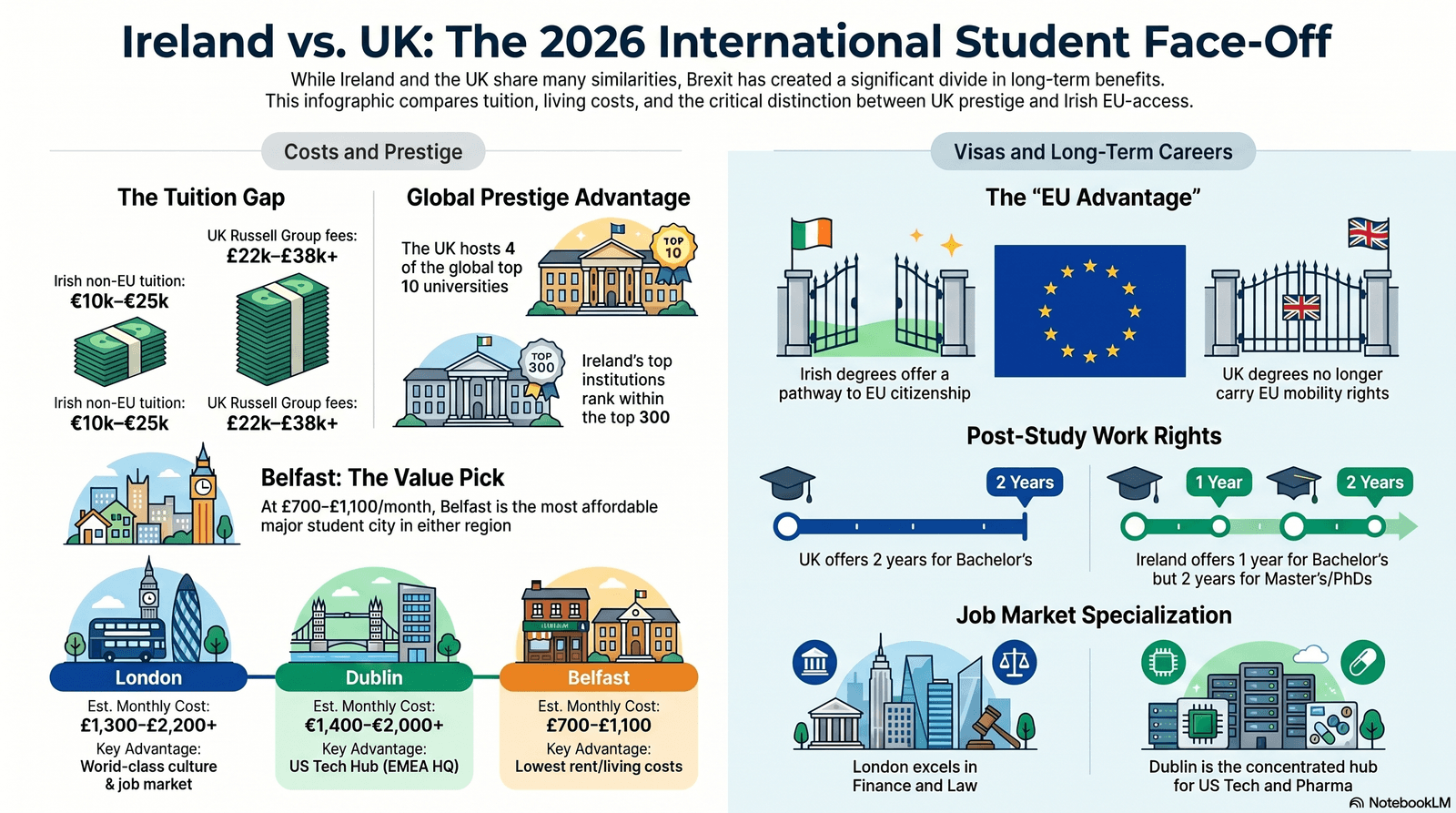
🏆 Higher-ranked universities
United Kingdom
Oxford #3, Cambridge #5, Imperial #8 (QS 2026)
🇪🇺 EU access after graduation
Ireland only
UK exited EU in 2020; Irish degrees carry full EU
recognition
💶 Lower non-EU tuition
Ireland (often)
€10k–€25k/yr vs £22k–£38k+ in the UK
🏙️ Most affordable city
Belfast
£700–£1,100/month — cheaper than Dublin or London
What this guide covers
Why This Comparison Matters in 2026
Ireland and the United Kingdom share a land border, a common language, centuries of intertwined history, and broadly similar academic cultures. From the outside, they can look interchangeable as study destinations. They are not — and the gap between them has widened significantly since Brexit.
The United Kingdom left the European Union on 31 January 2020. That single event reshaped what a UK degree means for an international graduate's long-term prospects. A degree from University College London no longer carries EU recognition for the purposes of freedom of movement. A degree from University College Dublin does. For a student from India, Nigeria, China, or Brazil who wants to build a career in Europe, this distinction is now the defining factor in the Ireland vs UK decision.
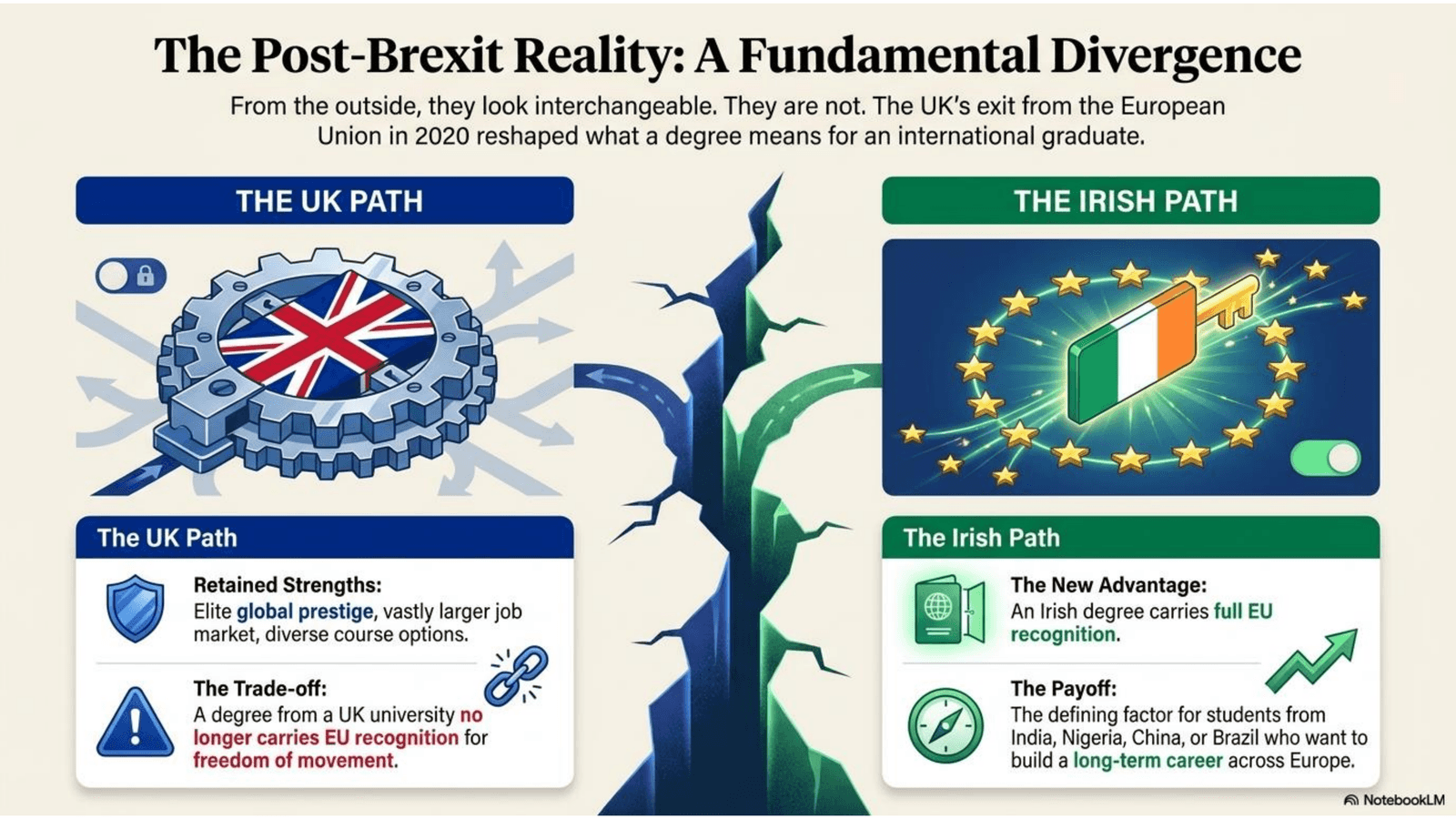
At the same time, the UK retains genuine strengths that Ireland cannot match: globally elite universities at the very top of the rankings, a vastly larger job market centred on London, and a more diverse range of courses and institutions across England, Scotland, Wales, and Northern Ireland. If your goal is a degree from Oxford, Cambridge, or Imperial College — and you intend to work in the UK or return home — the EU advantage of an Irish degree is irrelevant to you.
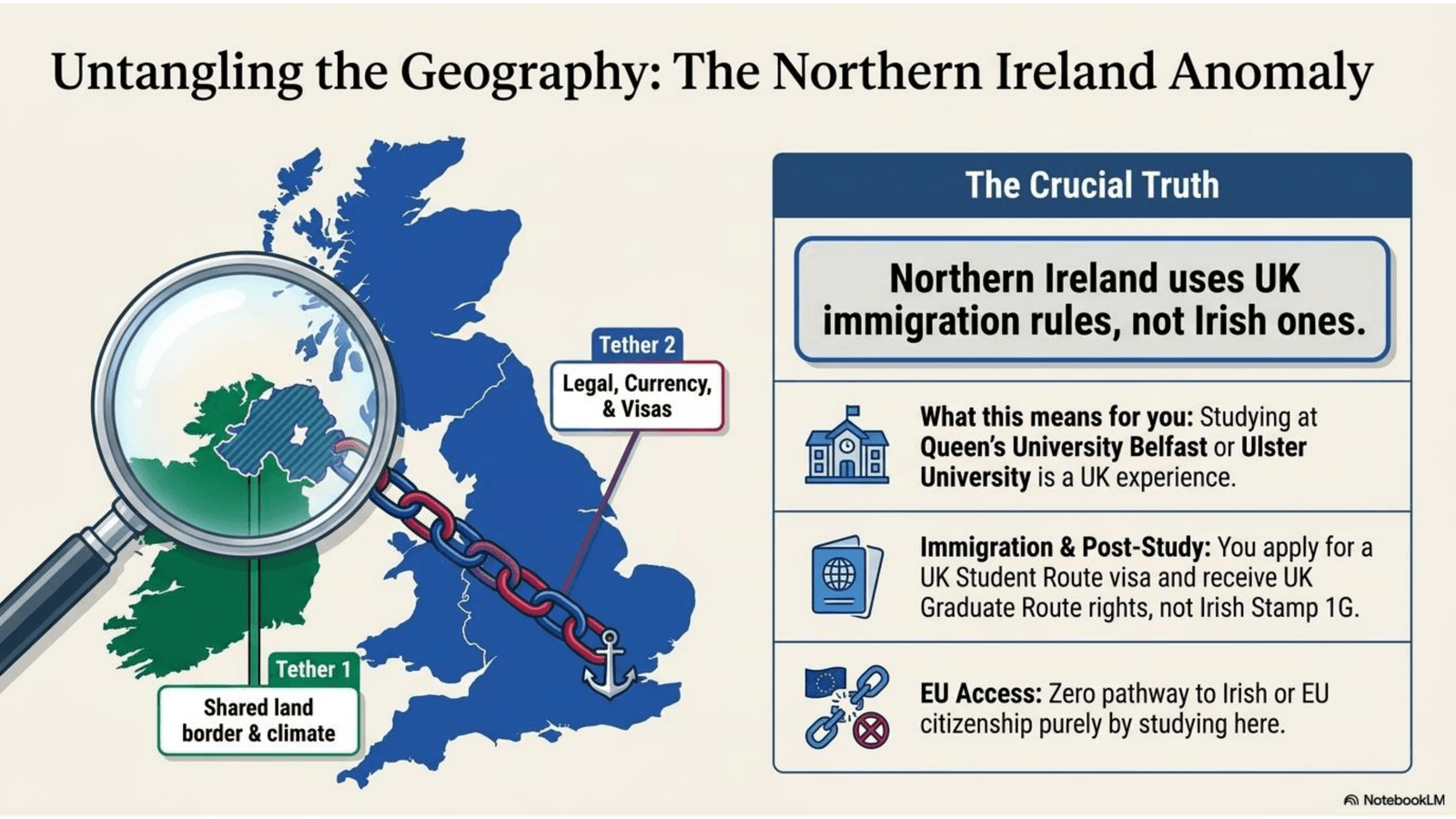
Northern Ireland adds a third dimension that most comparison guides ignore. It sits on the island of Ireland, shares a land border with the Republic, and is a fascinating cultural crossroads — but its immigration rules, tuition fees, and post-study work rights are entirely governed by UK law. Studying at Queen's University Belfast is a UK experience, not an Irish one.
The UK hosted approximately 679,970 international students in 2023–24 (HESA data), making it the world's second-largest destination for international higher education after the United States. Ireland hosted approximately 35,000 non-EU international students in 2025–26. Both countries are experiencing a housing crisis, rising living costs, and tightening immigration policy. Neither is getting cheaper.
Section 1 — Visa & Immigration
The immigration systems of Ireland and the UK diverged further after Brexit. Understanding both — and crucially, understanding what Northern Ireland means within the UK system — is essential before you apply.
United Kingdom: The Student Route UK
The UK's student immigration pathway is called the Student Route (previously Tier 4). Key facts for non-EU international students:
- You must have a Confirmation of Acceptance for Studies (CAS) from a UK Home Office-licensed sponsor university before applying
- Apply online via the UK Visas and Immigration (UKVI) portal; applications open 6 months before your course start date
- You must meet English language requirements (typically IELTS 5.5–7.0 depending on institution and course)
- You must show sufficient funds: £1,334 per month for up to 9 months in London; £1,023 per month elsewhere, plus your course fees
- A Biometric Residence Permit (BRP) was historically issued on arrival; from 2025, the UK is transitioning to a digital eVisa system — most new applicants now receive an eVisa rather than a physical BRP. Check current UKVI guidance before applying.
- Dependants: students on courses of 9 months or longer at postgraduate level may be able to bring dependants (rules tightened in January 2024)
Ireland: The Type D Study Visa and Stamp 2 Ireland
Ireland's study immigration pathway uses a Type D Long Stay Visa for non-EEA nationals whose courses exceed 90 days, followed by a Stamp 2 immigration permission upon arrival:
- Apply for the Type D Study Visa at your nearest Irish Embassy or Consulate; apply at least 8 weeks before your intended arrival
- Your course must be on the Interim List of Eligible Programmes (ILEP) — verify at irishimmigration.ie before applying
- On arrival, register with the Garda National Immigration Bureau (GNIB) in Dublin or Immigration Registration Officers elsewhere; you will receive an Irish Residence Permit (IRP) card. Registration fee: €300.
- Stamp 2 allows work of up to 20 hours per week during term and 40 hours per week during official academic holidays
- Irish visa is separate from UK visa — holding a UK Student visa does not give you the right to live or study in Ireland, and vice versa
Northern Ireland Northern Ireland
Despite being on the island of Ireland and sharing a land border with the Republic, Northern Ireland is part of the United Kingdom. International students at Queen's University Belfast or Ulster University apply for a UK Student Route visa — not an Irish visa. They receive UK post-study work rights under the UK Graduate Route — not Irish Stamp 1G. The physical proximity to Dublin is real; the immigration equivalence is not.
Post-Study Work Rights — the critical comparison
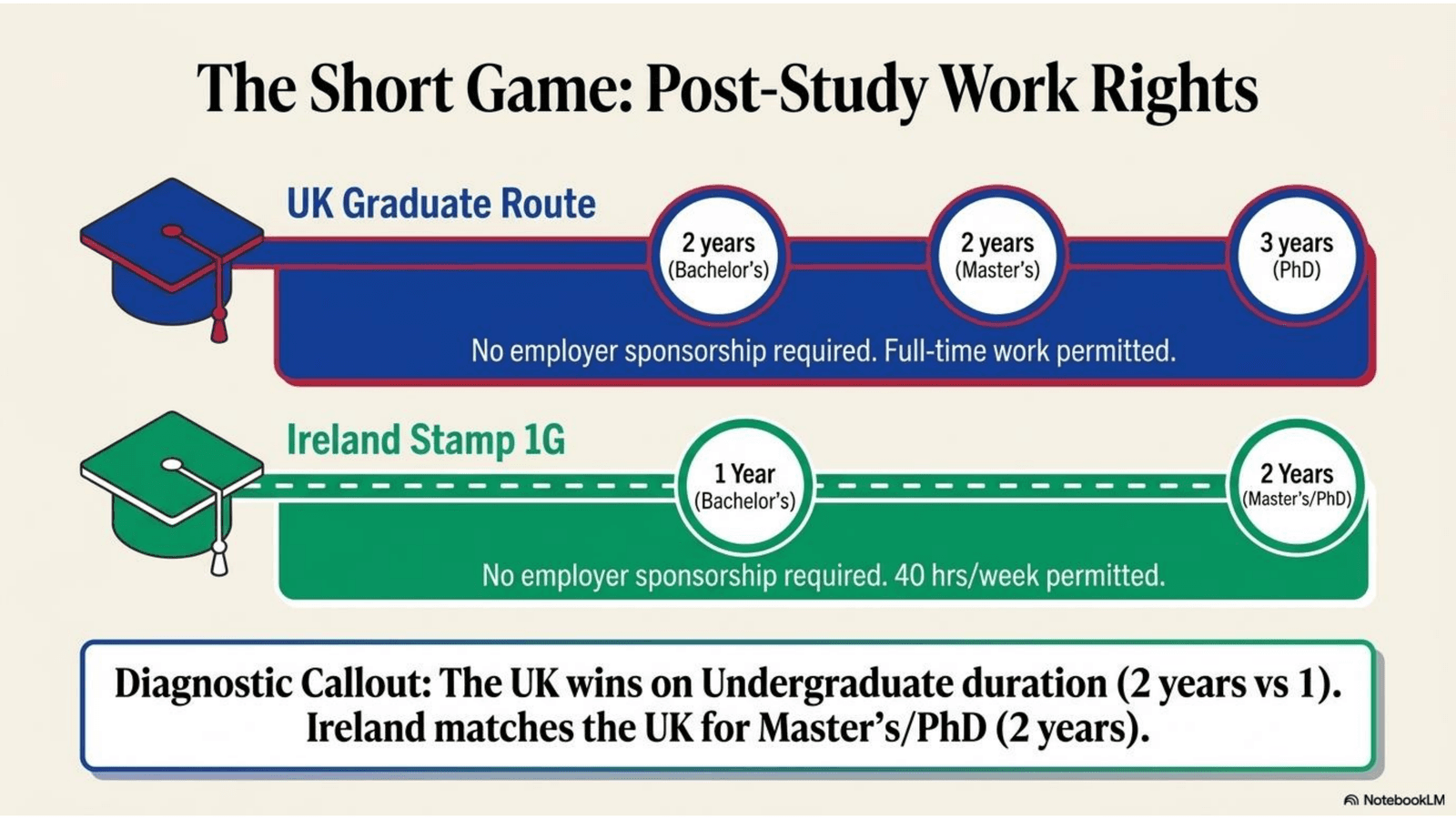
| Feature | UK Graduate Route | Ireland Stamp 1G |
|---|---|---|
| Duration (Bachelor's) | 2 years | 12 months |
| Duration (Master's) | 2 years | 24 months |
| Duration (PhD) | 3 years | 24 months |
| Employer sponsorship required? | No (during Graduate Route period) | No (during Stamp 1G period) |
| Work hours permitted | Full-time (no restriction) | Full-time (40 hrs/week) |
| Path to permanent residency | Skilled Worker visa required after Graduate Route; ILR after 5 years on eligible visa | Critical Skills Employment Permit → Stamp 4 after 21 months → IRP renewal; citizenship after 5 years |
| EU freedom of movement | ❌ No (post-Brexit) | ✅ Yes (via Irish citizenship path) |
| Applies to Northern Ireland? | ✅ Yes — UK rules apply | ❌ No — only Republic of Ireland |
Section 2 — Tuition Fees
Tuition fees are the single largest upfront cost in any study-abroad decision. The Ireland vs UK comparison on fees is more nuanced than it first appears.
United Kingdom — International Fees UK
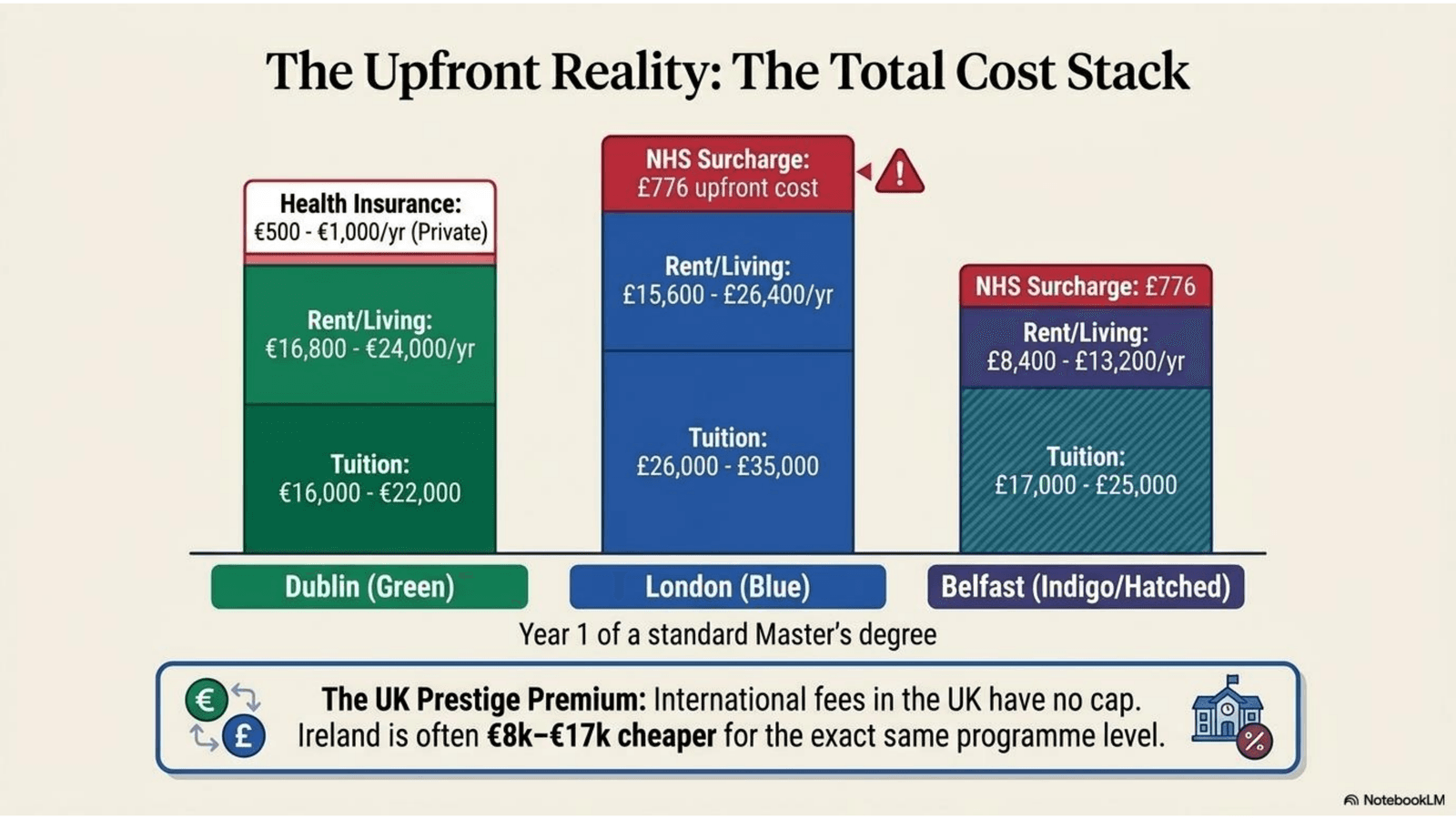
The UK introduced domestic undergraduate fee caps in 2024–25. For international (non-UK) students, no cap applies — universities set their own fees. At research-intensive Russell Group universities, international fees are now substantially higher than in Ireland at comparable programme levels.
| Programme Type | Domestic (UK/settled) | International (non-UK) | Typical Institutions |
|---|---|---|---|
| Undergraduate (Arts/Social Science) | £9,535/year (2024–25) | £22,000–£30,000/year | Manchester, Birmingham, Leeds, Edinburgh |
| Undergraduate (STEM/Engineering) | £9,535/year | £26,000–£38,000/year | Imperial, UCL, Manchester |
| Postgraduate (Taught Master's) | Varies (no cap) | £22,000–£35,000/year | King's College, LSE, Warwick |
| MBA | Varies | £40,000–£100,000+ (full programme) | London Business School, Oxford Saïd, Cambridge Judge |
| Medicine (MBBCh/MBBS) | £9,535/year | £37,000–£58,000/year | UCL, King's College, Edinburgh |
Republic of Ireland — Non-EU International Fees Ireland
| Programme Type | Non-EU International | Typical Institutions |
|---|---|---|
| Undergraduate (Arts/Social Science) | €10,000–€18,000/year | TU Dublin, Maynooth, ATU |
| Undergraduate (STEM/Engineering) | €14,000–€22,000/year | TCD, UCD, UCC, UL |
| Postgraduate (Taught Master's) | €12,000–€25,000/year | TCD, UCD, DCU, University of Galway |
| MBA (Smurfit School UCD) | €26,500/year (full-time programme) | UCD Michael Smurfit Graduate Business School |
| Medicine (MBBS equivalent) | €40,000–€60,000/year | RCSI, UCD, UCC |
Northern Ireland — International Fees Northern Ireland
Northern Ireland universities follow UK fee structures. International fees at Queen's University Belfast and Ulster University are in the same range as other UK institutions — typically £17,000–£27,000 per year for undergraduate and postgraduate programmes. Belfast's lower cost of living partially offsets this.
Section 3 — Cost of Living
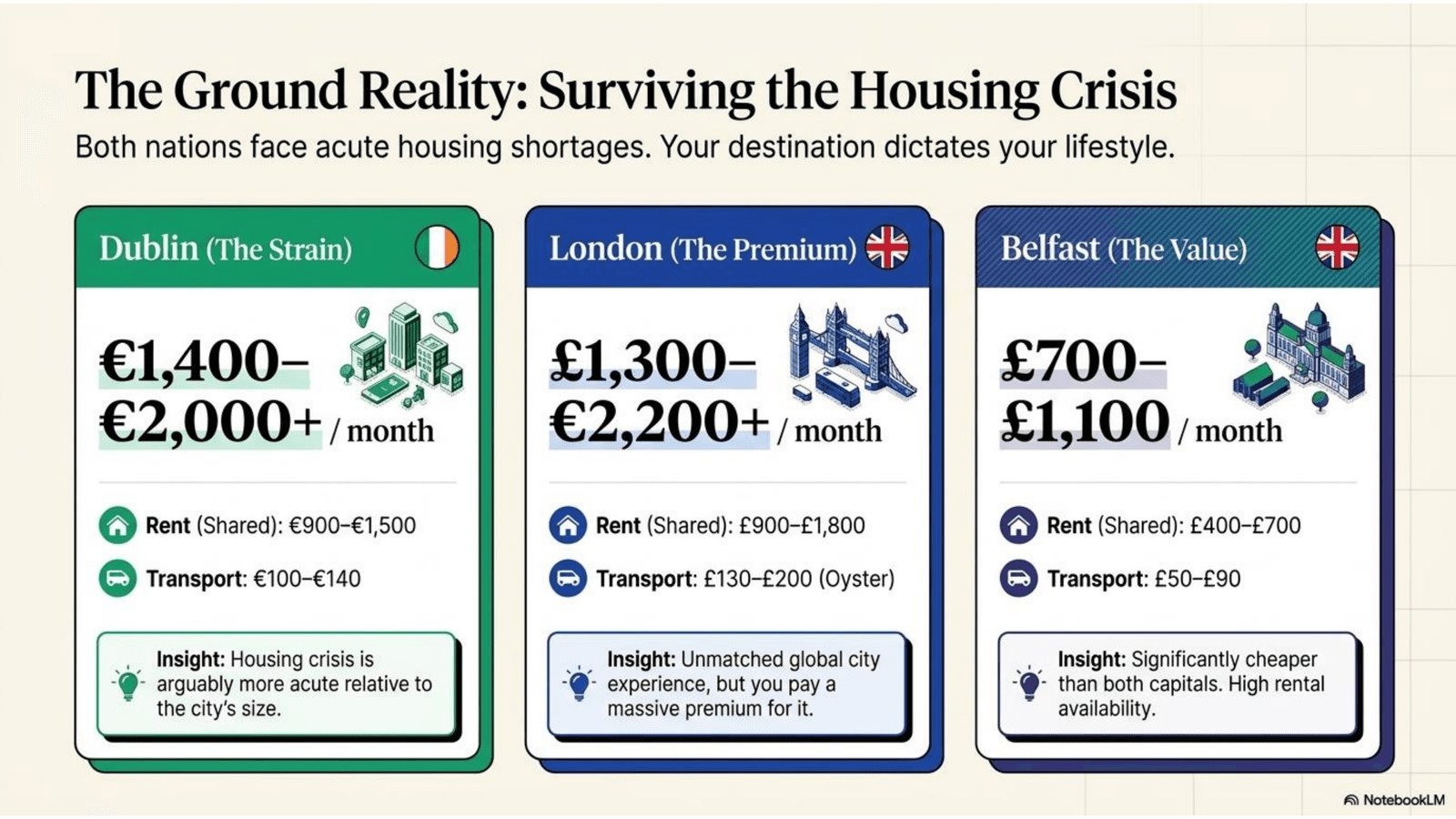
Both the UK and Ireland are facing a significant housing crisis that disproportionately affects students. Dublin and London are among the most expensive cities in Europe for renters. Belfast is a meaningful exception.
| Expense | Dublin 🇮🇪 | London 🇬🇧 | Belfast 🇬🇧 |
|---|---|---|---|
| Rent (shared room) | €900–€1,500 | £900–£1,800 | £400–£700 |
| Groceries | €200–€350 | £200–£350 | £160–£280 |
| Public transport | €100–€140 | £130–£200 (Oyster card) | £50–£90 |
| Phone plan | €15–€25 | £10–£25 | £10–£20 |
| Social / dining out | €80–€200 | £100–€250 | £60–£130 |
| Health insurance / NHS surcharge | €40–€80/month (private required) | NHS surcharge: ~£776/year (~£65/month) | NHS surcharge: ~£776/year (~£65/month) |
| TOTAL ESTIMATE | €1,400–€2,000+ | £1,300–£2,200+ | £700–£1,100 |
Mid-tier city comparison: Galway/Limerick vs Manchester/Leeds vs Belfast
| City | Country | Approx. Monthly Living Cost | Shared Room (monthly) |
|---|---|---|---|
| Belfast | Northern Ireland (UK) | £700–£1,100 | £400–£700 |
| Limerick | Ireland | €800–€1,200 | €500–€800 |
| Galway | Ireland | €1,000–€1,400 | €600–€900 |
| Manchester | England (UK) | £900–£1,400 | £600–£950 |
| Leeds | England (UK) | £850–£1,300 | £550–£900 |
| Edinburgh | Scotland (UK) | £1,000–£1,600 | £700–£1,100 |
International students on the UK Student Route must pay the Immigration Health Surcharge (IHS) upfront as part of their visa application. The current rate is £776 per year (as of April 2024; verify current rate at gov.uk/healthcare-immigration-application). For a 2-year master's programme, this adds £1,552 to your visa costs — a cost Ireland does not have. Ireland requires students to purchase private health insurance (approximately €500–€1,000/year), which is broadly comparable, though purchased annually rather than upfront.
Section 4 — University Rankings & Reputation
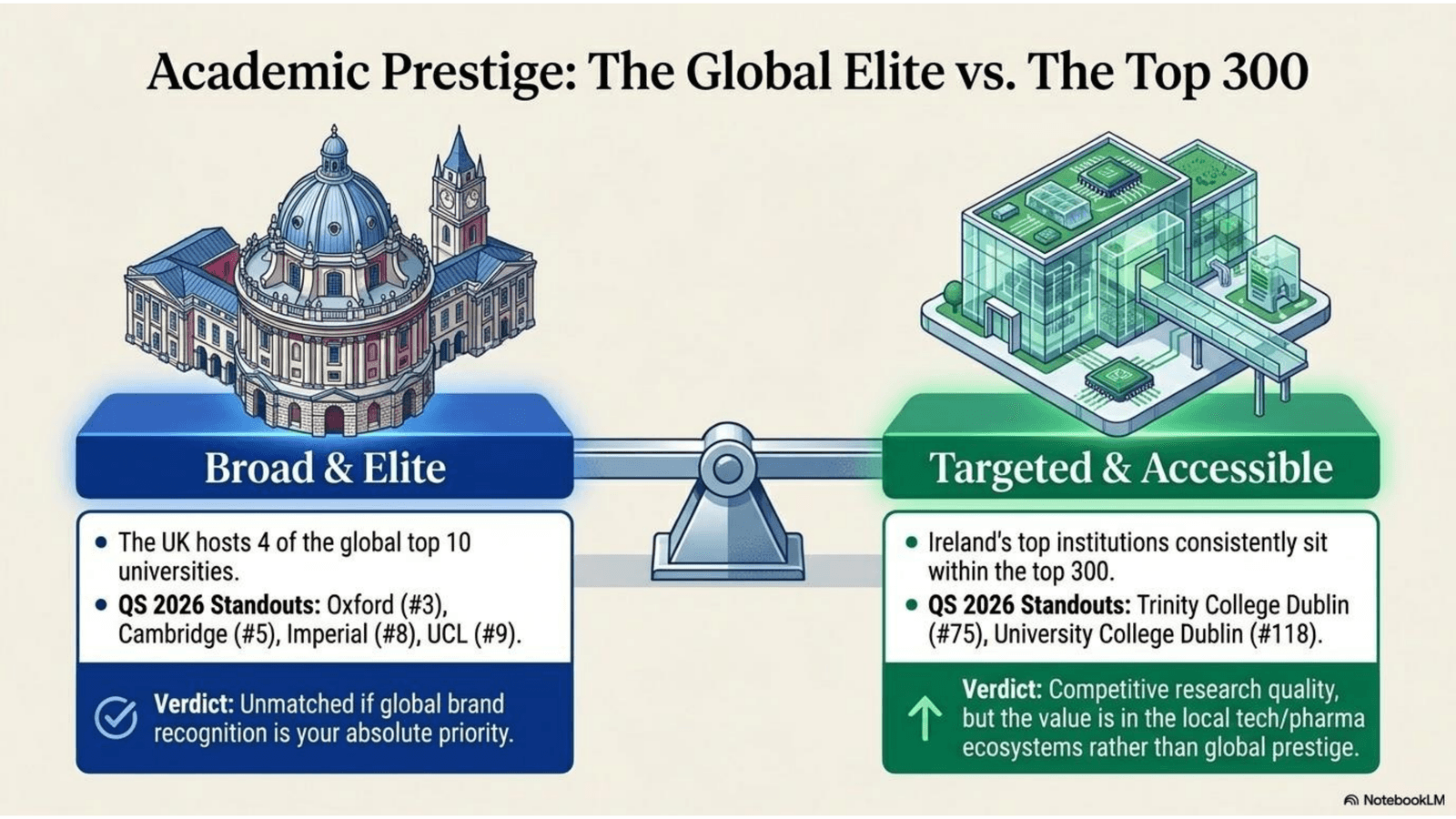
This is where the UK has an undeniable advantage at the very top of the global rankings. The honest assessment: if prestige and global brand recognition matter to your career goals, the UK's elite universities are stronger than anything Ireland can offer.
| University | Country | QS Rank 2026 | Strengths |
|---|---|---|---|
| University of Oxford | UK (England) | #3 | Humanities, law, medicine, sciences |
| University of Cambridge | UK (England) | #5 | STEM, mathematics, natural sciences |
| Imperial College London | UK (England) | #8 | Engineering, STEM, medicine |
| UCL (University College London) | UK (England) | #9 | Multi-faculty; medicine, architecture, arts |
| University of Edinburgh | UK (Scotland) | #27 | Medicine, law, arts, philosophy |
| University of Manchester | UK (England) | #34 | Business, engineering, life sciences |
| King's College London | UK (England) | #40 | Medicine, law, humanities |
| Queen's University Belfast | Northern Ireland (UK) | #201–250 | Law, medicine, engineering, humanities |
| Trinity College Dublin (TCD) | Ireland | #75 | Law, CS, humanities, medicine |
| University College Dublin (UCD) | Ireland | #118 | Business, engineering, agriculture |
| University College Cork (UCC) | Ireland | #246 | Pharmacy, food science, medicine |
| University of Galway | Ireland | #284 | Biomedical, engineering, law |
Value for Money vs. Prestige
Rankings are a single lens. For many career paths — particularly in technology, pharmaceuticals, financial services, and engineering — a degree from TCD or UCD combined with employment at Google Dublin, Pfizer Cork, or Citi Dublin carries more practical weight than a degree from a mid-ranked UK university that costs £10,000–£15,000 more per year.
The value-for-money frame is important. Ireland's top universities sit within the global top 300. For postgraduate study particularly, the research quality at TCD, UCD, and UCC is competitive with most UK institutions outside the Oxbridge/Russell Group elite. The question is not "Is Ireland's education inferior?" — it is "Does the UK prestige premium justify the additional fee and the loss of EU access?"
Scottish universities offer 4-year undergraduate degrees compared to England's 3-year standard. While domestic Scottish students pay no tuition fees, international students pay similar rates to English universities (£22,000–£35,000/year). Northern Ireland's Queen's University Belfast and Ulster University are typically lower-priced than English counterparts at £17,000–£25,000/year for most international programmes — placing them closer to Irish fee levels than London universities.
Section 5 — Employment After Study
Employment outcomes depend on where you want to work long-term — not just where you study. This section separates short-term work rights from long-term career geography.
UK: Graduate Route and the London Job Market UK
The UK Graduate Route (introduced July 2021) allows non-UK graduates from UK universities to stay and work in the UK for 2 years after completing their studies (3 years for PhD graduates). You can switch employers, change roles, and work in any sector without needing employer sponsorship during this period.
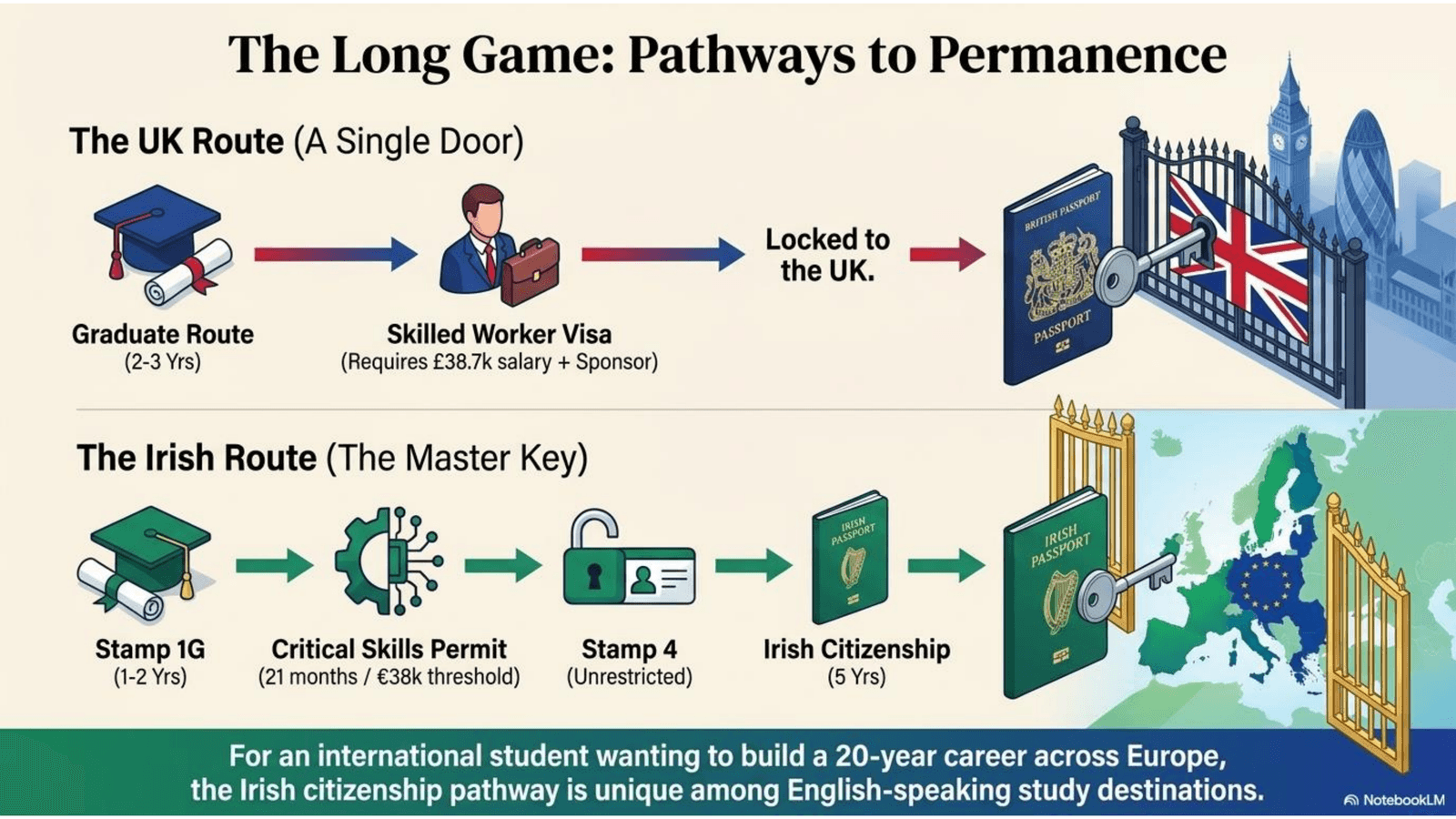
After the Graduate Route period, you must switch to a visa that requires employer sponsorship — primarily the Skilled Worker visa — to continue working in the UK legally. This requires an employer registered as a Home Office licence sponsor and a salary meeting the minimum threshold (£38,700/year for most roles as of April 2024; verify current thresholds at gov.uk).
London's job market is one of the largest and most diverse in the world:
- Global financial services hub: HSBC, Barclays, Goldman Sachs, JPMorgan
- Broad technology sector: Amazon, Google, Meta, Apple all have major London presences alongside British tech companies
- Consulting, law, media, creative industries — stronger in London than anywhere in Ireland
- Graduate starting salaries in London: £30,000–£50,000 in most professional sectors
Ireland: Stamp 1G, the EU Advantage, and Dublin's Tech Concentration Ireland
Ireland's Stamp 1G grants 24 months of post-study work permission for master's and PhD graduates — the same as the UK Graduate Route for master's students. The key differences are what comes after that initial post-study period.
Ireland's Critical Skills Employment Permit (CSEP) is available at a salary threshold of €38,000/year (verify current threshold at enterprise.gov.ie) for roles in eligible occupations. Holding a CSEP for 21 months leads to Stamp 4, which allows you to work in Ireland without any permit. After 5 years of legal residence in Ireland (aggregating various permission types), you may apply for Irish citizenship by naturalisation — which confers full EU citizenship and freedom of movement across all 27 EU member states.
An Irish citizen holds an EU passport. This conveys the right to live and work in France, Germany, the Netherlands, Spain, Portugal, Poland, Italy, and 23 other EU member states without a visa or work permit. No UK degree or UK post-study route offers this. For an international student who wants the flexibility to build a career anywhere in Europe over the next 20 years — not just in one country — the Irish citizenship pathway is unique among English-speaking study destinations.
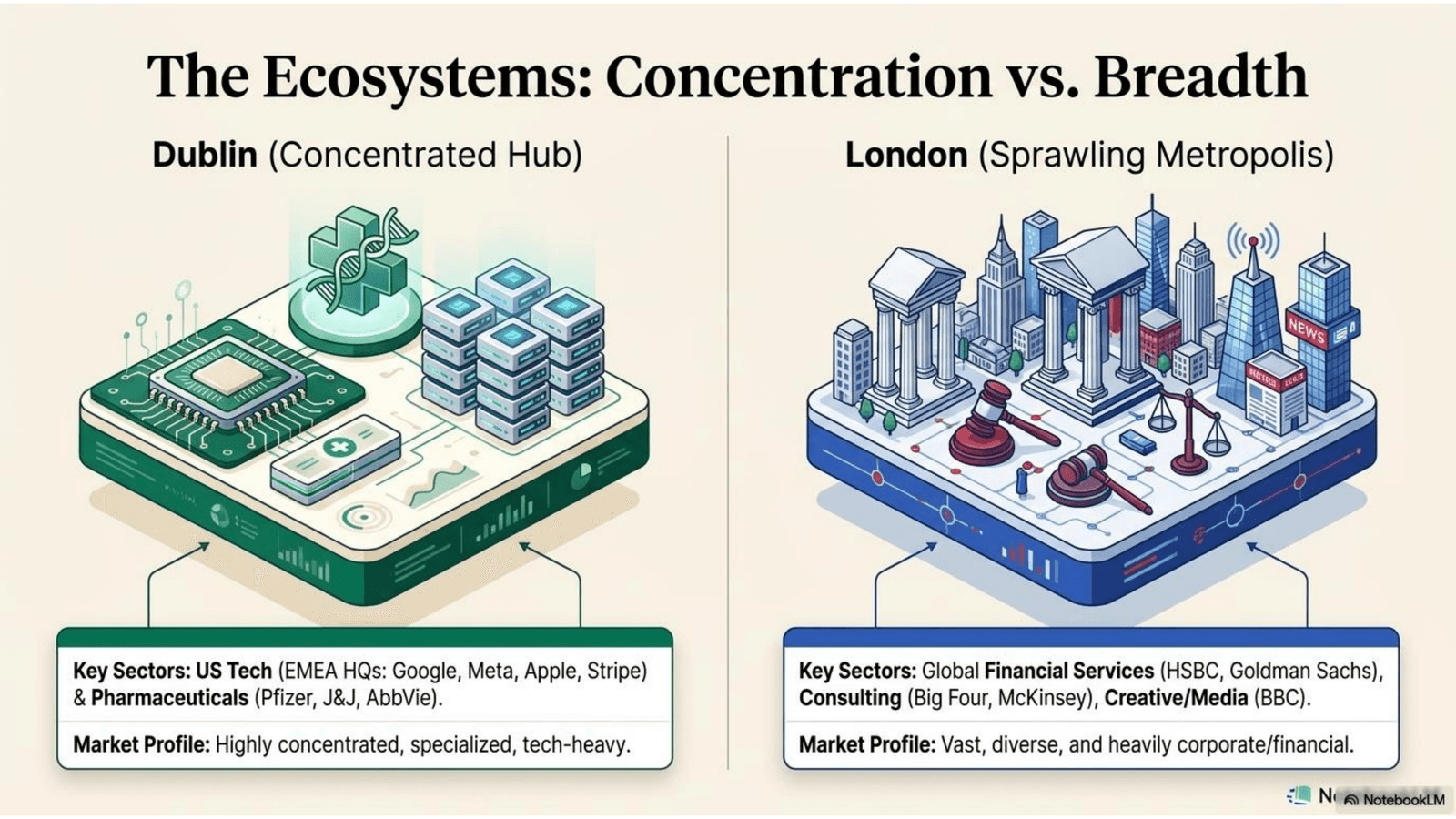
Dublin's US Tech Firm Ecosystem vs. London's Broader Market
| Sector | Dublin 🇮🇪 (Strong) | London 🇬🇧 (Strong) |
|---|---|---|
| US Tech (EMEA HQ) | Google, Meta, Apple, Microsoft, LinkedIn, Salesforce, TikTok, Airbnb, Stripe | Amazon, Google (UK), Spotify, Revolut — present but not EMEA HQ |
| Financial Services | Citi, JP Morgan, BNY Mellon, Mastercard | HSBC, Barclays, Goldman Sachs, Morgan Stanley, Lloyd's — much larger |
| Pharmaceuticals | Pfizer, J&J, AbbVie, Novartis, Eli Lilly (Cork, Limerick, Dublin) | AstraZeneca (Cambridge), GSK (London) — present but fewer Irish-scale operations |
| Consulting / Professional Services | Big Four present; smaller market overall | McKinsey, BCG, Bain, Deloitte, KPMG — much larger presence |
| Creative / Media | Smaller creative sector | BBC, advertising, publishing, fashion, film — world-class |
Section 6 — Cultural & Lifestyle
Both destinations share a language and a broadly similar Northern European climate — cold and wet for much of the year. The cultural differences are real but nuanced.
Irish Culture and Campus Life
Ireland is a genuinely welcoming country for international students, and this reputation is consistent and well-documented. Irish university campuses tend to be tightly knit communities — UCD's Belfield campus, Trinity's city-centre square, and UL's riverside campus in Limerick each have a distinctive campus culture. Students' Unions are active and politically engaged. Pub culture is central to Irish social life, though not exclusively — coffee culture, arts, and outdoor activities are all growing.
Ireland's smaller scale is both a strength and a limitation. Dublin is a genuinely cosmopolitan city with a lively arts, food, and music scene — but it is not London. You can reach Dublin airport from almost anywhere in the country in under three hours by road. The pace is slower than London; the community feel in smaller cities like Limerick, Galway, or Athlone is something that many international students cite as a decisive positive factor when reflecting on their choice.
British Culture and UK Campus Life
The UK's diversity of institutions means no single "British campus culture" exists. Oxford and Cambridge have traditions unlike anywhere else. London universities are largely non-residential, with students integrated into the life of a global city rather than an enclosed campus. Red-brick universities in Manchester, Leeds, and Birmingham have strong sports, arts, and nightlife cultures. Scottish universities have their own distinctive traditions.
London in particular offers an unmatched cultural offer: world-class museums (free entry), theatre, music venues, food markets, and the sheer diversity of a city of 9 million people. For students who want to be in the centre of a world city — and are prepared to pay for it — London is simply in a different league to Dublin. For students who want a high quality of life at a manageable scale, Dublin, Galway, or Cork often score higher on satisfaction surveys than London.
Northern Ireland: A Unique and Often Overlooked Context Northern Ireland
Northern Ireland occupies a genuinely unique position. It is part of the UK and follows UK rules, but it sits on the island of Ireland, shares the Common Travel Area with the Republic, and its capital Belfast is a city undergoing significant cultural and economic regeneration following the Good Friday Agreement of 1998.
International students in Belfast are generally welcomed warmly. Queen's University Belfast in particular has invested heavily in its international student experience and campus infrastructure. The divided community context — which shaped Northern Ireland's history for decades — is less immediately visible in day-to-day student life than it once was, but it is part of the cultural landscape that students should understand before arriving.
Belfast's affordability makes it genuinely attractive for cost-conscious students who want a UK degree and UK post-study work rights without London's price tag. The city has a strong music scene, significant arts investment, and improving connectivity to both Dublin (90 minutes by bus or train) and London (90 minutes by air).
Weather and Housing — Honest Assessment
- Weather: Both Ireland and the UK are wet, mild, and grey for much of the year. Dublin averages 1,461 hours of sunshine annually; London 1,630 hours; Belfast 1,368 hours. None of these figures will comfort a student arriving from India, Nigeria, or Southeast Asia. Pack layers regardless of destination.
- Housing crisis: Both countries face acute rental market shortages that disproportionately affect students. Dublin's rental market is arguably more strained relative to supply than London's. Belfast is a notable exception — rental availability is higher and prices are significantly lower.
- Part-time work: Ireland permits 20 hours/week during term; 40 hours during holidays on Stamp 2. The UK Student Route also permits 20 hours/week during term. Both countries set minimum wages: Ireland at €13.50/hour (January 2025); UK at £11.44/hour (April 2024 for workers 21+). On hourly rate terms, Ireland's minimum wage is currently higher in purchasing-power terms.
Section 7 — Decision Framework
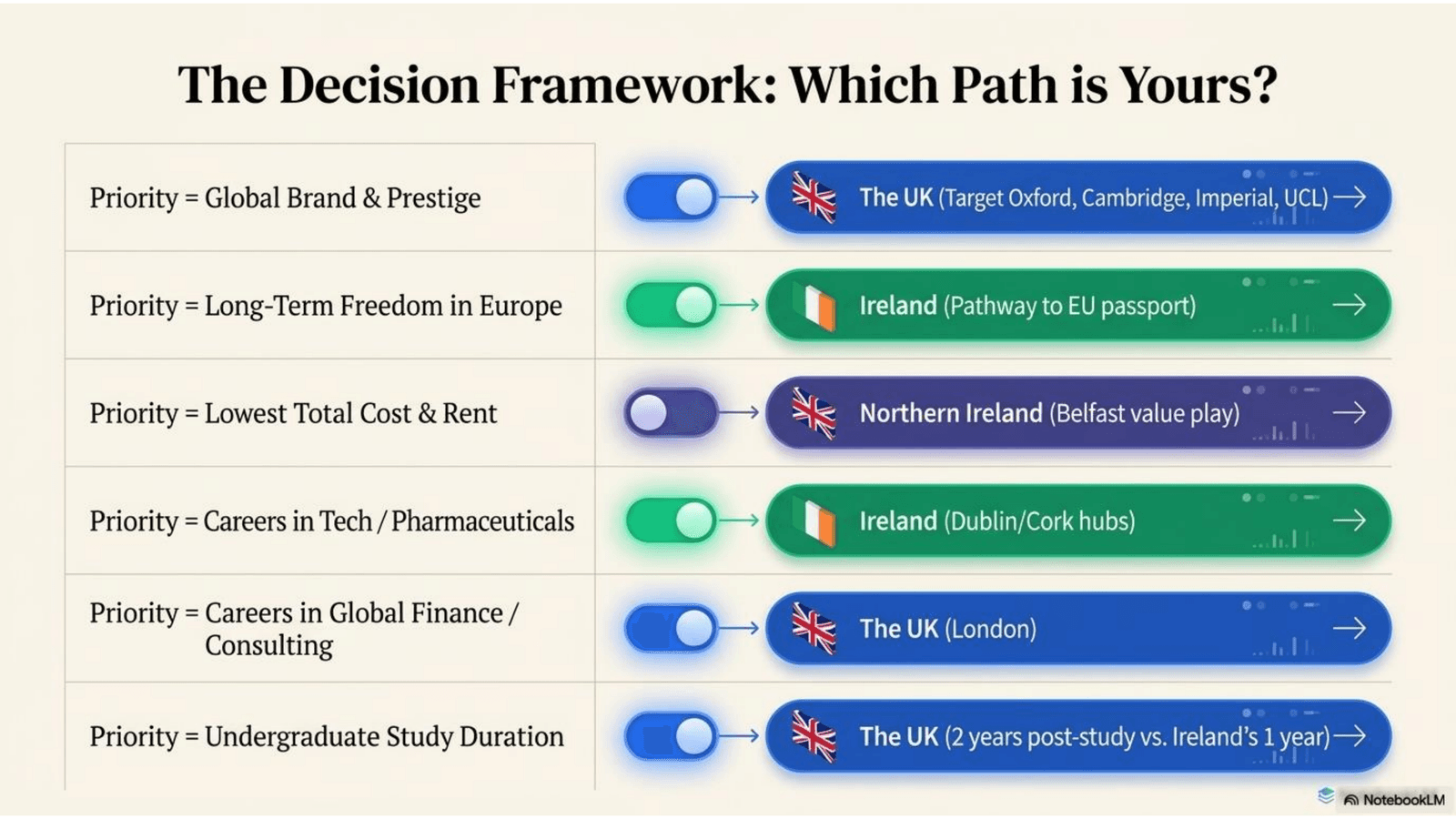
No destination is universally better. The right choice depends on your specific circumstances, career goals, and financial position. This framework is designed to help you make the decision deliberately.
🇮🇪 Choose Ireland if…
- EU access and a pathway to EU citizenship are important to your long-term plans
- You are targeting a career in US tech firms (Google, Meta, Apple, Microsoft, LinkedIn) — Dublin is their EMEA hub
- Tuition cost is a deciding factor — Ireland is often €5,000–€15,000 cheaper per year than equivalent UK programmes
- You are doing a Master's or PhD — Stamp 1G gives 24 months, matching the UK Graduate Route
- You prefer a smaller, tighter-knit student community and manageable city scale
- You plan to work in pharmaceuticals or life sciences — Cork and Limerick host the European operations of most major global pharma companies
- TCD or UCD's QS rankings (#75 and #118) meet the requirements of your home country's employer or government scholarship
🇬🇧 Choose the UK if…
- University brand and global prestige rankings are a priority — Oxford, Cambridge, Imperial, and UCL rank in the global top 10
- London's broader job market — finance, consulting, law, creative industries — aligns with your career goals
- You want a wider range of courses and specialist programmes (UK has over 160 higher education institutions)
- You are doing an undergraduate degree — the UK Graduate Route gives 2 years regardless of level, better than Ireland's 12 months for bachelor's graduates
- You are a PhD student — the UK Graduate Route gives 3 years post-study, compared to Ireland's 24 months
- Scotland's 4-year degree structure suits your educational background
- You plan to stay and build a career in the UK specifically — not continental Europe
Northern Ireland: A Specific Use Case Northern Ireland
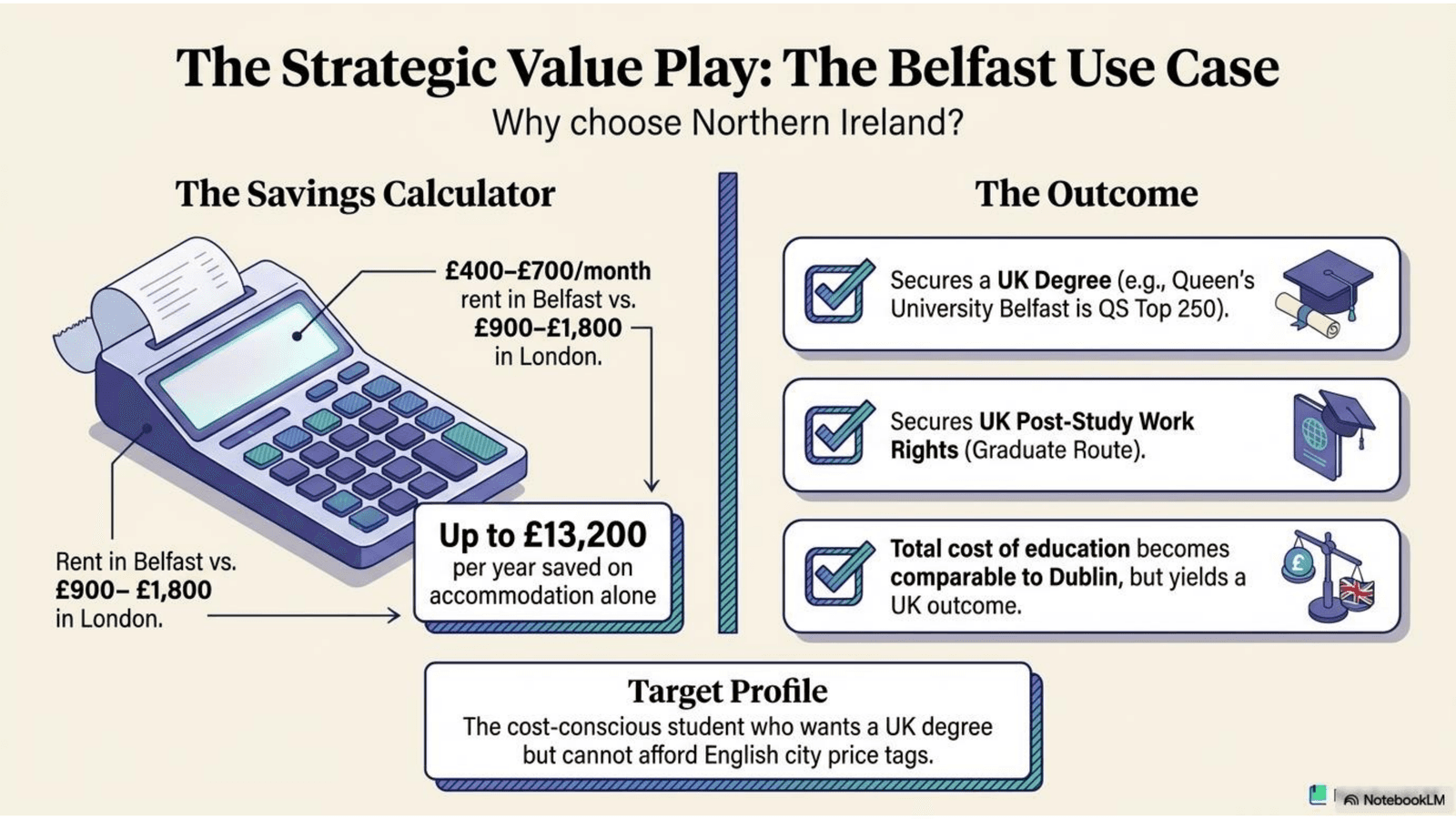
Northern Ireland makes strategic sense for a specific type of student: someone who wants a UK degree and UK post-study work rights but cannot afford London or other major English cities, and who is prepared to live in a smaller, more affordable city. Queen's University Belfast consistently ranks in the QS 201–250 band and offers strong programmes in law, medicine, engineering, and the social sciences.
The £400–£700/month shared-room rental cost in Belfast versus £900–£1,800 in London represents a saving of up to £13,200 per year on accommodation alone — partially offsetting the tuition premium of UK versus Irish fees, and making the total cost of a Belfast education more comparable to a Dublin one than headline tuition figures suggest.
Some students research "studying in Ireland" and end up considering Northern Ireland universities because they appear in search results alongside Irish institutions. To be absolutely clear: studying at Queen's University Belfast or Ulster University Coleraine does NOT give you Irish immigration status, Irish Stamp 1G, or a pathway to Irish or EU citizenship. You are in the UK. The Stamp 1G post-study work pathway and the Irish citizenship route apply exclusively to graduates of Republic of Ireland institutions. If EU access is your reason for considering Ireland, Northern Ireland is not the right choice.
Quick-Reference FAQs
Is it better to study in Ireland or the UK as an international
student?
Depends on your goals. The UK offers higher global rankings at
elite institutions and a larger job market. Ireland offers EU
access, strong tech sector employment in Dublin, and typically
lower tuition at comparable quality levels. For master's and PhD
students seeking EU career flexibility, Ireland is often the
stronger long-term choice.
What is the difference between the UK Graduate Route and
Ireland's Stamp 1G?
UK Graduate Route: 2 years (bachelor's/master's), 3 years (PhD).
Ireland Stamp 1G: 12 months (bachelor's), 24 months
(master's/PhD). The critical difference is what follows: Ireland
offers a pathway to EU citizenship and EU freedom of movement. The
UK does not, post-Brexit.
Is Northern Ireland the same as studying in the Republic of
Ireland?
No. Northern Ireland is part of the United Kingdom. Students there
use UK Student Route visas, receive UK Graduate Route post-study
work rights, and have no access to Irish Stamp 1G or Irish
citizenship pathways purely by virtue of studying in Belfast.
How much cheaper is Ireland than the UK for international
students?
Typically €5,000–€15,000 cheaper per year at equivalent programme
levels when comparing Ireland's research universities (TCD, UCD,
UCC) with comparable Russell Group UK institutions. Belfast is a
notable exception — QUB fees are closer to Irish levels than
London or Edinburgh.
Does an Irish degree give you access to work in the EU?
Your Irish degree is an EU-recognised qualification under the
Bologna Process. More significantly, graduating in Ireland and
building toward Irish citizenship (5 years of legal residence)
confers full EU passport rights — freedom to live and work
anywhere in the 27 EU member states without a visa.
Which city is cheapest — Dublin, London, or Belfast?
Belfast is significantly cheaper than both. Monthly living costs:
Belfast £700–£1,100; Dublin €1,400–€2,000+; London £1,300–£2,200+.
For mid-tier cities: Limerick (Ireland) and Manchester/Leeds (UK)
are broadly comparable.
Can I travel between Northern Ireland and the Republic of
Ireland freely?
Yes. The Common Travel Area (CTA) allows free movement between the
UK (including Northern Ireland) and Ireland for UK and Irish
citizens. International students on a UK Student visa can cross
the border to visit the Republic, but cannot live or study in
Ireland without a separate Irish visa. Students on Irish visas can
visit Northern Ireland freely but cannot reside or study there
without a UK visa.
When should I book flights from India to Dublin or
London?
For September intake, book in April or May — 3 to 5 months ahead.
August fares spike significantly as incoming students drive
demand. See the
monthly fare calendar for current
price trends on Dublin–Delhi and London–Delhi routes.
This guide forms part of a broader series for international students considering Ireland:
- Part 1 — Should I Study in Ireland? Universities, Costs & Flights (2026) — universities, tuition, GOI-IES scholarships, IELTS requirements, flights from India and China, and Stamp 1G post-study work rights
- Part 2 — Arriving in Ireland: Visa, IRP, PPS, Housing, Health & Safety — first-weeks checklist covering immigration, registration, tax setup, banking, accommodation, and student safety
- Part 3 — Ireland Student City Guide: Dublin, Galway, Limerick, Athlone & Cork — city-by-city comparison of cost, transport, safety, and student life
- Part 4 — The Honest Guide: What Nobody Told Me Before Coming to Ireland — practical realities on housing pressure, emergency tax, and job search expectations
If you are flying from India to Dublin or London to begin your studies, these guides cover which credit cards earn the most on your flight booking:
Ready to book your flight to Dublin or London?
Compare live fares on the Dublin–Delhi route and find the cheapest month to fly before your course starts.
All immigration rules, tuition fee ranges, post-study work right durations, living cost estimates, university rankings, visa requirements, and salary thresholds in this article are based on publicly available information from the following sources as of May 2026: UK Home Office (gov.uk/student-visa; gov.uk/graduate-visa), Irish Immigration Service (irishimmigration.ie), QS World University Rankings 2026 (topuniversities.com), HESA (Higher Education Statistics Agency, UK), Higher Education Authority Ireland (hea.ie), UCAS (ucas.com), and individual university websites. Fee ranges are indicative; verify directly with each institution for the 2026–27 intake. Immigration rules in both the UK and Ireland are subject to change — always confirm current requirements with the relevant immigration authority before applying. This article does not constitute immigration or financial advice.