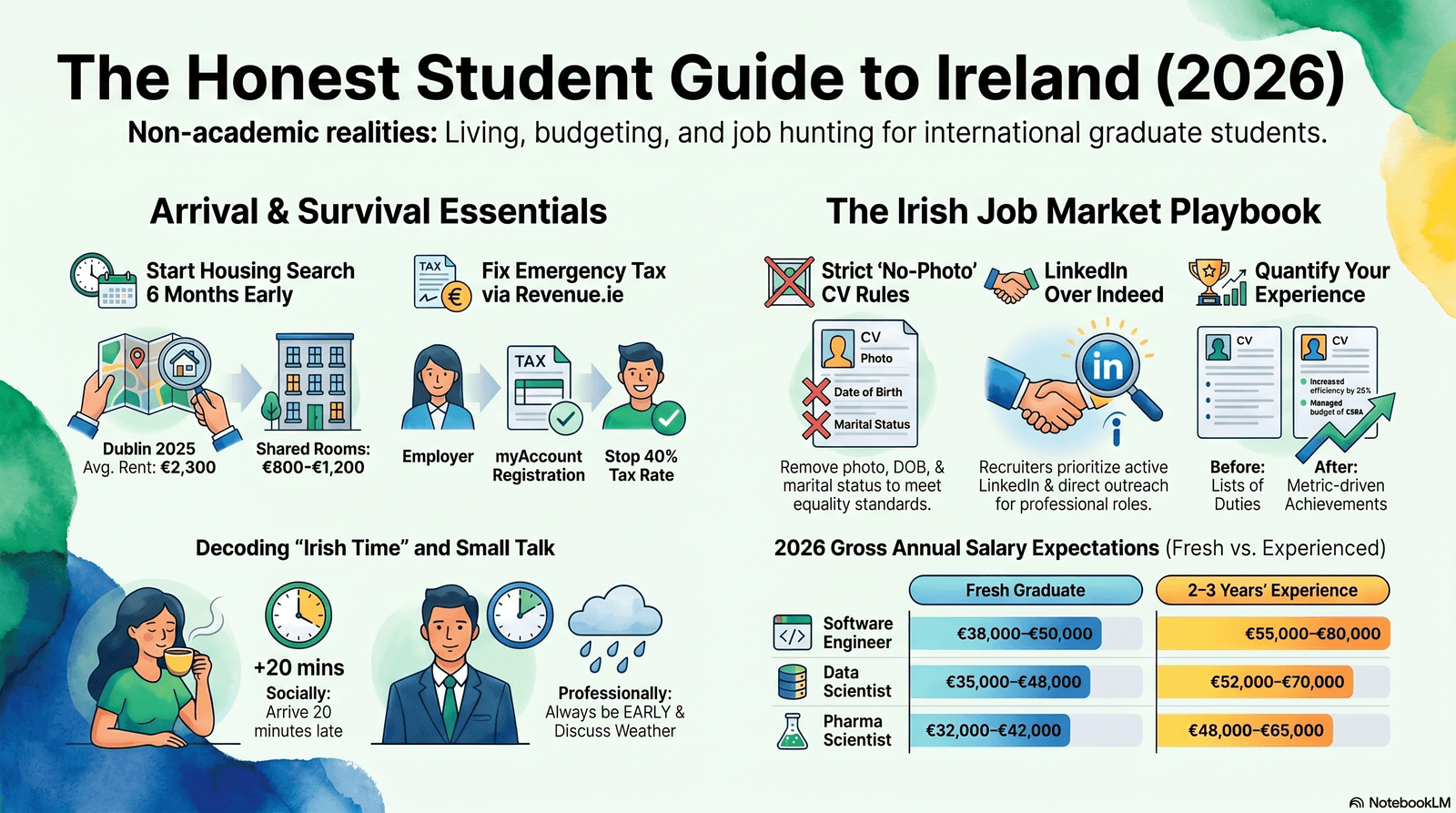
🏠 Biggest shock
The housing crisis
Start looking 6 months early, not 6 weeks
💸 Emergency tax
Register on revenue.ie immediately
You will get it back — it is not a fine
📄 Irish CV rule #1
No photo, no date of birth
One page for graduates; max two for experienced
💼 Job hunting tip
LinkedIn > Indeed in Ireland
Recruiters actively reach out — keep profile current
7 sections in this guide
- What I wish I knew before I came
- What students are asking on Reddit & Facebook (2025–26)
- Cultural shock moments nobody warned me about
- Practical shocks: tax, healthcare, damp, and driving
- Your Irish CV: what must change from your home format
- Fresh MS graduate vs. MS with experience — who gets hired?
- Job finding tips and tricks specific to Ireland
Section 1 — What I Wish I Knew Before I Came
Every official source about studying in Ireland — the HEA website, the university prospectus, the embassy information page — tells you what you need to apply. Very few tell you what you need to survive the first year without unnecessary stress. These are the ten things that come up, unprompted, in every honest conversation with international students who have been here at least six months.
1. The housing crisis is worse than any blog describes
Ireland — and particularly Dublin — has a documented, severe rental housing shortage. Threshold.ie, Ireland's national housing charity, reports that average Dublin rent reached €2,300 per month for a one-bedroom apartment in 2025. This is not a statistic that should be read and moved past. It means that even a shared room in a four-person house in Dublin 7 or Dublin 9 costs €800–€1,200 per month — before bills. Start your search the day your university offer is confirmed, not the week before term begins. Six months is not an exaggeration.
The primary platforms are Daft.ie and MyHome.ie for long-term rentals. For short-term and room-only, Rent.ie and SpareRoom.ie are widely used. University accommodation offices also maintain lists of verified private landlords. Facebook groups ("Accommodation in Dublin for Students", city-specific groups) move fast but require caution — always view a property before paying any deposit.
2. Your Indian or Chinese degree grading does not translate 1:1
Irish universities use a grade point average (GPA) system aligned to the National Framework of Qualifications (NFQ). An Indian first-class degree (60–75%+ depending on institution) typically converts to a 2:1 or First Class Honours in Irish terms, but individual universities make their own determination. Quality and Qualifications Ireland (QQI) and the Irish Naturalisation and Immigration Service both use country-specific grade conversion tables. If your university asks for transcripts, always include an official certified translation and a grading scale explanation from your home institution.
3. "Grand" does not mean good
Irish communication is famously indirect. "Grand" means acceptable, fine, or functioning — not excellent. "Not too bad" is a positive response. "I might" usually means no. "We should meet up sometime" is a social nicety that rarely results in a specific plan. Understanding this saves considerable confusion in academic, social, and professional settings. Your Irish supervisor saying your draft is "fine" is genuinely positive feedback.
4. The light is unlike anywhere in Asia
In June, the sun sets after 10pm. In December, it is dark before 4pm. This is not a minor inconvenience — for many international students from India or Southeast Asia, the dramatic reduction in daylight hours from October to February contributes directly to seasonal mood changes. Ireland has some of the highest rates of SAD (Seasonal Affective Disorder) awareness in Europe. Buy a SAD lamp (widely available in Argos and Boots for €30–€60). Take vitamin D — Irish GPs consistently recommend this for anyone not from a sunny climate. Walk outside during the daylight hours you have.
5. Everything is expensive compared to home
A coffee in Dublin costs €3.50–€5.00. A pint of lager costs €6.00–€7.50 in Dublin city centre. A basic lunch is €12–€18. A Tesco meal deal (sandwich, crisps, drink) costs €4–€5 and is considered good value. The minimum wage is €13.50 per hour (as of January 2025), which means Ireland is simultaneously expensive to live in and one of the better-paid entry-level labour markets in Europe. Adjust your mental price anchor immediately on arrival — comparing everything to Bengaluru or Chengdu prices will cause daily frustration.
6. Irish people are friendly — but deep friendships take time
This is one of the most consistent observations across international student communities. Irish people are warm, easy to talk to, and genuinely helpful to strangers. They are not, in the first instance, easy to form close friendships with. Many Irish people have tight pre-existing social groups from school and home. Do not interpret the lack of immediate deep friendship as rejection. Friendships develop slowly and tend to be long-lasting once formed. Invest time in sports clubs, university societies, and regular pub visits — these are where genuine Irish social integration happens.
7. The pub is not just for drinking
This is not a reason to drink if you do not drink — it is a reason to go to the pub if you do not drink. Irish pubs serve food, non-alcoholic drinks, and provide a social environment that has no direct equivalent in most other cultures. A large number of professional connections, social plans, and genuine friendships in Ireland are initiated or advanced in pub settings. You can sit in an Irish pub for two hours with a Club Orange or a sparkling water and nobody will comment or pressure you.
8. Sundays in smaller cities feel dead — plan ahead
Outside Dublin, many shops, supermarkets, and services operate on reduced Sunday hours or are closed entirely. In Limerick, Galway, and Athlone, a Sunday afternoon can feel remarkably quiet. Plan your grocery shopping for Saturday. If you need a pharmacy on a Sunday, identify the on-duty rotation pharmacy in your area in advance — pharmacists post their Sunday rota weekly.
9. Radiators are your best friend — Irish homes are cold
Irish rental properties vary enormously in quality of insulation and heating systems. Many older properties — particularly student flats and shared houses in Victorian-era Dublin terraces — are poorly insulated. A BER (Building Energy Rating) of D1 or below means your heating bills will be significant and the property will be cold in winter regardless of how much you run the radiator. When viewing properties, check the BER certificate — it is a legal requirement for rental listings in Ireland. A–C rated properties cost meaningfully less to heat.
10. You will need a rain jacket every day — not just in winter
Ireland's weather is described as "maritime temperate." In practice this means it can rain at any moment, any month, any time of day. June is not reliably dry. August is not warm in the way Mumbai or Delhi summers are warm. Pack a proper waterproof jacket (not a light hood — a genuine waterproof with sealed seams) before you arrive. Buying one in Ireland is fine too — Penneys sells decent waterproof jackets for €25–€35. The point is: do not arrive in September expecting summer.
Section 2 — What Students Are Actually Asking on Reddit & Facebook (2025–26)
These are the real questions, pulled from r/IrelandStudents, r/ireland, and numerous Facebook groups for international students in Ireland, with accurate, verified answers.
"Can I switch courses after arriving in Ireland?"
Yes, but with conditions. Any new programme must be on the Interim List of Eligible Programmes (ILEP), maintained by the Department of Justice. Switching from a Level 9 (Master's) to a Level 8 (Bachelor's) or to a new institution typically requires a new permission letter and re-registration at your local Immigration Registration Office (IRP office). Always notify your university's international office before making any change — they can guide the immigration implications. Switching without notification can jeopardise your Stamp 2 permission.
"My landlord won't give me a lease — is this legal?"
In Ireland, a written lease (tenancy agreement) is not legally mandatory, but a landlord is required to provide a written statement of the terms of the tenancy within one month of the tenancy beginning — this is a legal obligation under the Residential Tenancies Act 2004 (as amended). You are entitled to a rent book or written record of rent payments. If your landlord refuses both, contact Threshold.ie (threshold.ie, free advice) or the Residential Tenancies Board (RTB) at rtb.ie. Threshold operates a national helpline at 1800 454 454 (free, Monday–Friday).
"I got emergency taxed — how do I get it back?"
Emergency tax is applied when Revenue has not received a Tax Credit Certificate (TCC) from your employer before your first payslip. It is not a penalty. To resolve: (1) Register for myAccount at revenue.ie — free and takes 10 minutes with your PPS number. (2) Add your new employer using their tax registration number (on your payslip). (3) Revenue issues a TCC directly to your employer, and any over-deducted tax is refunded in your next payslip or at year-end via an End of Year Review (previously called a P21). You must actively do this — it does not happen automatically.
"Is my Indian driving licence valid in Ireland?"
Yes — a valid Indian driving licence allows you to drive in Ireland for up to 12 months from your date of entry. After 12 months as a resident, you must exchange it for an Irish driving licence. India is not on Ireland's automatic exchange list (unlike EU/UK/Australia), so you will need to pass the Irish theory test (online, €45) and a driving test. Start this process early — driving test waiting times in Dublin and Cork can exceed 6 months. Book via rsa.ie. A Chinese driving licence follows the same 12-month rule.
"Can my spouse or partner come with me on a student visa?"
A spouse or de facto partner of a non-EU student on Stamp 2 is not automatically entitled to live or work in Ireland. They can apply for a short-stay visitor visa (C visa) for visits of up to 90 days. Long-term spousal residency with work rights is generally only available after the primary applicant obtains Stamp 1G or a Critical Skills Employment Permit. This is a significant limitation compared to Canada (which allows spousal open work permits alongside study permits) and should factor into your destination choice if you are married or in a long-term relationship.
"What happens if I work more than 20 hours during term?"
Exceeding 20 hours per week during term time is a breach of Stamp 2 conditions. Revenue's PAYE Modernisation system (introduced in 2019) gives Revenue and the Department of Justice real-time payroll data. Violations can result in refusal to renew your student permission, refusal of Stamp 1G after graduation, or a requirement to leave the state. The 40-hour limit applies only during officially designated academic holiday periods — check your specific college's academic calendar each semester. "Holiday" means the university's official vacation dates, not a week when you happen to have no classes.
"My university accommodation fell through 2 weeks before arrival — what do I do?"
This happens every year and the recovery path is: (1) Contact your university's accommodation office immediately — they maintain emergency lists and can advise on temporary options. (2) Book short-term accommodation (hostel, Airbnb, or serviced apartment) for your first 2–4 weeks to give yourself time to search properly. (3) Post in your university's official student Facebook or WhatsApp groups — current students often know of rooms becoming available. (4) Search Daft.ie and SpareRoom.ie daily at 7am — new listings are posted overnight and go within hours in Dublin. (5) Consider staying in a cheaper city temporarily if Dublin accommodation is your starting crisis.
"Is it safe to be an international student from India or Asia in Ireland right now?"
Ireland is consistently ranked among Europe's safest countries. The 2024 Global Peace Index ranked Ireland 3rd globally (Institute for Economics and Peace, 2024). The overwhelming majority of international students from India, China, Nigeria, Brazil, and elsewhere report positive, safe experiences. Isolated incidents of racism do occur — as in every country — and should be reported to An Garda Síochána (999 or 112 for emergencies; local station for non-emergencies) and your university's equality office. The iReport.ie platform (run by the Irish Council for Civil Liberties) allows anonymous reporting of racist incidents. The lived reality for the vast majority of the 35,000+ non-EU students in Ireland is safe and positive.
"Can I do freelance work on a Stamp 2?"
No. Stamp 2 permits employed (PAYE) work only, up to 20 hours per week during term. Self-employment, freelancing (including remote work for overseas clients billed in your name), and running any form of business are not permitted under Stamp 2. This includes coding projects, design work, content creation, and tutoring billed privately. After graduation, Stamp 1G does not automatically permit self-employment either — you would need to register as a sole trader and ensure your immigration permission covers it. Seek professional immigration advice before starting any freelance activity.
Section 3 — Cultural Shock Moments Nobody Warned Me About
These are not complaints — they are observations that, once understood, make life in Ireland significantly easier and more enjoyable.
Shops close at 6pm — even in Dublin. Sundays are worse.
Ireland does not have the 24-hour retail culture of Indian or Chinese cities. Most high-street shops in Dublin close at 6pm on weekdays and 5–6pm on Sundays. Dundrum Town Centre and Jervis Shopping Centre stay open until 9pm on Thursday and Friday. Outside Dublin, regional shopping centres close earlier. Plan your purchases around this — arriving at a chemist at 6:15pm for medicine is a common and painful introduction to Irish retail hours.
Centra, Spar, and Londis convenience stores operate extended hours including Sundays. Most 24-hour petrol station forecourts sell basic food and pharmacy items. Tesco Extra stores in major cities (Tallaght, Naas Road) are open until midnight on weekdays. For late-night pharmacy needs, Boots at Dublin Airport is open 24 hours. Harcourt Street Pharmacy in Dublin 2 operates late-night and weekend hours.
Tipping: when, how much, and what happens if you do not
Ireland has a tipping culture, but it is more relaxed than the USA and less mandatory than some cultures assume. In restaurants, 10–15% is standard for table service if you are satisfied. Some restaurants add a service charge automatically — check before adding your own. In pubs, tipping is not expected for bar service — you can round up to the nearest euro if you want, but it is genuinely optional. Taxi drivers: round up or add €1–€2 on a standard fare. Hair salons: €2–€5 tip is customary. Not tipping in a restaurant will not cause an incident, but servers do notice and it is considered slightly rude if service was good.
Queuing is sacred
The queue in Ireland is inviolable. Cutting a queue — intentionally or accidentally — will be met with audible, pointed, specifically Irish passive-aggression. The remark will be aimed at the air immediately to your left, not at you, but you will know. Always join the back of any visible line, including at bus stops, coffee shops, post offices, and supermarket checkouts. This is one of the cultural rules with the fastest and most clear social feedback if broken.
Small talk about weather is a genuine social ritual
When an Irish person opens a conversation with "desperate weather today, isn't it?" they are not making an observation. They are extending an invitation to connect. The correct response is not a factual analysis of precipitation data. It is enthusiastic agreement, followed by your own weather observation, possibly with light humour. Weather talk in Ireland is a social lubricant that opens every interaction from shop assistant to GP. Learn it. Use it. It works.
"I will" does not mean yes in Ireland
This is perhaps the most practically important cultural note in this entire guide. When an Irish person says "I will, yeah" to a request, it means "I acknowledge your request and I do not want to say no right now." It does not mean they will do the thing. If you are depending on someone following through — a landlord fixing a boiler, a colleague completing a task, a friend confirming plans — get a specific date and method. "I will sort that out" without a date attached means: follow up again.
Alcohol culture — navigating social events without drinking
Ireland has a strong pub culture and alcohol is commonly present at social and professional events. Non-drinkers are entirely accommodated in Irish culture — the variety and quality of non-alcoholic options in Irish pubs has improved dramatically since 2020. No-lo beers (Heineken 0.0, Guinness 0.0, Athletic Brewing) are available in most pubs. You do not need to explain, apologise, or justify not drinking. Ordering a sparkling water or a Diet Coke at the bar is done by a significant minority of people on any given night.
Irish humour: sarcasm and self-deprecation are the primary modes
Irish humour is built on irony, understatement, and affectionate mockery. If an Irish colleague tells you that your presentation was "not the worst thing I have ever seen," this is genuine praise. If they are sarcastic about something you are proud of, it is almost certainly a sign of comfort and affection, not criticism. Learning to respond in kind — with light self-deprecation and a grin — is the fastest route to social integration. Taking Irish sarcasm literally will cause daily confusion.
"Fierce" is a compliment
"Fierce good craic" means excellent fun. "That's fierce altogether" means that's very impressive. "He's fierce strong at maths" is high praise. A small glossary of Irish English that will help in the first month: craic (fun, atmosphere, news), gas (funny), grand (fine), giving out (complaining), scarlet (embarrassed), press (kitchen cupboard), immersion (water heater — always turn it off when leaving the house).
The "Irish time" phenomenon
Social events in Ireland regularly start 20–30 minutes after the stated time. A party "starting at 8" means guests arrive from 8:30. A meeting at 9 usually begins with small talk until 9:10. The exception is formal professional settings — job interviews, academic appointments, and business meetings start on time and Irish employers notice lateness. The rule is: be on time for anything professional; allow flexibility for everything social.
Section 4 — Practical Shocks: Tax, Healthcare, Damp, and Driving
Get an Irish SIM card on Day 1
Your home SIM will work in Ireland with roaming, but long-term this is expensive and unreliable for data. Ireland's main networks are Three, Vodafone, Eir, and 48 (which runs on Three's network). For students, Three Ireland and 48 offer the most competitive prepay plans — typically €15–€20 per month for unlimited calls/texts and 20–30GB of data. You can buy a SIM at any Tesco, Supervalu, Centra, or directly in a network store. You do not need a PPS number to buy a prepay SIM. Bring your passport. Data quality varies by city — Three tends to have stronger rural coverage; Vodafone is stronger in Dublin city centre.
Emergency tax — how it works and how to fix it
Ireland operates PAYE (Pay As You Earn) income tax, where your employer deducts tax from your wages before paying you. When you start a new job, if your employer has not received your Tax Credit Certificate from Revenue, they are legally required to apply emergency tax — which means you pay the higher rate (40%) on all income with no tax credits applied. This is reversed once you register with Revenue. Every new worker in Ireland — Irish and international — goes through this process. It is administrative, not punitive. Revenue's myAccount portal (revenue.ie/myaccount) is where you register. You will need your PPS number, which you obtain from your local Intreo office or DSP office (bring your passport, IRP card, and proof of address).
Healthcare: GP waiting lists are real
Registering with a General Practitioner (GP, the Irish equivalent of a family doctor) in Dublin can take weeks to months due to shortage of available appointments. GP visit costs €50–€80 without a medical card. International students are not entitled to a medical card (which would make GP visits free) unless they are in receipt of certain payments. University student health centres — available at TCD, UCD, UCC, University of Galway, UL, and most other institutions — provide GP services at reduced rates for students. Register with your university health centre the first week you arrive, before you are sick. Waiting until you need an appointment to register guarantees a poor outcome.
Mental health: loneliness peaks at week 6–8, not week 1
This is well-documented in international student welfare research. The first few weeks of term involve orientation events, meeting new people, and the novelty of the new environment. The genuine challenge of social isolation typically peaks around weeks 6–8, when the novelty has faded, academic pressure has increased, and the depth of friendships has not yet developed. This is normal and widely experienced. Every Irish university has a student counselling service — at UCD it is free and available same-day for crisis support; at TCD, Niteline (1800 793 793) is a free listening service available 9pm–2:30am nightly during term. Use these services early, not only in crisis.
Damp in rental accommodation — what is normal, what is illegal
Ireland's climate means some surface condensation in poorly ventilated rooms is common. However, visible black mould (typically Stachybotrys or Aspergillus species) on walls, ceilings, or around windows is a sign of structural damp and is not acceptable in a rental property. Under the Housing (Standards for Rented Houses) Regulations 2019, all rental properties must be free from damp and in good structural repair. If your landlord refuses to address mould or damp, you can report it to your Local Authority's Environmental Health Officer or contact Threshold.ie. Document everything with photographs and dates before making a complaint.
What is a BER rating and why it matters when renting
A Building Energy Rating (BER) certificate is legally required for all rental properties in Ireland when advertised. The rating runs from A1 (most efficient) to G (worst). A D-rated property in February will be cold despite constant heating and will have higher electricity bills. An A or B rated property costs more in rent but saves considerably on bills. Check the BER before signing any lease — the certificate number can be verified at seai.ie/ber.
Section 5 — Your Irish CV: What Must Change From Your Home Format
An Indian or Chinese CV submitted without modification to an Irish employer creates immediate friction, even if your qualifications are excellent. The structural differences are significant and the reasons for them are rooted in Irish employment law and hiring norms.
What to remove from your home-country CV immediately
- Your photograph. Irish CVs do not include a headshot. Including one is unusual and, in some hiring processes, can inadvertently introduce bias concerns for employers who are aware of equality legislation. Remove it.
- Your date of birth and age. Ireland's Employment Equality Acts 1998–2015 prohibit discrimination on grounds of age. Irish employers do not expect and many prefer not to see your date of birth on a CV.
- Your marital status and nationality. Not expected and not helpful.
- Your photograph of a signature. Common in some Indian and Chinese CV formats — remove it.
- Lengthy objective statements. Replace with a concise 3–4 line personal profile if anything.
Length: one page for graduates, two pages maximum
Irish hiring managers receive hundreds of applications. A three or four-page CV from a recent graduate will be disadvantaged against a well-structured one-page document that delivers the same information concisely. If you have under three years of total work experience, aim for one page. If you have three to ten years of experience, two pages is appropriate. PhD researchers submit academic CVs (curriculum vitae) which are longer and follow a different format — but these are for academic positions, not industry roles.
Format Irish employers expect
The standard Irish CV structure is: (1) Name and contact details at the top — email address, phone number with country code (+353 or your Irish number), LinkedIn URL, and GitHub if relevant for technical roles. (2) Personal profile — 3–4 sentences. (3) Education — most recent first. (4) Work experience — most recent first, with bullet points describing achievements and impact rather than a list of duties. (5) Skills. (6) References available on request (you do not need to list names on the CV — you bring them to interview).
Indian and Chinese CVs frequently list job duties: "Responsible for managing a team of five." Irish CVs that stand out describe outcomes: "Led a team of five engineers to deliver a data pipeline reducing processing time by 40%." Every bullet point in your experience section should describe what you did and what it achieved, ideally with a metric. This is the single biggest structural change that improves response rates from Irish employers.
Cover letter: when required and how to write it in Irish style
A cover letter is expected when an Irish job advertisement explicitly requests one — which is roughly 60–70% of professional and graduate-level roles. An Irish cover letter is typically one page, three to four paragraphs. Paragraph one: which role you are applying for and why this company specifically. Paragraph two: your most relevant experience and skills. Paragraph three: why you want to work in Ireland and what you will bring. Final line: request for an interview and note that your CV is attached. Irish cover letters are professional but not formal in a rigid sense — they should sound like an intelligent, engaged person wrote them, not like a template.
LinkedIn profile for the Irish job market
LinkedIn is the primary professional network in Ireland. Your LinkedIn profile should be complete, consistent with your CV, and updated with your current location as Ireland. Use a professional headshot (the one place a photo matters). Write a headline that describes your current focus: "MSc Data Science candidate at UCD | Seeking data engineering roles in Ireland" is more effective than "Student." Use the "Open to Work" feature — visible to recruiters only, not your entire network — once you begin your job search.
Section 6 — Fresh MS Graduate vs. MS with Experience: Who Gets Hired?
This is one of the most consequential questions for international students planning their career in Ireland, and the honest answer is more nuanced than the optimistic version you will read in most guides.
✅ Fresh MS Graduate
Strongest fit: tech company graduate programmes, pharma associate scientist roles, data analyst entry-level roles, graduate consulting intakes, and software engineering roles in startups. Irish companies running structured graduate programmes (Google, Meta, Accenture, Deloitte, PwC, Pfizer, Boston Scientific) specifically target recent graduates. Course projects, GitHub portfolio, and thesis topic matter significantly. A strong LinkedIn profile and active participation in university career events differentiates you.
🎯 MS with 2–3 Years' Experience
Strongest fit: mid-level software engineering, data science, financial services analyst, cybersecurity analyst, and project management roles. You compete for roles that fresh graduates do not — and typically at a €5,000–€12,000 higher starting salary. The challenge is positioning your non-Irish experience credibly to Irish employers who may not recognise your previous company names. Named your employer's context: "Senior engineer at a 2,000-person FinTech firm regulated by the Reserve Bank of India" is more legible than just the company name.
Sectors that favour fresh graduates
Technology companies in Dublin's Silicon Docks — Google, Meta, Salesforce, HubSpot, LinkedIn — run annual graduate intakes and actively recruit from Irish universities. Applications open in September for the following summer and roles fill fast. Pharmaceutical companies (Pfizer Cork, Eli Lilly Kinsale, Johnson & Johnson Limerick) run Science and Engineering graduate programmes that explicitly target recent NFQ Level 8 and 9 graduates. The key differentiator for fresh graduates is work placement experience completed during your degree. UL's cooperative education model (mandatory 8-month placement) consistently produces the most employment-ready graduates in Irish employer surveys.
Sectors that require experience
Financial services in Dublin's International Financial Services Centre (IFSC) — Citi, Bank of America, State Street, Northern Trust — predominantly hire candidates with 2+ years of relevant experience for analyst and associate roles, even at entry level for non-graduate-programme positions. Management consulting at large firms (McKinsey, BCG, Bain have Dublin offices) typically recruits from MBA programmes or hires analysts with undergraduate degrees and strong academic records for Analyst roles, while Associate roles require MBA or 3+ years. Enterprise technology sales (Salesforce AEs, Oracle) explicitly requires prior sales experience.
Salary expectations: fresh graduate vs. experienced hire (2026)
| Role / Sector | Fresh Graduate | 2–3 Years' Experience |
|---|---|---|
| Software Engineer (Dublin) | €38,000–€50,000 | €55,000–€80,000 |
| Data Analyst / Data Scientist | €35,000–€48,000 | €52,000–€70,000 |
| Pharmaceutical Scientist | €32,000–€42,000 | €48,000–€65,000 |
| Financial Services Analyst | €35,000–€45,000 | €50,000–€70,000 |
| Cybersecurity Analyst | €38,000–€50,000 | €55,000–€80,000 |
Sources: Sigmar Recruitment Ireland Salary Guide 2026; Hays Ireland Salary Guide 2025; Glassdoor Ireland. Figures are gross annual salary before tax. Use Glassdoor Ireland and LinkedIn Salary to validate for specific companies before interview.
Irish employers hiring fresh graduates primarily assess communication skills, cultural fit, and potential — not just academic grades. A first-class honours degree alone does not guarantee employment. The ability to articulate your experience clearly in English, demonstrate curiosity about the company's work, and show genuine enthusiasm for living and building a career in Ireland matters as much as your transcript in the initial screening stages.
Section 7 — Job Finding Tips and Tricks Specific to Ireland
LinkedIn is more important than Indeed in Ireland
This is the single most consistent observation from international graduates who successfully found employment in Ireland. The Irish job market — particularly in technology, financial services, and pharma — is heavily relationship-driven. LinkedIn is where Irish recruiters spend their time, post roles before advertising them anywhere else, and search for passive candidates. An optimised LinkedIn profile in Ireland generates direct recruiter outreach within weeks. Indeed, Jobs.ie, and IrishJobs.ie are useful for breadth — use them all — but invest disproportionately in LinkedIn.
Reaching out to recruiters directly on LinkedIn works in Ireland
Irish professional culture accepts and expects direct LinkedIn outreach. A short, specific message to an internal recruiter at a company you want to work for is not considered impolite — it is initiative, which Irish employers value. The message format that works: (1) Name the specific role or team. (2) Describe your relevant background in one sentence. (3) Express genuine interest in the company specifically. (4) Ask if there is a suitable opportunity or if they would be open to a brief conversation. Keep it to four sentences. A generic "I am looking for opportunities, please find my CV attached" will be ignored.
Recruitment agencies are widely used — and genuinely useful
Ireland has a large, active recruitment agency sector. Sigmar Recruitment, Hays Ireland, Morgan McKinley, Brightwater, CPL, and Talent Solutions are among the major players. Registering with two or three agencies that specialise in your sector is standard practice in Ireland — not a sign of desperation. Agencies are paid by the employer, not by you. They have relationships with companies and often know about roles before they are publicly advertised. A good recruiter who knows your skills can place you in a role faster than applying cold through job boards. Respond promptly to recruiter messages on LinkedIn — a slow response is taken as low interest.
The "coffee chat" — informational interviews are real and they work
Asking someone at a company you admire for a 20-minute virtual coffee chat to "learn about their role and company" is a widely practised and accepted networking approach in Ireland. Many Irish professionals will say yes. The outcome is not a job offer — it is a relationship, a better understanding of the company, and potentially a referral when a role opens. Reach out via LinkedIn, be specific about what you want to discuss, and prepare two or three thoughtful questions about their career path or company direction. After the call, send a short thank-you message and stay in touch.
Use Glassdoor Ireland salary data before every interview
Glassdoor Ireland and LinkedIn Salary both provide anonymised salary data for specific companies and roles in Ireland. Before any interview where salary may be discussed, look up the salary range for that role at that specific company. Irish salary negotiation is straightforward — stating a specific range based on market data ("Based on Glassdoor data for this role at your company, I am targeting €X–€Y") is considered professional and well-prepared. Stating a number from your home country's job market will result in either a significantly lower offer than the market or an awkward recalibration.
Skills that Irish employers want in 2026
- Cloud platforms (AWS, Azure, GCP): All three are headquartered or have major Irish operations. Cloud certifications (AWS Solutions Architect, Azure Administrator, GCP Professional) are among the most-sought credentials in Irish tech hiring.
- AI and machine learning implementation: Not theoretical knowledge — practical deployment using TensorFlow, PyTorch, or cloud ML services. GitHub portfolios with working models are looked for.
- Cybersecurity: Ireland's National Cyber Security Centre reports persistent skills shortage in incident response, SOC analysis, and cloud security. CompTIA Security+, CISSP, and CEH certifications are in demand.
- Data engineering (not just data science): Irish employers increasingly differentiate — they want people who can build and maintain data pipelines (dbt, Airflow, Spark, Kafka), not just analyse clean datasets.
- Regulatory knowledge: In pharma and financial services, understanding of GxP (Good Practice regulations), GDPR, MiFID II, or FDA/EMA regulatory frameworks is a differentiating credential for specialist roles.
Attend university career fairs — they are not ceremonial
TCD Careers Fair, UCD Law and Business Careers Fair, UL Cooperative Education Career Fair, DCU Careers Day — these events directly connect students with Irish employers in a less competitive setting than online applications. Many companies at Irish university career fairs are looking for candidates they can channel into their formal application process before the online posting opens publicly. Show up early, bring printed copies of your CV, and research three to four companies before you go so you can have specific conversations rather than generic ones.
How to explain Indian or Chinese work experience to Irish employers
The challenge for international candidates is that Irish hiring managers may not know your previous employer's scale, sector, or reputation. Solve this by contextualising: "I worked at Infosys, one of India's largest IT services companies with 350,000 employees and clients including major European banks." Or: "I was a product manager at Alibaba Cloud, the largest cloud provider in China." Size, regulatory context, and client names that an Irish employer might recognise are more useful than company names alone. On your CV, add a one-line descriptor under the company name: "TCS — Fortune 500 IT services firm, 600,000 employees, India." This is not padding — it is contextual clarity that a local candidate's experience would have automatically.
For the foundation information on studying in Ireland, use these published guides:
Before you book, find out which Indian bank card gives you the best rewards, lowest forex markup, and lounge access on your Dublin flight:
Quick Reference — 8 Questions Answered
What is the biggest shock for international students arriving
in Ireland?
The housing crisis. Dublin rent for a shared room averages
€900–€1,500 per month. Start searching six months before arrival,
use Daft.ie, and explore Cork, Galway, and Limerick as lower-cost
alternatives.
Can I switch courses after arriving on a student visa?
Yes, but your new programme must be on the ILEP list and switching
institution or level may require updated immigration
documentation. Notify your university international office before
making any change.
I got emergency taxed — how do I get a refund?
Register on revenue.ie/myaccount, add your employer, and Revenue
will issue a Tax Credit Certificate. Overpaid tax is refunded in
your next payslip or at year-end.
Can my spouse come to Ireland while I study?
Short visits (under 90 days) via visitor visa only. Long-term
spousal residency with work rights requires Stamp 1G or Critical
Skills Employment Permit at minimum.
What happens if I work more than 20 hours during term?
It is a breach of Stamp 2 conditions with real immigration
consequences — including refusal of Stamp 1G. Revenue's PAYE
Modernisation provides real-time payroll data to the Department of
Justice.
Is it safe to be an international student from India or Asia in
Ireland?
Yes — Ireland is ranked 3rd globally in the Global Peace Index
2024. Isolated incidents of racism should be reported to An Garda
Síochána and iReport.ie.
Should I put my photo on an Irish CV?
No. Irish CVs do not include photographs, date of birth, or
marital status. Remove these before applying to any Irish
employer.
Can I freelance on a Stamp 2?
No. Stamp 2 permits only employed (PAYE) work. Freelancing,
self-employment, and remote contracting are not permitted under
Stamp 2 regardless of where the client is based.
Planning your flight to Dublin?
Find the cheapest month to fly from India to Dublin before you commit to your term start date — and see which Indian bank card maximises your rewards on the booking.
All immigration rules (Stamp 2, Stamp 1G, CSEP), tax information (emergency tax, PAYE, myAccount), housing regulations (Residential Tenancies Act, RTB, Threshold), health insurance requirements, BER ratings guidance, driving licence rules, and employment law references in this article are based on publicly available information from the Irish Department of Justice (irishimmigration.ie), Revenue Commissioners (revenue.ie), Threshold.ie, Residential Tenancies Board (rtb.ie), Road Safety Authority (rsa.ie), SEAI (seai.ie), the Irish Council for Civil Liberties (iReport.ie), and the Institute for Economics and Peace (Global Peace Index 2024) as of May 2026. Rules change — always verify current conditions at the relevant official source before making decisions. Irish employers and recruitment salary data referenced from Sigmar Recruitment Ireland Salary Guide 2026 and Hays Ireland Salary Guide 2025. This article is informational only and does not constitute legal, financial, immigration, or tax advice.