🛂 Student Visa Type
Type D Long Stay Study Visa
Apply via AVATS at irishimmigration.ie before
travelling
💶 Funds to Show
~€10,000 liquid savings
Separate from tuition already paid; verify at
irishimmigration.ie
🪪 IRP Registration Fee
€300 — cash or postal order
Book appointment at irishimmigration.ie before arrival in
Dublin
⚠️ Safety Helpline
Garda: 999 / 112
Indian Embassy Dublin: +353 1 668 0183
25 questions answered in this guide (Q18–Q43)
- Q18 — Do I need a student visa for Ireland?
- Q19 — How much money must I show for my visa?
- Q20 — Stamp 2 vs Stamp 2A — what is the difference?
- Q21 — What is the IRP card and how do I register?
- Q22 — What documents do I need for IRP registration?
- Q23 — How do I renew my IRP card?
- Q24 — What is a PPS number and why do I need one?
- Q25 — How do I get a PPS number?
- Q26 — How do I avoid emergency tax on student wages?
- Q27 — How does the Irish tax system work for part-time students?
- Q28 — Which bank account should I open?
- Q29 — What is the cheapest way to send money home?
- Q30 — How many hours can I work as a student?
- Q31 — Can I work full-time after graduation?
- Q32 — Where do students find part-time jobs?
- Q33 — How bad is the student housing crisis?
- Q34 — What are my housing options?
- Q35 — How do I avoid rental scams?
- Q36 — Do I need health insurance?
- Q37 — How do I register with a GP?
- Q38 — What mental health supports exist for students?
- Q39 — Is Ireland safe for Indian students in 2026?
- Q40 — How do I stay safe as an international student?
- Q41 — What should I know about Irish culture?
- Q43 — Which online communities should I join?
Your First Four Weeks: What to Do and in What Order
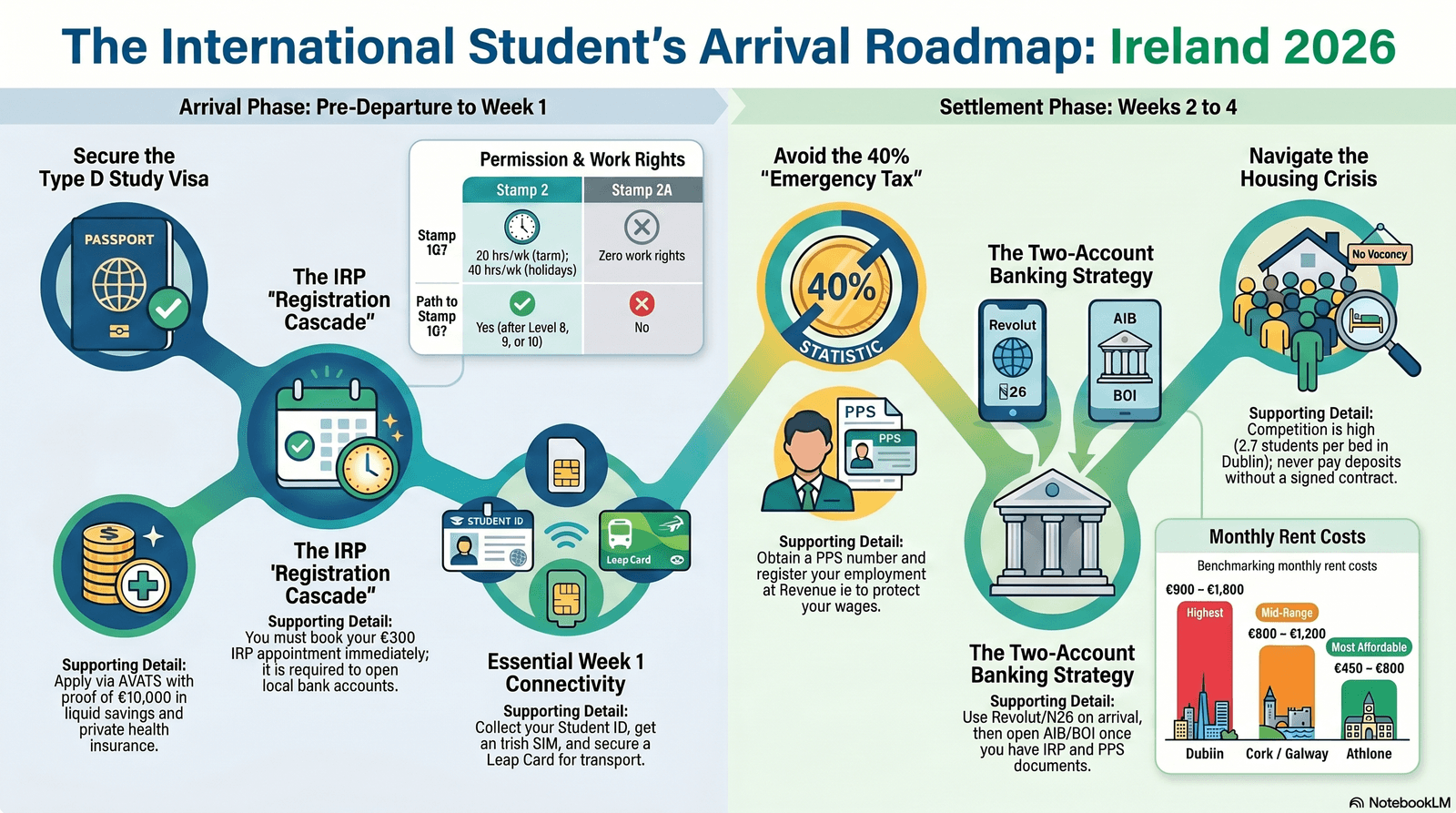
Arriving in Ireland with your offer letter is only the beginning. The next four weeks involve a chain of tasks — each one unlocking the next. Miss one and the knock-on delays compound quickly. Here is the correct order.
Pre-departure essentials
- Apply for and receive Type D Study Visa
- Open Revolut or N26 (no Irish address needed)
- Book IRP appointment online (Dublin students only)
- Confirm your permanent accommodation address
- Purchase health insurance policy
- Save Indian Embassy Dublin number: +353 1 668 0183
Immediate priorities
- Enrol at your university and collect student ID
- Register at IRP appointment (Burgh Quay or local office)
- Set up proof-of-address document (utility / bank letter)
- Get an Irish SIM card (Eir, Three, Vodafone, 48)
- Collect Leap Card for public transport
Financial setup
- Apply for PPS number (in person at Intreo, or online via MyWelfare.ie)
- Open AIB or Bank of Ireland student current account
- Register with Revenue at myAccount (revenue.ie)
- Claim Tax Credit Certificate before starting any job
Health and social setup
- Register with a GP practice near your accommodation
- Check GP medical card eligibility at gov.ie
- Register for university counselling services
- Join university society relevant to your background or interests
- Find part-time job if budget requires
The IRP card (or at minimum the immigration stamp in your passport at the port of entry) is required by most banks as proof of your right to be in Ireland. Your IRP card number is also needed for many official processes. Do not delay your IRP appointment — it cascades into everything else.
Section 1 — Student Visa
Q18 Do I Need a Visa to Study in Ireland?
It depends on your nationality. EU, EEA, and Swiss nationals do not require a visa to enter or study in Ireland. All other nationalities — including students from India, China, Pakistan, Bangladesh, Nigeria, and most non-European countries — must apply for a Type D Long Stay Study Visa before travelling.
Applications are submitted through the AVATS (Automated Visa Application and Tracking System) online portal at irishimmigration.ie. The process:
- Complete the online application form on AVATS
- Pay the visa fee: €60 for a single entry; €100 for multiple entry (amounts may change — verify at irishimmigration.ie)
- Print the completed form and bring it with all supporting documents to your nearest Irish Embassy or Visa Application Centre
- Attend biometrics if required at your local VAC
- Await a decision — typically 4–8 weeks; Dublin, Chennai, and Beijing VACs vary in processing time
You cannot apply for a study visa without a conditional or unconditional offer from an institution on the Interim List of Eligible Programmes (ILEP). This list is maintained by the Irish Immigration Service and is regularly updated — confirm your programme appears on it before you accept your offer and before you apply for a visa. The ILEP is searchable at irishimmigration.ie.
Visa documents checklist
- Valid passport (at least 12 months' validity beyond your intended stay)
- Completed AVATS application form
- Offer letter from an ILEP-listed Irish institution
- Proof of tuition fee payment (or financial evidence that fees can be met)
- Evidence of living funds (see Q19)
- Private medical insurance for the period of study
- Two recent passport photographs (white background)
- Academic transcripts and qualifications
- English language test results (IELTS, TOEFL, PTE, or Duolingo)
- Proof of accommodation in Ireland (if secured before departure)
Q19 How Much Money Must I Show for a Student Visa?
The Irish Immigration Service does not publish a single fixed figure, but in practice visa officers expect to see that you can meet your living costs independently for at least the first year of study. The benchmark widely cited by Irish immigration practitioners and university international offices is approximately €10,000 in liquid, accessible savings — separate from any tuition fees already paid.
Funds should be demonstrated through recent bank statements showing a consistent balance, not a lump sum deposited immediately before the application. Visa officers are alert to sudden deposits and may query the source of funds. Acceptable evidence includes:
- Personal or joint savings account statements (3–6 months)
- Fixed deposit statements showing accessible maturity dates
- Parental or sponsor bank statements with a signed sponsorship declaration
- Scholarship award letters (GOI-IES, CSC, etc.) confirming the stipend amount
The €10,000 benchmark is a working guideline, not a guaranteed minimum that can never change. Irish Immigration Service requirements can be updated with limited notice. Check the current guidance on the official portal before submitting your application.
Q20 What Is Stamp 2 vs Stamp 2A — and Why Does It Matter?
When you land in Ireland, the border officer stamps your passport with an immigration permission. For students, this is either Stamp 2 or Stamp 2A. The difference is significant.
| Permission | Programme Type | Work Rights | Path to Stamp 1G? |
|---|---|---|---|
| Stamp 2 | Full-time courses on the ILEP (degree, postgrad, language school above 25 hrs/wk) | 20 hrs/wk during term; 40 hrs/wk during official holidays | Yes — on completion of an NFQ Level 8, 9, or 10 programme |
| Stamp 2A | Courses NOT on the ILEP, or programmes under 25 hrs/wk | Zero work rights | No |
Students issued Stamp 2A cannot work legally under any circumstances, cannot access the Stamp 1G graduate pathway, and may face difficulties with some banking and government processes. Before enrolling in any Irish programme, confirm it is on the current ILEP. This is your responsibility — not your agent's or your institution's.
Section 2 — IRP Registration
Q21 What Is the IRP Card and How Do I Register?
The Irish Residence Permit (IRP) card is your official proof of immigration permission in Ireland. You must register and obtain your IRP card within 90 days of arriving in Ireland. Failing to do so is a breach of your immigration conditions.
As of January 2025, IRP registration is managed by Immigration Service Delivery (ISD) — the GNIB (Garda National Immigration Bureau) office that previously handled registrations at Burgh Quay has transitioned fully to ISD. The practical steps differ depending on where in Ireland you are based.
If you are based in Dublin
- Book an appointment online at irishimmigration.ie — the Burgh Quay Registration Office serves Dublin students in person
- Appointments are released in batches and go quickly — book as soon as you have a permanent address in Ireland, even before you travel
- Attend your appointment at 13–14 Burgh Quay, Dublin 2 with all required documents
- Pay the €300 registration fee on the day (cash or postal order; no card payment accepted)
- Your IRP card is posted to your registered address within 10–15 working days
If you are based outside Dublin
Students at universities in Cork, Galway, Limerick, Athlone, Waterford, and other cities register through their local immigration officer. Contact is typically made by email in advance of your first term. Your university's international student office will provide the specific contact details for your area. Processing in regional offices is generally faster than Burgh Quay.
IRP appointments at Burgh Quay are oversubscribed at the start of every academic year (September–October). Students who delay booking their appointment can find themselves waiting 6–10 weeks for a slot, putting them in breach of the 90-day requirement. Book your appointment as soon as you have a permanent address — even if your appointment date falls several weeks ahead. Having a booking on record demonstrates compliance to ISD.
Q22 What Documents Do I Need for IRP Registration?
- Valid passport — original, not a photocopy
- Original enrolment letter from your Irish institution confirming your registered programme and dates
- Proof of private medical insurance — a letter or certificate from your insurer showing cover for the period of your course
- Proof of address in Ireland — a utility bill, bank letter, or confirmed rental agreement at a permanent Irish address. Airbnb, hostel, or hotel addresses are not accepted
- €300 registration fee — in cash or by Irish postal order. Burgh Quay does not accept card payments
- Two passport-sized photographs (white or off-white background)
ISD requires a permanent residential address — not temporary accommodation — for IRP registration. This is also the address to which your IRP card will be posted. Students who arrive and stay in short-term Airbnbs or hostels while searching for permanent accommodation must secure a permanent address before they can register. This is one of the strongest practical reasons to arrange your accommodation before you travel to Ireland.
Q23 How Do I Renew My IRP Card?
IRP cards issued to students are typically valid for one year at a time (aligned to your academic year). You must renew before the expiry date on the card. Renewal is processed through the same ISD system — online at irishimmigration.ie for renewal applications, followed by an in-person appointment if required. Renewal documents include your current IRP card, updated enrolment confirmation, proof of continued health insurance, and the current renewal fee (verify the current amount at irishimmigration.ie as it can change annually). Start the renewal process at least 6–8 weeks before your card expires.
Section 3 — PPS Number
Q24 What Is a PPS Number and Why Do I Need One?
A PPS (Personal Public Service) number is Ireland's national social insurance and identification number. It is unique to each individual and is required for a wide range of essential interactions with Irish state services and employers. As an international student, you will need your PPS number for:
- Starting any form of paid employment in Ireland
- Registering with Revenue (to avoid emergency tax)
- Opening a full Irish bank account with AIB, Bank of Ireland, or PTSB
- Registering with a GP practice
- Accessing social welfare supports or medical card applications
- Certain university administrative processes
Q25 How Do I Get a PPS Number?
You can apply for a PPS number in two ways:
Online via MyWelfare.ie
The Department of Social Protection offers an online application at mywelfare.ie. You will need a verified MyGovID account, your passport details, and your Irish address. An appointment may be required to verify your identity at your local Intreo office before the number is issued.
In person at your local Intreo or Social Welfare office
Walk into or book an appointment at your local office. Required documents:
- Passport (original)
- IRP card (or evidence of IRP registration appointment)
- Proof of address in Ireland (utility bill, bank statement, or rent agreement)
- A statement of the reason you need the number (e.g., starting employment, registering for healthcare)
PPS numbers are typically issued within a few days of a successful appointment. The number is sent by post to your registered Irish address.
Section 4 — Tax and Revenue
Q26 How Do I Avoid Paying Emergency Tax on My Student Wages?
Emergency tax is one of the most common and frustrating financial shocks for new student workers in Ireland. If your employer does not have your correct tax details on record, they are legally required to apply emergency tax — which can mean deductions of up to 40% of your wages until the situation is resolved.
The steps to avoid this:
- Once you have your PPS number, go to revenue.ie and set up a free myAccount profile
- In myAccount, go to the Manage Your Tax section and register your new employment
- Revenue will issue a Revenue Payroll Notification (RPN) — formerly called a P2C or Tax Credit Certificate — electronically to your employer
- Your employer uses the RPN to apply the correct tax credits and cut-off points to your wages from your first payslip
Q27 How Does the Irish Tax System Work for Part-Time Students?
Ireland operates a Pay As You Earn (PAYE) system — tax is deducted from your wages by your employer before you are paid. The main deductions on your payslip are:
| Deduction | What It Is | Student Impact |
|---|---|---|
| Income Tax (PAYE) | Standard rate 20%; higher rate 40% above a threshold | Most students earn below the higher rate threshold; effective rate is typically 0–20% |
| USC (Universal Social Charge) | 0.5%–8% tiered charge on all income above €13,000/yr | Students earning under €13,000/yr are largely exempt from USC |
| PRSI (Pay Related Social Insurance) | 4% employee contribution; gives entitlement to some social benefits | Payable on most employment income; rate is 4% for employees |
The combined annual tax credit for 2026 is €1,875 personal tax credit + €1,875 employee tax credit = €3,750 total. This means the first €18,750 of income is effectively tax-free after credits are applied at the standard 20% rate. A student working 20 hours per week at the minimum wage earns approximately €13,000 annually — well within the tax-free threshold when credits are claimed correctly.
Section 5 — Banking
Q28 Which Bank Account Should I Open as a New Student in Ireland?
The best approach for international students is a two-account strategy: one digital account you open before you arrive (no Irish address required), and one traditional Irish bank account opened after you receive your IRP card and PPS number.
Open with only your passport. Use immediately for spending in Ireland. Excellent FX rates. IBAN available. Best for day-to-day spending on arrival.
German-licensed online bank; open with passport only. Irish IBAN provided. Good for students who want a European bank account structure immediately.
Best for international transfers home. Holds multiple currencies. Very low conversion fees (0.4–0.6%). Not a full current account but ideal alongside Revolut.
AIB Student Plus account — zero transaction fees. Requires IRP card, PPS number, and Irish address. Best for direct salary payments and Irish Direct Debits.
Student account with fee-free banking. Requires IRP card and PPS. Widely accepted by employers and landlords. Larger ATM network than AIB.
Permanent TSB Explore account. Offers cashback on some transactions. Less common than AIB or BOI but a solid alternative. Requires same standard documents.
Q29 What Is the Cheapest Way to Send Money from Ireland to India or China?
| Service | Typical Fee | Exchange Rate | Best For |
|---|---|---|---|
| Wise | ~0.4–0.6% of transfer amount | Mid-market rate (real rate) | India and China transfers — consistently best value |
| Revolut | ~0.5% (within plan limits; 1% outside) | Near mid-market | Smaller amounts within Revolut plan allowance |
| Western Union | ~1.5–2.5% + flat fee | Less favourable mark-up | Cash pickup for recipients without bank accounts |
| AIB / Bank of Ireland wire | €20–€35 flat per transfer | Less favourable bank rate | Very large transfers where the flat fee is proportionally small |
For regular remittances to family in India, Wise consistently delivers the lowest cost with the real exchange rate. A €500 transfer to India via Wise typically costs €2–€3 in fees; the same transfer via a high street bank wire can cost €20–€35 in fees plus an unfavourable exchange rate mark-up.
Section 7 — Work Rights for Students
Q30 How Many Hours Can I Work as an International Student in Ireland?
Work rights are determined by your immigration stamp — not by your university programme title. The rules for Stamp 2 holders in 2026:
| Period | Maximum Hours Permitted | Notes |
|---|---|---|
| During academic term | 20 hours per week | Applies across the full academic year except official holiday periods |
| Summer holidays (1 June – 30 September) | 40 hours per week | Full-time work permitted; many students use this period to reduce living cost pressures |
| Christmas holidays (15 December – 15 January) | 40 hours per week | Full-time work permitted during this window |
| Easter holidays | 40 hours per week | Full-time permitted; duration of Easter break varies by institution |
Q31 Can I Work Full-Time After I Graduate?
Yes — this is one of Ireland's most significant advantages for international graduates. On completing a qualifying programme, you can apply for Stamp 1G (the Third Level Graduate Programme), which permits full-time work (up to 40 hours per week) while you seek and start graduate-level employment. Duration depends on your NFQ level:
- NFQ Level 8 (Honours Bachelor's): 12 months — non-renewable
- NFQ Level 9 (Master's) or Level 10 (PhD): 24 months — issued as two 12-month periods. You must apply for the second year in month 11 of your first Stamp 1G.
Stamp 1G requires application from within Ireland while you hold valid Stamp 2. You must apply within 6 months of receiving your final results. Full details of the graduate pathway, the Critical Skills Employment Permit, and the route to Stamp 4 are covered in Part 3 of this series.
Q32 Where Do Students Find Part-Time Jobs in Ireland?
- Indeed.ie — the primary platform for all job types; filter by "part-time" and your city. New listings appear daily for hospitality, retail, and campus roles.
- LinkedIn — better for office-based, marketing, or tech-adjacent roles. A complete profile with your Irish university name increases visibility significantly.
- University notice boards and student union job boards — many campus jobs (library desk, café, ambassador roles) are only advertised internally.
- Hospitality and retail direct applications — walk into coffee shops, restaurants, and retail stores near campus. A direct approach with a short CV is often more effective than online applications for entry-level hospitality.
- Campus IT and helpdesk roles — Irish universities regularly hire student IT support assistants; check your university's human resources or IT department portal.
- EURES (eures.europa.eu) — European employment portal; useful for students at border-city universities considering cross-border work.
Ireland's national minimum wage was increased to €13.50 per hour for adults aged 20 and over from 1 January 2025. At 20 hours per week over a 30-week academic term, this generates approximately €8,100 gross in term-time earnings alone. During the summer 40-hour allowance (14 weeks), earnings can reach a further €7,560 gross — a combined annual potential of approximately €15,660 before tax. The minimum wage is subject to annual review by the Low Pay Commission; verify the current rate at gov.ie before budgeting.
Section 8 — Student Housing in Ireland
Q33 How Serious Is the Student Housing Crisis in Ireland?
The student accommodation shortage in Ireland is a structural, well-documented crisis — not a passing inconvenience. A 2026 analysis by University Business magazine and the Higher Education Authority found an estimated shortfall of 38,900 student bed spaces nationally. In Dublin, the ratio is approximately 2.7 students competing for each available bed space in purpose-built student accommodation (PBSA).
The practical consequence: students who do not secure accommodation well in advance of arrival frequently find themselves facing homelessness, extortionate short-term rental prices, or very long daily commutes. This is not hyperbole. Irish and international media routinely cover the crisis at the start of each academic year. Treating accommodation as an afterthought is one of the most consequential mistakes a new international student can make.
Q34 What Are My Housing Options as an International Student?
Five main categories of accommodation are available to students in Ireland, each with different cost, comfort, and availability profiles.
1. Purpose-Built Student Accommodation (PBSA) / On-Campus Residences
Managed student villages operated by universities (e.g., UCD Belgrove, Trinity Accommodation, UCC Victoria Mills) or private operators (Uninest, Aparto, Dwell). All-inclusive weekly rates covering room, utilities, broadband, and sometimes gym access. Book through your university's accommodation portal — most allocations open in March/April for the September intake. Apply on the first day applications open. Availability is exhausted within days for most Dublin universities.
2. Homestay (Digs)
Renting a room in an Irish family home, often with some meals included. "Digs" is the Irish term. Typically the safest and warmest option for students arriving alone for the first time. Usually booked through a university-affiliated homestay programme or agencies such as Accommodation Ireland (accommodation-ireland.com) or Host Families Ireland. Good availability outside Dublin.
3. Private Rented Shared House
Renting a room in a shared private house with other students or young professionals. Found on Daft.ie and Rent.ie. Highest autonomy but requires significant upfront costs (one month's rent deposit + first month's rent in advance). Most competitive market; suitable for students with confirmed Irish bank accounts and IRP card.
4. Co-Living / Shared Apartments
Private co-living operators (e.g., Yugo, urbanest, Scape) provide studio or en-suite cluster apartments with shared kitchens. More expensive per week than shared houses but more secure, all-inclusive, and easier to access for international students who cannot attend in-person viewings.
5. Extended Family or Community Networks
Many Indian and Chinese students find their first accommodation through community referrals — a relative, a WhatsApp group, a university society. This is pragmatic and often the fastest route to verified, affordable accommodation on arrival.
| City | Shared Room (Monthly) | On-Campus PBSA (Weekly) | Relative Cost |
|---|---|---|---|
| Dublin | €900–€1,800 | €180–€280/wk | ⬆️ Most expensive |
| Cork | €600–€1,000 | €130–€200/wk | Mid-range |
| Galway | €700–€1,200 | €130–€190/wk | Mid-range |
| Limerick | €550–€950 | €110–€170/wk | Good value |
| Athlone (TUS) | €450–€800 | €100–€150/wk | ⬇️ Most affordable |
Q35 How Do I Avoid Rental Scams?
Rental fraud targeting international students is a documented and growing problem in Ireland, especially as students search remotely from India and China before arriving. The core rule: never pay a deposit or any money without having a verified, signed rental agreement and proof of the landlord's ownership or management rights.
- Use only trusted platforms: Daft.ie and Rent.ie are Ireland's primary legitimate rental portals. Facebook Marketplace and WhatsApp groups carry significantly higher scam risk.
- Always request a video call viewing if you cannot attend in person — a legitimate landlord or property manager will always agree to this. Refusal is a red flag.
- Never transfer money via Western Union, MoneyGram, Bitcoin, or Revolut/Wise to unknown contacts before signing a contract and receiving a copy.
- Unusually low rent for a good property in a central location is almost always a scam. Check current market rates on Daft.ie's rental price report before engaging.
- Verify the property exists using Google Street View to confirm the address and building are real before paying anything.
- Check the RTB (Residential Tenancies Board) register at rtb.ie — registered landlords and tenancies can be partially verified here.
- Your university's accommodation office maintains lists of vetted, inspected private landlords and homestay providers — use these first.
Section 9 — Health Insurance and GP Access
Q36 Do I Need Health Insurance in Ireland?
Yes — private health insurance is a mandatory requirement for IRP registration for non-EU students. Without a valid health insurance policy, you cannot register your IRP card, which means you cannot legally remain in Ireland beyond your initial 90-day landing permission.
Ireland operates a two-tier health system. Public healthcare (through the HSE) is available but access is difficult without a medical card, and GP waiting lists in Dublin can be very long. Private health insurance gives you access to private GP services, consultants, and faster diagnostic services.
| Provider | Student Plan Name | Approximate Annual Cost | Key Coverage |
|---|---|---|---|
| Laya Healthcare | Laya Simply Connect / Student Health | €400–€550/yr | GP visits, outpatient, physiotherapy, dental (limited) |
| VHI | VHI Student Plan | €350–€520/yr | GP visits, inpatient, outpatient, mental health support |
| Irish Life Health | 4D Health Student | €380–€540/yr | GP unlimited (selected GPs), telehealth, hospital cover |
Always read the policy excess (the amount you pay per claim before insurance kicks in) and confirm that the plan meets the minimum coverage level required for IRP registration. Verify current premium rates directly with each insurer — health insurance premiums in Ireland change annually.
Q37 How Do I Register with a GP in Ireland?
In Ireland, you choose and register with a specific GP practice rather than being automatically assigned one. This requires you to actively contact practices near your accommodation and ask if they are accepting new patients. Key points:
- In Dublin, GP practices in student-heavy areas (Rathmines, Ranelagh, Phibsborough, Clondalkin) are frequently at capacity. Call or visit multiple practices as soon as you arrive.
- Outside Dublin, availability is generally better — Limerick, Galway, and Cork students typically register within their first two weeks.
- A private GP visit costs approximately €60–€80 without a medical card.
- Some practices offer a free initial registration consultation — ask when calling.
- Your university student health centre (if it has one) operates as a de facto GP service for registered students and is typically free or heavily subsidised. Check your university's campus services page.
Medical card eligibility
Non-EU students may be eligible for a medical card if their income falls below the means test threshold. A medical card covers free GP visits, prescription drugs (standard list), and free public hospital inpatient care. The means test is applied weekly rather than annually — a student working part-time at minimum wage during term time may qualify. Apply via the online means test calculator at gov.ie.
Section 10 — Mental Health and Wellbeing
Q38 What Mental Health Supports Exist for Students in Ireland?
The transition to life in a new country — different food, different social norms, different weather, a new academic culture, and separation from family — creates real psychological pressure that many students underestimate. Homesickness, loneliness, financial anxiety, and academic stress can compound quickly in the first semester. Reaching out early is not a sign of weakness; it is the rational response.
Niteline
1800 793 793Confidential, non-judgemental listening service run by trained student volunteers. Operates on term-time nights (hours vary by term). Free from any Irish phone.
Samaritans Ireland
116 12324 hours a day, 7 days a week, 365 days a year. Free from any phone in Ireland. Available in English. For anyone experiencing distress or crisis.
Jigsaw
jigsaw.ieFree mental health support for people aged 12–25. Walk-in and appointment services in Dublin, Cork, Galway, Limerick, Waterford, Sligo, and more cities. No referral needed.
Your University Counselling Service
Free & ConfidentialEvery Irish HEI provides free, confidential counselling to registered students. Book via your student portal or by calling the student services office. Sessions are typically one-on-one with a qualified counsellor.
Text About It
Text HELLO to 50808Free, anonymous, 24/7 text-based support service (the Irish equivalent of Crisis Text Line). Staffed by trained volunteers. Good option for students who prefer not to call.
Student Assistance Fund
Via your SUMost universities maintain a Student Assistance Fund for students in acute financial difficulty — including international students. Contact your Students' Union welfare officer to apply.
Academic researchers call it "culture shock" — a predictable cycle of initial excitement, followed by frustration or disorientation, followed by gradual adjustment. Most international students experience some version of it in months 2–4 of their first academic year. It is normal, it passes, and you are not the only one going through it. Irish university counselling services see high demand in October–November specifically because of this phenomenon. Book early — waiting lists for university counselling can extend to 6–8 weeks at peak times.
Section 11 — Safety in Ireland
Q39 Is Ireland Safe for Indian and International Students in 2026?
Ireland is, overall, a safe country by international standards. Violent crime rates are comparatively low, the Gardaí (Irish police) are generally accessible and responsive, and Irish society is broadly welcoming of international students. However, it is important to give an honest picture.
In August 2025, the Indian Embassy in Dublin issued a formal safety advisory following a series of racially motivated incidents affecting Indian nationals in certain Dublin suburban areas. The Embassy documented at least 13 reported attacks in the preceding months, leading to formal communications with the Irish government and a police investigation response from An Garda Síochána. India Day 2025 in Phoenix Park was postponed as a precautionary measure in response to these concerns.
The Irish political response was swift: condemnation from Sinn Féin, the Labour Party, and the Social Democrats; formal Garda hate crime investigations opened; and a commitment to increasing Garda presence in affected areas. As of 2026, the Irish government has also accelerated review of dedicated hate crime legislation.
The overwhelming majority of the 35,000+ international students studying in Ireland each year — including tens of thousands from India — complete their programmes without experiencing any racially motivated incident. Ireland's Indian community is large, well-established, and actively supported by a network of cultural associations, embassy resources, and university welfare services. Awareness and sensible precaution are appropriate; fear is not the right response.
Q40 How Do I Stay Safe as an International Student in Ireland?
- Travel in groups after dark — particularly in outer Dublin suburban areas including Tallaght, Clondalkin, Ballymun, and Blanchardstown. These are specific areas where incidents were concentrated; central Dublin, Cork, Galway, and Limerick have had no comparable pattern of incidents.
- Save key emergency contacts before you arrive: Garda emergency line: 999 or 112 (free from any phone). Indian Embassy Dublin: +353 1 668 0183. Chinese Embassy Dublin: +353 1 269 1707. Your university security office number.
- Report all incidents to An Garda Síochána — dial 999 for emergencies, or visit your local Garda station for non-emergency reports. Request that the incident be recorded as a hate crime if you believe race or nationality was a motivating factor. This matters for Garda hate crime statistics and resource allocation.
- Also inform your Indian or Chinese Embassy if you experience or witness a racially motivated attack. Embassies track incidents and use aggregate data in formal diplomatic representations to the Irish government.
- Use the Walk Safe service if your university provides it — many Irish universities offer a scheme where a trained volunteer accompanies students walking home at night. Ask your SU.
- Stay aware of your surroundings in unfamiliar areas, particularly on buses and in areas with limited lighting after midnight.
- Connect with your community — Irish-Indian associations, Hindu Cultural Society of Ireland, and university multicultural societies are a source of peer support and practical local knowledge.
Section 12 — Irish Culture and Daily Life
Q41 What Should I Know About Irish Culture and Daily Life?
Practical cultural awareness reduces friction significantly in your first semester. Ireland is not the same as the UK, the USA, or any other English-speaking country — it has its own distinct social rhythms.
| Aspect | What to Expect | Student Tip |
|---|---|---|
| The pub | Central to Irish socialising for all ages; not primarily about drinking | You are never obligated to drink alcohol. Ordering a soft drink or sparkling water is entirely unremarkable. Pubs are where professional networks are built, sports are watched, and friendships are formed. |
| The weather | Rain is possible on any day of any month. Average temperature ranges from 5°C (winter) to 18°C (summer). | A good waterproof jacket is your single most important purchase. Umbrellas are ineffective in Irish wind. Students arriving from India or Nigeria consistently underestimate how cold and damp October–March can feel. |
| Directness vs. politeness | Irish communication is warm but often indirect. "That's grand" can mean anything from genuine approval to polite disagreement. | If you receive ambiguous feedback from a tutor, landlord, or employer — ask a direct follow-up question. Irish social politeness rarely means what it literally says at face value. |
| Tipping norms | 10–15% expected in sit-down restaurants; not expected in pubs, fast food, or cafés | Tipping is appreciated but not compulsory. Student budget? 10% is perfectly standard and respectful. |
| Sunday rhythms | Ireland remains quieter on Sundays than most European cities. Shops outside Dublin city centre often close by 6pm. | Do your weekly grocery shop on Saturday, not Sunday evening. Aldi and Lidl close early on Sundays in most towns. |
| Queuing | Strict. Informal queuing is widely observed even without formal barriers. | In any line — supermarket, bus, coffee shop — the queue is sacred. Cutting is considered extremely rude and will draw notice. |
| Food culture | Most students self-cater. A warm pub meal is a social institution. Asian grocery stores (particularly in Dublin 1, Capel Street area) are well-stocked. | Spice Village, Asian Food Market (Drury Street, Dublin 2), and Vietnamese grocers on Parnell Street stock a wide range of Indian and East Asian ingredients at reasonable prices. |
Section 13 — Online Communities and Networks
Q43 Which Online Communities Should I Join as an International Student in Ireland?
Community connection is one of the most underrated factors in a positive student experience. Finding your people quickly — whether for practical advice, social events, or just reassurance that you are not alone — makes a material difference to wellbeing in your first semester.
Reddit communities
- r/StudyInIreland — active community of current and prospective international students; good for practical questions
- r/ireland — general Irish community; honest, sometimes blunt, but genuinely helpful for real-world questions about Irish life
- r/UCD, r/TCD, r/UCC — university-specific communities with course advice, accommodation tips, and social events
- r/DublinBike — useful for students using the Dublinbikes public cycle scheme
Facebook groups
- "International Students In Ireland" — large group, very active around September; good source for accommodation leads and social events
- University-specific international student groups — check your university's official page for the link; most universities have a dedicated group for new international arrivals
Indian community resources
- Indian in Ireland — Facebook group; practical community for Irish-Indian residents and students
- Hindu Cultural Society of Ireland — social and religious events, practical support networks, festivals including Diwali celebrations
- India Ireland Cultural Association — cultural events, festivals, professional networking for the Indian community in Ireland
Chinese community resources
- University WeChat groups — most Chinese student communities self-organise on WeChat; join via QR codes distributed at freshers' week or through your university's international student office
- Irish Chinese Cultural Society — based in Dublin; cultural events and community support
- Chinese Embassy Dublin — student registration services and emergency consular assistance: +353 1 269 1707
Quick-Reference FAQ — Q18 to Q43
Q18: Do I need a visa for Ireland?
Non-EU/EEA/Swiss nationals — yes. Apply for a Type D Long Stay
Study Visa via AVATS at irishimmigration.ie before travelling.
EU/EEA/Swiss nationals do not need a visa.
Q19: How much money must I show?
Approximately €10,000 in liquid savings, separate from tuition
fees already paid. Verify the current requirement at
irishimmigration.ie before applying.
Q20: Stamp 2 vs Stamp 2A?
Stamp 2: 20 hrs/week during term, 40 hrs/week during holidays.
Stamp 2A: zero work rights. Confirm your programme is ILEP-listed
for Stamp 2.
Q21: How do I get an IRP card?
Register within 90 days of arriving. Dublin: in-person appointment
at Burgh Quay (book at irishimmigration.ie). Other cities: contact
local immigration officer by email. Fee: €300 cash or postal
order.
Q22: What documents for IRP?
Passport, enrolment letter, health insurance certificate,
permanent proof of address, €300 fee, two passport photos.
Q23: IRP renewal?
Apply at irishimmigration.ie before your card expires. Start the
process 6–8 weeks ahead. Bring updated enrolment confirmation and
renewed health insurance.
Q24: What is a PPS number?
Ireland's national social insurance identifier. Required for
employment, banking, Revenue registration, GP access, and social
welfare. Apply via MyWelfare.ie or in person at your local Intreo
office.
Q25: How do I get a PPS number?
Apply online at mywelfare.ie or in person with your passport, IRP
card, proof of address, and a reason for need. Issued within a few
days of a successful appointment.
Q26: Avoiding emergency tax?
Register on myAccount at revenue.ie. Your employer receives an RPN
(Revenue Payroll Notification) and applies the correct tax rate.
Without this, emergency tax of ~40% is deducted.
Q27: Irish tax for part-time students?
Combined annual tax credit of €3,750 (2026) means the first
~€18,750 of income is effectively tax-free. Most part-time
students earn below this threshold.
Q28: Which bank account to open?
Open Revolut or N26 before you arrive (no Irish address needed).
Open AIB or Bank of Ireland student account once you have your IRP
card and PPS number. Use Wise for remittances home.
Q29: Cheapest way to send money home?
Wise (~0.4–0.6% fee, real exchange rate) is the best option for
India and China. Revolut is competitive for smaller amounts within
plan limits. Bank wires cost €20–€35 flat.
Q30: How many hours can I work?
Stamp 2: 20 hrs/week during term; 40 hrs/week during summer
(June–September) and Christmas holidays (15 Dec–15 Jan). Stamp 2A:
zero hours.
Q31: Full-time work after graduation?
Apply for Stamp 1G: 12 months for Level 8 graduates, 24 months for
Level 9/10. Full details in Part 3 of this series.
Q32: Where to find part-time jobs?
Indeed.ie, LinkedIn, university notice boards, and direct
applications to hospitality and retail businesses near campus.
Q33: Student housing crisis?
An estimated 38,900 bed-space shortfall nationally (2026). Dublin
ratio: 2.7 students per available bed space. Start searching and
applying before your offer is confirmed.
Q34: Housing options?
On-campus PBSA, homestay/digs, private shared house, co-living,
and community networks. Costs range from €450–€800/month (Athlone)
to €900–€1,800/month (Dublin).
Q35: Avoiding rental scams?
Use only Daft.ie or Rent.ie. Never pay without a signed contract
and video-call viewing. Unusually low rent is a red flag. Verify
property exists on Google Street View.
Q36: Do I need health insurance?
Yes — mandatory for IRP registration. Options: Laya Healthcare,
VHI, Irish Life Health student plans at approximately
€400–€600/year.
Q37: How to register with a GP?
Contact GP practices near your accommodation directly and ask if
they are accepting new patients. University student health centres
are often a free or subsidised alternative. Private GP visits cost
€60–€80 without a medical card.
Q38: Mental health supports?
Niteline (1800 793 793, term-time nights); Samaritans (116 123,
24/7); Jigsaw (jigsaw.ie, free for under-25s); Text About It (text
HELLO to 50808, 24/7); your university counselling service (free,
book via student portal).
Q39: Is Ireland safe for Indian students?
Generally safe, with precautions needed. The Indian Embassy issued
a safety advisory in August 2025 following reported racially
motivated incidents in certain Dublin suburbs. Garda
investigations were opened and patrols increased. The vast
majority of students complete their programmes without incident.
Q40: How to stay safe?
Travel in groups at night; save emergency numbers before you
travel (999/112 for Garda; +353 1 668 0183 for Indian Embassy);
report any incident to both Garda and your Embassy; stay connected
to your community network.
Q41: Irish culture essentials?
Pub culture is social not just about alcohol; weather requires a
waterproof jacket; communication is warm but often indirect;
tipping is 10–15% in restaurants; Sundays are quiet; queuing is
taken seriously.
Q43: Online communities?
Reddit: r/StudyInIreland, r/ireland, university subreddits.
Facebook: "International Students In Ireland", university-specific
groups. India: Hindu Cultural Society of Ireland, India Ireland
Cultural Association. China: university WeChat groups, Irish
Chinese Cultural Society.
This is Part 2 of a 3-part guide for international students in Ireland. Part 3 covers the pathway from graduation to long-term residency:
- Part 3 — Work Permits, Stamp 1G & Staying On: The Critical Skills Employment Permit application process in detail, route to Stamp 4 (no permit required to work), the Stamp 4 to Stamp 5 citizenship pathway, and how to build a long-term career in Ireland after graduation. Read Part 3 →
Missed Part 1? It covers Ireland's top universities, tuition fees, scholarships including the GOI-IES, cost of living by city, and flight options from India and China.
Planning to use an Indian bank card to book your Dublin flights? Save ₹2,000–₹7,500 on your booking with the right card and offer:
Ready to book your flight to Dublin?
Compare live fares from India and around the world to Dublin — find the cheapest month before you commit to your university start date.
Immigration rules, visa fees, IRP fees, tax credits, minimum wage rates, health insurance premiums, rental prices, and benefit details in this article are based on information from the Irish Immigration Service (irishimmigration.ie), the Department of Social Protection (gov.ie/en/organisation/department-of-social-protection/), Revenue Ireland (revenue.ie), the Residential Tenancies Board (rtb.ie), the Health Service Executive (hse.ie), and the Indian Embassy in Dublin as of May 2026. Immigration rules, financial thresholds, and programme ILEP status can change with limited notice. Always verify current requirements directly with the relevant Irish government authority before making financial commitments or immigration applications. MyFlightOffers is not an immigration adviser. This article is informational and does not constitute legal, financial, or immigration advice.