Food budgets in Ireland 2026: at a glance
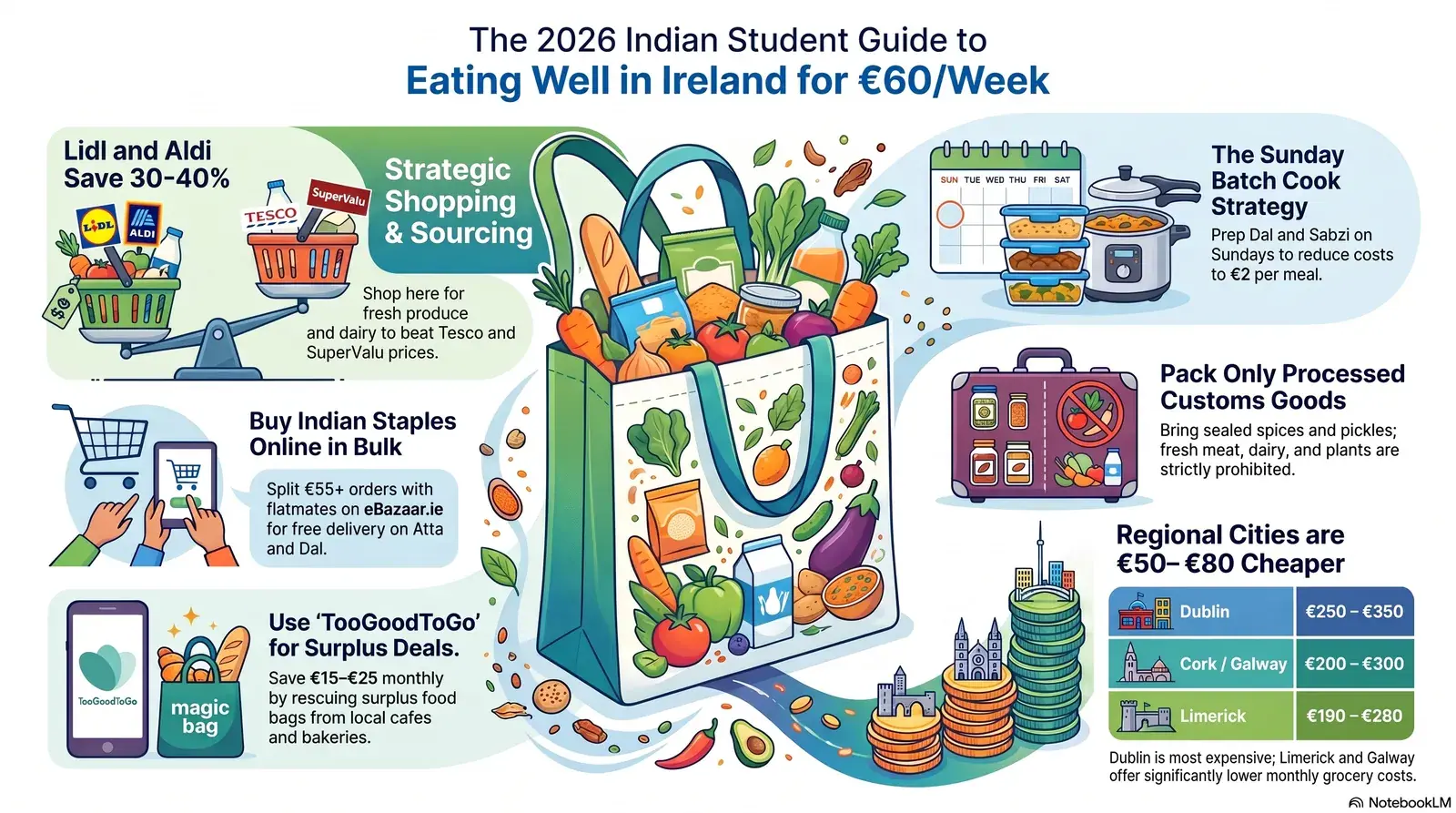
The key facts every Indian student needs before reading further: Dublin costs more, Lidl and Aldi save the most, and online Indian grocery stores have transformed access to staples across all Irish cities.
- Budget benchmark: Indian students cooking at home spend €200–€350 per month on food in Ireland in 2026 — regional cities are €50–€80 cheaper than Dublin.
- Cheapest supermarket: Lidl and Aldi are 30–40% cheaper than Tesco and SuperValu. Tesco with an active Clubcard narrows the gap on weekly staples.
- Indian grocery tip: Online stores (eBazaar.ie, Domo Mart, Vegspot) deliver atta, dal, and spices nationwide for free on orders over €40–€55 — cheaper per kilogram than most physical shops.
€250–€350 (groceries only)
€200–€300 (Galway, Cork, Limerick)
Lidl and Aldi (30–40% saving vs Tesco)
eBazaar.ie, Domo Mart, Vegspot — nationwide
How much do Indian students in Ireland actually spend on food?
Most Indian students cooking at home in Ireland spend between €200 and €350 per month on groceries in 2026, depending on the city. Dublin is the most expensive, while Limerick, Galway, and Cork are meaningfully cheaper despite little difference in supermarket shelf prices. The gap comes from local shop variety, availability of cheap takeaway options near campuses, and the cost of eating out when cooking feels impossible during deadline season.
Cost-of-living trackers in 2026 put average monthly grocery spend for a single person in Dublin at €250–€350, compared to €200–€300 in Galway, €200–€300 in Cork, and €190–€280 in Limerick. The supermarket shelf price difference between Dublin and Limerick is negligible — roughly €2–€4 on a standard weekly basket — but Dublin students tend to supplement grocery shopping with more frequent café visits and convenience-store purchases, which inflates the monthly total. A mid-range restaurant meal in Dublin averages €18–€25, while the same meal in Limerick averages €12–€17.
Students who cook Indian food at home consistently land at the lower end of the spending range. A week of dal, sabzi, rice, and roti from scratch costs €15–€25 in total, roughly €2–€3 per meal — comparable to what the same meal would cost in a tier-1 Indian city, once you account for bulk buying of staples from Indian grocery stores.
On-the-Ground Insight: “My first month in Dublin I was spending €400 on food because I kept buying ready meals and eating out. When I finally figured out the Lidl routine — shop Tuesday morning, buy reduced bread and dairy, batch cook dal and rice on Sunday — I got it down to €180 including one or two takeaways. The Spice Bazaar on Moore Street sorted my masala and atta situation.” — Priya N., MSc Data Analytics, UCD, Fall 2025 Intake
Which supermarket in Ireland saves Indian students the most money?
Lidl and Aldi are Ireland’s cheapest supermarkets in 2026, offering savings of 30–40% compared to Tesco or SuperValu on comparable own-brand products. Tesco with an active Clubcard narrows the gap significantly on specific weekly staples, while Dunnes Stores and SuperValu are mid-range and better for convenience than for price.
For Indian students, the supermarket hierarchy matters most for the items you buy from mainstream shops: eggs, milk, frozen chicken, vegetables, olive oil, bread, and lentils. Aldi announced price drops worth over €9 million to customers in July 2026, reinforcing its position as the budget leader. Both Lidl and Aldi refresh their “Super Savers” range weekly, with fresh vegetables often 20–50% cheaper than branded equivalents at Tesco.
| Supermarket | Price Tier | Loyalty Scheme | Best for Indian Students | Approximate Monthly Saving vs Tesco (no card) |
|---|---|---|---|---|
| Aldi Ireland | Cheapest | None | Vegetables, eggs, milk, frozen chicken | €30–€50 |
| Lidl Ireland | Cheapest | None | Bakery, vegetables, weekly specials | €30–€50 |
| Tesco Ireland | Mid–High (with Clubcard: Mid) | Clubcard (1 pt per €1, 100 pts = €1 voucher; Clubcard prices 20–40% off) | Clubcard price deals, larger stores, online delivery | Reference |
| Dunnes Stores | Mid | Simply Better rewards | Butcher counter, fresh produce quality | €5–€15 |
| SuperValu | Mid | Real Rewards | Campus proximity, local convenience | €5–€15 |
The Tesco Clubcard strategy: Sign up for free at tesco.ie. You earn 1 point for every €1 spent; every 100 points converts to €1 in Clubcard vouchers. The bigger benefit is Clubcard prices — items marked with the Clubcard logo are 20–40% cheaper for members than the standard shelf price. A double Clubcard points promotion ran from 9–22 February 2026. Always scan your card before checkout; you cannot apply points after the transaction.
Where can I find Indian groceries in Dublin, Cork, Galway, and Limerick?
Indian grocery availability in Ireland has expanded significantly in 2026. Physical stores are concentrated in Dublin and Galway, while online retailers with nationwide delivery now make Indian staples accessible in any county within 1–3 business days.
Physical Indian grocery stores by city
For students who want to buy in person and smell the spices before they buy, Dublin and Galway have the best physical options. Cork and Limerick students are better served by online ordering.
Dublin: Spice Bazaar has operated since 2006 and is the largest Asian supermarket chain in Ireland, with multiple Dublin locations carrying Indian, Filipino, and African food products. Asian Mart on Parnell Street and Moore Street area stores stock atta (10 kg bags), basmati rice (5 kg and 10 kg), whole and ground spices, ghee, dal varieties, ready-to-eat snacks, and Indian beverages. Prices for 10 kg atta bags at physical Dublin stores typically range from €9–€15 depending on brand. Mini India offers same-day delivery within eligible Dublin postcodes for orders placed before 4pm.
Galway: Spice Bazaar also has a Galway location, making it one of the better-served regional cities for physical Indian groceries. The Galway city centre also has several Asian food shops near the Eyre Square area catering to the large international student population at University of Galway.
Cork and Limerick: Physical Indian grocery options are limited in both cities. Students in Cork can find some Indian products at Asian supermarkets near the city centre, but the range is narrower. Limerick-based students benefit directly from eBazaar.ie, which operates its warehouse from Limerick and offers same-region delivery advantages.
Online Indian grocery stores with nationwide delivery
The online Indian grocery market in Ireland is well developed in 2026. For bulk staples — 10 kg atta, 5 kg basmati, large spice jars — online ordering is almost always cheaper per kilogram than physical shops, and free delivery thresholds are reachable with a typical monthly shop.
| Store | Key Products | Free Delivery Threshold | Delivery Coverage | Notable Feature |
|---|---|---|---|---|
| eBazaar.ie | 1,800+ products: atta, dal, rice, spices, pooja items, 120+ brands | Free over €54.99 | All 32 counties incl. Northern Ireland | Limerick warehouse; widest brand range |
| Domo Mart | Rice, dal, atta, snacks, large-format packs | Free over €40 (check site) | Nationwide, Cork/Galway 2–3 days | Bulk pack focus; good for group orders |
| Vegspot | Spices, snacks, fresh items (select areas) | Next-day delivery available | Nationwide | Fast dispatch; regular offers |
| Desi Grocery | Basmati rice, specialist brands, pickle range | Check site for current threshold | Republic of Ireland | Good for rice variety and specialty items |
| Mini India | Fresh veg delivery (select areas), dry goods | Same-day in Dublin/Limerick (order before 4pm) | Dublin + Limerick same-day; nationwide otherwise | Same-day fresh vegetables — unique offering |
What does a realistic €60 weekly shop look like for an Indian student?
A €60 weekly shop at Lidl or Aldi, supplemented by a monthly Indian grocery order, provides full coverage for three meals a day with variety — including both vegetarian and non-vegetarian cooking. The key is separating your Indian-staple spend (done monthly in bulk online) from your fresh produce and protein spend (done weekly at Aldi or Lidl).
| Category | Items | Approx. Weekly Cost (Aldi/Lidl) | Notes |
|---|---|---|---|
| Vegetables | Onions (1 kg), tomatoes (500 g), potatoes (2 kg), spinach, cauliflower or courgette, garlic, ginger (fresh or paste) | €8–€12 | Aldi Super Savers often include seasonal veg at 50% off |
| Protein | Eggs (12), chickpeas (tinned, 4×400g), lentils (dry red/yellow, 500g) or frozen chicken (1 kg) | €8–€14 | Dry lentils from Aldi/Lidl work fine; reserve Indian dal for flavour dishes |
| Dairy | Milk (2 litres), natural yoghurt (500 g), butter or ghee (from Indian store monthly) | €4–€6 | Lidl and Aldi own-brand dairy is significantly cheaper than branded |
| Bread & carbs | Sliced bread (800 g) or wrap pack; rice covered by monthly Indian order; roti from atta (monthly) | €2–€4 | Buy reduced bakery (yellow-sticker) when available |
| Fruit | Bananas (6), apples (6), or seasonal offer fruit | €3–€5 | Lidl Super Savers regularly include banana/apple packs under €1 |
| Miscellaneous | Cooking oil (sunflower/rapeseed), salt, sugar, tea bags | €4–€6 | Buy in large format; Aldi and Lidl own-brand cooking oil is €1.49–€2.49 for 1 litre |
| Indian staples (monthly ÷4) | Atta, basmati rice, chana dal, masoor dal, cumin, coriander powder, turmeric, garam masala (bought monthly from Indian store) | €7–€12 (weekly share of monthly order) | Order in bulk online; 10 kg atta lasts 6–8 weeks; 5 kg rice lasts 4–6 weeks |
Adding these up: a typical week lands at €36–€55 for a single student, with the lower end achievable when Aldi or Lidl weekly specials are used and Indian staples were ordered in a recent bulk run. The €60 ceiling comfortably includes occasional treats — a chocolate bar, a packet of biscuits, a can of coconut milk for a Friday curry.
What five Indian meals can you batch cook on Sunday for the whole week?
The most effective food strategy for Indian students in Ireland is a Sunday batch cook: 2–3 hours of cooking yields 10–15 meals, reducing weekday effort to 10–15 minutes of reheating. At €2–€3 per meal including Indian grocery costs, this beats every alternative except not eating.
Here are five practical recipes, all cooked from Irish supermarket ingredients plus Indian staples:
1. Dal Tadka — Use 300 g masoor dal (red lentils, available at Aldi/Lidl or Indian stores), one large onion, 3 tomatoes, and your spice kit (cumin seeds, turmeric, coriander powder, garam masala, dried chillies). One pot feeds 4–5 servings and stores in the fridge for 4 days. Cost: €1.50–€2.50 for the whole batch. Serve with rice or roti.
2. Aloo Gobi — Potatoes and cauliflower are consistently among the cheapest vegetables at Aldi and Lidl, often under €0.80/kg. A 500 g cauliflower and 4 medium potatoes with tomatoes and spices makes 3–4 portions. Cost: €1.50–€2.00 for the batch. Stores well for 3–4 days.
3. Chana Masala — Use tinned chickpeas (400 g tins are €0.45–€0.65 at Aldi/Lidl, or buy dried from Indian store and soak overnight). Two tins of chickpeas with onion, tomato, and chana masala powder make 4 servings. Cost: €1.80–€2.50 for the batch. This freezes well — make a double batch and freeze half.
4. Egg Bhurji or Egg Curry — A 12-pack of eggs at Aldi or Lidl is €2.50–€3.50. Egg bhurji (scrambled eggs with onion, tomato, and spices) takes 15 minutes and provides 3 servings. Egg curry takes slightly longer but stores better. Cost per serving: €0.80–€1.20. Good fallback when the main dal runs out mid-week.
5. Chicken Curry — Frozen chicken breast or thigh from Aldi or Lidl is €4–€7 per kilogram. 500 g of chicken with tomatoes, onion, yoghurt, and garam masala makes 3–4 portions. Cost: €3.50–€5.50 for the batch. Marinate the chicken overnight in yoghurt and spices for better flavour. For vegetarians, substitute with paneer from the Indian grocery store (€3–€5 for 200 g) or double the chickpea batch.
Dedicate 2.5 hours on Sunday. Cook dal tadka and one sabzi (aloo gobi or chana masala) as a base. Make a large batch of rice. Prep egg bhurji ingredients in a bowl so Tuesday dinner takes 12 minutes. Total grocery cost for the week’s meals: €15–€22. That is €1.50–€2.20 per meal across 10 meals.
Which apps cut the most off your food bill in Ireland?
Three tools consistently make the biggest difference for Irish students in 2026: TooGoodToGo for rescued surplus food, the Tesco Clubcard app for automatic price discounts, and Lidl’s and Aldi’s weekly leaflet apps for planning around special offers.
TooGoodToGo is the most underused student tool in Ireland. The app connects you with restaurants, cafés, bakeries, and supermarkets that have surplus unsold food at the end of service. You buy a “Surprise Bag” at half price or less and collect it at a specified time. In 2026, TooGoodToGo operates in over 1,800 locations across Ireland, with over 880,000 registered Irish users. A typical Surprise Bag is priced at €3.99–€5.99 and contains food worth €8–€15 at retail. Two bags per week saves €15–€25 per month. The cons: you cannot choose what is in the bag, and collection windows are fixed (usually within a 30–60 minute slot). It works best as a supplement to your weekly shop, not a replacement.
Tesco Clubcard app: Beyond in-store scanning, the app shows personalised offers based on your purchase history. Setting up the app takes five minutes. Offer examples from early 2026 included 50% off selected dairy products, double points on own-brand items, and Clubcard prices on hundreds of lines 20–40% below the standard shelf price. Students spending €60/week at Tesco who consistently use Clubcard prices save an estimated €12–€20 per week versus paying full shelf price on the same items.
Lidl and Aldi weekly leaflets: Both supermarkets publish their weekly special offers (Lidl calls them “Super Savers”) online and via their apps. Checking these on Monday or Tuesday before your weekly shop — and building your menu around what is on special — routinely reduces a vegetable and protein bill by €5–€10 per week. Indian students in particular benefit when the Aldi/Lidl Indian food week runs (typically once per quarter), which brings tikka paste, basmati rice, and Indian snacks at low prices.
Student-focused cashback: TopCashback Ireland and the UCD Students’ Union deals page (and equivalent at other colleges) list rotating food and grocery discounts. These are smaller savings but compound over a full academic year.
Where can Indian students eat out cheaply in Dublin?
Eating out in Dublin on a student budget is possible if you avoid the touristy spots and know where student deals are. The best options in 2026 are Pablo Picante for a filled burrito and drink at €6.95, KC Peaches for hot mains from €5, and Milano restaurants offering 30% off food and drink Sunday to Thursday with a student ID or UNiDAYS account.
A short list of the best-value student options around Dublin in 2026:
Pablo Picante offers a student deal of a burrito plus soft drink or water for €6.95 — one of the best value hot meal deals in the city centre. KC Peaches has a small hot mains box from €5. Bunsen runs a student burger meal (burger + fries + soft drink) for €11.45 with a valid student card. Milano (formerly Pizza Express Ireland) gives 30% off food and drink bills Sunday to Thursday with a student ID or UNiDAYS. YO! Sushi offers 20% off via UNiDAYS, including takeaway.
For Indian food specifically, look at lunch specials at Indian restaurants around the Capel Street, Mary Street, and Parnell Street areas in Dublin — several offer buffet-style lunch deals at €9–€13. These are substantially better value than dinner service. In Limerick, restaurant meals average €12–€17 for a main, and early bird menus (typically 5–7pm) reduce prices by 15–25%.
What Indian food can you bring through Irish customs?
Commercially packaged, processed foods from India — including spices, tea, coffee, packaged rice, atta, dal, snacks, and pickles — are generally permitted into Ireland. Fresh meat, raw dairy products, and fresh plant material (including fresh vegetables and fruits) from India are prohibited under EU border control rules.
Ireland follows EU import rules as a member state. The key distinction is between products of animal origin (meat, dairy, eggs, honey) and processed/packaged foods of non-animal origin. Under Food Safety Authority of Ireland (FSAI) guidance for personal imports, the following applies to passengers arriving from India:
Generally allowed: Commercially packaged and sealed spices (cumin, coriander, turmeric, garam masala blends), packaged tea (including masala chai blends), packaged rice, atta, and dal, packaged biscuits, namkeen, murukku and other dry snacks, packaged pickle jars, commercially produced chutneys, and packaged papads/poppadums. These must be in original sealed commercial packaging with ingredient labels.
Prohibited: Fresh or frozen meat of any kind (chicken, mutton, seafood), raw or pasteurised dairy products (paneer, ghee in non-commercially sealed formats, fresh yoghurt), fresh fruits and vegetables, and fresh or dried plant material without phytosanitary certificates. Home-cooked food falls into a grey area and is commonly stopped at customs.
Declaration rule: All goods must be declared to Irish Revenue on arrival. Using the green “nothing to declare” channel with prohibited food items risks confiscation and a fine. When in doubt, use the red channel and declare. Customs officers are primarily interested in animal products and fresh plant material; sealed commercial packages are rarely a problem. The FSAI publishes a personal imports guidance page that is updated with current rules.
Monthly food budget calculator
Estimate your monthly food spend in Ireland based on your actual habits. The calculator uses the spending benchmarks documented in this article: average weekly supermarket spend of €45 (from a range of €36–€55), TooGoodToGo bag price of €3.99–€5.99, and eating-out estimates of €7–€15 per meal at budget options. Adjust the defaults to match your lifestyle.
🧮 Monthly Food Budget Estimator
Calculates your estimated monthly food cost based on your weekly grocery spend, TooGoodToGo usage, and eating-out habits.
Frequently Asked Questions
How much does an Indian student spend on food per month in Ireland?
Most Indian students cooking at home in Ireland spend between €200 and €350 per month on food in 2026. Dublin students typically spend €250–€350 on groceries, while students in Galway, Cork, and Limerick spend €200–€300. Those who eat out frequently can reach €400–€500 per month.
Where can I buy Indian groceries in Ireland?
Physical stores include Spice Bazaar (multiple Dublin locations and Galway) and Asian Mart. Online stores with nationwide delivery include eBazaar.ie (free delivery over €54.99, Limerick warehouse), Domo Mart, Vegspot, Desi Grocery, and Mini India (same-day delivery in Dublin/Limerick for orders before 4pm).
Which supermarket is cheapest for students in Ireland?
Lidl and Aldi are consistently the cheapest supermarkets in Ireland in 2026, with savings of 30–40% versus Tesco or SuperValu on comparable own-brand items. Tesco with an active Clubcard narrows the gap, with Clubcard prices 20–40% below standard shelf price on hundreds of products.
Can I bring Indian spices and food from home to Ireland?
Commercially packaged spices, tea, rice, atta, dal, and packaged snacks from India are generally allowed. Fresh meat, raw dairy, and fresh plant material from India are prohibited under EU rules. All goods must be declared to Irish Revenue on arrival. Check the FSAI personal imports guidance before travelling.
How much can I save using TooGoodToGo in Ireland?
TooGoodToGo operates in over 1,800 stores across Ireland in 2026. Surprise bags are priced at approximately €3.99–€5.99 and contain food worth €8–€15 at retail. Two bags per week saves €15–€25 per month compared to buying the same food at full price.
Planning your move to Ireland? Compare live flight fares first.
Once your food and living budget is mapped, lock in the best fare for your Ireland flight. Check our Dublin fare calendar for the cheapest months to fly.
All prices, supermarket rankings, and customs rules cited in this article are based on publicly available official and commercial sources as of July 2026. Supermarket prices change weekly; the rankings reflect general 2026 positioning. Irish customs rules for food imports are governed by EU law and are subject to change — always verify current rules with the Food Safety Authority of Ireland and Revenue Ireland before travelling. MyFlightOffers is not affiliated with any supermarket, grocery store, or food app mentioned. This article does not constitute financial or legal advice.
- The Indian Student’s Money Survival Guide in Ireland — banking, budgeting, sending money home, and avoiding common financial traps
- Ireland Banking Guide for International Students 2026 — how to open a bank account, best student accounts, and Revolut setup
- Ireland Student Survival Guide: Hidden Subsidies 2026 — transport passes, GP visit cards, food bank locations, and grants most students miss
- Study in Ireland Cost Estimator — build a full monthly budget for rent, transport, food, and fees in one place