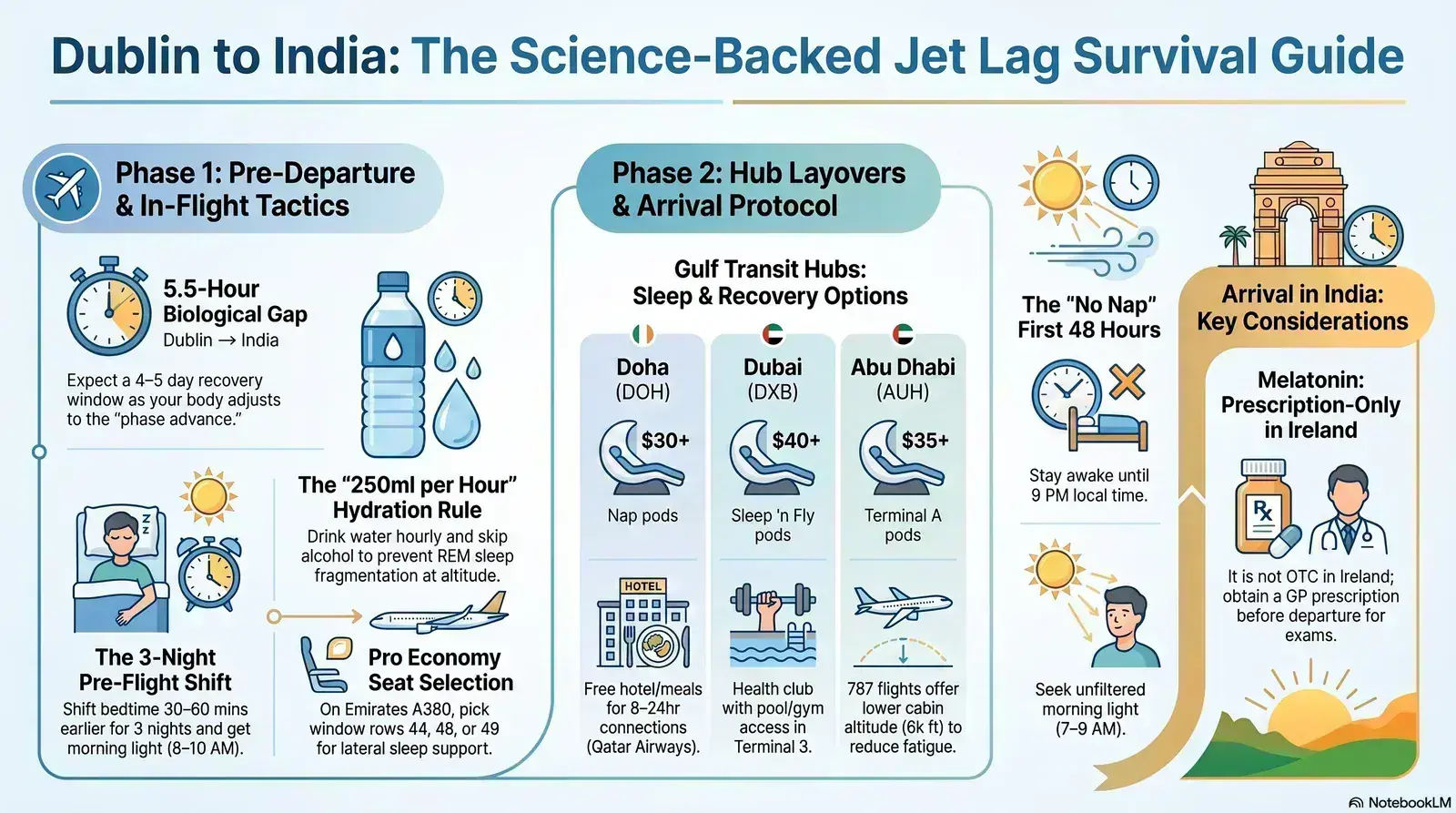
- Eastbound is harder: India is 4.5 hours ahead in summer (March–October) and 5.5 hours ahead in winter. Your body needs roughly one day per time zone to resync — plan on 4–5 days of mild fatigue after arriving in India.
- Shift your clock 3 nights before departure: Going to bed 30–60 minutes earlier each evening and getting morning light cuts recovery time by a full day or more, confirmed by a 2025 PMC circadian study.
- Melatonin is prescription-only in Ireland: You cannot buy it over the counter at an Irish pharmacy. Ask your GP for a short course before a trip with an exam deadline or an early-morning onward connection.
+4.5 hrs summer / +5.5 hrs winter (IST never changes)
4–5 days typical; up to 7–8 days for sensitive travellers
Prescription only (HPRA) — not available OTC in any pharmacy
0.5–3 mg at destination bedtime for 3–5 nights on arrival
In this guide
- Why eastbound to India feels harder
- Pre-flight sleep shifting — 3 nights before
- In-flight strategy: hydration, light, and alcohol
- Gulf hub layover: nap or push through?
- Arrival protocol: first 48 hours
- Melatonin and sleep aids: Ireland’s rules
- Seat choice on A380s and 777s
- Special cases: exams, business, and kids
- Frequently asked questions
1. Why Does Flying East to India Feel Harder Than the Return?
Your body clock runs on a natural cycle of roughly 24.2 hours, making it biologically easier to extend the day (flying westbound back to Ireland) than to shorten it (flying eastbound to India). India Standard Time is 4.5 hours ahead of Irish time in summer and 5.5 hours ahead in winter, forcing every biological process — hunger, alertness, melatonin release, core temperature peaks — to shift earlier, which the human circadian system resists strongly.
India Standard Time (IST, UTC+5:30) never observes daylight saving time. Ireland uses Irish Summer Time (UTC+1) from late March to late October and Greenwich Mean Time (UTC+0) in winter. The Ireland-India gap therefore narrows to 4.5 hours in summer and widens to 5.5 hours in winter. Passengers booking a late-October or November return from Delhi are crossing 5.5 zones — a meaningfully harder adaptation than the same route in June when the gap is 4.5 hours.
A 2025 analysis of 1.5 million nights of sleep data, cited in peer-reviewed circadian literature, confirmed that eastward travel disrupts sleep quality for two or more weeks in a significant share of travellers. The consensus estimate for unaided recovery is approximately one day per time zone for casual travellers, with up to 1.5 days per zone for eastbound journeys in those more sensitive to circadian disruption — meaning a winter Dublin-to-Delhi crossing can disrupt sleep for seven to eight days if no adjustments are made. The return westbound journey typically resolves within two to three days under the same unaided conditions.
The underlying mechanism is phase advance versus phase delay. Your 24.2-hour biological clock adapts more easily to phase delay (staying up later, the westbound pattern) because it naturally wants to run slightly beyond the 24-hour solar day anyway. Phase advance — going to sleep and waking earlier to match India's earlier sunrise — requires active intervention to complete in a reasonable time. The interventions in the sections below are ordered by the timing at which you encounter them: before the flight, on the plane, at the layover, and after landing.
2. Pre-Flight Preparation: Shifting Your Clock Three Nights Before
For an eastbound flight to India, shift your bedtime earlier by 30–60 minutes per night for three to five nights before departure, and get bright outdoor morning light exposure during those same days. Research published in PMC (article 1262683) demonstrated that a gradual pre-flight sleep advance combined with morning bright light significantly reduced subsequent jet lag severity after eastward transmeridian travel.
In practice, if you normally go to bed at midnight Dublin time and your flight departs on a Saturday morning: aim for 11:30 pm on Tuesday, 11:00 pm on Wednesday, 10:30 pm on Thursday, and 10:00 pm on Friday. This approach begins shifting your clock towards IST before you leave the country. Combined with morning light — even standing outdoors for fifteen minutes between 8 am and 10 am Irish time — you can advance your circadian phase by one to two hours before boarding. That head-start meaningfully shortens your post-arrival recovery window.
For those who have obtained a GP prescription for melatonin, adding 0.5 mg taken at approximately 9:00 pm Irish time (which corresponds to around 1:30 am IST in summer, 2:00 am IST in winter) on the two to three nights before departure reinforces the pre-flight advance. The 0.5 mg dose is as clinically effective as larger doses for circadian shifting — higher amounts do not accelerate adaptation and increase the risk of morning grogginess the day of departure.
3. In-Flight Strategy: Hydration, Meals, Light, and What to Skip
The long-haul cabin environment actively undermines circadian adaptation: relative humidity below 20% (compared to 40–60% in a typical home), cabin pressure equivalent to 8,000 feet of altitude, and alcohol that fragments whatever sleep you manage to get. Your in-flight priorities, in order of impact, are: set your watch to IST the moment you board; drink 250 ml of water per hour of flight; avoid alcohol entirely; and time your sleep window to align with India’s nighttime hours.
Hydration
Long-haul flight research published in the journal Nutrients (2020, PMC7551461) confirmed that flights promote fluid shifts to the lower extremities and blood viscosity changes consistent with dehydration. The mechanism is dual: pressurised cabin air holds relative humidity below 20%, and the equivalent altitude of 8,000 feet means you breathe slightly faster, losing additional fluid through exhalation. Drink 250 ml of water approximately every hour of flight. Avoid carbonated drinks — they cause bloating at altitude — and consider electrolyte sachets on flights longer than eight hours. Adequate hydration reduces the fatigue component of jet lag independently of circadian effects.
Alcohol
Alcohol is a diuretic that compounds in-flight dehydration and — critically — severely fragments REM sleep, the most restorative stage for circadian recovery. A single 250 ml glass of wine at cruising altitude can reduce sleep quality enough to eliminate the benefit of a three-hour in-flight nap. For the outbound leg to India, skip alcohol entirely. On the return westbound leg, where adaptation is faster and forgiving, a single drink with dinner is substantially less harmful to recovery.
Caffeine at Altitude
Caffeine is more nuanced than its reputation suggests. At cruising altitude, caffeine’s half-life increases by approximately 30%, meaning a flat white consumed two hours before your intended sleep window will still be circulating three to four hours later. For an eastbound Dublin-to-Gulf night departure, limit caffeine to the first two to three hours of the flight only. For passengers connecting in the Gulf and boarding the second leg into India, no caffeine after boarding the final sector is a firm rule if you intend to sleep on the overnight leg.
Light Management
Light is the single most powerful circadian synchroniser available to a traveller. A Dublin-to-Gulf departure in the morning or early afternoon will involve daylight for the first several hours; keep the window blind open during this period to reinforce wakefulness. Then close it and wear a sleep mask for any sleep attempt timed to India’s midnight-to-dawn window — on most itineraries, this falls during the second leg from the Gulf hub into India. On arrival in India, step outside and get unfiltered morning light between 7 am and 9 am IST on each of the first three mornings. Outdoor light — not indoor LED lighting — produces the phase-advancing circadian signal needed to resync to India time quickly.
4. Gulf Hub Layover: Nap or Push Through?
For a layover under six hours, limit rest to a single 20-minute power nap to avoid waking mid-sleep-cycle feeling worse than before. For a layover of six hours or more, access the airport’s dedicated sleep facility and target a consolidated 3–4 hour sleep block timed to overlap with India’s nighttime. All three major Gulf hubs offer commercially viable sleep options, and they differ significantly in cost and what your airline provides free of charge.
| Gulf Hub | Short Nap Option (2 hrs) | Overnight Sleep Option | Airline-Provided Free Hotel | Shower & Fitness |
|---|---|---|---|---|
| Dubai DXB | Sleep ’n Fly pods in T1 and T3; from approx. $40 incl. shower; available 08:00–22:00 | Dubai International Hotel (within T3 secure zone); rooms sold in 3/6/12/24-hour blocks | None standard; Emirates provides hotel only for 8+ hr missed connections | Health club with pool, gym and jacuzzi inside T3 hotel; hourly day-pass rates |
| Doha DOH | Nap pods and cushioned quiet rooms in Concourses A–D; from approx. $30; family cabins available | Qatar Airways Oryx Hotel; also transit hotels bookable airside | Qatar Airways provides free hotel + meals + transfers for eligible 8–24 hr layovers (request at Dublin check-in) | Vitality Wellbeing Centre at Oryx Hotel — gym, pool, spa accessible to non-guests for a fee |
| Abu Dhabi AUH | Sleep pods in Terminal A; from approx. $35 per pod session | On-site Terminal A airport hotel; also external Abu Dhabi hotels via Etihad Stopover packages | Etihad’s free stopover hotel for eligible passengers requiring 24+ hrs in Abu Dhabi (advance arrangement required) | Lounge shower access for eligible Etihad fare class and tier passengers |
The Doha option stands out for Indian-route passengers on Qatar Airways: a free hotel placement with meals for connections between 8 and 24 hours eliminates the cost barrier and provides a genuine sleep environment. Request this at check-in in Dublin or book it in advance via the Qatar Airways Stopover Programme. Arriving at Doha and attempting to arrange it at the transfer desk is less reliable, particularly during peak India-route departure windows around midnight to 2 am.
One tactical note on layover timing: a Gulf connection between 2 pm and 6 pm IST is a poor window for a long nap if you are heading to India. This slot falls during an IST afternoon natural low-alertness period, and sleeping through it risks disrupting the subsequent night’s sleep in India. Use this window for movement, a meal at local time, and a shower. Target any sleep attempt to between 10 pm and 2 am IST, which corresponds to the overnight departure time for most India-bound second legs from the Gulf.
On-the-Ground Insight: “I landed in Delhi at 6 am after a Doha layover where I slept from 10 pm to 2 am IST in the Qatar-arranged hotel. That four-hour block completely changed my first day in India — I stayed awake the entire day without a crash and felt back to normal by day three rather than day six like my previous trip where I had just slept in the departure lounge.” — Priya M., Trinity College Dublin, Intake September 2025
5. Arrival Protocol: Your First 48 Hours
The single most impactful rule for your first 48 hours in India: do not go to bed before 9 pm local time on day one, no matter how tired you feel. For the return to Ireland: get outside into natural outdoor light within two hours of waking on your first morning back. These two behaviours anchor your circadian clock to the new time zone faster than any supplement or pharmaceutical intervention.
First 48 Hours in India
On day one in India, eat meals at Indian local mealtimes even if you have no appetite — the gut clock is a secondary circadian oscillator that responds to meal timing independently of light exposure. Aim for breakfast at 8 am IST, lunch at 1 pm IST, and dinner at 8 pm IST. Go to bed as close to 10 pm IST as possible, even if this means pushing through a 3 pm slump that feels physiologically brutal. A 20-minute nap between 2 pm and 3 pm IST is permissible and will not disrupt nighttime sleep, but any nap longer than 45 minutes starting after 3 pm IST will almost certainly keep you alert until 2 am IST that night.
Morning light remains your highest-leverage tool after landing. Step outside between 7 am and 9 am IST on each of the first three mornings — even ten minutes of unfiltered outdoor exposure on the first morning produces a strong phase-advancing circadian signal. Researchers at Johns Hopkins University Student Well-Being describe outdoor morning light as the single most effective free intervention available for eastbound jet lag recovery, outperforming both melatonin and caffeine management in isolation.
Light physical activity on arrival day is beneficial: a 20-minute walk outside achieves two circadian goals simultaneously — light exposure and gentle exercise — without the aerobic intensity that can elevate core body temperature and delay sleep onset.
First 48 Hours Back in Ireland
Westbound jet lag from India back to Dublin is milder because phase delay is naturally easier for the 24.2-hour human clock. Most returning travellers find themselves sleepy by 8 pm Irish time for two to three days and waking spontaneously between 4 am and 6 am IST-linked time. The mirror-image strategies apply: stay awake until at least 9 pm Irish time on arrival evening; get outdoor light before 10 am on the first two mornings home; and avoid napping after 3 pm Irish time on day one. Caffeine can be used strategically to push through the 3 pm IST-equivalent slump (which falls around 9:30 am Irish time in summer) without disrupting nighttime sleep.
6. Melatonin and Sleep Aids: What Is Legal in Ireland and India
Melatonin is a prescription-only medicine in Ireland, classified as an exempt medicinal product by the Health Products Regulatory Authority (HPRA). It is not available over the counter at pharmacies such as Boots or LloydsPharmacy. The only licensed melatonin product in Ireland as of July 2026 is Circadin (2 mg, prolonged-release), which is licensed specifically for adults over 55 with primary insomnia — not for jet lag in the general population. Supplement-grade melatonin sold online is not authorised under Irish food or medicines law.
If you are a student or younger traveller flying to India for exams or a placement, speak to your GP at least two weeks before travel to discuss a short prescription course. The evidence-based protocol for eastbound travel to India is: 0.5–3 mg of immediate-release melatonin taken at destination bedtime (approximately 10 pm IST) starting on the evening of arrival in India and continuing for three to five nights. Research consistently shows that 0.5 mg is as effective as 3 mg for most travellers — higher doses increase morning grogginess without accelerating circadian adaptation. Timing is the critical variable, not the milligram amount.
Two to three nights before the flight, some circadian researchers recommend taking 0.5 mg in the early evening (approximately 9 pm Irish time) as part of the pre-flight phase advance described in Section 2. This requires a prescription in Ireland. Do not take melatonin in the morning or early afternoon — mistimed daytime melatonin can deepen jet lag rather than alleviate it.
Non-pharmaceutical sleep aids available OTC in Ireland include magnesium glycinate (some evidence for improved sleep quality; widely available in pharmacies and health stores), lavender-based sleep sprays (limited clinical evidence), and valerian root (weak evidence, OTC). None of these products shift the circadian clock — they may support sleep quality on a given night but cannot advance the phase to match India time in the way that appropriately timed melatonin does.
Antihistamine sleep aids such as promethazine (sold as Phenergan at Irish pharmacies without prescription) suppress REM sleep and cause significant morning sedation lasting four to six hours. Using them the night before an important commitment in India is counterproductive, as the sedation effect blunts the cognitive performance circadian adaptation is meant to restore. Phenergan is only appropriate as a last-resort sedative on a first disrupted night, not as a nightly jet lag solution.
7. Seat Choice and Cabin Tactics on A380s and 777s
The Dublin–India routes operated by Emirates, Qatar Airways, and Etihad via Gulf hubs use primarily the Airbus A380 and Boeing 777-300ER for their long-haul sectors. In economy, seat selection produces a measurable difference in sleep quality, and the gains are achievable without any class upgrade.
Emirates A380 Economy (Main Deck)
The Emirates A380 main deck economy cabin offers 32–34 inches of seat pitch and 18-inch seat width, which rank among the most generous in long-haul economy as of 2026 airline seat comparisons published by AirlineRatings. For maximum sleep quality, target window seats in rows 44A/K, 48A/K, or 49A/K on the main deck — these positions sit mid-cabin away from forward galley activity and rear galley noise, and the fuselage wall provides lateral support for side-sleeping. Exit rows on the A380 offer 34–40 inches of pitch and are selectable at no extra cost on most Emirates configurations (select at check-in or online check-in, which opens 48 hours before departure).
The Emirates A380 Premium Economy cabin on the aircraft's upper deck adds 40 inches of pitch, a 19.5-inch wide seat, and 8 inches of recline with a leg rest — if your budget extends to a premium economy fare, the sleep quality improvement over standard economy is substantial for a 7–9 hour Gulf-sector leg.
Qatar Airways A380 and A350-900
Qatar Airways deploys A380s and A350-900s on its Doha connection. Both aircraft types carry a 31–32 inch economy pitch. The A350’s 4-way adjustable headrest with moveable side panels is a standout feature for sleeping without a neck pillow and reduces the premium on bulkhead or exit row selection. On the A380, outer pod window seats (the three-seat pods on the sides) are quieter than the centre four-seat pods during the overnight leg. Qatar’s Qsuite business class is the industry benchmark for flat-bed sleeping — at economy prices, however, seat selection and a sleep kit (see below) produce the largest gains.
Etihad A380 and Boeing 787-9
Etihad’s A380 economy offers a 17.5-inch seat width and 31-inch pitch, which is slightly tighter than Emirates. On routes where Etihad deploys the Boeing 787-9 for the Abu Dhabi connection, cabin pressure is maintained at the equivalent of 6,000 feet rather than the 8,000 feet typical of older-generation aircraft. This lower effective altitude reduces physiological dehydration and fatigue during the flight, producing a meaningful difference in how a passenger feels on landing — a relevant consideration for travellers booking the Abu Dhabi connection versus Dubai or Doha routes.
8. Special Cases: Exam Week, Business Travellers, and Flying with Children
Three traveller groups face distinctly higher stakes from jet lag on Ireland–India routes: students returning for semester exams, frequent business travellers managing meeting performance, and parents flying with young children whose circadian systems have no concept of diplomatic compromise. Each group needs a slightly different tactical approach layered on top of the general strategies above.
Students Returning for Exams
Arrive at least 72 hours before your first exam — 96 hours is a more reliable buffer. Even one disrupted night before an exam is associated with reduced recall performance: a UCD well-being study cited by the Johns Hopkins jet lag resource estimates a 15–20% reduction in short-term memory retrieval after a single night of fragmented sleep. If you are flying back to Ireland from India after the summer break, westbound adaptation typically completes in two to three days, meaning a Friday arrival before a Monday afternoon paper is technically within the recovery window, but only if you strictly follow the Day 1 no-nap rule and the morning light protocol on Saturday and Sunday. For critical exams, a Thursday arrival is the safer choice. Request a GP prescription for melatonin before your outbound trip if exams fall within 96 hours of your return landing.
Business Travellers
Book afternoon arrivals at your destination wherever possible: arriving in India between 2 pm and 5 pm IST lets you check in, eat dinner at local time, and target a genuine 10 pm bedtime without forcing an unnaturally early night. Keep any day-one nap to 45 minutes or less, scheduled between 2 pm and 3 pm IST. The Timeshifter app (developed with circadian rhythm researchers) generates a personalised plan from your specific flight times, including precise light exposure windows, melatonin timing recommendations, and caffeine guidance timed to your itinerary. For frequent Ireland-India flyers who must perform from day one, the app subscription cost is negligible against the productivity cost of five days of impaired cognition.
Flying with Young Children
Children’s circadian systems are, in some respects, more sensitive than adults, and night-waking in a new time zone can persist significantly longer for toddlers and infants than for adults making the same crossing. The most effective tactics are also the simplest: maintain your child’s regular bedtime routine using destination local time from the very first night; keep cabin lighting dimmed and screens off if the child wakes at night during the flight (the instinct to offer a tablet is understandable but accelerates circadian disruption for already jet-lagged small travellers); and book a bassinet seat (bulkhead row) in advance, as both Emirates and Qatar Airways offer these free of charge subject to availability, which closes quickly on popular India routes.
Do not give children melatonin without first consulting your GP or paediatrician — paediatric dosing is age-specific and the evidence base is more limited than for adults. For children over five, the combination of outdoor light exposure, consistent meal timing at destination hours, and active play outside on the first two mornings after arrival is as effective as any pharmaceutical intervention and carries no risk. Maintaining a consistent nap-and-bedtime schedule from night one in India — even at slightly different clock times than usual — reduces the disruption window for the whole family significantly.
Frequently Asked Questions
How long does jet lag last after flying from Ireland to India?
Expect 4–5 days of mild fatigue after an eastbound Dublin-to-India flight. India is 4.5 hours ahead in summer (March–October) and 5.5 hours ahead in winter (October–March). Research suggests roughly one day of recovery per time zone crossed for eastbound travel, with some studies citing up to 1.5 days per zone for sensitive travellers.
Can I buy melatonin without a prescription in Ireland?
No. In Ireland, melatonin is a prescription-only medicine regulated by the Health Products Regulatory Authority (HPRA). It is not available over the counter. The only licensed product is Circadin, prescribed primarily for adults over 55 with insomnia. For jet lag, ask your GP for a short prescription course before travel.
Is it better to sleep or stay awake during a Gulf hub layover?
It depends on your layover length. For connections under 6 hours, limit rest to a single 20-minute power nap to avoid waking mid-sleep-cycle. For layovers of 6 hours or more, access the airport’s dedicated sleep facility — all three major Gulf hubs (Dubai DXB, Doha DOH, Abu Dhabi AUH) have paid pod or cabin options — and target a 3–4 hour sleep block timed to your destination’s nighttime.
Which seat is best for sleeping on an Emirates A380 economy?
On the Emirates A380 main deck economy, window seats in rows 44A/K, 48A/K, or 49A/K sit away from galley traffic and give you a wall to lean against. The Emirates A380 economy cabin offers 32–34 inches of pitch and 18-inch wide seats. Exit rows add 34–40 inches of pitch at no extra class upgrade cost on most Emirates configurations.
When should I take melatonin to adjust to India time?
For eastbound travel to India, take a low dose of 0.5–3 mg of melatonin at India bedtime (approximately 10 pm IST) starting on the evening of arrival and continuing for 3–5 nights. Do not take it earlier in the day — mistimed melatonin can worsen jet lag. Pair melatonin use with morning light exposure in India, which is the most powerful circadian signal available.
Ready to book your Ireland-India flight?
Compare live fares across Emirates, Qatar Airways, and Etihad on Dublin–India routes. Check the seasonal fare calendar to book at the best price before you plan your jet lag recovery schedule.
- NEW Beat Jet Lag on Ireland-India Flights — this guide
- Dublin to Delhi Flight Guide 2026 — airlines, fare benchmarks, hub comparison for the DUB-DEL route
- Direct Dublin to India Flight: Will a Non-Stop Ever Happen? — route viability analysis and realistic outlook for 2026–2027
- Best Time to Book Flights 2026 — data-backed booking windows for Ireland–India routes by season
- Finding Affordable Flights: Dublin to Delhi — step-by-step fare-hunting strategy for the DUB-DEL route
- Premium Economy vs Economy on Ireland-India Routes 2026 — when the upgrade is worth the extra cost, with a True Cost Formula and airline-by-airline comparison
All information in this article is based on publicly available peer-reviewed research, official airline documentation, and Irish pharmacy regulatory guidance as of July 2026. Circadian science, airline seat configurations, and pharmacy rules change — verify current specifications directly with your carrier and with the HPRA or your GP before travel. This article does not constitute medical advice. MyFlightOffers is not affiliated with any airline, airport, pharmaceutical company, or app developer mentioned.