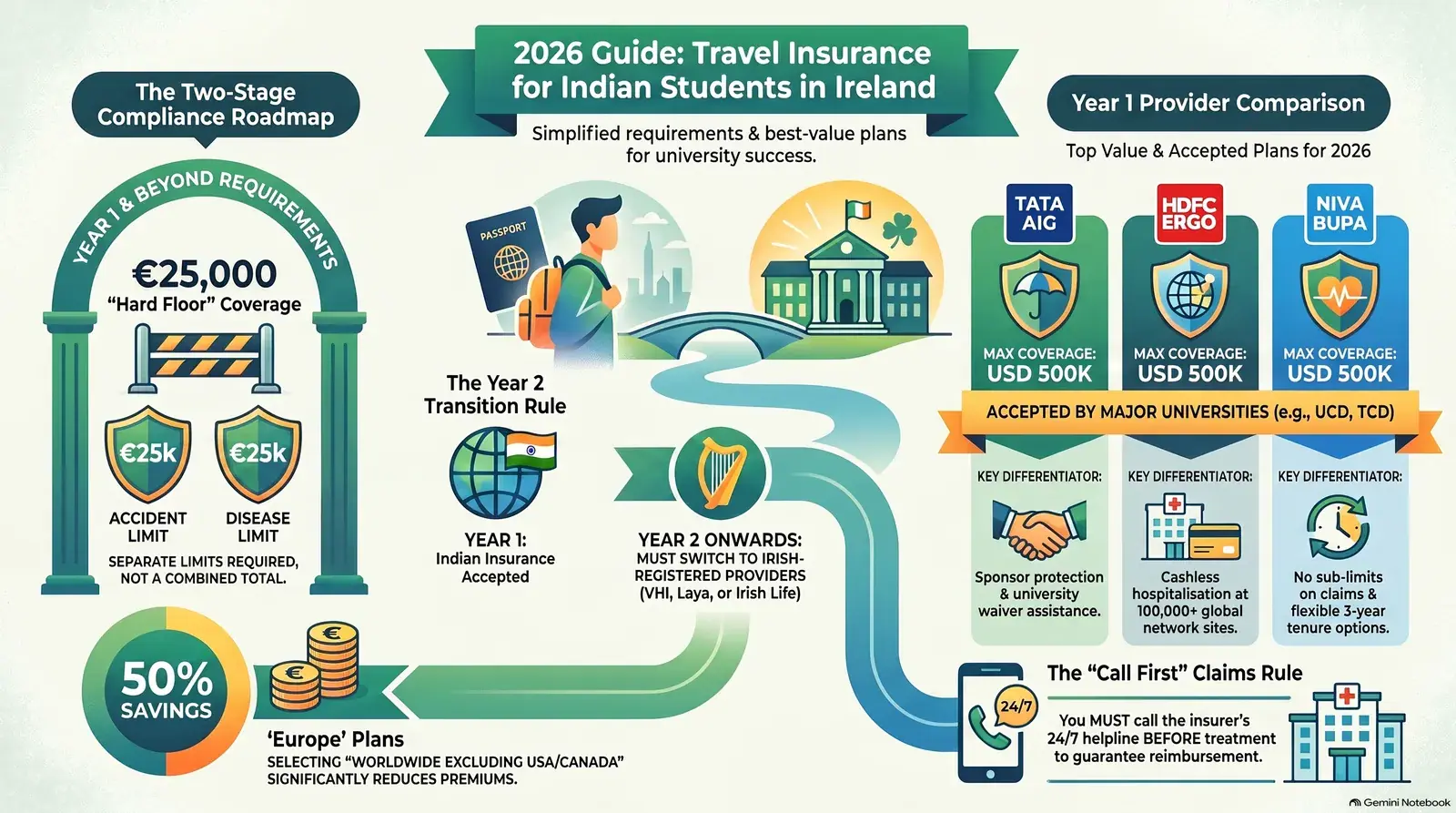
- The visa floor is €25,000: Irish immigration requires at least €25,000 coverage for accidents and €25,000 for disease. Indian travel insurance plans meet this — and most exceed it by 10–20×.
- Year 1 only rule: Indian travel insurance is accepted for your first year in Ireland. From Year 2, you must switch to an Irish-based insurer (VHI, Laya, or Irish Life Health) to renew your IRP residence permit.
- Annual premiums for Ireland are ₹12,000–₹22,000: Buying a Europe plan (Worldwide excluding USA/Canada) keeps your cost significantly lower than a USA plan. The best-value pick depends on whether you need cashless hospitalisation, mental health cover, or multi-year tenure.
In this guide
- What the Irish visa insurance rule actually requires
- What the HSE covers vs what insurance must cover
- Top 5 Indian insurance plans for Ireland 2026 compared
- Coverage checklist — what to look for before buying
- Annual vs single-trip: which is right for Ireland stays?
- How to claim: GP visit, A&E and lost baggage step by step
- Year 2 transition: switching to an Irish provider
- Frequently Asked Questions
What does the Irish student visa insurance rule actually require?
The Irish immigration authority requires all non-EEA students to hold valid health insurance providing a minimum of €25,000 coverage for accidents and a separate minimum of €25,000 for disease, covering the full period of any hospitalisation in Ireland. This is a hard floor — not an average or a combined limit. A policy with a single €25,000 aggregate that covers both accident and disease does not satisfy the requirement.
This rule applies at two stages: when you apply for your Irish student visa from India, and again every year when you renew your Irish Residence Permit (IRP). Failing to present valid proof of adequate insurance at either stage can result in visa refusal or IRP non-renewal.
- Minimum €25,000 for accident AND €25,000 for disease (two separate minimums)
- Coverage must be continuous — a gap causes your Stamp 2 to lapse
- Insurance must remain valid for the entire hospitalisation duration, not just admission
- Documentation must be in English (or formally translated)
- Indian travel insurance satisfies Year 1 requirements only
- From Year 2: policy must come from an Irish-registered insurer
In practice, every major Indian student travel insurance plan — Tata AIG, HDFC ERGO, Bajaj General, Niva Bupa, and Digit — provides coverage of USD 50,000 to USD 500,000 (roughly €46,000 to €460,000 at 2026 rates), which comfortably clears the €25,000 threshold on both accident and disease. The visa floor is therefore not the binding constraint — the real questions are which plan offers the best real-world claims experience, which universities accept which plans, and what additional benefits matter for your specific situation.
Many students renew their Indian travel insurance for Year 2 without realising this breaks the IRP renewal condition. The Irish Immigration Service explicitly requires Year 2+ students to hold insurance from an Irish-registered insurer. Renewing your Tata AIG or HDFC ERGO policy into Year 2 will satisfy your bank and university but not the immigration authority. Plan your switch before your first IRP renewal appointment.
Does the HSE provide free healthcare to Indian students? What does insurance need to cover?
No — non-EEA students including Indian students on a Stamp 2 visa do not receive free HSE public healthcare, and must fund all GP visits, specialist appointments and most A&E charges through their own private insurance. This is a common misconception that costs students hundreds of euro in their first semester.
Here is what the system actually looks like for a newly arrived Indian student in 2026. The HSE (Health Service Executive) divides access into two categories: Category 1 (medical card holders — fully free) and Category 2 (limited eligibility). Non-EEA students are ordinarily in Category 2 if they intend to stay for one year or more, which means they can access public hospital services at reduced cost — but a GP visit is not free, and A&E is not free without a GP referral.
€50–€70 per visit at most practices. University campus health centres often charge less (€30–€40) — check with your college.
€100 per non-referred visit. With a GP referral to A&E: free. A&E admission (inpatient) is covered once you are formally admitted.
Up to €506 at some public hospitals for short-term non-EEA visitors — confirmed by ICOS (Irish Council for International Students) as of 2025 revised charges.
Once formally admitted, public hospital inpatient care is available to all ordinarily resident persons. Your insurer covers the charges under the policy's hospitalisation benefit.
EU/EEA students are in a different position — they can use their European Health Insurance Card (EHIC) to access HSE services as if they were Irish public patients. This advantage does not extend to Indian or other non-EEA students. For Indian students, the practical consequence is that every routine healthcare cost — GP for a chest infection, physiotherapy after a sports injury, a dentist visit — comes out of pocket or through your travel insurance claim.
The medical card is means-tested and available to anyone whose income falls below the HSE's weekly thresholds after allowable expenses. Most Irish-based Indian students working within their 20-hours-per-week Stamp 2 limit will not qualify unless their living costs are very high relative to income. Checking eligibility through Citizens Information Ireland takes ten minutes and is worth doing in your second semester when income patterns are established.
On-the-Ground Insight: "I had a bad chest infection in November — my first winter in Galway — and went to the local GP without thinking. It cost me €65 for the consultation and €22 for antibiotics. I only found out afterwards that my Tata AIG policy would have reimbursed both if I had kept the receipts and submitted within 30 days. Now I photograph every medical receipt on the spot and submit the same evening on their app." — Priya R., MSc Data Analytics, University of Galway, Sept 2025 intake
Top 5 Indian travel insurance plans for Ireland 2026: detailed comparison
For Ireland specifically, you need a "Worldwide excluding USA and Canada" plan — which is 30–50% cheaper than a Worldwide including USA/Canada plan and meets the Irish visa requirement in full. The five plans below all satisfy the €25,000 visa floor and are accepted by major Irish universities including UCD, TCD, UCC, University of Galway, DCU, and RCSI.
| Insurer / Plan | Annual Premium (Europe, 25-yr-old, USD 500K) |
Max Coverage | Tenure | Key Differentiator | Best For |
|---|---|---|---|---|---|
| Tata AIG Student Guard Plus |
₹14,000–₹22,000/yr (₹1,051–₹1,598/mo) |
USD 50K–500K | Up to 2 yrs | Pre-existing life-threatening cover; sponsor protection; study interruption | Most trusted Widely accepted by Irish universities |
| HDFC ERGO Student Suraksha |
₹12,000–₹20,000/yr | USD 50K–500K | 30 days–2 yrs | Cashless at 1,00,000+ hospitals worldwide; no sub-limits on Gold/Platinum | Cashless hospitalisation priority |
|
Bajaj General Student Companion / Elite |
₹13,000–₹21,000/yr | USD 50K–200K | Up to 2 yrs | Mental & nervous disorder cover in Elite plan; inter-collegiate sports injury | Mental health and sports coverage |
|
Niva Bupa TravelAssure Student |
₹14,000–₹22,000/yr | USD 500K (no sub-limits) | Up to 3 yrs | No sub-limits on any single claim; longest tenure; renewal option available | 2–3 year courses; max flexibility |
|
Digit Student Travel Insurance |
₹12,000–₹19,000/yr | USD 50K–500K | Up to 2 yrs | 100% app-based claims; COVID-19 hospitalisation explicitly covered; policy extension if health requires longer stay | Digital-first Fastest claims process |
Indicative annual premiums for a 25-year-old Indian student, 1-year tenure, USD 500,000 sum insured, Worldwide excluding USA/Canada plan. Premiums vary by age, plan variant, and add-ons. Always get a live quote from Policybazaar or the insurer's own website before buying. Sources: NRIOL, beincareer.com, Policybazaar premium data (March 2026).
Tata AIG Student Guard Plus — what makes it the market leader?
Tata AIG's Student Guard Plus is the most widely cited plan among Indian students at Irish universities because of its pre-existing life-threatening condition coverage, its established 20+ year track record in the Indian market, and its university waiver form assistance. The coverage tiers range from Plan A (USD 50,000) up to Student Supreme (USD 500,000), and students aged 16–35 are eligible.
The plan's sponsor protection benefit is particularly relevant for Indian students: if your parent or financial sponsor suffers accidental death or permanent total disability during your studies, Tata AIG reimburses your remaining semester tuition fees up to the policy limit. Similarly, study interruption cover reimburses prepaid tuition if you are medically unable to continue your course. Both benefits are unique to student-focused plans and are absent from standard travel insurance policies.
Tata AIG also offers a full premium refund if your Irish student visa is rejected — a meaningful risk mitigation given that visa timelines can stretch. Students already in Ireland who need insurance can apply for special approval online through NRIOL, subject to underwriting guidelines and a 24–48 hour waiting period before claims activate.
HDFC ERGO Student Suraksha — cashless hospitalisation advantage
HDFC ERGO's Student Suraksha plan is the strongest choice if cashless hospitalisation is your priority — the plan provides access to a network of over 1,00,000 hospitals worldwide, meaning you typically do not pay upfront and claim later. In a medical emergency in Ireland, this eliminates the stress of fronting potentially thousands of euro before getting reimbursed.
The Silver tier (USD 100,000) is adequate for Ireland, where healthcare costs — while high by Indian standards — are significantly lower than the USA. Students on a tight budget can start at the Bronze level (USD 50,000) while still clearing the visa floor. The Platinum Plus add-on covers pregnancy hospitalisation and childcare for infants aged 7–90 days, which is relevant for married students or those who may start a family during a 2-year Master's course. HDFC Bank customers can buy directly through HDFC Bank's platform and earn credit card reward points on the premium.
Niva Bupa TravelAssure — the no-sub-limits, long-tenure option
Niva Bupa's TravelAssure Student plan is the only plan in this comparison offering up to 3-year tenure in a single policy, and it carries no sub-limits — meaning any single hospitalisation claim can use the full USD 500,000 if needed, without hitting a per-incident cap. Most competitor plans cap individual surgery or room-rent components; Niva Bupa does not.
For Indian students on a 2-year Master's course in Ireland, buying a 2-year Niva Bupa policy for Year 1 and Year 2 (with the transition to an Irish insurer noted for IRP renewal) eliminates the administrative overhead of annual renewal. The policy extension option — activated if your health condition or course duration extends beyond the original plan date — adds further flexibility. More details at Niva Bupa's official student travel insurance page.
Coverage checklist: what must your Ireland travel insurance include?
Every Indian student travel insurance plan sold for Ireland should provide the following core benefits — if a plan omits any of these, it is either an inadequate plan or you are reading the wrong variant's brochure. Cross-check each item against the policy schedule (the specific document that states your limits) rather than the marketing brochure.
- Emergency medical expenses: Minimum €25,000 accident + €25,000 disease (the visa floor); USD 100,000+ recommended for realistic protection.
- Hospitalisation — room rent and ICU: Confirm no daily room-rent sub-limit that caps you at €100/night when Irish private hospital rooms cost €350–€700/night.
- Medical evacuation and repatriation: Covers emergency air transport to India if treatment is unavailable or safer at home.
- Repatriation of mortal remains: Mandatory for Irish visa; covers the cost of returning remains to India in the event of death.
- Study interruption: Reimburses prepaid semester tuition if you are medically unable to continue — a critical benefit not in standard travel plans.
- Sponsor protection: Tuition reimbursement if your financial sponsor suffers accidental death or permanent disability.
- Compassionate family visit: Covers economy airfare + accommodation for one family member if you are hospitalised for 7+ consecutive days.
- Loss of passport: Reimburses passport replacement fees and related expenses.
- Baggage loss/delay: Compensation for checked baggage lost, stolen, or delayed by 12+ hours.
- Trip cancellation: Covers non-refundable costs if you must cancel before departure due to medical emergency, visa refusal, or sponsor death.
- Pre-existing conditions (except life-threatening emergencies — only Tata AIG and Reliance explicitly cover this)
- Routine dental care beyond emergency pain relief from a natural tooth
- Elective or cosmetic surgery
- Professional or competitive sports injuries (Bajaj Elite adds inter-collegiate sports as an add-on)
- Alcohol or drug-related incidents (mental health add-ons in Bajaj Elite and HDFC ERGO Platinum cover treatment, not incidents under influence)
- Travel specifically to obtain medical treatment abroad
- AIDS, HIV, and related conditions
Annual vs single-trip plan: which is right for students staying in Ireland for 1+ years?
For any stay exceeding six months — which covers virtually every student course in Ireland — an annual or multi-year plan always delivers better value per day than a series of single-trip policies, and also eliminates the risk of a coverage gap caused by forgetting to renew.
A standard Master's course in Ireland runs 12 months (taught component) to 24 months (with dissertation or research component). A one-year student travel insurance plan from any of the five providers above covers this period in a single purchase. Compare this to a series of single-trip policies: a 90-day policy might cost ₹4,000–₹6,000, and you would need to buy four consecutive policies across a year — with the administrative risk of a gap between policies during which any medical event is uninsured.
- 4 × 90-day single-trip policies (typical): 4 × ₹5,000 = ₹20,000 — with 4 separate applications and 3 renewal windows where coverage can lapse
- 1 × annual plan (Tata AIG/HDFC ERGO/Niva Bupa): ₹14,000–₹22,000 — single application, continuous coverage, no renewal risk
- Savings with annual plan: ₹2,000–₹8,000 per year, plus eliminating the administrative burden
- For 2-year courses: Niva Bupa's 2-year tenure option (buy once, covered for both years) provides the maximum simplicity
There is one scenario where a single-trip plan makes sense for an Ireland-bound student: if your course is a short-term language or certificate programme of under six months, and you are not required to hold insurance for an IRP renewal. In that case, a 90-day or 180-day single-trip plan priced at ₹3,500–₹6,000 may be the most economical choice. Always verify with your college's international office whether your programme requires IRP registration before deciding.
How to claim on your Indian travel insurance in Ireland: GP visit, A&E and lost baggage
The single most important step before any claim in Ireland is to call your insurer's 24/7 international emergency helpline — the number is printed on your policy card and should be saved on your phone before you board your flight. Calling first is not just good practice; it is a policy condition for cashless claims — if you arrange and pay for treatment without notifying the insurer, you may face a reimbursement rejection on procedural grounds.
Claiming for a GP visit
GP visits in Ireland cost €50–€70 at most practices as of 2026, and are claimable under the outpatient or OPD benefit of your student travel insurance plan. The claim process for a non-emergency GP visit is reimbursement (not cashless), as walk-in GP clinics are not typically part of the insurers' direct-billing network.
Step by step: (1) See your GP and pay the fee — usually €50–€70. (2) Ask for an itemised receipt and a copy of the prescription if medication was issued. (3) Photograph or scan both documents on the same day. (4) Log in to your insurer's app or website (Digit and Reliance have the fastest processes; Tata AIG's portal is also reliable). (5) Create a new claim, select "Outpatient Medical Expenses," upload your documents, and enter your policy number and trip dates. (6) Submit within 30 days of the consultation date. Reimbursement typically takes 7–21 working days depending on the insurer.
Claiming for an A&E or hospital admission
For any A&E visit or hospital admission — the kind of emergency where you or someone accompanying you will be stressed — call your insurer's emergency helpline immediately or as soon as you are stable, and they will manage the hospital billing directly.
If you are taken to an Irish public hospital by ambulance, the hospital will register you as a patient first. Once you are stable, contact your insurer's helpline and provide your policy number. For HDFC ERGO's cashless network, the hospital billing department and the insurer settle directly. For insurers without a direct-billing relationship with the specific Irish hospital, you (or a companion) collect all bills, discharge summaries, and doctor's reports, and submit a reimbursement claim within 30 days. The A&E charge (€100 without GP referral for 1-year+ students) and any inpatient room charges are covered under your hospitalisation benefit.
Claiming for lost or delayed baggage
If your checked baggage is lost or delayed on the way to Ireland, report it to the airline's baggage desk at the airport immediately and obtain a Property Irregularity Report (PIR) — this document is mandatory for your insurance claim.
For baggage delay (typically covered after 12 hours): keep receipts for essential items you purchase while waiting (clothing, toiletries, phone charger). Submit the PIR, receipts, and airline confirmation of delay to your insurer for reimbursement up to the policy limit. For total baggage loss: file the PIR, complete the airline's formal claim, and then submit the airline's settlement offer (or written denial) along with your belongings list to your insurer for the balance up to the policy limit. Do not skip the airline claim step — insurers require evidence you pursued the primary responsible party first.
Transitioning to an Irish health insurance provider for Year 2: VHI, Laya and Irish Life Health
From your second year in Ireland onwards, the Irish immigration authority requires you to hold a private health insurance plan from an Irish-registered insurer as a condition of IRP renewal — your Indian travel insurance plan, however comprehensive, will not satisfy this requirement. This is the rule most students discover only when they book their IRP renewal appointment and are told their documents are insufficient.
The three main Irish private health insurance providers — VHI Healthcare, Laya Healthcare, and Irish Life Health — all offer student-specific plans at rates typically ranging from €150–€500 per year for basic international student cover. Many Irish universities have negotiated group schemes with these providers at discounted rates: University of Galway, for instance, offers group schemes with both VHI and Irish Life Health for students on 1-year-plus programmes. Always ask your college's International Office for a student discount code before buying independently.
The practical transition timeline: buy your Indian travel insurance to cover from your departure date through to approximately Month 11 in Ireland. Around Month 10, research Irish providers, compare plans, and purchase an Irish policy starting from Month 12 onwards. Present your Irish insurance certificate at your IRP renewal appointment. The overlap of one month ensures you are never uninsured during the transition.
- VHI: Student plans from ~€180–€350/year; hospital cover with day-case procedures included; university group rates available at UCD, TCD, UCC
- Laya Healthcare: Student Essential plan from ~€170–€320/year; cash benefits for GP visits and physiotherapy; accepted by University of Galway, DCU, Maynooth
- Irish Life Health: Student Plan from ~€160–€300/year; includes a GP allowance and hospital cover; group rates negotiated via several universities
Note that Irish private health insurance premiums are community-rated — meaning all adults pay the same rate regardless of pre-existing conditions, unlike most Indian travel insurance plans. This is a significant advantage for students with health conditions that would be excluded or increase premiums in Indian plans.
Frequently Asked Questions
What is the minimum travel insurance required for an Irish student visa?
The Irish student visa requires a minimum of €25,000 coverage for accidents and €25,000 for disease, covering the full duration of hospitalisation in Ireland. This must remain valid for your entire stay. Travel insurance from Indian providers is accepted for your first year only — from Year 2 you must switch to a private health insurance plan from an Irish-based insurer such as VHI, Laya Healthcare, or Irish Life Health.
Which Indian travel insurance plan is best for Indian students in Ireland in 2026?
For Ireland in 2026, Tata AIG Student Guard Plus and HDFC ERGO Student Suraksha are the most widely accepted by Irish universities. Tata AIG covers pre-existing life-threatening conditions and offers sponsor protection, study interruption, and compassionate family visits. HDFC ERGO's cashless hospitalisation network at over 1 lakh hospitals worldwide is a major advantage. Annual premiums for a Europe plan (Worldwide excluding USA/Canada) range from ₹12,000 to ₹22,000 for a 25-year-old student with USD 500,000 coverage.
Does the HSE provide free healthcare to Indian students in Ireland?
No. Non-EEA international students — including Indian students on a Stamp 2 visa — do not receive free HSE public healthcare. Access to the public health system is available to those accepted as ordinarily resident (intending to stay 1+ year), but standard GP visits still cost €50–€70 and A&E charges €100 per non-referred visit. EU/EEA students using an EHIC card get better access; Indian students must rely on private travel insurance.
How do I claim on my Indian travel insurance for a GP visit in Ireland?
Call your insurer's 24/7 international helpline (printed on your policy card) before or immediately after seeing a GP. For cashless treatment, the insurer directs you to a network provider and settles directly. For reimbursement: pay the GP fee (typically €50–€70), collect the receipt and any prescription, and submit within 30 days via the insurer's app or website along with your policy number and trip details. Digit and Reliance offer the fastest fully app-based claims process; Tata AIG and HDFC ERGO also accept online submissions.
Can I use the same Indian travel insurance plan for my full 2-year Masters in Ireland?
Indian travel insurance is accepted for your first year in Ireland only. From the second year onwards, Irish immigration requires you to hold a private health insurance plan from an Irish-based insurer — VHI, Laya Healthcare, or Irish Life Health — as a condition of renewing your IRP (residence permit). Niva Bupa TravelAssure offers up to 3-year tenure which covers Year 1; you will still need to switch to an Irish provider for Year 2 onwards to satisfy IRP renewal requirements.
What does travel insurance NOT cover for Indian students in Ireland?
Standard Indian student travel insurance for Ireland excludes: pre-existing medical conditions (except life-threatening emergencies — only Tata AIG and Reliance explicitly cover this), cosmetic or elective surgery, routine dental care beyond emergency pain relief, injuries from professional or competitive sports, self-inflicted injuries, war or civil unrest, travel specifically for medical treatment abroad, and long-term or palliative care. Always read the policy exclusions before buying, especially if you have an existing medical condition.
Planning your flight to Ireland? Compare live fares now.
Once your insurance is sorted, lock in your flight. Check live fare calendars for Dublin routes and find the cheapest time to fly India to Ireland.
All insurance premium figures, visa requirements, and HSE access rules cited in this article are based on publicly available official sources, insurer websites, and aggregator data as of August 2026. Insurance premium ranges are indicative — always obtain a live quote from the insurer or Policybazaar before purchasing. Irish immigration requirements may change — verify current rules at the Irish Immigration Service. MyFlightOffers is not affiliated with any insurer mentioned in this article. This article does not constitute insurance, financial, or immigration advice.
- GUIDE Dublin to Delhi Flight Guide 2026 — compare Emirates, Qatar and Air India routes, layover times and booking strategies
- Best Time to Book Flights in 2026 — data-backed seasonal pricing windows for India–Ireland routes
- Ireland Student Medical & Health Guide 2026 — GP registration, HSE entitlements, mental health services and pharmacy costs for international students
- The Indian Student's Money Survival Guide in Ireland — banking, budgeting, and payment methods for Indian students in Ireland