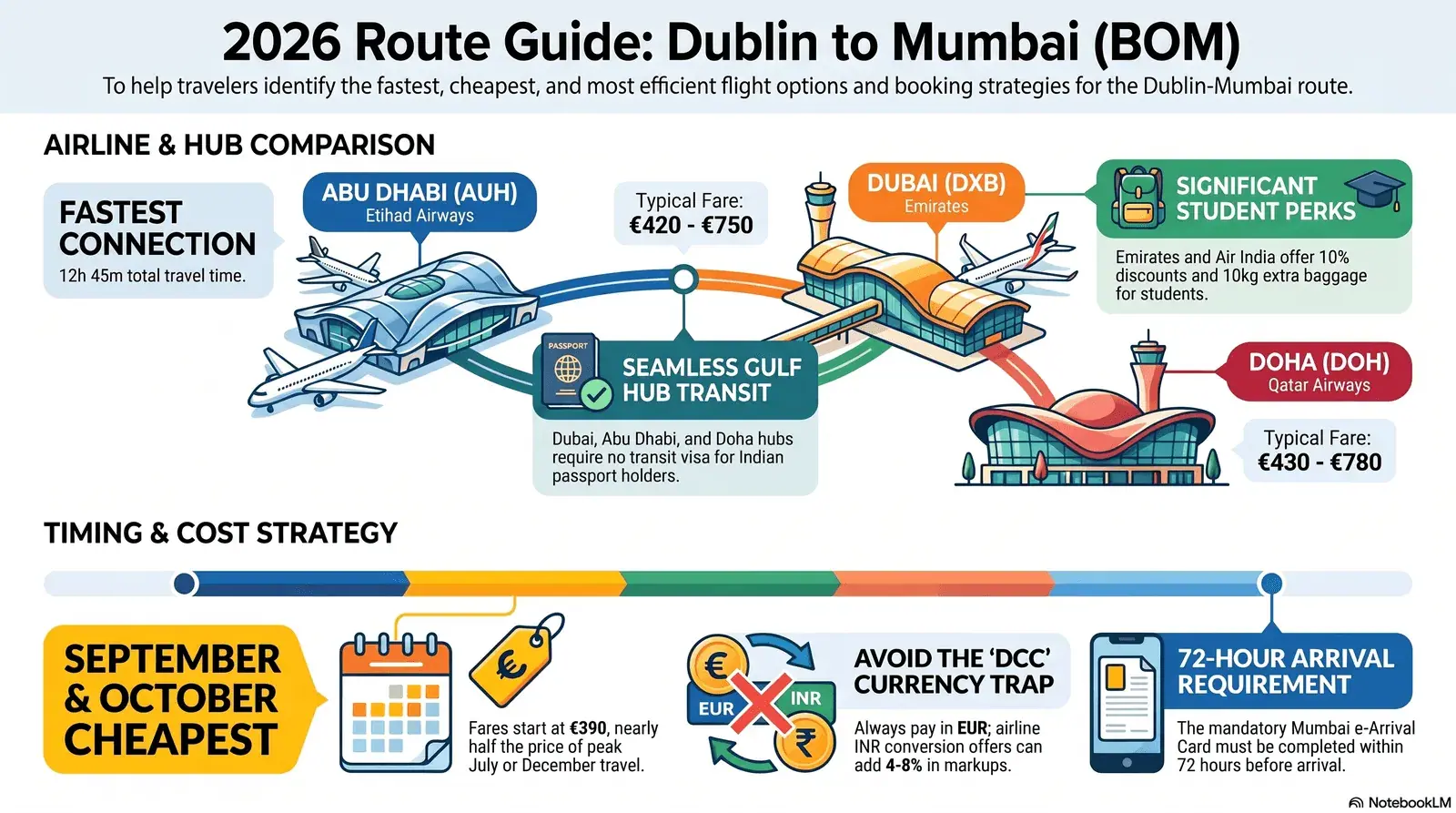
- No direct flight exists: All DUB–BOM itineraries connect via a Gulf hub (Dubai, Abu Dhabi, Doha) or a European hub (Frankfurt), adding 12h 45m–17+ hours total journey time depending on connection.
- September–October is cheapest: One-way fares drop to approximately €390–€550 — roughly 30–40% cheaper than peak July/August. Etihad via Abu Dhabi and Emirates via Dubai are the most competitive carriers in 2026.
- Mumbai e-Arrival Card is mandatory: Complete India's digital arrival registration within 72 hours before departure. Use the ATITHI app from Indian Customs to pre-fill your baggage declaration and avoid Red Channel queues.
Etihad via Abu Dhabi — approx. 12h 45m total journey
September & October — avoid July–Aug & Dec–Jan peaks
Dubai (DXB) or Abu Dhabi (AUH) — free transit visa, most flights
Emirates: 10% off + 10 kg extra (promo code STUDENT, valid Jun 2026+)
In this guide
- Why there is no direct DUB–BOM flight
- Best airlines and route options for 2026
- Hub comparison: Dubai vs Abu Dhabi vs Doha vs Frankfurt
- Fare benchmarks and cheapest months to book
- True Cost formula: baggage and the numbers that matter
- Student fare discounts and extra baggage programmes
- Paying for your ticket: DCC traps and Indian bank card tips
- Mumbai arrival checklist: Terminal 2, customs and e-Arrival Card
- Booking strategy: when, where and how
1. Why there is no direct Dublin to Mumbai flight in 2026
No airline operates a non-stop service between Dublin (DUB) and Mumbai (BOM) in 2026, and none has announced plans to do so. The straight-line distance between the two cities is approximately 7,200 km — well within the range of modern long-haul aircraft — but route economics work against a Dublin–Mumbai nonstop. Dublin's catchment population (~1.4 million in the city, ~4.9 million on the island of Ireland) is simply too small to fill a widebody on this specific pairing every day. Airlines instead route passengers through their high-volume Gulf hubs — Dubai, Abu Dhabi, or Doha — where a feed from Dublin combines with traffic from dozens of other European cities to fill daily Mumbai departures.
Emirates operates multiple Dublin departures per day to Dubai (DXB), where passengers can connect to multiple daily Mumbai flights. Similarly, Etihad Airways provides connections via Abu Dhabi (AUH), Qatar Airways connects via Doha (DOH), and Lufthansa routes through Frankfurt (FRA). Turkish Airlines also serves the route via Istanbul (IST), adding another competitive option.
The practical implication for passengers is that the DUB–BOM journey involves one connection and a total travel time of approximately 12 hours 45 minutes (via Abu Dhabi, the fastest routing) to upwards of 17 hours when connections or layover times are longer. Understanding how each hub performs — in terms of transit experience, connection security, and minimum connection time — is the most important factor when choosing your airline.
2. Best airlines and route options for Dublin to Mumbai in 2026
Four airlines dominate the Dublin–Mumbai market in 2026: Emirates (via Dubai), Etihad Airways (via Abu Dhabi), Qatar Airways (via Doha), and Lufthansa (via Frankfurt) — each offering distinct trade-offs on price, journey time, baggage, and connection experience. Turkish Airlines via Istanbul is an additional option worth checking for competitive off-peak fares, particularly outside summer.
| Airline | Hub | Typical Total Journey | Economy Baggage (Standard) | Frequency (DUB–hub, daily) | 2026 Fare Range (one-way) |
|---|---|---|---|---|---|
| Emirates | Dubai (DXB) | ~13–14 hours | 25 kg (Saver) / 30 kg (Flex) | Multiple daily | €420–€750 |
| Etihad Airways | Abu Dhabi (AUH) | ~12h 45m–14h | 23 kg (Saver) / 30 kg (Flex) | 2 daily | €390–€720 |
| Qatar Airways | Doha (DOH) | ~13–15 hours | 23 kg | Daily | €430–€780 |
| Lufthansa | Frankfurt (FRA) | ~13–16 hours | 23 kg | Multiple daily | €450–€820 |
| Turkish Airlines | Istanbul (IST) | ~13–15 hours | 23 kg | Daily | €380–€700 |
Fare ranges reflect approximate economy class one-way pricing for off-peak travel (September–October 2026) versus peak summer (July–August). Always check directly on the airline website or a fare aggregator for the most current prices before booking. Source: Skyscanner, Expedia, momondo — July 2026.
Emirates via Dubai (DXB)
Emirates is the most established and highest-frequency option on the DUB–BOM routing, connecting Dublin to its Dubai hub daily with multiple onward Mumbai departures throughout the day. The total journey time via DXB typically runs 13–14 hours depending on connection time. Emirates operates Terminal 3 at Dubai International Airport exclusively, meaning your connection stays within the same terminal complex — a significant convenience advantage when transiting. The minimum connection time at DXB within Terminal 3 is 60 minutes for international-to-international connections, but most travel advisors recommend 90 minutes or more to account for long taxiway walks between concourses. Economy class baggage starts at 25 kg on Saver fares, rising to 30 kg (Flex) and 35 kg (Flex Plus).
Etihad Airways via Abu Dhabi (AUH)
Etihad Airways via Abu Dhabi typically delivers the shortest total journey time on the DUB–BOM route — approximately 12 hours 45 minutes on well-timed connections — and is frequently the most price-competitive airline in off-peak months. Etihad operates two Dublin departures per day to AUH, connecting into multiple daily Abu Dhabi–Mumbai services. The minimum connection time at Abu Dhabi International Airport is 45 minutes for Etihad connections (85 minutes for US-bound flights), but a 90-minute connection is advisable for peace of mind, particularly if your Dublin departure is delayed. Standard Economy (Saver) baggage is 23 kg; Flex tickets allow 30 kg. Etihad's Abu Dhabi stopover programme offers eligible passengers with layovers of 6–24 hours the option of complimentary hotel accommodation — useful if you choose a longer connection deliberately to rest.
Qatar Airways via Doha (DOH)
Qatar Airways via Hamad International Airport (DOH) operates at least one daily Dublin–Doha service, with multiple onward Doha–Mumbai connections — making it a reliable third option, especially attractive when competitive fares appear or when the Dubai and Abu Dhabi options are sold out. Hamad International Airport was purpose-built for transfer passengers and supports a minimum connection time of just 45 minutes for Qatar Airways flights. The airport frequently ranks among the world's best for transit experience. Passengers with layovers of 8–24 hours can apply for a complimentary hotel stay under Qatar Airways' transit accommodation programme. Standard baggage is 23 kg in Economy.
Lufthansa via Frankfurt (FRA)
Lufthansa via Frankfurt provides a European alternative hub for the Dublin–Mumbai journey, with a DUB–FRA leg of approximately 2 hours 05 minutes and a FRA–BOM sector of approximately 8 hours 30 minutes — totalling 13–16 hours depending on connection time. Frankfurt Airport operates on a minimum connection time of typically 45–60 minutes for Lufthansa-operated same-terminal connections, though 90 minutes is more comfortable given the airport's size. Lufthansa connects into its daily Dublin–Frankfurt service, with the Frankfurt–Mumbai nonstop operating daily. The European routing is occasionally price-competitive outside peak summer and is the preferred option for passengers who wish to avoid Gulf hub connections or have existing Star Alliance status with Lufthansa.
3. Hub comparison: Dubai vs Abu Dhabi vs Doha vs Frankfurt
Choosing the right hub is as important as choosing the right airline — the wrong connection can mean a stressful sprint between gates, an avoidable overnight delay, or missing a baggage allowance advantage. Here is a structured comparison of the four main connection hubs for Dublin–Mumbai passengers in 2026.
| Hub Airport | Serving Airline | Minimum Connection Time | Recommended Buffer | Transit Visa (Indian passport) | Layover Hotel Option |
|---|---|---|---|---|---|
| Dubai DXB (T3) | Emirates | 60 min (intl-to-intl) | 90–120 min | Not required for airside transit | Emirates Dubai Connect (8–26 hr layovers) |
| Abu Dhabi AUH | Etihad Airways | 45 min | 90 min | Not required for airside transit | Yes, 6–24 hr layovers — request via Etihad |
| Doha DOH (HIA) | Qatar Airways | 45 min | 60–90 min | Not required for airside transit | Yes, 8–24 hr layovers — request via QR |
| Frankfurt FRA | Lufthansa | 45–60 min (same terminal) | 90 min | Schengen transit visa may apply — check | Via Lufthansa partner hotels (own cost) |
For most Indian passport holders travelling from Dublin, the Gulf hubs (Dubai, Abu Dhabi, Doha) are simpler from a visa perspective — no airport transit visa is required for airside connections on any of these three. All three airports are modern, English-friendly, and well-equipped for transit passengers. The choice between them comes down primarily to fare competitiveness and connection timing on your specific travel dates.
4. Fare benchmarks and cheapest months for Dublin to Mumbai 2026
September and October are consistently the cheapest months to fly from Dublin to Mumbai in 2026, with one-way economy fares starting from approximately €390 (Etihad, Skyscanner July 2026) and return fares from approximately €700 — 30–40% cheaper than the July/August peak season. Demand drops significantly in autumn as the summer holiday season ends and the pre-Christmas booking surge has not yet begun.
Peak season on this route runs from late June through early September (driven by Indian diaspora summer travel) and again in December (Christmas and New Year). Fares during July and August regularly reach €700–€1,000+ for a one-way economy ticket. The December–January holiday peak is similarly expensive, driven by students and workers returning to India for festivals and family visits.
| Month | Demand Level | Approx. One-Way Fare (Economy) | Best For |
|---|---|---|---|
| January–February | Low–Medium | €450–€600 | Post-holiday deals, semester-end travel |
| March–May | Medium | €480–€700 | Easter travel, spring — book 8 weeks ahead |
| June–August | Peak | €700–€1,200+ | Unavoidable for many — book 3–4 months ahead |
| September–October | Low ✓ BEST | €390–€550 | Cheapest window — book 6–8 weeks in advance |
| November | Low–Medium | €420–€620 | Good value; pre-Diwali outbound can spike |
| December–January | Peak | €650–€1,100+ | Holiday travel — book 10–12 weeks ahead minimum |
Source: Skyscanner, Expedia, momondo fare analysis — Dublin to Mumbai routes, July 2026. Prices are indicative and fluctuate based on availability, airline pricing algorithms, and booking date.
On-the-Ground Insight: "I was flying home to Mumbai for Diwali from Dublin and made the mistake of booking only three weeks out. The cheapest fare I could find on Qatar Airways was over €900 one-way. The year before, I had booked two months in advance for roughly the same dates and paid €520 on Etihad. The difference was nearly €400 for the exact same journey just because I delayed." — Priya M., TU Dublin, Engineering, 2025–2026
5. The True Cost formula: baggage and the numbers that actually matter
The advertised base fare on the Dublin–Mumbai route rarely reflects the total cost of travel — extra checked baggage, forex markup fees, and seat selection can add €100–€250 to any itinerary. The following formula is a practical way to compare competing fare options like-for-like.
True Cost = Base Fare + Cost of Extra Checked Bag (if your allowance is insufficient) + Forex Markup Fee (if paying in EUR with an Indian card)
A worked example for a student travelling with 30 kg of luggage (typical for those returning home for a long break):
| Airline (fare class) | Base Fare | Included Baggage | Extra Bag Cost (to 30 kg total) | Forex Markup (3.5%) | True Cost |
|---|---|---|---|---|---|
| Etihad Economy Saver | €390 | 23 kg | ~€60 (7 kg upgrade) | ~€16 | ~€466 |
| Etihad Economy Flex | €520 | 30 kg | €0 (sufficient) | ~€18 | ~€538 |
| Emirates Economy Saver | €420 | 25 kg | ~€50 (5 kg upgrade) | ~€16 | ~€486 |
| Emirates Economy Flex | €540 | 30 kg | €0 (sufficient) | ~€19 | ~€559 |
In the example above, the cheapest advertised fare (Etihad Saver at €390) becomes €466 once you account for extra baggage and a 3.5% forex markup — still cheaper than the Etihad Flex ticket at €520/€538, but by a narrower margin than the headline fares suggest. The key lesson: always compare the True Cost, not the base fare, when you need more than 23 kg.
6. Student fare discounts and extra baggage programmes for DUB–BOM
Students aged 16–31 (Emirates) or 12–30 (Air India) can access official student discount programmes offering 10% off base fares plus an additional 10 kg checked baggage — potentially saving €50–€120 on a Dublin to Mumbai return journey. These programmes are underused by Irish-based students and represent genuine, verifiable savings backed by the airlines' own official pages.
Emirates Student Offer 2026
Emirates' official Student Offer provides up to 10% off Economy fares and an additional 10 kg or one extra checked piece on most routes including Dublin to Mumbai — valid for students aged 16–31 booking from 1 June 2026 onwards using promo code STUDENT. Eligibility requires Skywards membership, a valid student ID or university acceptance letter, and age between 16 and 31. The extra baggage does not apply on USA/Canada routes but is available on the DUB–DXB–BOM itinerary. Present your student ID at check-in; Emirates may verify at the gate.
Air India Student Offer
Air India's student fare programme offers up to 10% off base fares plus 10 kg additional checked baggage (up to a maximum of 40 kg in Economy), available to students aged 12–30 enrolled full-time at a recognised institution. Air India does not operate a direct Dublin service but codeshares with Lufthansa and other Star Alliance members, meaning some DUB–FRA–BOM itineraries may be eligible. Book through airindia.com and present your original student ID and visa or acceptance letter at check-in. A one-time free date change is also included on bookings made through Air India's direct channels.
| Programme | Airline | Age Eligibility | Discount on Fare | Extra Baggage | Verification Required |
|---|---|---|---|---|---|
| Emirates Student Offer | Emirates | 16–31 | Up to 10% on Economy | +10 kg or 1 extra piece | Student ID or acceptance letter + Skywards |
| Air India Student Fare | Air India | 12–30 | Up to 10% on base fare | +10 kg (max 40 kg total) | Student ID + valid visa/acceptance letter |
7. Paying for your Dublin–Mumbai ticket: avoiding DCC traps and using Indian bank cards
Booking a Dublin–Mumbai flight with an Indian credit or debit card can trigger two separate hidden costs: Dynamic Currency Conversion (DCC) and a standard cross-border transaction markup charged by Indian banks — together costing 4–8% above the mid-market rate. Understanding both and taking active steps to avoid them can save €20–€60 on a typical economy ticket.
What is Dynamic Currency Conversion (DCC) — and how to avoid it
DCC occurs when an airline's payment page offers to convert the fare from EUR into INR at the checkout stage — usually framed as a convenience ("Pay in Indian Rupees") but hiding a currency conversion markup of 4–8% above the interbank rate. Always choose to pay in the local currency (EUR, for a booking on a European version of the airline's website) rather than in INR. On most airline sites, this option appears at the payment summary screen — look for a currency toggle or a checkbox labelled "Pay in [home currency]" and leave it set to the site's base currency.
Point-of-Sale (PoS) fare arbitrage
The same Dublin–Mumbai flight segment can appear at different prices depending on which regional version of the airline website you use. Booking on the Irish or UK version of an airline's site often reveals different fare buckets than the Indian version. This is due to GDS fare distribution rules that vary by country of sale. If you have access to both an Irish bank card and an Indian card, it is worth comparing the total fare on both regional sites — the difference can be €30–€80 on some routings, particularly with Emirates and Qatar Airways.
Enabling Indian bank cards for international booking
If you are booking with an Indian credit or debit card from Ireland, you may need to manually enable international transactions and lift per-transaction limits in your bank's app before the fare expires. Specific steps differ by bank, but the general process is: log into your bank's mobile app → go to Card Settings or International Usage → enable international transactions → set a per-transaction limit high enough to cover the fare (typically ₹50,000–₹1,00,000 for an economy ticket). For HDFC, ICICI, and SBI cards, this can usually be done in-app without calling the bank. Without enabling international usage, OTP-based authentication commonly fails on foreign airline sites — particularly if your registered Indian mobile number is not active.
8. Mumbai arrival checklist: Terminal 2, customs and the e-Arrival Card
All international flights into Mumbai land at Terminal 2 (T2) of Chhatrapati Shivaji Maharaj International Airport (CSMIA), operated by Adani Airports — passengers proceed through immigration, baggage reclaim, and customs in a single linear process that typically takes 30–60 minutes outside peak travel periods.
India e-Arrival Card — mandatory registration
India requires all foreign nationals and Overseas Citizen of India (OCI) cardholders to complete the digital e-Arrival Card registration before travel to Mumbai Terminal 2 in 2026, with registration available up to 72 hours before arrival at the official CSMIA passenger guide page. The e-Arrival Card replaces the old paper disembarkation form. The process takes approximately 5 minutes online. If you cannot complete it before departure, kiosk counters are available in the airport before the immigration hall — but these add time to your clearance.
Customs: Green Channel and the ATITHI app
Mumbai Terminal 2 operates a dual-channel customs system: Green Channel (nothing to declare) and Red Channel (dutiable or restricted goods) — and the Indian Customs ATITHI mobile app allows passengers to pre-fill their baggage and currency declaration digitally before landing, reducing Red Channel queues significantly. Passengers carrying foreign currency exceeding the equivalent of USD 5,000 in cash or total forex (including cards) exceeding USD 10,000 must declare on arrival. If you are returning with new electronics, gifts, or gold jewellery that exceeds the duty-free allowance (₹50,000 for Indians returning after 3+ days abroad), complete the ATITHI declaration before your flight lands.
Arrival sequence at T2
On landing at Mumbai T2: proceed through the air bridge into the arrivals hall → passport/OCI card check at immigration (biometric counters are available) → baggage reclaim on the carousel assigned at the arrival board → Green or Red Channel customs → exit to arrivals. Pre-booked airport transfers or metered taxis are available immediately outside the Terminal 2 arrivals hall. The dedicated Chhatrapati Shivaji Maharaj International Airport Metro station connects T2 to central Mumbai — confirm the metro line is operational on your arrival date as services can be subject to change.
9. Booking strategy: when, where and how to get the best Dublin–Mumbai fare in 2026
The single most effective booking strategy for Dublin to Mumbai in 2026 is to set a fare alert 8–12 weeks before your intended travel date and book when the price drops to within your target range — rather than waiting for a mythical "best day of the week" to buy. Fare pricing algorithms on this route are driven by seat inventory and demand signals, not day-of-week patterns.
Where to search
Use Google Flights for initial research and fare tracking — its "Price Graph" calendar view makes it easy to identify cheap windows. Cross-check on Skyscanner and Kayak. Once you have confirmed your preferred airline and routing, book directly on the airline's own website for the cleanest booking experience, easiest rebooking if things change, and access to any student or Skywards member rates.
Self-connection risk
Never book the Dublin leg and the Mumbai onward leg as separate tickets unless you are deliberately building in at least 4+ hours of connection time and understand the full rebooking risk. A self-connection (two separate tickets on different bookings) means that if your Dublin flight is delayed and you miss your onward Gulf connection, the second airline has no obligation to rebook you — you would need to purchase a new ticket at walk-up rates. Always book the full DUB–hub–BOM itinerary on a single ticket through one airline or its codeshare partner to protect your connection.
Flexible date strategy
Moving your travel date by even two or three days in either direction can save €80–€150 on a single-way ticket. If your travel window allows any flexibility, use Google Flights' month-view calendar to identify the cheapest specific dates before locking in your booking. The cheapest days on the DUB–BOM route are typically Tuesday, Wednesday, and Saturday departures from Dublin during off-peak months.
Frequently Asked Questions
Is there a direct flight from Dublin to Mumbai (BOM)?
No. There are no non-stop flights between Dublin (DUB) and Chhatrapati Shivaji Maharaj International Airport (BOM) in 2026. All routes require at least one stopover - most commonly via Dubai (Emirates), Abu Dhabi (Etihad), Doha (Qatar Airways), or Frankfurt (Lufthansa). The total journey takes between 12 hours 45 minutes and 17+ hours depending on the hub and connection time.
Which airline is cheapest for Dublin to Mumbai in 2026?
Etihad Airways via Abu Dhabi is consistently competitive in 2026, with one-way fares starting from approximately €390 (around $430) in September and October - the cheapest months on this route. Emirates via Dubai and Qatar Airways via Doha are strong alternatives with higher frequency. Booking 6-8 weeks in advance typically yields the best prices.
What is the cheapest month to fly from Dublin to Mumbai?
September and October are the cheapest months for Dublin to Mumbai flights in 2026, with average one-way fares around €390-€550. Peak season (July and August) and the winter holiday period (December-January) see fares rise substantially. Booking approximately 40-60 days in advance typically yields the best prices.
Do I need an e-Arrival Card for Mumbai in 2026?
Yes. India requires all foreign nationals and OCI cardholders to complete the digital e-Arrival Card registration before travel. Registration can be completed online up to 72 hours prior to arrival at csmia-mumbai.adaniairports.com. If online registration is unavailable, kiosk counters are available before the immigration area at Terminal 2.
How much checked baggage can I bring on Dublin to Mumbai flights?
Allowances vary by airline and fare class. Emirates Economy allows 25 kg (Saver) up to 35 kg (Flex Plus). Etihad Economy allows 23 kg (Saver) up to 30 kg (Flex). Qatar Airways Economy typically offers 23 kg, while Lufthansa's standard economy allows 23 kg. Students with valid ID can claim extra 10 kg on Emirates and Air India via official student programmes.
Ready to book? Compare live Dublin to Mumbai fares now
Compare flight deals across top carriers, track seasonal prices, and book your tickets at the best rate.
- Dublin to Delhi Flight Guide 2026 — airline comparison, cheapest months, e-visa and transit tips for the DUB–DEL route
- Dublin to Chennai (MAA) Flights 2026 — route guide comparing Etihad, Emirates, Qatar and Lufthansa for the DUB–MAA journey
- Dublin to Bangalore (BLR) Flights 2026 — full route guide with fare benchmarks, hub comparison and baggage true-cost formula
- Middle East Layover Guide: Dubai, Doha & Abu Dhabi 2026 — how to turn your Gulf stopover into a free mini-break, with transit visa rules for Indian passport holders
- Best Time to Book Flights in 2026 — data-driven guide to booking windows, advance purchase rules and fare alert strategy
- Dublin to Hyderabad (HYD) Flights 2026 — Route Guide, Best Airlines & Booking Tips — compare Etihad via Abu Dhabi, Qatar Airways via Doha, Emirates via Dubai, and British Airways via Heathrow for the DUB–HYD route; includes September fare benchmarks from ~€536 and the mandatory India e-Arrival Card guide
- Dublin to Kolkata (CCU) Flights 2026 — Route Guide, Best Airlines & Booking Tips — compare Emirates via Dubai, Qatar Airways via Doha, and Etihad via Abu Dhabi for eastern India; includes Durga Puja peak-pricing guide and Kolkata airport arrival tips
All information in this guide is based on publicly available official sources as of July 2026. Flight schedules, baggage policies, student programme eligibility, fare levels, and airport procedures can change at short notice. Always verify the current position directly with the airline, the airport authority, or the relevant government body before travelling. MyFlightOffers is not affiliated with any airline or organisation mentioned in this guide. This article does not constitute financial, immigration, or customs advice.