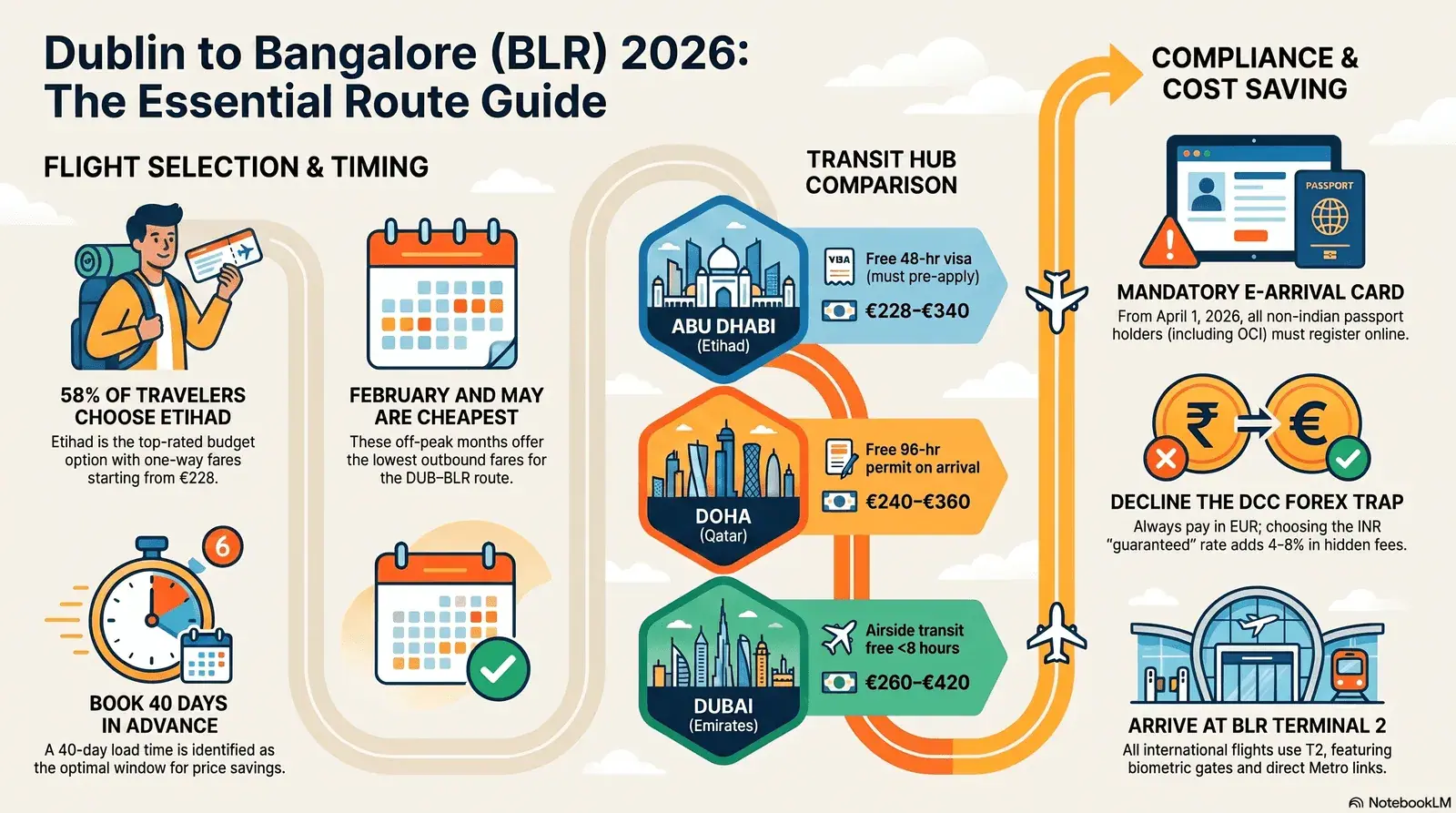
- No direct flight exists: DUB–BLR requires one connection through Abu Dhabi (Etihad), Doha (Qatar Airways), Dubai (Emirates), or Addis Ababa (Ethiopian Airlines).
- Etihad via AUH is cheapest: Economy one-way fares start from approximately €228–€280 in February and May; Etihad also offers a complimentary 48-hour Abu Dhabi transit visa for Indian passport holders.
- E-Arrival Card is now mandatory: All non-Indian-passport holders (including OCI cardholders) must submit an e-Arrival Card online within 72 hours before landing at BLR from 1 April 2026.
Cheapest airline
Etihad Airways via Abu Dhabi from ~€228 one-way
Journey time
13–16 hours (1 connection)
Cheapest months
February & May (DUB→BLR); October & March (BLR→DUB)
Best hub for Indian transit
Doha (no transit visa, 96-hr free permit)
In this guide
- Why there is no direct Dublin–Bangalore flight
- Best airline options for DUB–BLR in 2026
- Hub comparison: Abu Dhabi vs Doha vs Dubai vs Addis Ababa
- Fare benchmarks and cheapest months to fly
- True cost formula: fare + baggage + forex
- Booking tips: Indian bank cards, OTAs, and DCC trap
- Arriving at Bangalore Terminal 2: e-Arrival Card and immigration
1. Why There Is No Direct Dublin–Bangalore Flight
No airline currently operates a non-stop route between Dublin (DUB) and Bengaluru (BLR) because the economics of the ~8,440 km route cannot support daily widebody frequencies on either end's own traffic volumes alone. Dublin's India traffic is significant but not on the scale of London Heathrow, Frankfurt, or Amsterdam — the three European hubs from which Air India does operate direct services to BLR.
Dublin Airport handled approximately 32 million passengers in 2025 (source: Dublin Airport), but India-bound travellers represent a relatively niche segment compared to the transatlantic and intra-European flows that dominate the airport. Profitably filling a Boeing 787 or A350 on a 9–10 hour non-stop DUB–BLR sector five to seven times per week requires either a massive O&D market or strong sixth-freedom connecting traffic — and Dublin offers neither at the scale that Gulf carriers have from their respective hubs.
In practice, this means every DUB–BLR journey is an interlining exercise: fly DUB to a Gulf hub (or Addis Ababa), then connect onto the trunk India route. The Gulf carriers — Etihad Airways, Qatar Airways, and Emirates — have built their entire business model on exactly this type of sixth-freedom traffic. They fly from Dublin daily, feed passengers through their mega-hubs in Abu Dhabi, Doha, and Dubai, and then dispatch them onward to Bangalore on high-frequency trunk routes that make the whole network commercially viable.
2. Best Airline Options for DUB–BLR in 2026
The four realistic airline options for Dublin to Bangalore in June 2026 are Etihad Airways via Abu Dhabi, Qatar Airways via Doha, Emirates via Dubai, and Ethiopian Airlines via Addis Ababa. Each offers a meaningfully different price, journey time, baggage allowance, and transit experience.
Etihad Airways (DUB–AUH–BLR)
Etihad is the most popular and often the cheapest option for Dublin to Bangalore, with 58% of route travellers choosing this airline according to aggregator data from Momondo (June 2026). Etihad Airways operates a daily Dublin–Abu Dhabi service (EY 047, departing approximately 13:30 DUB) and up to three daily Abu Dhabi–Bangalore services (EY 201, EY 203, EY 205). The total journey time with a typical 2–3 hour layover in AUH is around 13–14 hours.
Economy baggage allowance on Etihad's Economy Value fare is 1 × 23 kg checked bag. Economy Flex and Economy Space fares include 2 × 23 kg (46 kg total). Students and those carrying heavy luggage should factor in the cost of a second bag — at Etihad's pre-purchase rate of approximately €65–€90 per extra bag, this can significantly shift the true cost equation.
Qatar Airways (DUB–DOH–BLR)
Qatar Airways via Hamad International Airport (DOH) is the second most popular option, offering 14 connecting frequencies per week from Bangalore to Dublin and a highly competitive economy price point comparable to Etihad. Qatar Airways flies Dublin–Doha daily (QR 021, departing approximately 14:10 DUB) and operates multiple Doha–Bangalore sectors each day. Journey time with a standard layover is 14–16 hours.
Qatar's Economy Classic fare includes 1 × 23 kg checked bag. Economy Comfort and Business fares step up to 2 × 23 kg and 2 × 32 kg respectively. Qatar's Student Club programme offers an additional +10 kg baggage allowance — worth considering if you hold a valid student card.
Emirates (DUB–DXB–BLR)
Emirates via Dubai International Airport (DXB) offers 21 weekly connecting frequencies on the Bangalore leg, but as of June 2026 the airline is operating at a reduced DXB–BLR schedule due to ongoing Gulf airspace disruptions, with short-notice cancellations remaining possible. Emirates flies Dublin–Dubai twice daily (EK 162 morning, EK 164 evening). Dubai–Bangalore is served by EK 564 and EK 568 daily, though full frequency restoration has not yet been confirmed by Emirates as of this writing.
Ethiopian Airlines (DUB–ADD–BLR)
Ethiopian Airlines via Addis Ababa Bole International Airport (ADD) is the only non-Gulf routing and is worth considering during peak-season periods when Gulf carrier prices spike significantly above €400 one-way. Ethiopian Airlines operates a seasonal Dublin–Addis Ababa service (March–April schedule; confirm current status before booking) with daily Addis–Bangalore service (6 hours 35 minutes non-stop). Total journey time is 16–18 hours. Ethiopian's economy baggage allowance is 1 × 23 kg; the airline is less reliable for rebooking and customer support compared to the Gulf carriers.
3. Hub Comparison: Abu Dhabi vs Doha vs Dubai vs Addis Ababa
Choosing your hub is about more than price — transit visa eligibility, lounge access, layover experience, and the risk of a missed connection all vary significantly between the four hub options.
| Hub | Airline | Transit Visa (Indian passport) | Min. Layover to Exit Airport | Stopover Programme | Typical Economy Fare (one-way, June 2026) |
|---|---|---|---|---|---|
| Abu Dhabi (AUH) | Etihad Airways | Free 48-hr transit visa (Etihad tickets only; ticket no. must start 607) | 8+ hours | Free hotel for 10–24 hr layovers (Quick Connect); 1–2 night packages available | €228–€340 |
| Doha (DOH) | Qatar Airways | Free 96-hr transit visa on arrival (5+ hr layover, Qatar Airways tickets) | 5+ hours | Discover Doha: hotel + breakfast, tours discounted; 12+ hr layover required | €240–€360 |
| Dubai (DXB) | Emirates | Airside transit: no visa needed for <8 hr. Land-side: UAE visa needed (or Visa on Arrival for Indian holders with valid US/UK/EU visa) | 8+ hours (land-side) | Dubai Connect: free hotel for eligible fare classes; disruptions ongoing June 2026 | €260–€420 |
| Addis Ababa (ADD) | Ethiopian Airlines | Visa on Arrival (USD 52 for 30 days) or e-Visa required | Any (e-Visa or VoA needed) | No dedicated stopover programme | €290–€480 (seasonal route) |
For most Indian passport holders connecting through the Gulf without a prior US, UK, or Schengen visa, Doha offers the most generous and easiest transit — a complimentary 96-hour permit on arrival with no pre-application required. Abu Dhabi's 48-hour Etihad visa is also straightforward but must be arranged through Etihad's online portal in advance; it is not granted on arrival.
On-the-Ground Insight: "I transited through Doha on Qatar Airways with a 9-hour layover. I didn't need any pre-arranged visa — I walked through immigration, got a 96-hour stamp, and spent the afternoon at the National Museum of Qatar. The free transit facility is genuinely excellent and I saved about €40 compared to Etihad for the same travel dates." — Priya N., MSc Data Analytics, University of Limerick, Class of 2025, travelling home to Bengaluru December 2025
4. Fare Benchmarks and Cheapest Months to Fly
The cheapest months to fly Dublin to Bangalore are February and May for the outbound journey, and October and March for the return (BLR to DUB) — avoiding peak Indian festive seasons and Irish school holiday periods.
Fares on this route follow a clear demand pattern driven by two calendars simultaneously: Irish public holidays and Indian festive seasons. The most expensive periods are:
- Late June to August — Irish summer holiday peak; university students returning home after exams
- October (Navratri/Diwali period) — Indian festive travel demand spikes, return fares from BLR rise sharply
- December 20 – January 10 — Christmas and New Year overlap; the single most expensive period on both directions
| Month | DUB→BLR (Economy one-way, approx.) | BLR→DUB (Economy one-way, approx.) | Demand driver |
|---|---|---|---|
| January (mid) | €310–€380 | €290–€380 | Post-New Year dip |
| February | €228–€280 | €260–€330 | Off-peak; cheapest DUB→BLR month |
| March | €260–€320 | €240–€310 | Off-peak return; cheapest BLR→DUB |
| April | €290–€370 | €270–€350 | Easter and Ugadi holiday impact |
| May | €240–€310 | €260–€330 | Second cheapest outbound window |
| July–August | €380–€520 | €350–€490 | Irish summer peak |
| October (Diwali) | €330–€450 | €380–€540 | Festive travel spike from India |
| December (20–31) | €480–€650+ | €450–€600+ | Christmas–New Year peak; most expensive |
Fare data sourced from Momondo Ireland, KAYAK, and Google Flights, June 2026. All figures are indicative; live prices shift daily based on seat inventory.
5. True Cost Formula: Fare + Baggage + Forex
The sticker price for a DUB–BLR ticket rarely reflects what you will actually pay once you factor in checked baggage costs and the forex markup on your payment card — especially if you are booking with an Indian bank card from Ireland.
True Cost = Base Fare + Extra Checked Bag Fee + Forex Markup Fee
Worked Example: Etihad Economy Value vs Economy Flex
A €280 Economy Value fare on Etihad can end up costing €60–€95 more than it appears if you need a second checked bag and pay with an Indian bank card that charges a forex markup. Here's the breakdown:
| Cost component | Economy Value (€280 base) | Economy Flex (€360 base) |
|---|---|---|
| Base fare (one-way, DUB–AUH–BLR) | €280 | €360 |
| Checked baggage | 1 × 23 kg included; 2nd bag ~€75 pre-purchase | 2 × 23 kg included (46 kg total) |
| Forex markup (HDFC/ICICI 3.5% on EUR payment) | ~€12.50 on €355 total | ~€12.60 on €360 total |
| True Cost (2-bag traveller) | ~€367 | ~€373 |
| True Cost (1-bag traveller) | ~€292 | ~€373 |
The takeaway: if you are travelling with two checked bags, Economy Value and Economy Flex are almost identical in true cost. Choose Flex for the flexibility and skip the stress of paying for a second bag at check-in (airport add-on prices are typically 40–60% higher than online pre-purchase rates).
6. Booking Tips: Indian Bank Cards, OTAs, and the DCC Trap
Indian bank cards — including HDFC Diners, ICICI Coral, SBI SimplyCLICK, and Axis Magnus — are widely used by the Indian diaspora in Ireland to book DUB–BLR tickets, but they carry a 3.5%–3.75% forex markup that can add €10–€20 to every booking if you are not careful about currency selection.
The DCC (Dynamic Currency Conversion) Trap
When booking on etihad.com, qatarairways.com, or emirates.com with an Indian-issued bank card, the payment gateway may offer to charge you in Indian Rupees (INR) rather than Euros (EUR). Always decline this offer — the DCC conversion rate applied by the gateway carries a 4–8% markup over the mid-market EUR/INR rate.
Which Indian Card Works Best for DUB–BLR Bookings?
For booking from Ireland with an Indian-issued card, zero-forex options like the Niyo Global prepaid card or the Fi Money account eliminate the 3.5% forex markup entirely. However, these are not credit cards and do not provide the same purchase protection or reward points as premium travel credit cards.
If you want to use an Indian credit card and earn reward points, make sure to:
- Enable international transactions on your card via your bank's mobile app at least 24 hours before booking (HDFC, ICICI, SBI, and Axis all require this step for cards issued after the 2020 RBI mandate)
- Check your daily international transaction limit — many Indian credit cards default to a ₹2,00,000/day limit, which may be insufficient for a business or premium economy booking
- Always select EUR on the payment page and let your Indian card convert at its own (known) forex rate rather than the airline's DCC rate
OTA vs Direct Airline Booking: Which Is Cheaper?
For the DUB–BLR route, booking directly on the airline's website is generally preferable to using an OTA (MakeMyTrip, Cleartrip, EaseMyTrip) — airline direct fares are the same price or lower, and you avoid OTA convenience fees of ₹300–₹1,200 per passenger.
The exception: Indian OTAs like MakeMyTrip and Cleartrip periodically run bank-specific deals — for example, ICICI Bank Credit Card EMI offers with up to ₹15,000 off on travel bookings (valid June 2026, ICICI Bank). These can make an OTA booking genuinely cheaper even after fees, particularly for the BLR→DUB return leg where you may be paying in INR on an Indian platform.
Point of Sale (PoS) Arbitrage on This Route
The DUB–BLR route exhibits moderate Point of Sale pricing differences — booking on Etihad's Irish site (etihad.com/en-ie) in EUR typically gives lower fares than booking on the Indian site (etihad.com/en-in) in INR at the current exchange rate. This is because Gulf carriers price their Irish-origin inventory in EUR and manage yield differently from Indian-origin inventory in INR. Always compare both regional sites before confirming your booking — the difference can be €20–€40 per ticket in favour of the Irish site when booking from Dublin.
7. Arriving at Bangalore Terminal 2: e-Arrival Card and Immigration
All international flights to Bangalore now arrive and depart from Terminal 2 (T2) of Kempegowda International Airport — a purpose-built "Terminal in a Garden" opened in 2023, featuring biometric e-gates, 34 immigration counters, and 9 baggage belts.
Is the e-Arrival Card Required for DUB–BLR Travellers?
Yes — from 1 April 2026, all foreign nationals and OCI cardholders entering India (including at BLR T2) must complete the digital e-Arrival Card online within 72 hours before landing. Indian citizens holding an Indian passport are exempt.
The e-Arrival Card is submitted free of charge through the official Indian government portal at indianvisaonline.gov.in/earrival. The form takes approximately 5 minutes and asks for your flight number, arrival date, purpose of visit, and accommodation address. No document upload is required. You will receive a QR code by email which immigration officers at BLR T2 may check on arrival.
BLR T2 Immigration: What to Expect
T2 handles peak international arrivals efficiently — Etihad and Qatar flights from AUH/DOH typically land in the late evening or early morning, which means you may face a 20–40 minute queue at immigration during peak Diwali and summer periods.
T2's immigration hall features 34 counters, 6 e-gates for eligible passport holders, and visa-on-arrival kiosks. Indian citizens with an Indian passport can use Digi Yatra for seamless biometric processing. Foreign passport holders and OCI cardholders should join the designated international arrivals queue — there is a separate fast-track for Etihad and Qatar business class passengers.
From BLR T2, Namma Metro (Purple Line) connects the airport directly to central Bengaluru (Majestic / KR Puram) in approximately 40 minutes for ₹60–₹80. Pre-paid taxi kiosks inside the arrivals hall charge ₹700–₹1,200 to Koramangala, Whitefield, or Indiranagar depending on traffic.
Verdict: How to Book the Best DUB–BLR Ticket in 2026
For most travellers flying Dublin to Bangalore in 2026, Etihad via Abu Dhabi offers the best combination of price, schedule, and transit flexibility — followed closely by Qatar Airways via Doha if you want a more generous transit visa and a compelling stopover option.
Book 5–7 weeks ahead in February or May for the lowest outbound fares. Pay in EUR on the airline's Irish regional website to avoid DCC markup. Pre-purchase your second checked bag at booking time rather than at the airport. If you hold an Indian bank card, enable international transactions at least 24 hours before booking. And if you hold a foreign passport or OCI card, complete your e-Arrival Card within 72 hours of your BLR landing time — immigration staff at T2 are increasingly checking for the QR code on arrival.
Frequently Asked Questions
Is there a direct flight from Dublin to Bangalore?
No. As of June 2026, there are no non-stop flights between Dublin Airport (DUB) and Kempegowda International Airport Bengaluru (BLR). All routes require at least one connecting hub - most commonly Abu Dhabi, Doha, or Dubai.
Which airline is cheapest for Dublin to Bangalore in 2026?
Etihad Airways via Abu Dhabi is consistently the most affordable option, with one-way economy fares starting from approximately €228-€280 in off-peak months (February and May). Qatar Airways via Doha is a strong alternative at a similar price point.
What is the total journey time from Dublin to Bangalore?
With one connection through a Gulf hub (Abu Dhabi, Doha, or Dubai), total journey time is typically 13-16 hours including the layover, covering approximately 8,440 km (5,240 miles). Ethiopian Airlines via Addis Ababa takes 16-18 hours.
Do Indian passport holders need a transit visa to connect via Dubai, Doha, or Abu Dhabi?
For Doha: No visa needed - Indian citizens get a complimentary 96-hour transit visa on arrival when flying Qatar Airways with a layover of 5+ hours. For Abu Dhabi: Etihad offers a complimentary 48-hour transit visa for Indian passengers on eligible tickets. For Dubai: Emirates passengers with layovers under 8 hours can remain airside without a visa; longer stopovers require a UAE visa or visa on arrival (for eligible Indian passport holders with a valid US, UK, or EU visa).
Is the e-Arrival Card required when flying into Bangalore in 2026?
The e-Arrival Card is mandatory for all foreign nationals (including OCI cardholders) arriving in India from 1 April 2026. It must be submitted online via the Indian government portal within 72 hours before arrival. Indian citizens with an Indian passport are exempt.
Ready to book? Compare live Dublin to Bangalore fares now
Check current fares across Emirates, Qatar Airways, Etihad, and more to Kempegowda International Airport (BLR).
- NEW Dublin to Mumbai (BOM) Flights 2026 — Route Guide, Best Airlines & Booking Tips — compare Emirates, Etihad, Qatar Airways and Lufthansa for the DUB–BOM route with fare benchmarks from ~€390 in September and Mumbai Terminal 2 arrival checklist
- GUIDE Dublin to Delhi Flight Guide 2026 — full route analysis for DUB–DEL including Air India direct vs Gulf connections
- Direct Dublin to India Flight Options 2026 — which Indian cities now have direct or near-direct services from Dublin
- Best Time to Book Flights 2026 — data-backed booking windows for transatlantic, Europe, and India routes
- Finding Affordable Flights Dublin to Delhi — price comparison tools, GDS fare buckets, and low-fare alert strategies
- Indian Student's Money Survival Guide in Ireland — zero-forex cards, TCS rules, and Indian payment methods that work in Ireland
All flight schedules, fare ranges, baggage allowances, transit visa rules, and airport information are based on publicly available official sources as of June 2026. Fares fluctuate daily based on seat inventory and demand; figures quoted are indicative only. Emirates DXB–BLR disruption status may have changed since publication — always verify directly with the airline before travel. MyFlightOffers is not affiliated with any airline, airport, or bank mentioned in this article. This article does not constitute financial or travel advice. Always check visa requirements with the relevant embassy before booking.