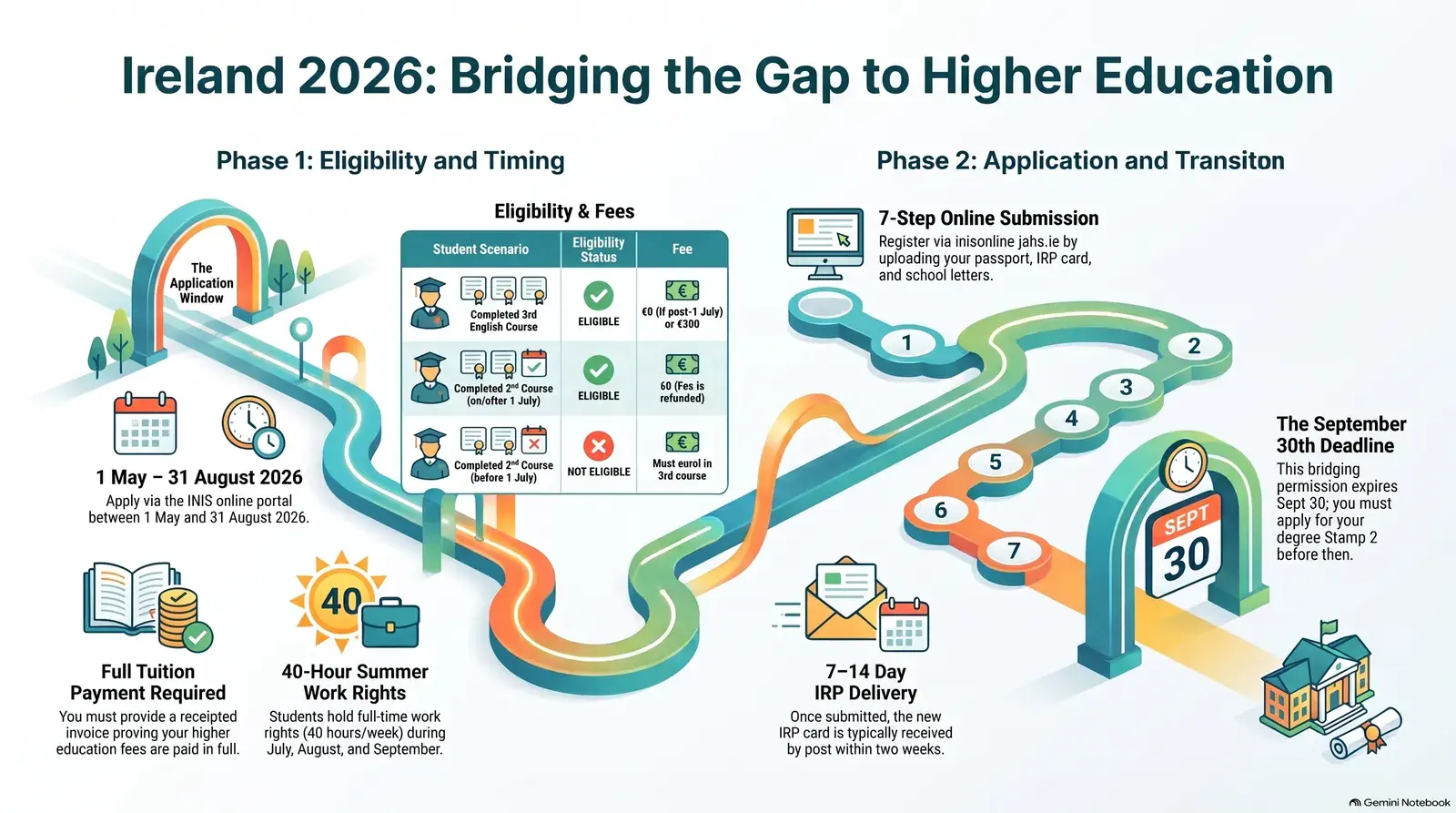
- Who qualifies: Students who completed a 3rd English language course (any date), or a 2nd English language course on or after 1 July 2026, AND have enrolled and paid in full for an ILEP-listed higher education programme starting by end of October 2026.
- Apply by 31 August 2026: The application window is 1 May to 31 August 2026 only. Apply via the ISD online portal at inisonline.jahs.ie. Students whose course finished on or after 1 July pay no fee (refunded). Those whose 3rd course finished before 1 July pay €300.
- Renew before 30 September: The bridging permission expires 30 September 2026. You must renew your IRP for your higher education programme before that date or you will be without lawful permission.
1 May – 31 August 2026
30 September 2026
€0 (refunded)
€300 standard IRP renewal fee
20 h/week term time; 40 h/week holidays
ISD notice, 15 April 2026
What is the ISD Stamp 2 Bridging Permission?
The Stamp 2 Bridging Permission is a temporary immigration permission announced by Ireland's Immigration Service Delivery (ISD) on 15 April 2026, designed specifically for non-EEA English language students who have completed their language course and been accepted onto a higher education programme in September or October 2026 — but whose IRP card expires before their degree starts.
Under normal Stamp 2 rules, a student's Irish Residence Permit is linked to a specific course. When that course ends, the IRP expires. A student who finishes an English language course in June or July faces an immediate problem: their university semester does not begin until September, yet their lawful permission to remain in Ireland ends when the course does. Historically, students in this position had to leave Ireland and apply for re-entry, or remain unlawfully during the gap — both poor outcomes.
The 2026 Bridging Permission addresses this directly. It grants a short-term Stamp 2 permission — valid from the date of expiry of the student's current IRP card until 30 September 2026 — on the condition that the student has already enrolled in and paid fees for an ILEP-listed higher education programme commencing by the end of October 2026.
The Interim List of Eligible Programmes (ILEP), managed by ISD, is the official register of courses and institutions that can sponsor non-EEA student immigration permissions in Ireland. For a higher education programme to count toward the bridging permission, both the institution and the specific programme must appear on the ILEP. Institutions transitioning to the replacement TrustEd Ireland quality mark remain eligible. Always verify your institution's status directly on the ISD ILEP search tool before applying.
The bridging permission was announced on 15 April 2026 and is valid from 1 May 2026 to 31 August 2026 for applications — it does not roll over into 2027. Ireland's English Language Training (ELT) sector served 124,789 students in 2025 according to ICEF Monitor, and a significant share of those students follow the pathway from English language study into Irish higher education. This policy recognises that pathway and removes a structural barrier to it.
Who qualifies for the Stamp 2 Bridging Permission — and who does not?
Eligibility hinges on which English language course you have completed, when you completed it, and whether you have a confirmed and fully paid place on an ILEP-listed higher education programme starting by the end of October 2026.
ISD has set out three distinct categories. The critical dividing line is 1 July 2026 for students who have completed a 2nd English language course.
| Student category | Eligible? | Fee | Additional condition |
|---|---|---|---|
| Completed 3rd English language course (any date) | ✅ Yes | €300 if finished before 1 Jul; €0 (refunded) if finished on/after 1 Jul | Must be enrolled and paid in full for ILEP higher education programme starting by end Oct 2026 |
| Completed 2nd English language course on or after 1 July 2026 | ✅ Yes | €0 (fee refunded) | Must be enrolled and paid in full for ILEP higher education programme starting by end Oct 2026 |
| Completed 2nd English language course before 1 July 2026 | ❌ No | N/A | Not eligible regardless of application date. May enrol on a 3rd English language course under standard rules instead |
| Completed 1st English language course only (no 2nd or 3rd) | ❌ No | N/A | Standard Stamp 2 renewal for further English language study applies |
| IRP card expired more than one month ago | ❌ No | N/A | Bridging permission requires an in-date IRP or one that expired within the last month. If your IRP has lapsed further than that, contact ISD directly. |
In addition to the course-completion criteria, every eligible applicant must meet all of the following conditions at the time of application:
- Hold an in-date IRP card — or one that expired within the last month — showing Stamp 2 permission.
- Have adhered to all conditions attached to the current residence permission (no illegal working, no overstay, no criminal convictions).
- Have enrolled in an ILEP-listed higher education programme commencing by the end of October 2026.
- Have paid the full course fees to the higher education institution — partial payment or a payment plan does not satisfy this requirement.
- Apply via the ISD online portal during the valid window (1 May 2026 to 31 August 2026).
ISD's notice refers to students who have "successfully completed" their English language programme. Students who are still mid-course at the time of application cannot avail of the bridging permission — their existing Stamp 2 permission covers them while the course runs, and the bridging permission is only relevant once the course has ended and the IRP is about to expire.
What documents do you need to apply?
You will need four categories of documents ready before you start your online application: your identity documents, your current IRP card, proof of completing your English language programme, and proof of enrolment and full fee payment for your higher education programme.
Based on ISD's published requirements and the standard documentation checklist for Stamp 2 renewals via the INIS online portal, have the following ready as digital scans or clear photographs:
Identity & immigration: The biometric page of your current valid passport. Your current Irish Residence Permit (IRP) card — both sides. If your IRP expired within the past month, include it along with a brief explanatory note.
English language course completion: Your course completion certificate or final transcript from the ILEP-listed English language school. The certificate must show the name of the course, the provider name (matching its ILEP listing), your name, and the completion date.
Higher education enrolment and fees: An official letter of acceptance or enrolment from the ILEP-listed higher education institution, showing the course name, the start date (confirming it falls by end of October 2026), and your full name. A receipted invoice or bank transfer confirmation showing that the full course fees have been paid — a payment plan or part-payment does not satisfy this requirement.
Proof of compliance with immigration conditions: You do not need to submit a separate compliance document, but ISD will cross-reference your immigration history. Ensure you have not breached your previous Stamp 2 conditions (working more than 20 hours per week during term, overstaying a previous permission, or working in sectors not covered by your permission).
The INIS portal specifies that documents must be clearly readable. Blurry photographs, partially-cropped IRP cards, or screenshots of PDF emails are frequently rejected during processing. Use a scanner if available; if not, photograph in natural daylight on a flat surface. The IRP card must be photographed front and back, not just the front face.
Step-by-step: how to apply for the Stamp 2 Bridging Permission via the INIS portal
The entire application is completed online via the ISD's portal at inisonline.jahs.ie — there is no paper application, no in-person appointment, and no walk-in option for the bridging permission.
Step 1 — Create or log in to your INIS account. Go to inisonline.jahs.ie and log in with your existing account. If you registered your previous IRP online, you already have an account. New users must register with the email address linked to their immigration history; use the same email you registered with when you first arrived in Ireland.
Step 2 — Select "Registration Renewal." On the dashboard, select the option for Registration Renewals, then choose "Registration Renewal" from the sub-menu. Do not select "New Registration" — this will route your application incorrectly and cause unnecessary delays.
Step 3 — Select the correct renewal reason. When prompted to describe the reason for renewal, select the option that reflects your situation: transitioning from English language study to higher education. The portal will ask you to confirm details of your previous permission and your new programme.
Step 4 — Upload your documents. Upload each required document in the order the portal requests. The portal accepts JPEG, PNG, and PDF formats. Files must be under 5 MB each. If your fee receipt is a PDF, compress it before uploading if it exceeds the limit.
Step 5 — Pay the application fee (if applicable). Students whose 2nd or 3rd English language course finished on or after 1 July 2026 are fee-exempt. The portal will still show the standard €300 fee during checkout for some applicants — ISD has confirmed that this fee is refunded during processing for those who qualify for the exemption. Pay the fee if prompted; you will not lose the money if you are eligible for the exemption. Students whose 3rd English language course finished before 1 July 2026 pay the standard €300 with no refund.
Step 6 — Submit and note your reference number. After submission, the portal generates a reference number. Save this — you will need it if you need to follow up on your application status via the ISD Customer Service Portal.
Step 7 — Await your new IRP card. Once approved, your new IRP card is delivered by post to your registered Irish address including your Eircode. Ensure your address on the portal is current. If you have moved since registering, update your address before submitting the application.
On-the-Ground Insight: "I finished my English language course at a Dublin school in mid-July 2026 and my IRP expired on 31 July. I had already accepted a place at TU Dublin for September. I applied for the bridging permission on 3 August, uploaded my course certificate, my university acceptance letter, and the bank transfer receipt showing I had paid the semester fees. The portal said €300 but I paid it anyway because I had read that it would be refunded. By 12 August I had my new IRP card in the post. The whole process took about 20 minutes to apply and 9 days to receive the card." — Ying H., TU Dublin, September 2026 intake
How the bridging permission covers the August–September gap
The Stamp 2 Bridging Permission is granted from the date of expiry of your current IRP card and runs until 30 September 2026, effectively filling the gap between the end of your English language course and the start of your higher education semester.
In practice, most non-EEA English language students in Ireland complete their course between May and July. University and Institute of Technology (IT) semesters typically begin in late September or early October. The gap between an English language IRP expiry and a degree programme start is typically 6 to 14 weeks — a period during which students were previously in a legal grey area.
The bridging permission resolves this as follows. Suppose a student's IRP expires on 15 August 2026 after completing a third English language course. Their BSc programme at University College Cork begins on 28 September 2026. Under previous rules, the student would have been unlawfully present from 16 August. Under the 2026 bridging permission, the student applies before 31 August, receives a bridging Stamp 2 valid to 30 September, and is then required to renew to a full degree-programme Stamp 2 before 30 September — ensuring continuous lawful permission without any gap.
Many students mistakenly believe the bridging permission covers them for the duration of their degree programme. It does not. The permission expires on 30 September 2026 regardless of when your degree starts. You must apply separately for a Stamp 2 renewal for your higher education programme before 30 September. Failure to do so means your permission lapses on 30 September — even if your degree has already started.
Work rights and IRP status during the bridging period
The Stamp 2 Bridging Permission carries the same work entitlements as a standard Stamp 2: non-EEA students may work up to 20 hours per week during term time and up to 40 hours per week during designated holiday periods.
The relevant holiday periods under the current ISD definition are June to September inclusive, and 15 December to 15 January. Because the bridging permission runs through August and September, you are technically in a holiday period for most of its duration — meaning up to 40 hours per week of work is permitted during July, August, and September 2026, as confirmed by Citizens Information.
There is no separate work permit required — the Stamp 2 itself is the work authorisation. You must carry your IRP card when working, as employers are entitled to verify immigration status. If your previous IRP has expired and your new bridging permission IRP card has not yet arrived in the post, keep a copy of your application reference number and the email confirmation of your application as evidence that you have an outstanding renewal; this is not a watertight protection but gives you documentary evidence in the event of an employment inspection.
The standard national minimum wage of €14.15 per hour applies to all Stamp 2 holders who work in Ireland, regardless of sector, from 1 January 2026 (Workplace Relations Commission). There is no special rate for English language students or students on bridging permissions.
- Up to 40 hours per week in July, August, September (holiday period)
- Minimum wage: €14.15/hour (20+), €12.74/hour (19-year-olds), €11.32/hour (18-year-olds)
- No separate work permit needed — the Stamp 2 is the authorisation
- Keep your IRP card on your person when working
- Once term starts in September/October, revert to 20 hours/week maximum
What happens next: renewing your IRP for your higher education programme
Before 30 September 2026 — when the bridging permission expires — you must apply for a full Stamp 2 renewal for your higher education programme via the ISD online renewal portal at irishimmigration.ie.
The renewal process for your degree Stamp 2 is the standard online IRP renewal, not the bridging permission process. Use the same INIS portal (inisonline.jahs.ie) and select "Registration Renewal." You will need the following documents:
- Your valid passport (biometric page).
- Your current bridging-permission IRP card (both sides).
- A letter of enrolment from your higher education institution confirming your course name, the start date, and the end date of the academic year.
- Proof that your fees are paid in full for the current academic year.
- The €300 standard IRP renewal fee (this is a separate fee from the bridging permission fee — it is not waived).
Once approved, your new IRP card will specify Stamp 2 permission for the duration of your academic year — typically 12 months. You will need to renew it annually for each subsequent year of your programme. According to ISD's standard processing guidance, all IRP renewals in Ireland are now handled fully online since November 2024, and applications should be submitted within 12 weeks of the current IRP expiry — do not apply more than 12 weeks early as the application will be refused.
Bridging permissions can take 7–14 days to process. To be safe, submit your degree programme IRP renewal application in early September, immediately after your course begins, so that your new full IRP card arrives before 30 September 2026. Processing times during the September peak period can be slightly longer than the off-peak average of 7–9 days.
After you receive your degree Stamp 2 IRP card, your work entitlements revert to the standard Stamp 2 term-time limit of 20 hours per week, with 40 hours permitted only during the designated holiday periods (June–September and 15 December–15 January). Students enrolled in a higher education programme on Stamp 2 are also entitled to undertake work placements as part of their accredited programme, even if those placements exceed the 20-hour weekly limit — provided the placement is explicitly part of the accredited curriculum and the university provides a supporting letter.
Common mistakes that cause refusal of the Stamp 2 Bridging Permission
The most common reasons for refusal are applying too late, having an IRP that expired too far in the past, selecting a higher education programme that is not on the ILEP, and providing proof of partial rather than full fee payment.
Based on ISD's eligibility criteria and standard immigration practice in Ireland, the following errors consistently cause applications to fail or be returned without processing:
Applying after 31 August 2026. The notice is valid from 1 May to 31 August 2026 only. There is no extension or late application window under the bridging permission framework. If you miss the deadline, your only options are to leave Ireland or seek urgent advice from a qualified immigration solicitor.
IRP expired more than one month ago. ISD requires an in-date IRP or one that expired within the last month. If your IRP expired in June and you apply in August — two months later — you are outside the acceptable window. Apply as soon as your course ends and your IRP expires, not weeks later.
Completed your 2nd English language course before 1 July 2026. This is one of the most common points of confusion. If your 2nd English language course ended in May or June 2026, you are not eligible for the bridging permission, regardless of when you apply. ISD's notice is explicit: "This bridging permission does not apply to students who have successfully completed a 2nd English Language course prior to 1st July regardless of the date of application." Your option in this case is to enrol on a 3rd English language course under normal Stamp 2 rules.
Higher education programme not listed on ILEP. If your university or college programme is not on the ILEP or the TrustEd Ireland list, it does not qualify. Private colleges, short professional courses, and programmes below NFQ Level 6 are frequently not on the ILEP. Verify your programme's status on the ISD ILEP search tool before applying — checking the institution is not enough, you must verify the specific programme.
Partial fee payment or payment plan. ISD requires evidence that the course fees have been paid in full. A letter from the university saying you have been accepted, or a payment plan confirmation showing monthly instalments, does not satisfy this requirement. If you cannot pay fees in full before applying, you cannot avail of the bridging permission until you can provide the full fee receipt.
Not meeting all other Stamp 2 conditions. If your immigration history shows a breach of Stamp 2 conditions — such as having worked more than 20 hours per week during term time — ISD may refuse the renewal on compliance grounds. This check is automatic and cannot be overridden by providing strong documentation on the other criteria.
Some students assume they can leave Ireland, re-enter on a visitor permission, and then apply for a student permission from within the State. This approach is unlikely to work, will almost certainly be flagged by immigration officers at the port of entry, and does not replace the bridging permission route. If you are eligible for the bridging permission, apply for it before 31 August 2026. If you are not eligible, seek advice from a registered immigration solicitor before taking any action.
Frequently asked questions
Who qualifies for the ISD Stamp 2 Bridging Permission 2026?
Students who have completed a 3rd English language course listed on the ILEP, or those who completed a 2nd English language course on or after 1 July 2026, and have enrolled in and paid fees in full for an ILEP-listed higher education programme starting by end of October 2026. Applicants must also hold an in-date IRP card or one that expired within the last month.
What is the deadline to apply for the Stamp 2 Bridging Permission?
The application window is 1 May 2026 to 31 August 2026. Applications submitted after 31 August 2026 will not be accepted under this notice. The permission itself expires on 30 September 2026.
How much does the Stamp 2 Bridging Permission cost?
Students whose 2nd or 3rd English language course finished on or after 1 July 2026 are fee-exempt — the €300 application fee is refunded when the application is processed. Students whose 3rd English language course finished before 1 July 2026 pay the standard fee of €300.
Can I work while on the Stamp 2 Bridging Permission?
Yes. The bridging permission is a standard Stamp 2, which allows work of up to 20 hours per week during term time and up to 40 hours per week during holiday periods (June to September inclusive, and 15 December to 15 January).
What do I need to do after the bridging permission expires on 30 September 2026?
You must renew your IRP card for your new higher education programme before 30 September 2026. Apply via the ISD online portal at irishimmigration.ie with your letter of enrolment, proof of fees paid, and passport. Your new IRP will reflect the duration of your degree programme.
What happens if I completed my 2nd English language course before 1 July 2026?
Students who completed their 2nd English language course before 1 July 2026 are not eligible for the Bridging Permission regardless of when they apply. ISD's guidance states these students may enrol on a 3rd English language course under the standard rules and renew their Stamp 2 permission on that basis.
Planning your move to Ireland? Compare live fares first.
Once your Stamp 2 is in order, compare Dublin flight fares before you book. Use MyFlightOffers to find the cheapest fare calendar and one-way student ticket options from India to Ireland.
All information about the Stamp 2 Bridging Permission, IRP renewal procedures, work rights, and ILEP eligibility is based on publicly available official sources including the ISD notice of 15 April 2026, the ISD irishimmigration.ie portal, and Citizens Information Ireland as of August 2026. Immigration policy changes without notice — always verify the current rules directly on irishimmigration.ie or with a qualified immigration solicitor. MyFlightOffers is not affiliated with ISD, the Department of Justice, or any educational institution mentioned. This article does not constitute immigration or legal advice.
- NEW Stamp 1G to Critical Skills Employment Permit 2026: New €40,904 Threshold and Graduate Carve-Out — the Stamp 1G to CSEP pathway explained with the 2026 salary thresholds
- Study in Ireland 2026: Visa, Housing and IRP Complete Guide — the end-to-end guide to arriving in Ireland as an international student
- Ireland Banking Guide for International Students 2026 — how to open a bank account before your IRP arrives
- The Indian Student's Money Survival Guide in Ireland — forex cards, remittances, and zero-markup cards for India-Ireland spending
- Revenue Emergency Tax Guide for International Students in Ireland — how to claim back emergency tax once you have your PPS number and IRP