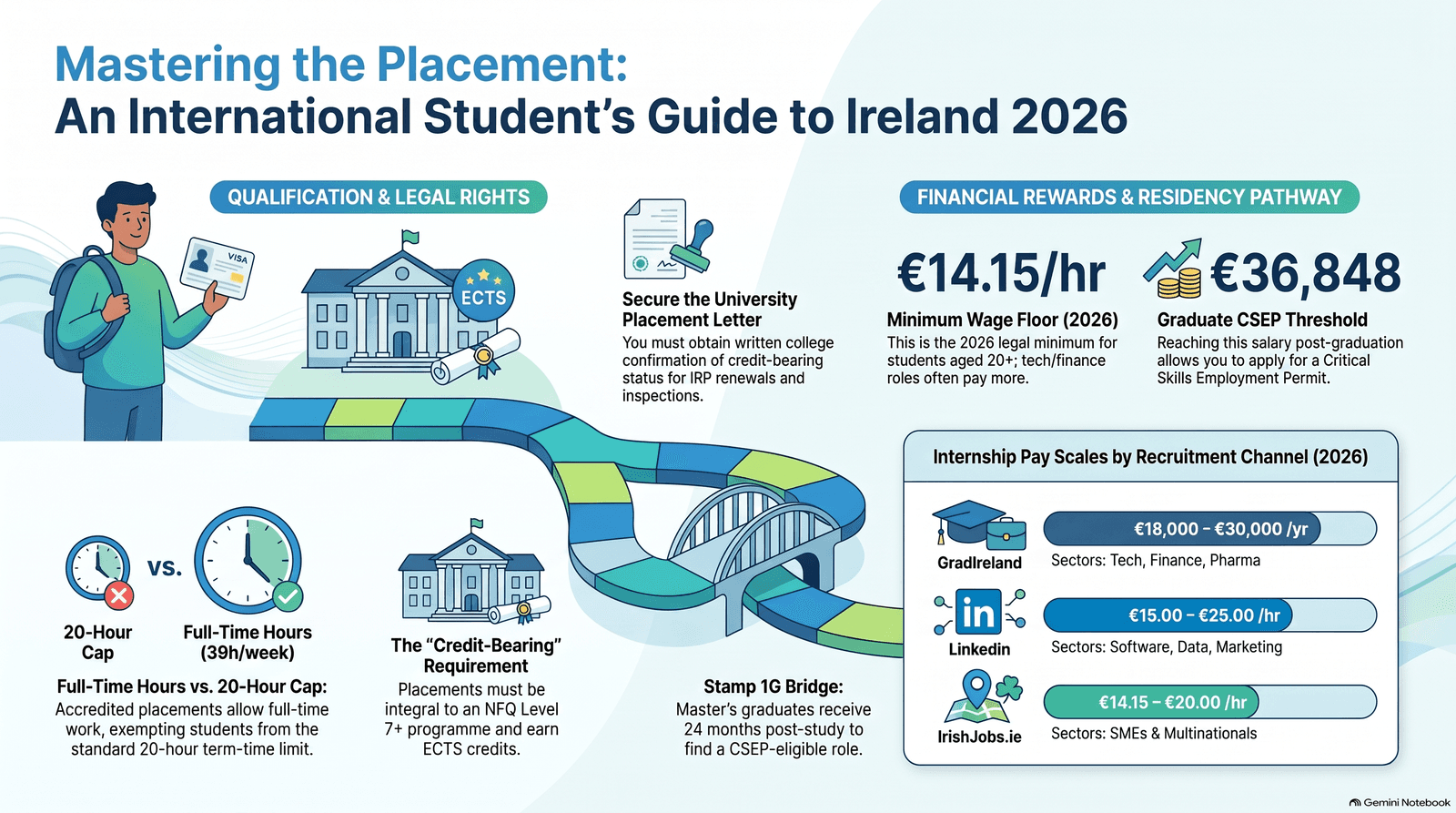
- Full-time hours are legal on Stamp 2 if your placement is an integral, credit-bearing part of a programme listed on the ILEP or approved under the TrustEd Ireland mark at NFQ Level 7 or above — but you must get a written confirmation letter from your institution first.
- Every paid placement student earns at least €14.15/hr (the 2026 national minimum wage for workers aged 20+) and pays PRSI Class A at 4%, building social insurance entitlements from day one.
- A placement is your fastest route to a CSEP — the €36,848 recent-graduate threshold (within 12 months of qualification) means a single placement-to-hire pathway can secure your Irish work future without a labour market test.
20 hours/week for casual jobs; full-time for accredited placements
€14.15/hour — applies to all placement students without exception
€36,848/yr — if within 12 months of your qualifying award (from 1 Mar 2026)
GradIreland, IrishJobs, LinkedIn, your university Career Development Centre
In this guide
- What Stamp 2 allows — the full-time placement rule explained
- How to confirm your placement qualifies
- Where to find paid internships in Ireland 2026
- How to negotiate your placement terms
- Your rights during placement: pay, PRSI and workplace protections
- Placement pay calculator: estimate your take-home
- Turning a placement into a full-time offer: the CSEP pathway
- Frequently asked questions
What Stamp 2 allows — the full-time placement rule explained
Stamp 2 student permission allows international students to work up to 20 hours per week during term time and up to 40 hours per week during holiday periods (June, July, August, September, and 15 December to 15 January). For accredited work placements that form an integral part of your programme, the 20-hour cap does not apply — you may work standard full-time hours, typically 39 hours per week, for the duration of the placement module.
This distinction matters enormously. Without understanding it, many students turn down full-time placement offers or accept reduced hours unnecessarily. Immigration Service Delivery (ISD) guidance is clear: where a work placement forms an integral part of an eligible academic programme leading to a major award at Level 7 or above on the National Framework of Qualifications (NFQ), students may exceed the ordinary 20-hour term-time limit.
There are three conditions that must all be satisfied:
- The programme must be listed on the Interim List of Eligible Programmes (ILEP) or the institution must have received the TrustEd Ireland quality mark from QQI (28 higher education institutions were awarded this mark in January 2026; the ILEP continues to operate until end 2026 while the TrustEd transition completes).
- The placement must contribute academic credits (ECTS) toward your final award — it must not be optional or tacked onto the programme informally.
- The placement generally should not exceed 50% of the total programme duration, though in practice most structured placement modules are one semester (12–16 weeks) out of a full academic year.
One additional rule applies to the timing of non-placement periods. Orientation week and reading weeks are classified as term time under ISD rules, so the 20-hour limit applies during those periods even if you happen to be between placement modules. Plan your side employment around your academic calendar accordingly.
| Work type | Hours allowed (term time) | Hours allowed (holiday) | Stamp 2 restriction |
|---|---|---|---|
| Casual / part-time job | Up to 20 h/week | Up to 40 h/week | Applies strictly |
| Accredited placement (NFQ Level 7+, credit-bearing) | Full-time (typically 39 h/week) | Full-time | Exempt — no 20 h cap |
| Orientation / reading week | Up to 20 h/week | N/A (term period) | Applies strictly |
| Self-employment / own business | Not permitted | Not permitted | Prohibited on Stamp 2 |
How to confirm your placement qualifies
Before accepting any full-time placement offer, obtain a formal written letter from your institution confirming that the placement is an integral part of your accredited programme, that it carries ECTS credits, and that the employer and role description have been approved by your academic coordinator. Without this letter, you are relying solely on verbal assurance if an immigration officer questions your working arrangement.
Here is the exact confirmation process:
Step 1 — Verify your programme is on ILEP or TrustEd
Check the ILEP database on the ISD website and confirm your institution and programme name appear. The ILEP is searchable by institution and QQI level. If your institution received the TrustEd Ireland quality mark from QQI (announced January 2026), that is the new equivalent and supersedes ILEP eligibility. Most Irish universities and institutes of technology are TrustEd-approved for 2026.
Step 2 — Confirm ECTS credit allocation in your programme handbook
Your programme handbook or module descriptor must show that the work placement module carries a specific ECTS credit allocation. A typical six-month co-op module carries 30 ECTS. If no ECTS are attached, the module may not satisfy the ISD placement exemption, and the 20-hour cap will apply.
Step 3 — Request the university placement letter
Your academic placement office issues a letter addressed "To Whom It May Concern" confirming the placement start and end dates, the employer name, the ECTS credits, and the programme code. Keep a copy on your phone and a paper copy at home. Employers who regularly take on Stamp 2 placement students know this process; if an employer is unfamiliar with it, that may indicate they have not hosted international students before and you should verify their intentions carefully.
On-the-Ground Insight: "My placement coordinator at UCD told me I needed the university letter before my first day. The employer assumed it wasn't needed, but when I registered my IRP renewal, the GNIB officer asked specifically whether I had written confirmation from my college that the job was credit-bearing. That letter saved me a very stressful conversation." — Priya M., MSc Business Analytics, UCD, September Intake 2025
Where to find paid internships in Ireland 2026
The most effective channels for international students to find paid placements in Ireland in 2026 are GradIreland, IrishJobs.ie, LinkedIn, your university's Career Development Centre, and sector-specific employer portals — in that order of placement-offer density for non-EEA candidates.
GradIreland — the specialist graduate and placement platform
GradIreland is Ireland's official higher-education careers platform, carrying structured placement and graduate scheme listings from major employers who actively recruit from Irish universities. Unlike generic job boards, GradIreland listings are typically from employers who understand the Stamp 2 placement framework and can provide the university confirmation letter process without confusion. Filter by "Internship / Placement" under the opportunity type and narrow by discipline and region.
IrishJobs.ie — broad market coverage
IrishJobs.ie carries hundreds of internship and placement listings across all major sectors. The platform is particularly strong for finance, professional services, and technology roles in Dublin, with additional listings for Galway (life sciences and medtech), Cork (pharma and finance), and Limerick (engineering). Use the "Internship" filter and set location to your target city.
LinkedIn — employer-direct approach
LinkedIn remains one of the highest-conversion channels for non-EU students because it allows direct outreach to hiring managers and placement coordinators before a role is formally posted. Set your LinkedIn headline to include your programme name, graduation date, and "Open to placement opportunities — Stamp 2." Search for the company name and "placement" or "intern" and apply through the platform. Respond within 24 hours of any recruiter contact — placement hiring cycles move faster than graduate scheme timelines.
University Career Development Centres — highest success rate
Your institution's Career Development Centre (CDC) typically maintains live lists of approved employer partners who have previously hosted Stamp 2 placement students and can move quickly through the placement confirmation process. TU Dublin's CDC and equivalent offices at UCD, DCU, and UCC all run annual placement fairs in September and January. Register with the CDC in Week 1 of your programme — placement cohorts fill early and late registrants miss the first intake.
| Portal / Channel | Best for | Top sectors available (2026) | Typical placement pay |
|---|---|---|---|
| GradIreland | Structured programmes, big employers | Tech, finance, consulting, pharma | €18,000–€30,000/yr |
| IrishJobs.ie | Broad market; SMEs + multinationals | All sectors; strong in Dublin | €14.15/hr–€20/hr |
| Direct outreach; tech & finance | Software, data, marketing | €15/hr–€25/hr (tech) | |
| University CDC | Pre-vetted Stamp 2 employers | Sector varies by institution | €14.15/hr–€22/hr |
| Indeed.ie | High volume; good for retail/hospitality | Retail, hospitality, logistics | €14.15/hr–€16/hr |
How to negotiate your placement terms
Placement negotiation covers four variables: hourly pay, supervisor quality, ECTS credit allocation and academic supervisor contact, and start date flexibility — in that order of practical importance for your career outcome.
Negotiating pay above minimum wage
The national minimum wage of €14.15 per hour (for workers aged 20 and over) is a floor, not a benchmark — many employers expect students to negotiate. In technology and finance roles in Dublin, internship pay typically ranges from €15 to €25 per hour depending on the employer size and the technical complexity of the role. The average full-year placement salary reported by Glassdoor Ireland in mid-2026 is approximately €34,650 annually, which equates to roughly €16.66 per hour on a 40-hour week.
When negotiating, anchor your ask on the role's market rate rather than on your cost of living. Cite the GradIreland salary data for your sector as your benchmark, state your relevant skills, and ask for a specific figure. Most placement coordinators have a pay band with at least 10–15% flexibility above the floor.
Negotiating supervisor and project quality
The single biggest predictor of a placement converting to a graduate hire is having a named, senior line manager (not just an HR contact) who is invested in your development. Before accepting, ask directly: "Who will be my day-to-day manager? What projects will I be contributing to in the first four weeks?" Vague answers — "you'll be supporting the team" — are a signal that the placement is poorly structured. A well-run placement will have a 30/60/90-day plan ready before your start date.
Confirming ECTS credit and academic supervisor contact
Your employer must be willing to complete your university's placement supervision forms, attend a mid-placement check-in call with your academic supervisor, and sign off your final placement report. If an employer balks at any of these requirements, the placement likely cannot carry academic credit, which means the full-time hour exemption may not apply. Confirm these obligations in writing before signing any placement agreement.
Start date flexibility
Most Irish placement cycles begin in January (Semester 2 start) or September (Semester 1 start), but many employers — especially tech multinationals — can accommodate a January or February start for a six-month module. If you need time to complete end-of-semester exams first, ask for a three-week buffer. This is a routine request for placement students and experienced employers expect it.
Your rights during placement: pay, PRSI and workplace protections
As a paid placement student working under a contract of service in Ireland, you have the same employment rights as any other employee — including the national minimum wage, PRSI contributions, the Employment Equality Acts, and protection under the Safety, Health and Welfare at Work Act 2005.
Minimum wage — no exceptions for placement students
From 1 January 2026 the national minimum wage is €14.15 per hour for workers aged 20 and over, €12.74 per hour for workers aged 19, and €11.32 per hour for workers aged 18. These rates apply to all workers — full-time, part-time, fixed-term, agency, and placement — regardless of the nature of the work experience arrangement. The only statutory exceptions are close relatives of a sole-trader employer and formal statutory apprentices registered with SOLAS. If you are offered less than the applicable minimum wage, you are entitled to refuse and report the employer to the Workplace Relations Commission (WRC).
PRSI — building your social insurance record
Placement students pay PRSI Class A at a rate of 4% on gross weekly earnings, with the employer also paying an employer PRSI contribution on top — from 1 October 2026, both rates increase by 0.1% to 4.1% employee and higher employer rates. Your PRSI contributions are recorded with the Department of Social Protection and build your entitlement to Illness Benefit, Maternity/Paternity Benefit, and eventually Jobseeker's Benefit. Even a six-month placement generating 26 weekly PRSI contributions is a meaningful start to your Irish social insurance record.
PAYE income tax and tax credits
Placement students pay PAYE income tax at the standard rate of 20% on annual earnings up to the standard rate band (€44,000 for a single person in 2026) and at 40% on any income above that band. You are entitled to the Personal Tax Credit of €2,000 and the Employee (PAYE) Tax Credit of €2,000 — a combined credit of €4,000 per year that effectively makes the first €20,000 of your annual income tax-free at the 20% rate. If you start mid-year, make sure your employer registers you with Revenue and you receive a Tax Credit Certificate — otherwise you will be placed on emergency tax, which takes a flat 40% from earnings above a threshold regardless of your actual liability. Register with Revenue's myAccount immediately when you start work.
Universal Social Charge (USC) also applies: 0.5% on the first €12,012 of annual income, 2% on €12,012–€27,382, and 3% on €27,382–€70,044. Most placement students earning around €28,000–€35,000 annually will pay USC across the 0.5% and 2% bands, with a small amount at 3%.
Workplace rights and harassment protections
The Employment Equality Acts 1998–2015 prohibit harassment and discrimination on nine protected grounds (gender, age, disability, race, religion, sexual orientation, civil status, family status, and Traveller community membership) in every Irish workplace — including placement workplaces. If you experience bullying or harassment, Citizens Information outlines your right to raise a formal complaint with your employer's HR department and, if unresolved, to refer the matter to the WRC. The Safety, Health and Welfare at Work Act 2005 additionally requires employers to provide a safe work environment — this includes psychological safety and freedom from bullying. Your university placement office is also a support channel; they have a formal relationship with your employer and can escalate issues if needed.
Placement pay calculator: estimate your take-home
Use this calculator to estimate your weekly and annual take-home pay during your placement, based on your hourly rate and hours per week. Constants used: €14.15/hr minimum wage (documented above), 4% PRSI (documented above), 20%/40% PAYE standard/higher rate, €4,000 combined tax credits (Personal Credit €2,000 + PAYE Credit €2,000, per Revenue 2026), USC bands 0.5%/2%/3% (documented above), standard rate band €44,000.
🧮 Placement Take-Home Pay Estimator (Ireland 2026)
Enter your hourly rate and weekly hours to estimate gross and approximate net pay after PAYE, PRSI and USC. This is an estimate — contact Revenue for your precise tax position.
Turning a placement into a full-time offer: the CSEP pathway
The Critical Skills Employment Permit (CSEP) is the fastest legal route from a student placement to permanent Irish residency, and a placement student who converts to a full-time hire is among the most competitive CSEP candidates possible — the employer already knows their capability, no labour market test is required, and the recent-graduate salary threshold (€36,848/yr from 1 March 2026) is significantly lower than the standard €40,904/yr threshold.
Understanding the two CSEP salary thresholds
From 1 March 2026, the Department of Enterprise, Trade and Employment (DETE) set two distinct salary thresholds for the CSEP. The standard threshold is €40,904 per annum for roles on the Critical Skills Occupations List (CSOL). The graduate threshold is €36,848 per annum for graduates who apply within 12 months of completing a qualifying degree at Level 7 or above — roughly a €4,000/yr saving for an employer compared to the standard rate, which can make the difference between a company approving a head count and declining it. These thresholds were increased from 1 March 2026 (up 7.66% from the 2025 figures) and are reviewed annually by DETE.
Any job paying €68,173 or more per annum qualifies for a CSEP regardless of whether the occupation appears on the CSOL — useful for senior data engineering, quant finance, or product leadership roles.
The Stamp 1G bridge period
When you graduate, you move from Stamp 2 to Stamp 1G (the Third Level Graduate Programme), which lets you live and work full-time in Ireland in any sector without a permit for up to 24 months (Masters graduates) or 12 months (Bachelor's graduates). This is your window to convert a placement relationship into a formal CSEP role. The optimal timeline is to have a CSEP-eligible offer confirmed and submitted to DETE by month 18 of your Stamp 1G at the latest, to allow processing time of four to eight weeks and ensure seamless continuity of your Irish working status.
Positioning yourself during placement for a graduate hire
The behaviours that convert a placement into a job offer are specific: ship visible work, build a relationship with your line manager beyond task completion, and signal your post-graduation availability explicitly by month four of a six-month placement. Irish tech and finance employers typically begin their graduate headcount planning for October in June–July. If you do not raise the topic of post-graduation employment by month four, you may miss the planning cycle and face a delayed offer even if your manager wants to retain you.
- Minimum salary: €36,848/yr (recent graduate, within 12 months of qualifying award) — set by DETE from 1 March 2026
- No labour market test required — employer does not have to prove they advertised to Irish/EEA candidates first
- Immediate family reunification from day one of permit
- After 21 months on CSEP → eligible for Stamp 4, which grants unrestricted labour market access
- Processing time: 4–8 weeks through the DETE online portal (either employer or employee can initiate)
Frequently asked questions
Can Stamp 2 students work more than 20 hours per week on placement?
Yes. Stamp 2 students may work full-time hours (typically 39 hours per week) on a placement that forms an integral part of an accredited programme at NFQ Level 7 or above, where the placement contributes ECTS credits toward the final award. The standard 20-hour weekly limit applies only to casual part-time work, not to mandatory academic placements. Always carry a written confirmation letter from your institution.
What is the minimum wage for student placements in Ireland in 2026?
The national minimum wage in Ireland from 1 January 2026 is €14.15 per hour for workers aged 20 and over. Workers aged 19 earn €12.74/hr and workers aged 18 earn €11.32/hr. These rates apply to all employees including placement students — no employer may pay below the applicable rate for any work trial, internship, or placement.
Do placement students pay PRSI in Ireland?
Yes. Placement students working under a contract of service pay PRSI Class A at 4% of their gross weekly earnings (from October 2026 the rate increases by 0.1% to 4.1%). The employer also pays an employer PRSI contribution. PRSI contributions accrue toward future social insurance entitlements including Jobseeker's Benefit.
How can I find paid internships in Ireland as an international student?
The most effective portals for 2026 are GradIreland (gradireland.com), IrishJobs.ie, LinkedIn, and your university's Career Development Centre. Sectors with strong international student hiring include technology, finance, pharmaceutical, and professional services. Your programme coordinator can also confirm which employers have existing placement agreements with your institution.
What is the CSEP salary threshold for recent graduates in Ireland 2026?
For the Critical Skills Employment Permit (CSEP) the general minimum annual salary from 1 March 2026 is €40,904. Recent graduates who qualified within the past 12 months may apply under a lower graduate threshold of €36,848 for roles in critical skills occupations. Both thresholds are set by the Department of Enterprise, Trade and Employment (DETE).
Ready to fly to Ireland for your placement? Compare live fares first.
Whether you are arriving for a September placement intake or flying home between semesters, compare live Dublin fare calendars and find the cheapest booking window before you buy.
All information in this article is based on publicly available official sources including Immigration Service Delivery, Revenue.ie, Workplace Relations Commission, and DETE, as of September 2026. Immigration rules, tax rates, and employment permit thresholds change regularly. Always verify current information directly with the relevant authority before making decisions. MyFlightOffers is not affiliated with any organisation mentioned. This article does not constitute immigration, legal, tax, or financial advice.
- NEW Stamp 1G to Critical Skills Employment Permit 2026 — updated salary thresholds, the €36,848 graduate carve-out, and the roadmap to 2027
- Revenue Emergency Tax Guide for International Students — how to claim back overpaid PAYE if your employer places you on emergency tax
- Ireland Banking Guide for International Students 2026 — opening a bank account, managing PRSI deductions and salary payments
- The Indian Student's Money Survival Guide in Ireland — forex cards, sending money home, and managing two currencies during a placement year