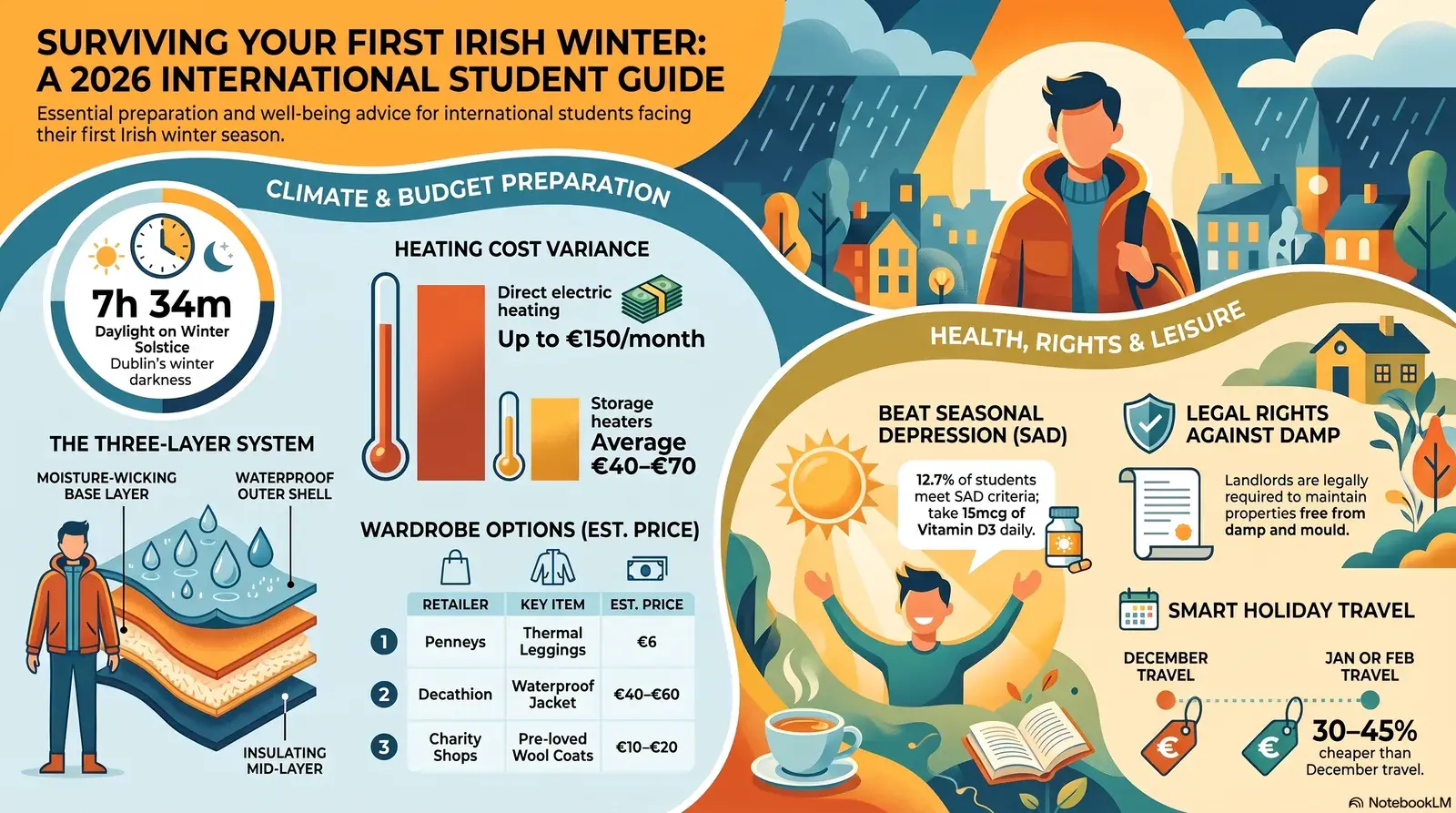
- It's not the cold, it's the dark: Dublin gets just 7 hours 34 minutes of daylight on the winter solstice (21 December 2026) and averages 1h 44min of actual sunshine per day in December. SAD is real — 12.7% of college students show symptoms.
- Heating bills can double or triple: Winter utility costs in private student accommodation run €70–€130 per person per month. Learning to use storage heaters and immersion heaters correctly is the single biggest way to protect your budget.
- Christmas flights spike hard: Dublin–India return fares in December often reach €800–€1,200+. January and February are the cheapest months to fly, making a deferred trip home a smarter financial decision.
3°C to 9°C (Nov–Feb 2026)
7 hours 34 minutes
1 hour 44 minutes
€70–€130 per person/month
What is Irish winter weather actually like?
Irish winter is mild by European standards but relentlessly damp, grey, and dark — and those last two qualities are what catch most international students off guard. Average temperatures between November and February range from 3°C at night to 9°C during the day, according to Met Éireann. In the winter of 2025–26, the national mean temperature was 6.58°C — 1.21°C above the long-term average, making it the twentieth mildest winter since records began in 1900. The coldest night recorded was -5.3°C at Athenry, County Galway on 4 January.
Snow is a myth for most of Ireland. Dublin averages fewer than five days with snowfall per year, and actual lying snow is even rarer. What you will experience is horizontal drizzle driven by westerly Atlantic winds, weeks of unbroken grey cloud, and mud on every footpath.
The darkness is the real shock. Dublin sits at 53 degrees north — almost the same latitude as Moscow. On the winter solstice, 21 December 2026, Dublin gets just 7 hours 34 minutes of daylight from sunrise to sunset. Average actual sunshine hours in December drop to 1 hour 44 minutes per day. The sun rises around 8:35am and sets by 4:08pm. If you have morning lectures and evening seminars, you can go entire days without seeing direct sunlight.
Mumbai sits at 19°N and gets roughly 11 hours of daylight in December. Chennai at 13°N gets 10.7 hours. Kolkata at 22°N gets 10.5 hours. Dublin at 53°N gets 7.5 hours. That is a reduction of 3–3.5 hours of daylight per day compared to what most Indian students are used to — and it compounds every single day from late October through late January.
How do I build a winter wardrobe on a student budget in Ireland?
A functional Irish winter wardrobe costs under €100 if you shop at the right three places: Penneys for base layers and basics, Decathlon for technical waterproofs, and charity shops for a quality wool coat. You do not need expensive outdoor gear. You need layering, waterproofing, and the discipline to actually wear it.
The layering principle
Layering is more effective than a single heavy coat for Irish weather because temperatures fluctuate between heated buses, cold streets, and damp lecture halls. The three-layer system works best: a moisture-wicking thermal base layer (to keep sweat off your skin), an insulating mid-layer (a fleece or padded gilet), and a waterproof outer shell. Irish drizzle soaks a non-waterproof jacket in minutes; a cheap €40 waterproof from Decathlon will serve you better than an expensive wool coat.
Where to shop
Penneys (Primark in the rest of the world) is the go-to for affordable winter basics — thermal leggings from €6, knitted jumpers from €12, padded puffer jackets from €25, and waterproof boots from €18. The flagship store on Mary Street in Dublin city centre is one of the largest in the chain. Do not overlook the men's section for heavyweight hoodies and fleeces regardless of your gender — they run larger and are often cheaper than women's equivalents.
Decathlon is the specialist for anything technical: Quechua waterproof jackets from around €40–€60, thermal base layers from €12, hiking boots from €35. The quality far exceeds the price point. Students who plan day trips or hikes should budget €60–€80 here once and save money on everything else.
Charity shops are the most underrated option for warm winter coats. Oxfam Ireland has 45 shops across the island, and Society of St Vincent de Paul (SVP) shops are found in virtually every town. Pre-loved wool overcoats — the kind that genuinely keeps the Irish wind out — regularly appear for €10–€20. Brand-name waterproof jackets turn up regularly too. Thursday evenings and Saturday mornings are the best time to arrive after new donations arrive mid-week.
Waterproof boots or ankle boots with a grip sole. Irish footpaths turn slippery from wet leaves in October and stay that way until March. Canvas trainers are genuinely dangerous. Budget €25–€50 for a pair of waterproof ankle boots from Penneys or Decathlon before your first month ends.
How do I avoid a shock electricity bill in student accommodation in Ireland?
Winter utility bills in private student rentals — where bills are not included — typically add €70–€130 per person per month on top of rent, and can run 2–3 times higher than summer bills if you do not understand the heating systems in your property. Knowing how your specific heating type works is the single most impactful thing you can do for your budget.
| Heating Type | Typical Winter Cost (per person/month) | How It Works | Key Student Tip |
|---|---|---|---|
| Gas central heating | €60–€90 | Shared boiler, timer and thermostat controlled | Set thermostat to 18–20°C; programmable timers save significantly over manual control |
| Storage heaters | €40–€70 | Charges overnight using cheap night-rate electricity; releases heat during the day | Set the "input" dial to high before bed; set the "output" dial to low in the morning and increase only as needed |
| Direct electric heaters | €90–€150 | On-demand electric heat — the most expensive option | Avoid leaving on when the room is unoccupied; use a timer plug to run only during occupied hours |
| Immersion (hot water) | €15–€30 (water only) | Electric coil inside a water cylinder — heats water for showers and taps | Switch off immediately after use; a forgotten immersion left on for 24 hours costs approximately €3–€5 |
What are storage heaters and how do they work?
Storage heaters are the most common heating system in Irish rental properties, and the biggest source of unnecessary electricity bills for students who do not understand them. They work by drawing electricity overnight when the rate is cheaper (typically under a day/night tariff from providers like Electric Ireland), storing that heat in a ceramic core, and releasing it gradually during the day. The two dials on a storage heater are not a thermostat: the input dial controls how much heat is stored overnight (set high before bed); the output dial controls how fast heat is released (set low in the morning, increase as needed).
The mistake most students make is turning the output dial up full and leaving it there — this dumps the entire day's stored heat by midday and leaves you with a cold room by evening, prompting the temptation to buy a cheap plug-in electric fan heater, which runs at peak rate and is three to four times more expensive per hour than storage heating.
Immersion heater discipline
Immersion heaters heat the water in a hot water cylinder for showers, washing, and kitchen use. The advice from Electric Ireland is to set the temperature to around 65°C (which kills bacteria while being efficient), use it for 30–45 minutes before a shower, and switch it off immediately after. A sticky note on the bathroom mirror saying "TURN OFF IMMERSION" is not a cliché — it is the cheapest efficiency upgrade available.
If your property has a hot water cylinder with a lagging jacket (the foam or fibre wrap), heat retains for 2–4 hours after switching off. Check when you arrive — missing lagging jackets are common in older Irish properties and can be purchased for under €15 from any hardware shop.
Not all Irish student properties have mains gas. Older terraced houses common in Dublin, Cork, and Galway may use oil-fired heating, electric storage heaters, or direct electric — each with very different cost profiles. Ask the landlord for a copy of the last winter electricity or oil bill before you sign. This is a standard and legitimate question and you are entitled to ask it.
What is Seasonal Affective Disorder and how do I manage it as a student in Ireland?
Seasonal Affective Disorder (SAD) is a clinically recognised recurrent depression triggered by reduced exposure to natural light during autumn and winter, and students from tropical and subtropical countries are disproportionately affected when they move to Ireland. Research published in peer-reviewed journals finds that approximately 3% of the general population experience a full depressive episode in winter, but among college students the figure is significantly higher — 12.7% meet SAD criteria and a further 29% show subsyndromal seasonal depression (the "winter blues" that do not meet full diagnostic criteria but meaningfully affect concentration, energy, and mood).
Ireland's position at 53°N means students arriving from Chennai, Mumbai, Delhi, Lagos, or Nairobi face a reduction of 3–4 hours of daily daylight compared to what their bodies expect. Dr Freja Petersen, a chartered psychologist working in the Trinity College Dublin Student Counselling Service, notes that international students — particularly those from equatorial regions — are among the groups most commonly referred for SAD-related presentations during the November–February period.
Vitamin D supplementation
The Food Safety Authority of Ireland (FSAI) recommends that adults take a daily supplement of 15 micrograms (600 IU) of vitamin D3 during the Irish winter, as insufficient sunlight makes dietary sources and summer skin synthesis inadequate. The upper safe daily intake is 100 micrograms (4,000 IU) for adults. Vitamin D3 supplements are widely available in pharmacies including Lloyd's Pharmacy, Boots, and Pharmacy Plus for approximately €5–€10 for a three-month supply. The research link between low vitamin D and depression is well-established: a 2014 meta-analysis published in The British Journal of Psychiatry found vitamin D deficiency significantly associated with depression, and supplementation in deficient populations produced measurable mood improvements.
SAD lamps and morning light exposure
A 10,000 lux SAD lamp used for 20–30 minutes each morning (not at night — it suppresses melatonin) is the most evidence-based non-pharmaceutical intervention for seasonal depression. Models start at around €30–€60 online. HSE guidelines and the British Journal of Psychiatry endorse bright light therapy as a first-line treatment equivalent in efficacy to antidepressant medication for seasonal presentations.
College counselling services
Every Irish higher education institution funded by the State is required to provide student counselling services. Most are free for registered students, with initial waiting times of one to three weeks for a first appointment — shorter than most NHS or HSE community mental health waits. Contact your college's student services office in October rather than waiting until symptoms become severe. Proactive outreach in autumn means you are already in the system when January arrives.
On-the-Ground Insight: "I genuinely did not believe people when they told me Irish winters were hard. I am from Hyderabad — I thought cold weather would be fine. But by December I could not get myself to attend 9am lectures. It was dark outside when I left, dark when I came back. My college counsellor told me straight away to start vitamin D, get a SAD lamp, and go for a walk at lunch every day. That combination plus the gym made the difference. I wished I had started in October instead of January." — Priya V., MSc Data Analytics, University of Galway, September 2025 Intake
How do I stay active when it's dark at 4:30pm in Ireland?
The key to staying active through an Irish winter is shifting your expectations from outdoor to indoor exercise and using the Irish college system's subsidised facilities. Every Irish university and most institutes of technology provide gym access to registered students at significantly subsidised rates — typically €80–€150 per semester, compared to €40–€70 per month at commercial city-centre gyms.
Student unions run a broad range of indoor clubs and societies: martial arts, yoga, dance, badminton, squash, table tennis, basketball, and swimming. Joining one of these in September or October — before the winter darkness sets in — provides a structured reason to leave your room three times per week. The social element is equally important: SAD and low mood feed on isolation, and a training partner or team removes the activation barrier that stops most people exercising alone in winter.
For outdoor exercise, the trick is the lunch window. Between 12:30pm and 2:00pm in November and December, there is typically some daylight even when overcast. A 30-minute brisk walk in the middle of the day provides the light exposure most beneficial for circadian rhythm regulation — more effective than the same walk at 8am in darkness. Irish parks including Phoenix Park in Dublin (the largest urban park in Europe at 1,752 acres) and the National Trails network remain accessible and free year-round.
Too Good To Go is worth mentioning here in a different context: purchasing a surprise bag from a local café or bakery for €3–€5 gives you a reason to walk somewhere at lunchtime, gets you outdoors, and feeds you cheaply — a triple benefit for mental health, activity, and food budget.
What are my rights as a tenant if my Irish accommodation has damp or mould?
Irish landlords are legally required under the Housing (Standards for Rented Houses) Regulations to maintain rental properties free from damp, with adequate structural integrity, ventilation, and heating — and damp or mould constitutes a breach of this standard. This is not optional guidance; it is enforceable law.
Damp is endemic in older Irish housing stock. The combination of high external rainfall (Ireland receives 1,000–2,500mm per year in different regions), insufficient insulation in pre-2000 buildings, and the condensation generated by cooking, showering, and breathing in small spaces creates conditions ideal for mould. Look for black or green patches on walls, window reveals, ceilings above bathrooms, and behind wardrobes placed against external walls.
What to do if you discover mould
Document everything with dated photographs and notify your landlord immediately in writing — email is sufficient and creates a timestamped record. State clearly that there is damp or mould, describe its location and extent, and request remediation within a specific timeframe (14 days is reasonable for moderate mould). Keep a copy of every communication. If the landlord does not respond or refuses to act, you can file a dispute with the Residential Tenancies Board (RTB) at no cost to you.
From 1 March 2026, Ireland's strengthened tenancy legislation creates Tenancies of Minimum Duration — most new tenancies now run for a rolling six-year protected period. Rent can only be increased once per year and by no more than 2%, or the rate of inflation — whichever is lower. This means a landlord cannot use a rent increase as a veiled threat in response to a maintenance complaint. The Threshold housing charity provides free advice to tenants facing housing issues and can guide you through the RTB dispute process.
Preventing condensation mould (tenant-side steps)
While structural damp is always the landlord's responsibility, condensation mould can partly be managed by tenants. Open windows for 10–15 minutes after cooking or showering, even in winter. Never dry laundry on radiators — it adds enormous moisture to the air and significantly increases heating bills because the heater works harder to raise air temperature to the set point. A small electric clothes airer with a dehumidifier function (available from €30–€50) is a better investment than a radiator-draped damp towel rack.
Should I fly home for Christmas or stay in Ireland as an international student?
Whether to fly home for Christmas depends primarily on budget — December fares from Dublin to India typically range from €600–€1,200+ for a return ticket, making it one of the most expensive travel periods of the year. Students from closer to Ireland (EU countries, Middle East) face lower fare barriers; students from India, China, or sub-Saharan Africa face costs that can represent one to two months of living expenses.
| Option | Approx. Cost (2 Weeks, Dec–Jan) | Best For | Key Downside |
|---|---|---|---|
| Fly home (India/South Asia) | €600–€1,200 return fares + transfers | Students who haven't seen family since September; first-year homesickness | Most expensive flight period of the year; 9–12 hours travel each way is exhausting mid-semester |
| Stay in Dublin | €800–€1,100 (rent + food + activities) | Budget-focused students; those with Christmas internships or part-time work | Some college services and student dorms close; city feels quieter; can feel isolating alone |
| Budget European city break | €200–€500 (Ryanair/Aer Lingus + hostel + food) | Students who want to travel but cannot afford India fares | Still away from family; requires advance planning as Christmas bookings fill fast |
| Fly home in January/February | €350–€600 return (off-peak) | Any student who can flex travel to the cheapest months | Miss the Christmas holiday itself; some family events are during the December period |
The case for flying in January or February
January and February are consistently the cheapest months to fly from Dublin to India, with return fares averaging 30–45% less than peak December pricing. If your academic schedule allows a trip home in late January or February (post-exam period), you can visit family for the same emotional benefit at a significantly lower financial cost. Booking 10–12 weeks in advance secures the best rates — November bookings for January travel represent the sweet spot. According to data from Skyscanner, the cheapest month to fly from India to Dublin historically is November, while January and February are the cheapest months to fly back, reversing the seasonal premium.
Students staying in Dublin over Christmas should note that the Christmas markets and festive lighting transform the city through December. The St Stephen's Green Continental Market runs from 18 November to 22 December 2026, and the Christmas at Dublin Castle market features alpine-style chalets and live music. Both are free to enter. In Galway, the Galway Continental Christmas Market on Eyre Square — Ireland's oldest and largest — has 50+ wooden chalets and is free admission. Cork runs "Corkmas" with light installations, artisan markets, and a Christmas parade from late November into early January.
- Budget under €500 for travel: Stay in Dublin or book a European city break. Use the money saved for a January/February trip home during cheaper fares.
- Budget €600–€1,000: A deferred India trip in January/February is possible. Check MyFlightOffers fare calendar for the cheapest window.
- Budget over €1,000 or no budget constraint: Fly home in December. Book immediately — December fares fill by late October. Book return leg in January for cheaper rates home.
What are the genuine upsides of an Irish winter for international students?
Irish winter has genuine compensations that most international students only discover after surviving their first one — particularly around cheap travel, festive events, and academic opportunity. Here is what the fresher orientation talks tend to leave out.
The cheapest flights of the year are in January and February
The post-Christmas lull in demand makes January and February the optimal months for budget travel from Dublin. Ryanair and Aer Lingus run their heaviest promotional sales in January, covering European destinations from €9.99 one-way. Students with a Student Leap Card already have reduced-rate bus and rail access for domestic travel, but January is when the intercity routes to Cork, Galway, and Limerick are least crowded and often discounted. A weekend in Galway in January — grey skies, turf fires in pubs, the Claddagh in winter — is genuinely underrated.
Christmas markets are free and genuinely fun
As noted above, Dublin, Galway, and Cork all host major Christmas markets from mid-November through late December, all with free entry. Galway's market is one of the top-rated Christmas markets in Europe and runs from early November 2026. The seasonal atmosphere — mulled wine, German bratwurst stands, handmade craft stalls — provides a very different social experience from the summer term and a memorable shared experience with non-Irish classmates.
Library and study space availability peaks
December and January are when Irish domestic students go home or scatter for holidays, leaving university libraries, study rooms, and common areas significantly less crowded than term-time. Students staying in Ireland during the Christmas break often report the most productive study periods of their academic year. Dissertation chapters, research papers, and professional certification exams all benefit from the quiet that Irish winters create in campus buildings.
Part-time work rates and hours often increase
Retail, hospitality, and logistics employers in Ireland ramp up hiring significantly for the November–December period, with many offering higher hourly rates for weekend and evening shifts over Christmas. Students on Stamp 2 visas are permitted to work up to 20 hours per week during term time — a limit that rises to 40 hours per week during the Christmas and summer vacation periods. A well-timed Christmas period of extra hours can meaningfully supplement a semester budget.
Frequently Asked Questions
What is Irish winter weather actually like?
Irish winter is mild but persistently damp and grey. Average temperatures range from 3°C to 9°C between November and February. The key challenge is not extreme cold but relentless drizzle, strong westerly winds, and very short daylight hours — as little as 7 hours 34 minutes on the winter solstice (21 December 2026) in Dublin. Snow is rare, occurring fewer than five days per year on average.
How do I avoid a shock electricity bill in student accommodation in Ireland?
In private rentals, bills add €70–€130 per person per month in winter. For storage heaters: charge them fully at night on the cheaper night rate, then use the output sparingly during the day. For immersion heaters: always switch off after use — a forgotten immersion can cost €3–€5 per day. Set your thermostat to 18–20°C rather than higher, keep interior doors closed, and never dry laundry on radiators as it drives up damp and kills heating efficiency.
What is Seasonal Affective Disorder and how do I manage it as a student in Ireland?
Seasonal Affective Disorder (SAD) is a recurrent depression triggered by reduced daylight hours in autumn and winter. Ireland at 53°N gets as little as 1 hour 44 minutes of sunshine per day in December. Research finds 12.7% of college students show SAD symptoms, with students from tropical or equatorial regions at higher risk. Management includes: daily vitamin D3 supplements (the FSAI recommends 15 micrograms daily for adults), a 30-minute morning walk in natural light, a SAD lamp (10,000 lux, used 30 minutes at breakfast), regular exercise, and contacting your college counselling service early — most offer free sessions with short waiting times.
What are my rights as a tenant if my Irish accommodation has damp or mould?
Under Irish housing standards legislation, landlords must keep rental properties in good structural repair, free from damp, and with adequate ventilation and heating. If you discover mould, document it with dated photographs and notify your landlord in writing (email is sufficient) requesting repairs within a reasonable timeframe. If the landlord fails to act, you can file a complaint with the Residential Tenancies Board (RTB) at rtb.ie. From 1 March 2026, new tenancies are protected under Tenancies of Minimum Duration (six-year rolling term), and rent can only be increased once per year by 2% or inflation — whichever is lower.
Should I fly home for Christmas or stay in Ireland as an international student?
Flying home from Dublin to India in December costs €600–€1,200 or more, as peak Christmas fares are among the most expensive of the year. If budget is tight, staying in Dublin (€800–€1,100 for two weeks covering rent, food, and activities) can be cheaper and avoids the fatigue of a 9–12 hour flight. January and February are the cheapest months to fly, so a deferred trip home shortly after Christmas can save €300–€500 on the return ticket. A European city break (€200–€500 for flights, accommodation, and food) is a strong middle ground for students who want to travel but cannot afford full India fares.
Flying to or from Ireland? Compare live fares first.
Whether you're planning a Christmas flight home, a January return, or a cheap European break, the MyFlightOffers fare calendar shows you the cheapest booking windows and live prices across all major airlines serving Dublin.
All information in this article — including temperature and daylight statistics (Met Éireann), electricity bill estimates (Electric Ireland, Selectra.ie, Acolyte Living), SAD prevalence figures (peer-reviewed academic sources), vitamin D recommendations (FSAI), tenant rights (RTB, Threshold), rental law changes (Residential Tenancies Act 2026), and flight fare benchmarks (Skyscanner, Kayak) — is based on publicly available information as of July 2026. All costs, regulations, and rules are subject to change. Always verify current information directly with the relevant authority. MyFlightOffers is not affiliated with any organisation mentioned. This article does not constitute medical, financial, legal, or immigration advice.
- NEW Surviving Your First Irish Winter (2026) — this guide
- Indian Grocery and Food Budget Guide for Students in Ireland 2026 — supermarket rankings, Indian stores by city, the €60 weekly shop, batch cooking, and customs rules for food from home.
- Ireland Student Survival Guide: Hidden Subsidies and Savings 2026 — TFI Leap Card fares, Student Assistance Fund, Revenue PAYE refunds, and 50+ ways to spend less every week.
- Ireland Student Medical and Health Guide 2026 — GP registration, EHIC/S1 forms, college counselling, and HSE mental health services for international students.
- Study in Ireland 2026: Visa, Housing, and IRP Card Guide — the end-to-end arrival guide covering student visa conditions, IRP card registration, and finding accommodation.