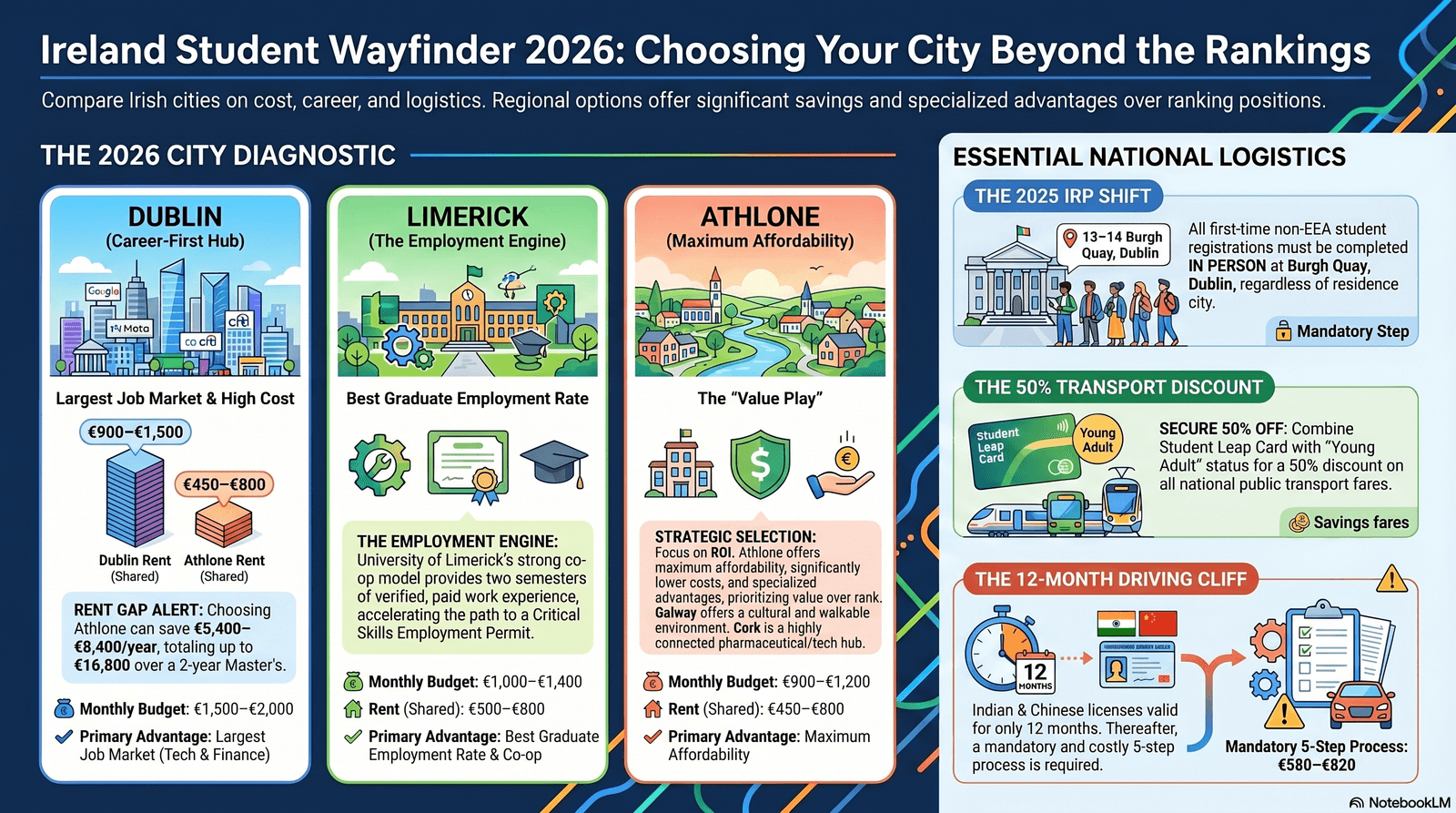
💰 Most Affordable City
Athlone
€900–€1,200/month total budget
🏙️ Best Job Market
Dublin
Google, Meta, Stripe, Citi all headquartered here
🎓 Best Graduate Employment Rate
Limerick (UL)
Ireland's strongest co-op education model
🚌 National Transport Card
Leap Card
Student version gives major discounts across all
cities
What this guide covers — 7 questions answered
- Q44 — Student life in Dublin: TCD, UCD, DCU, TU Dublin, RCSI, Maynooth
- Q45 — Student life in Galway: University of Galway, ATU
- Q46 — Student life in Limerick: UL, TUS
- Q47 — Student life in Athlone: TUS Midlands
- Q48 — Student life in Cork: UCC, MTU
- Q49 — Public transport across Ireland: Leap Card, Irish Rail, Taxsaver
- Q50 — Indian and Chinese driving licences in Ireland: what you need to know
Ireland's Student Cities Feel Completely Different — Here Is the Honest Breakdown
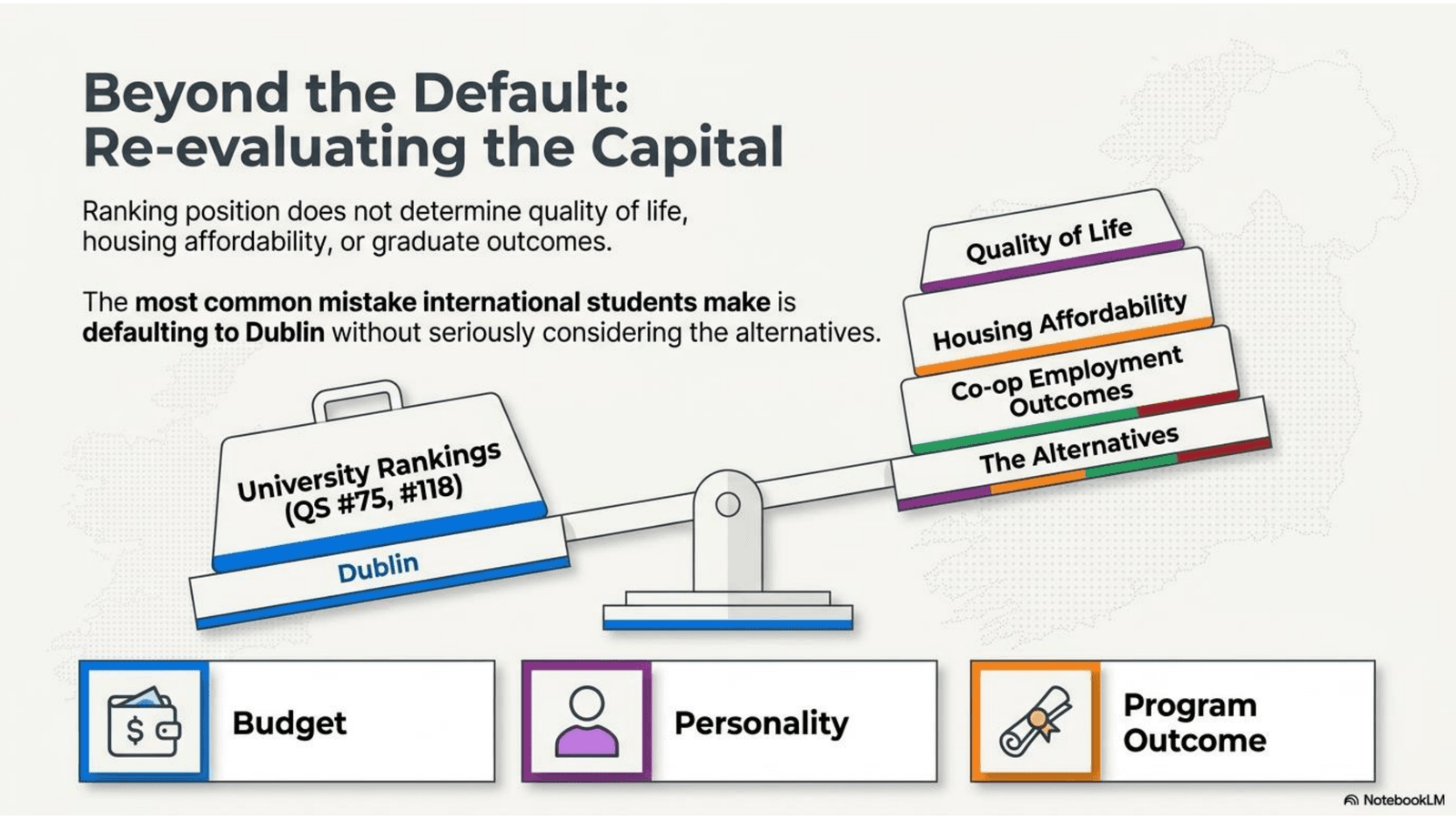
One of the most common mistakes international students make when choosing to study in Ireland is defaulting to Dublin without seriously considering the alternatives. The university rankings point toward Dublin — TCD is ranked QS #75, UCD at #118 — but ranking position does not determine quality of life, housing affordability, or graduate outcomes. A student choosing the University of Limerick on a co-operative education programme often graduates with 12 months of verified, paid work experience and a domestic employer network that no ranking can replicate.
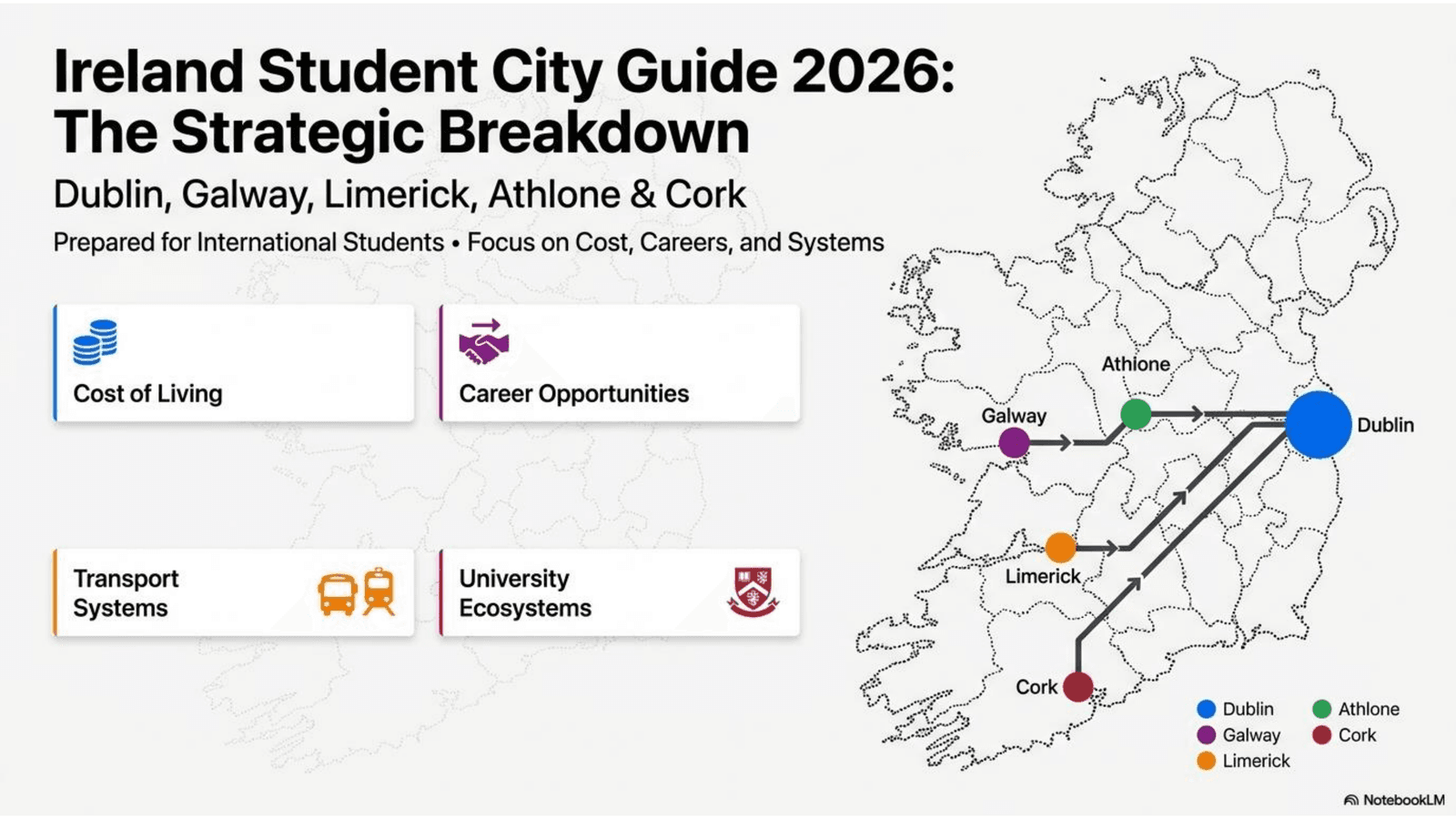
This guide gives each city equal and honest treatment. It does not advocate for one over another — the right city depends entirely on your programme, your budget, your personality, and what you want from three or four years of your life. What it does is give you the facts to make that decision confidently.
Each city section follows the same structure: universities present, housing costs and popular areas, transport options, student discounts, things to do, IRP registration process, and a monthly budget summary. The national transport and driving licence sections at the end apply to all cities.
Q44 Student Life in Dublin Most Expensive
Universities
Dublin is home to the largest concentration of higher education institutions in Ireland. The main universities and institutes relevant to international students are:
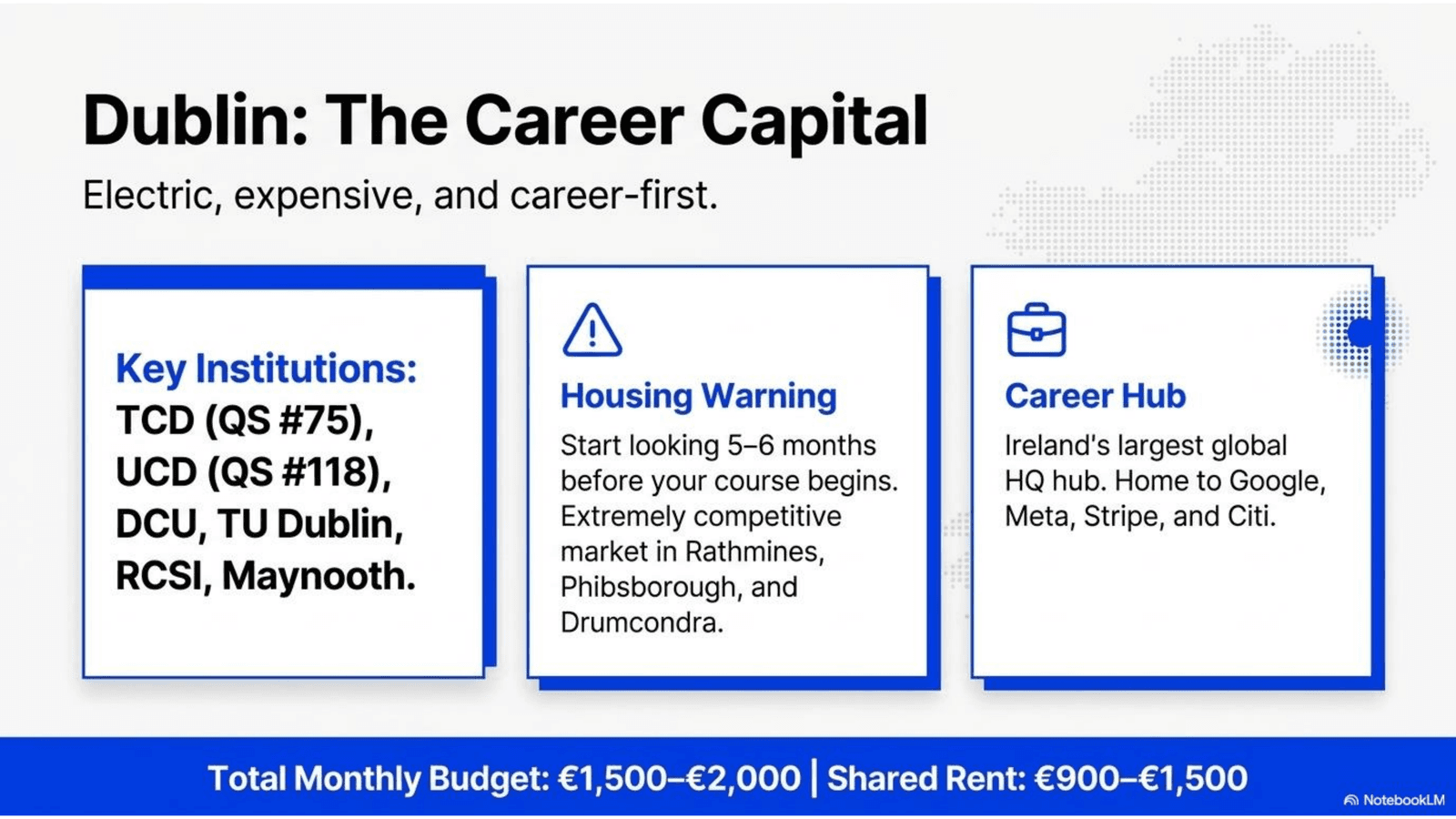
- Trinity College Dublin (TCD) — QS #75; city centre, College Green
- University College Dublin (UCD) — QS #118; Belfield campus, Dublin 4
- Dublin City University (DCU) — Glasnevin, Dublin 9; strong computing and engineering
- Technological University Dublin (TU Dublin) — Grangegorman, Dublin 7; largest technological university in Ireland
- RCSI University of Medicine and Health Sciences — St Stephen's Green, Dublin 2; specialist medicine and pharmacy
- Maynooth University — Maynooth, Co. Kildare; 30 minutes by commuter rail from Dublin city centre; strong humanities and computer science
Housing: Dublin's Biggest Challenge
Dublin has a genuine and well-documented housing shortage. Rental demand from working professionals, domestic students, and international students all compete in the same market. The August student surge is particularly intense — every September-intake international student in the city arrives in the same three-week window, and landlords know it. Rooms listed in June are gone by July.
Current Dublin rent benchmarks for students (May 2026):
- Shared room in a house: €900–€1,500/month
- Purpose-built student accommodation (PBSA): €950–€1,600/month (en-suite; bills included; longer waiting lists)
- Digs (room in a local family home): €700–€1,100/month; often includes breakfast and dinner
Popular Student Areas in Dublin
- Rathmines and Ranelagh (Dublin 6 and 6W): The classic student belt for TCD and UCD students. Walking or cycling distance to TCD; 20–25 minute bus to UCD. Dense with cafés, supermarkets (Lidl Rathmines, Aldi Ranelagh), and restaurants. Among Dublin's most sought-after areas — expect to compete for rooms.
- Phibsborough (Dublin 7): Strong choice for TU Dublin Grangegorman students; 10 minutes on the Luas from city centre; growing café and restaurant scene; Lidl Phibsborough on the high street.
- Drumcondra (Dublin 9): Convenient for DCU; direct bus to city centre; slightly more affordable than Rathmines; quieter residential character.
- Donnybrook and Stillorgan (Dublin 4): Proximity to UCD Belfield; suburban; served by frequent bus routes; higher rents but calmer environment.
Daft.ie is Ireland's dominant property platform; Rent.ie and MyHome.ie are secondary. Your university's accommodation office maintains lists of vetted landlords and off-campus options — check this before going to public platforms. Facebook groups specific to your university ("UCD 2026 International Students", "TCD Accommodation 2026") often have faster-moving listings than formal platforms.
Getting Around Dublin
Dublin has the most developed public transport network in Ireland, operated by Transport for Ireland (TFI):
- Dublin Bus: Extensive city-wide network; €1.80 flat student fare with Student Leap Card on most city routes
- Luas (tram): Two cross-city lines (Red and Green); connects Tallaght/Saggart to Broombridge and Cherrywood to Broombridge; key for UCD (Stillorgan stop), TU Dublin (Grangegorman stop), and St Stephen's Green area (RCSI, TCD vicinity)
- DART: Coastal rail line from Malahide and Howth to Greystones; passes through Tara Street, Connolly, and Pearse stations (for TCD); essential for students living in coastal suburbs
- Dublin Bikes: Docked bicycle-sharing scheme with 116 stations; annual membership €35; fastest way to cross the city centre in 15 minutes or less
Student Discounts in Dublin
- ISIC Card: Accepted at cinemas (Cineworld Parnell Street, Odeon Point Village), the National Concert Hall, and many restaurants on or near Grafton Street. Apply at isic.ie — approximately €12–€15 per year.
- Penneys O'Connell Street: Dublin's flagship Penneys (Primark) is one of the largest in Europe and the most affordable place to build a wardrobe suitable for Ireland's cold and wet winters. No student discount card required — prices are already the lowest on the high street.
- Lidl Phibsborough and Lidl Ranelagh: Two of the most student-frequented Lidl branches in the city; weekly shop for one person €40–€55.
- National Gallery of Ireland (Merrion Square): Permanent collection is completely free to visit; world-class European and Irish art. No booking required for the permanent collection.
- Chester Beatty Library (Dublin Castle): Free entry to one of the world's finest collections of manuscripts, printed books, and decorative arts from Asia, the Middle East, and Europe. Winner of the European Museum of the Year award.
- Student Beans / UNiDAYS: Both platforms give online shopping discounts on ASOS, Nike, adidas, Spotify, and food delivery apps. Register with your college email address.
Things to Do in Dublin as a Student
- Temple Bar: Dublin's cultural quarter on the south bank of the Liffey; live music, galleries, and the weekend food market (Saturday–Sunday). Note: as an entertainment district, Temple Bar is more tourist-focused; locals and students tend to favour nearby streets like Dame Street, South Great George's Street, and Drury Street for bars and restaurants.
- Phoenix Park: One of the largest urban parks in Europe at 1,750 acres; free entry; home to a wild deer herd (over 600), the Dublin Zoo, and Áras an Uachtaráin (the President's residence). Excellent cycling and running routes.
- National Museum of Ireland (Kildare Street and Collins Barracks): Free entry to Ireland's natural history, archaeology, and decorative arts collections. The bog bodies and Viking Dublin exhibitions are remarkable.
- Howth and Dalkey: Coastal villages reachable in 30–40 minutes from city centre by DART; cliff walks, seafood, and views of Dublin Bay. Essential day trips in any season.
- Kilmainham Gaol: Historic prison with guided tours (booking required; small fee); essential for understanding modern Irish history.
Safety Note
Dublin is broadly a safe city for international students. However, as with any major European capital, neighbourhood awareness matters. Areas with higher reported incidents of anti-social behaviour and street crime include parts of Tallaght, Clondalkin, and Ballymun — all of which are outer-suburban areas not adjacent to the main student districts described above. The city centre, Rathmines, Ranelagh, Phibsborough, and Drumcondra are considered safe for student living. Walk confidently, keep phones and valuables out of sight on busy streets, and use taxis or rideshare apps (FreeNow, Uber) for late-night journeys rather than walking alone in unfamiliar areas. An Garda Síochána (Irish Police) emergency number is 999 or 112.
IRP Registration in Dublin
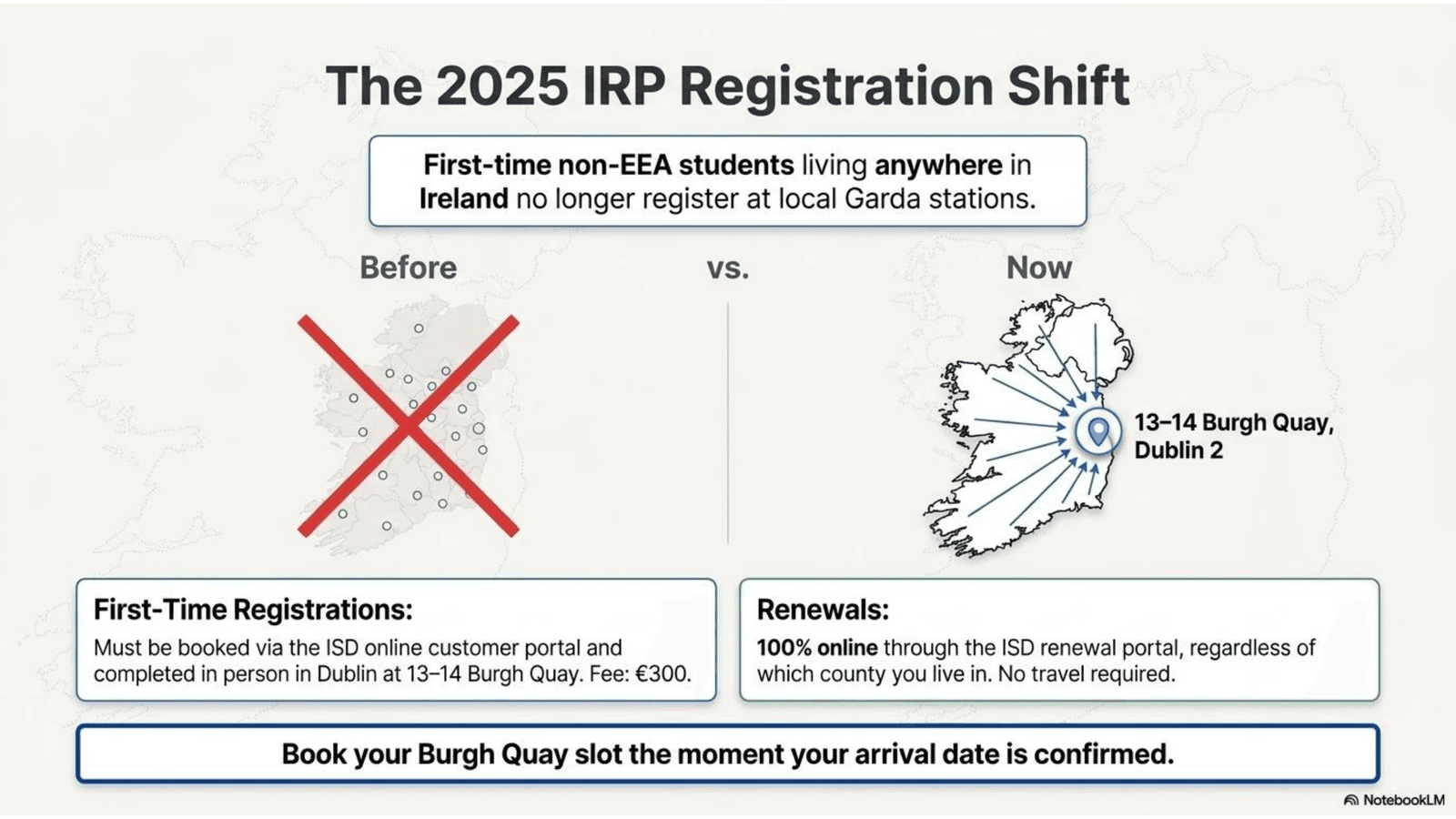
From 2025 onwards, all first-time IRP registrations for students living anywhere in Ireland are managed centrally by Immigration Service Delivery (ISD) at the Registration Office, 13–14 Burgh Quay, Dublin 2.
You must first create an account on the ISD online customer portal and use it to book a first-time registration appointment. You can set up your portal account before you travel to Ireland, and you should start looking for appointments as soon as you know your arrival date, because slots are limited and can fill quickly at the start of each semester.
On the day of your Burgh Quay appointment, you attend in person with your passport, college offer/registration letter, proof of fees paid or sponsor letter, proof of accommodation in Ireland, and the €300 registration fee. Your Irish Residence Permit (IRP) card is normally posted to your Irish address within 10 working days after a successful registration.
If you are renewing your IRP (not first-time), you do not normally attend in person at Burgh Quay. Renewals are submitted online through the ISD renewal portal, regardless of which county you live in.
Dublin Monthly Budget Summary
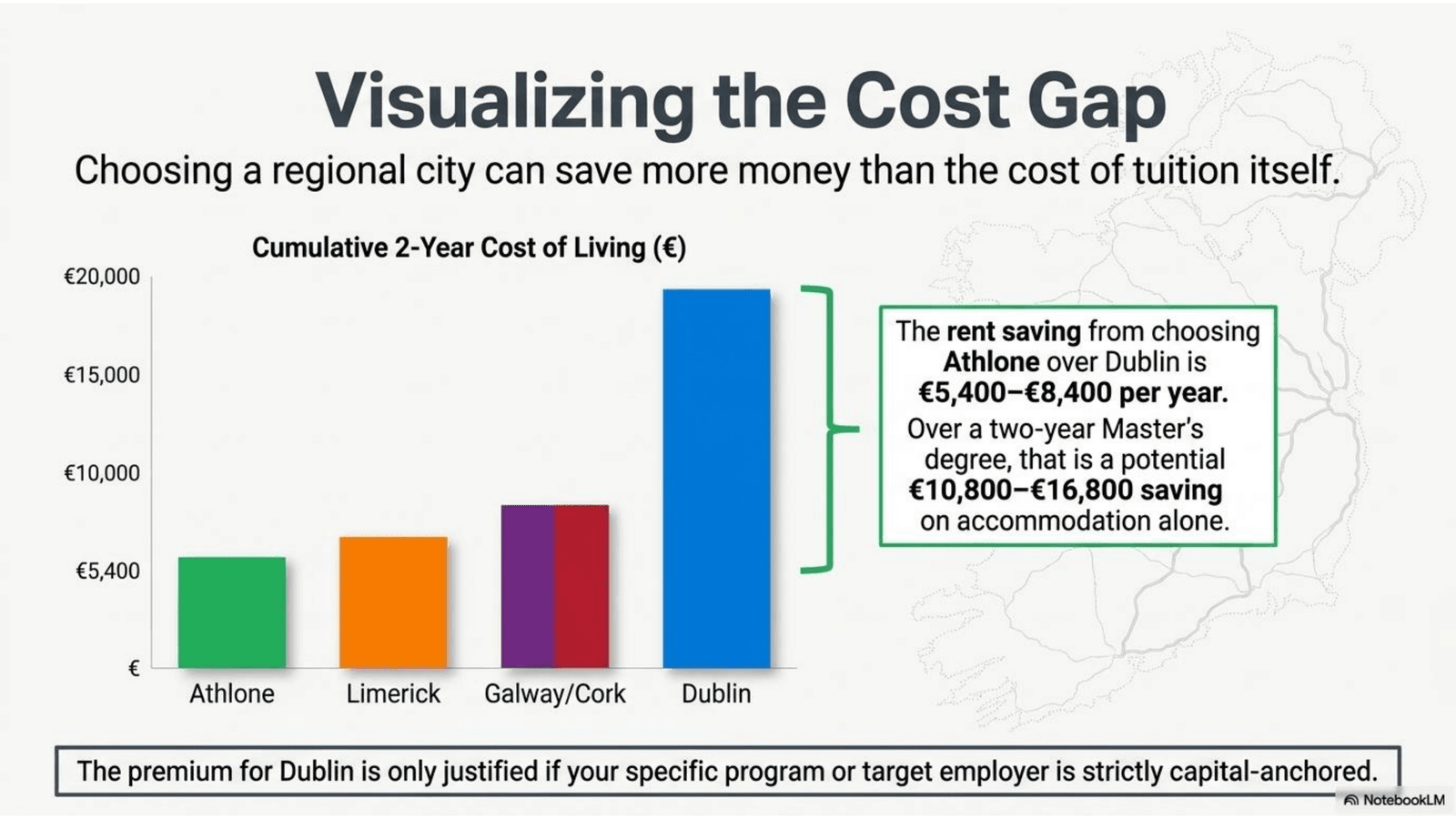
Dublin is the most expensive of Ireland's student cities by a significant margin. The premium is justified if your programme, employer targets, or career plan are specifically Dublin-anchored. If they are not, a comparable academic experience in Cork, Galway, or Limerick can save €4,000–€10,000 per year in living costs.
Q45 Student Life in Galway Cultural Capital
Universities
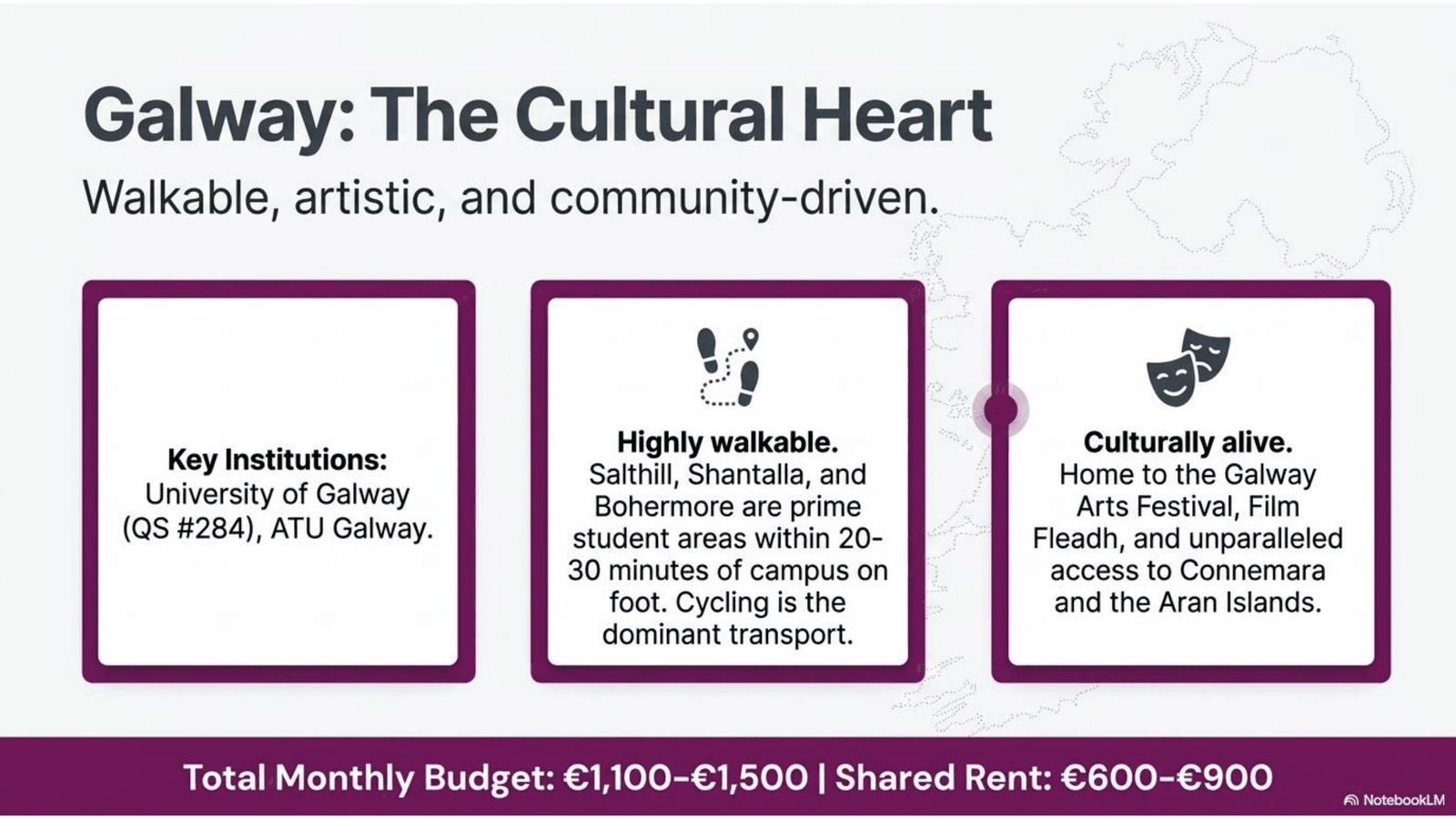
- University of Galway — QS #284; main campus on the west bank of the River Corrib; 19,000+ students; strong in biomedical science, engineering, law, and marine science
- ATU Galway (Atlantic Technological University) — Dublin Road campus; applied and vocational programmes in engineering, business, and computing; among Ireland's lowest non-EU tuition fees at €9,000–€14,000/year
Housing in Galway
Galway's rental market is competitive but meaningfully more accessible than Dublin. The city is compact enough that most student housing is within cycling or walking distance of both universities.
- Shared room: €600–€900/month
- University of Galway student village (on-campus): Limited places; apply as early as possible via accommodation.universityofgalway.ie
- Private student accommodation: Several purpose-built developments near the Dangan area; similar pricing to private rentals
Popular Student Areas in Galway
- Salthill: Coastal suburb 3 km from city centre; the promenade walk is a Galway institution; popular with students and families alike; short bus ride to both campuses.
- Shantalla and Bohermore (Galway North): Established student residential areas directly north of the University of Galway campus; 10–15 minute walk to most faculty buildings.
- Newcastle and Knocknacarra: Quieter western suburbs; good for students wanting a calmer environment; served by city bus routes.
Getting Around Galway
Galway is one of the most walkable student cities in Ireland. The city centre, the university campus, and most student residential areas are within 20–30 minutes on foot. Cycling is extremely popular and the City Connect cycle network has expanded significantly.
- Bus Éireann and City Direct: Urban bus routes connect suburbs to the city centre; Leap Card accepted
- Cycling: Most practical daily transport option; secure bike storage at both universities; second-hand bikes available from the University of Galway's Students' Union
- Walking: Shop Street, the Latin Quarter, and Eyre Square are all walkable from most student areas
Student Discounts in Galway
- Eye Cinema (Wellpark Retail Park): Regular student nights with reduced ticket prices; bring your student ID or ISIC card.
- Students' Union (NUIG SU): Galway's University SU operates discount schemes with local restaurants, the university sports complex (free gym access in some membership tiers), and retail outlets near campus.
- Lidl Galway (Headford Road): The dominant budget supermarket for Galway students; weekly shop €40–€55.
- Galway Film Fleadh (July): One of Ireland's oldest film festivals; student tickets at significantly reduced rates; world cinema and Irish film premieres.
Things to Do in Galway
- Claddagh Village: Ireland's oldest fishing village, immediately across the Corrib from the city centre; the origin of the Claddagh ring; peaceful and historically rich.
- Salthill Promenade: A 2 km waterfront walk along Galway Bay; the local tradition of "kicking the wall" at the end is genuinely observed; spectacular sunsets over the Burren and Clare hills.
- Aran Islands Day Trip: Ferry from Rossaveal (45 minutes by bus from Galway city) to Inis Mór, Inis Meáin, or Inis Oírr; one of the most striking landscapes in Western Europe; Dún Aonghasa cliff fort is unmissable. Return ferry tickets approximately €25–€35.
- Connemara National Park: 40 minutes by bus from Galway; mountain walking, bog landscapes, and the Twelve Bens range; free entry to the park itself.
- Galway Arts Festival (July) and Galway Races (July/August): The city's two signature summer events; both draw enormous crowds and transform the city; book accommodation well in advance if you are staying for either.
IRP Registration in Galway
Galway students no longer register their IRP at Mill Street Garda Station. Under the updated national process, all first-time registrations for non-EEA students in Galway are booked through the ISD online customer portal and completed in person at the Registration Office, 13–14 Burgh Quay, Dublin 2.
The documents you bring to your Burgh Quay appointment are the same regardless of where in Ireland you live: passport, college documentation, proof of fee payment, proof of accommodation, and the €300 registration fee. Plan your travel from Galway to Dublin (Irish Rail or coach) around your appointment time and allow extra time for queues on the day.
For renewal of an existing IRP card, Galway students use the ISD online renewal portal and normally do not need to travel to Dublin, unless specifically instructed.
Galway Monthly Budget Summary
Galway combines genuine academic credibility at the University of Galway with a quality of life that many students rank above Dublin despite a smaller footprint. The west coast landscape, the thriving arts scene, and the strength of the student community make it a compelling alternative for students whose programme is available there.
Q46 Student Life in Limerick Best Employment Outcomes
Universities
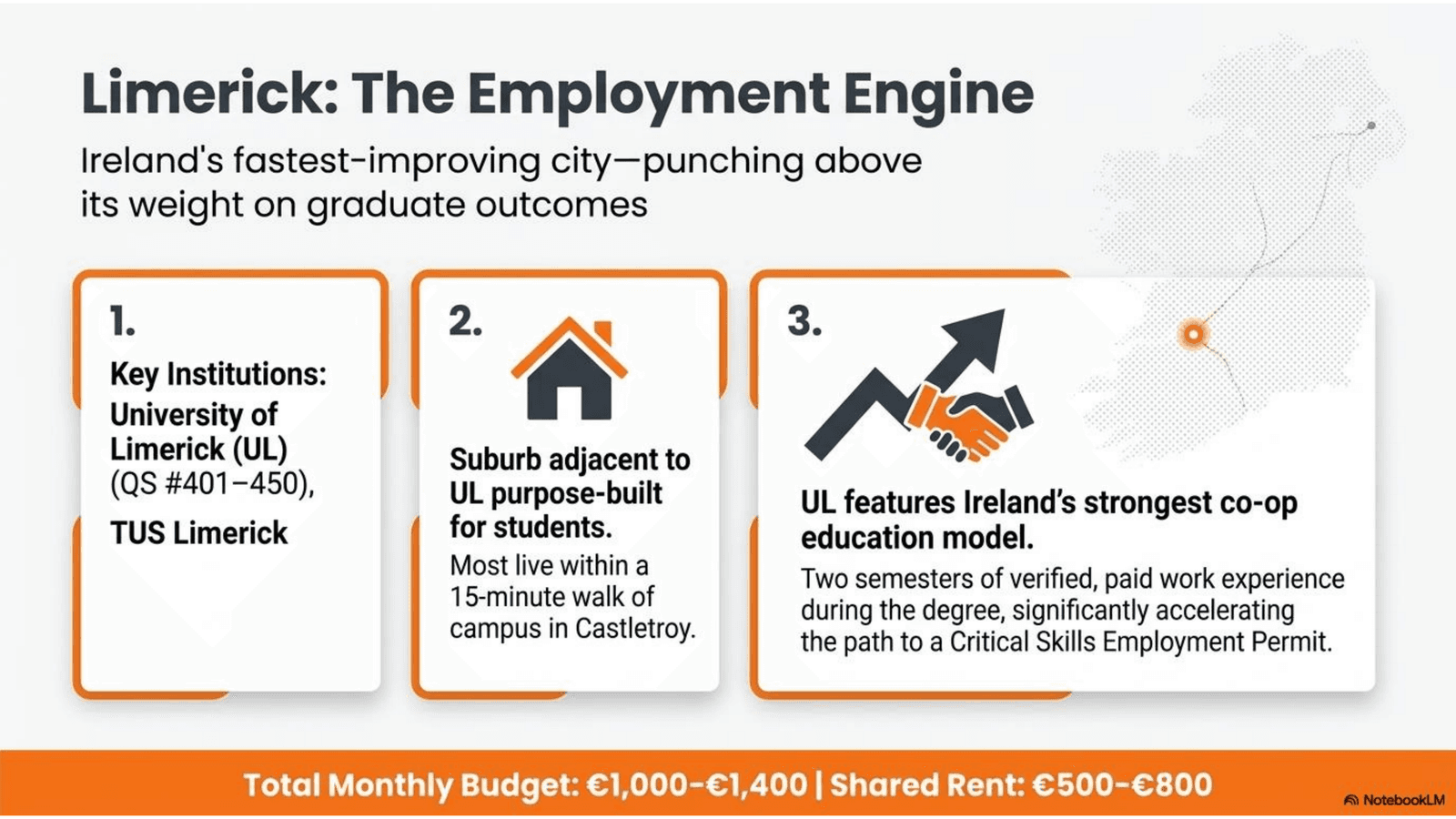
- University of Limerick (UL) — QS #401–450; 350-acre riverside campus in Castletroy, 5 km east of Limerick city centre; 16,000+ students; Ireland's highest graduate employment rate; renowned for its mandatory co-operative education programme (co-op), which places students in paid work for two semesters during their degree
- TUS (Technological University of the Shannon) — Limerick — Moylish and Clonmel campuses; applied technology, engineering, and business programmes; part of the same TUS group as the Athlone campus
Housing in Limerick: The Castletroy Advantage
The suburb of Castletroy — immediately adjacent to UL's campus — is purpose-built for student living. Most UL students live within a 15-minute walk of campus in a dense belt of student housing, shared houses, and apartments. This is Limerick's key advantage over Dublin: you do not need to navigate a sprawling city to reach university.
- Shared room in Castletroy: €500–€800/month
- UL Campus Accommodation (on-campus villages): Multiple self-catering villages; apply via ul.ie/accommodation; fills quickly for new entrants
- Private PBSA near UL: Developments like UL Courtyard and Kilmurry Village; comparable to on-campus pricing
- Limerick city centre: 10–15 minutes by bus from UL campus; slightly cheaper than Castletroy in some cases; more urban environment
Getting Around Limerick
- Bus Éireann Route 304: The dedicated student bus between UL campus, Castletroy, and Limerick city centre; frequent service during term time; Leap Card accepted
- Cycling: The Castletroy–UL corridor is flat and has dedicated cycle lanes; cycling is practical for most daily commutes
- Limerick city: Compact and walkable; most city centre services within 20 minutes on foot from the central bus station
- Intercity: Limerick rail station connects to Dublin Heuston (1 hr 40 min), Cork (1 hr), and Ennis; useful for weekend travel
Things to Do in Limerick
- King John's Castle: 13th-century Norman castle on Thomond Island in the River Shannon; excellent interactive museum; student discount available
- The Hunt Museum: One of Ireland's finest private art and antiquity collections; housed in the Georgian Customs House on the river; free entry on certain days; student discounts available
- Munster Rugby at Thomond Park: Limerick is the heartland of Munster Rugby — attending a Thomond Park match during the season is a defining experience of the city; student tickets available from Munster Rugby
- Cliffs of Moher: Approximately 1 hour from Limerick by car or Bus Éireann tour; one of Ireland's most visited natural landmarks; highly recommended for first-year students settling in
- Bunratty Castle and Folk Park: 15 minutes from Limerick; authentically reconstructed 19th-century Irish village with period demonstrations; student prices available
UL's co-op programme places students in paid work placements for two semesters during a four-year degree — typically after Year 2 and Year 3. For international students, this provides Irish work experience, an Irish employment reference, and an income supplement during the placement period. Co-op placements are sourced by UL's Cooperative Education and Careers Division and span employers in technology, pharmaceutical, engineering, and financial services sectors. Many UL international graduates convert their co-op employer into a full-time graduate offer, significantly accelerating the path to a Critical Skills Employment Permit (CSEP).
IRP Registration in Limerick
Limerick-based students no longer complete first-time IRP registration at Henry Street Garda Station. All first-time registrations for students living in Limerick are now booked through the ISD online customer portal and completed at the Registration Office, 13–14 Burgh Quay, Dublin 2.
The online portal lets you choose an available time slot, usually within 2–3 weeks, so you can plan your trip from Limerick to Dublin around your appointment. You must bring your passport, college documents, financial evidence, accommodation proof, and €300 registration fee.
Once you already have an IRP card, renewal is done fully online via the ISD renewal portal, without attending Burgh Quay or any Garda station in person, unless specifically requested.
Limerick Monthly Budget Summary
Limerick is the most underestimated student city in Ireland. Its graduate employment rate, co-op programme, affordable living costs, and improving city centre make it a genuinely compelling choice for students in engineering, science, business, and sport science — particularly those who prioritise career outcomes over urban lifestyle.
Q47 Student Life in Athlone Best Value in Ireland
University
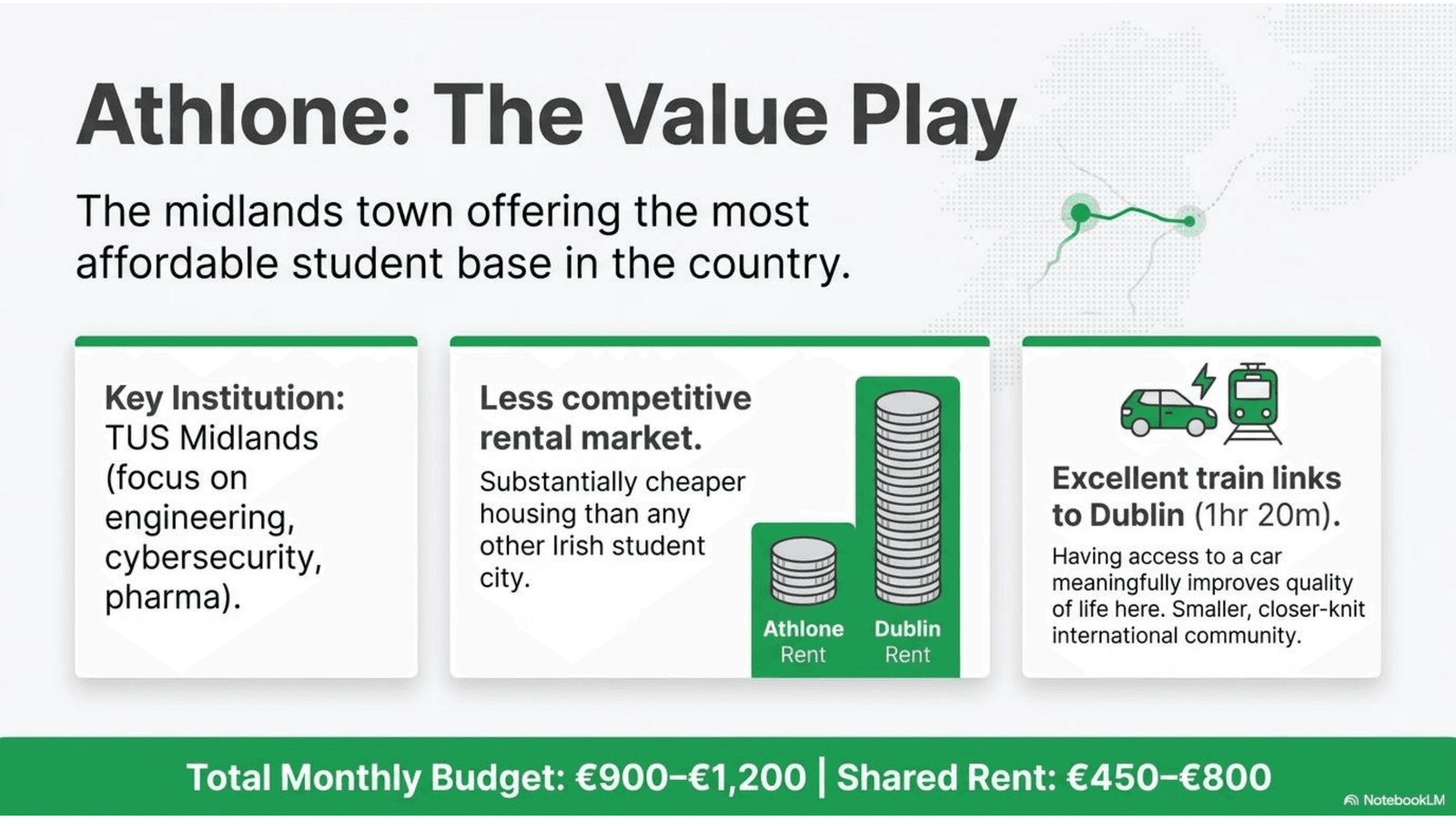
- Technological University of the Shannon (TUS) — Athlone campus — The Athlone campus of TUS is the main HEI for students in the Irish midlands. Approximately 6,000 students on the Athlone campus (15,000+ across all TUS campuses including Limerick). Programmes include engineering, technology, cybersecurity, pharmaceutical science, gaming and VR, and Ireland's only dedicated Microbiology degree. Non-EU undergraduate fees approximately €13,500/year. Website: tus.ie
Housing in Athlone: The Clear Winner on Cost
Athlone is the most affordable place to live as a student in Ireland. The combination of a smaller rental market, lower demand relative to Dublin or Galway, and the TUS campus location on the eastern edge of the town creates a housing environment that is substantially less competitive than any other Irish student city.
- Shared room in Athlone: €450–€800/month
- TUS student village (on-campus accommodation): Purpose-built student housing adjacent to campus; apply via tus.ie; bills typically included
- Private rentals in Athlone town: More available and more affordable than comparable units in Galway or Cork
Getting Around Athlone
Athlone is a town, not a city, and its transport options reflect that. Planning ahead is important.
- Train: Athlone railway station connects to Dublin Heuston in approximately 1 hour 20 minutes and to Galway in approximately 1 hour. Irish Rail fares are significantly cheaper when booked 7 or more days in advance. The train is the most reliable way to travel to Dublin for appointments, interviews, or events.
- Local bus: Bus Éireann city routes operate within Athlone; less frequent than in the larger cities. A bicycle or car is a practical supplement for students based further from campus.
- Car: Athlone is one of the few Irish student cities where having access to a car meaningfully improves quality of life — particularly for grocery shopping, exploring the midlands, and visiting Lough Ree. Students with a driving licence should consider this.
- Cycling: The Athlone town centre is compact and flat; cycling works well for the campus-to-town commute.
Community Note for International Students
TUS Athlone has a growing international student intake, but the overall international student community in the town is smaller than in Ireland's main cities. This is not necessarily a disadvantage — many students find the closer-knit TUS community easier to navigate than the anonymity of a large urban university. However, if you are arriving without pre-existing connections, it is strongly advisable to join the TUS international student Facebook groups, WhatsApp communities, and your programme's Discord or messaging group before you arrive. Contact TUS's international office at [email protected] — they run orientation programmes and peer mentoring specifically for new international students.
Things to Do in Athlone and the Midlands
- Athlone Castle: 12th-century Norman castle on the west bank of the River Shannon; the visitor centre covers the history of the Shannon and the 1691 Siege of Athlone; free or reduced entry for students.
- Lough Ree Boat Trips: The River Shannon opens into Lough Ree immediately north of Athlone; boat hire and guided tours available; one of Ireland's most scenic inland waterways; Islands including Hare Island are accessible by boat.
- Midlands Cycling Routes: The Beara-Breifne Way and several looped cycling trails pass through the midlands and Lough Ree shoreline; excellent for weekend exploration.
- Sean's Bar (Athlone): Claims to be the oldest pub in Ireland, established in 900 AD; on the west bank of the Shannon; a genuine piece of Irish history and a student institution.
- Day trips: Athlone's central location makes it the perfect base for exploring Connemara (1 hour), Galway (1 hour), Clonmacnoise (30 minutes), and the Cliffs of Moher (1.5 hours).
IRP Registration in Athlone
Athlone students used to register at Athlone Garda Station on Retreat Road, but this local GNIB process has been replaced. For first-time registration from 2025 onwards, all Athlone-based non-EEA students must use the ISD online customer portal to book an appointment at the Registration Office, 13–14 Burgh Quay, Dublin 2.
You can create your portal account before you arrive in Ireland, and you should start checking for Burgh Quay appointment slots as soon as your visa is granted and your travel dates are confirmed. When travelling from Athlone, most students use the direct Irish Rail service to Dublin Heuston and then connect by Luas or bus into the city centre for their appointment.
Renewal of an existing IRP card is fully online through the ISD renewal portal, with your new card posted to your registered Irish address; attending a local Garda station in Athlone is no longer part of the IRP renewal process.
Athlone Monthly Budget Summary
Athlone is Ireland's best-value student location by a clear margin. For cost-conscious students whose programme is available at TUS, the combination of low rent, low living costs, and a supportive campus community can make Athlone the most financially sound decision of their academic career.
Q48 Student Life in Cork Ireland's Second City
Universities
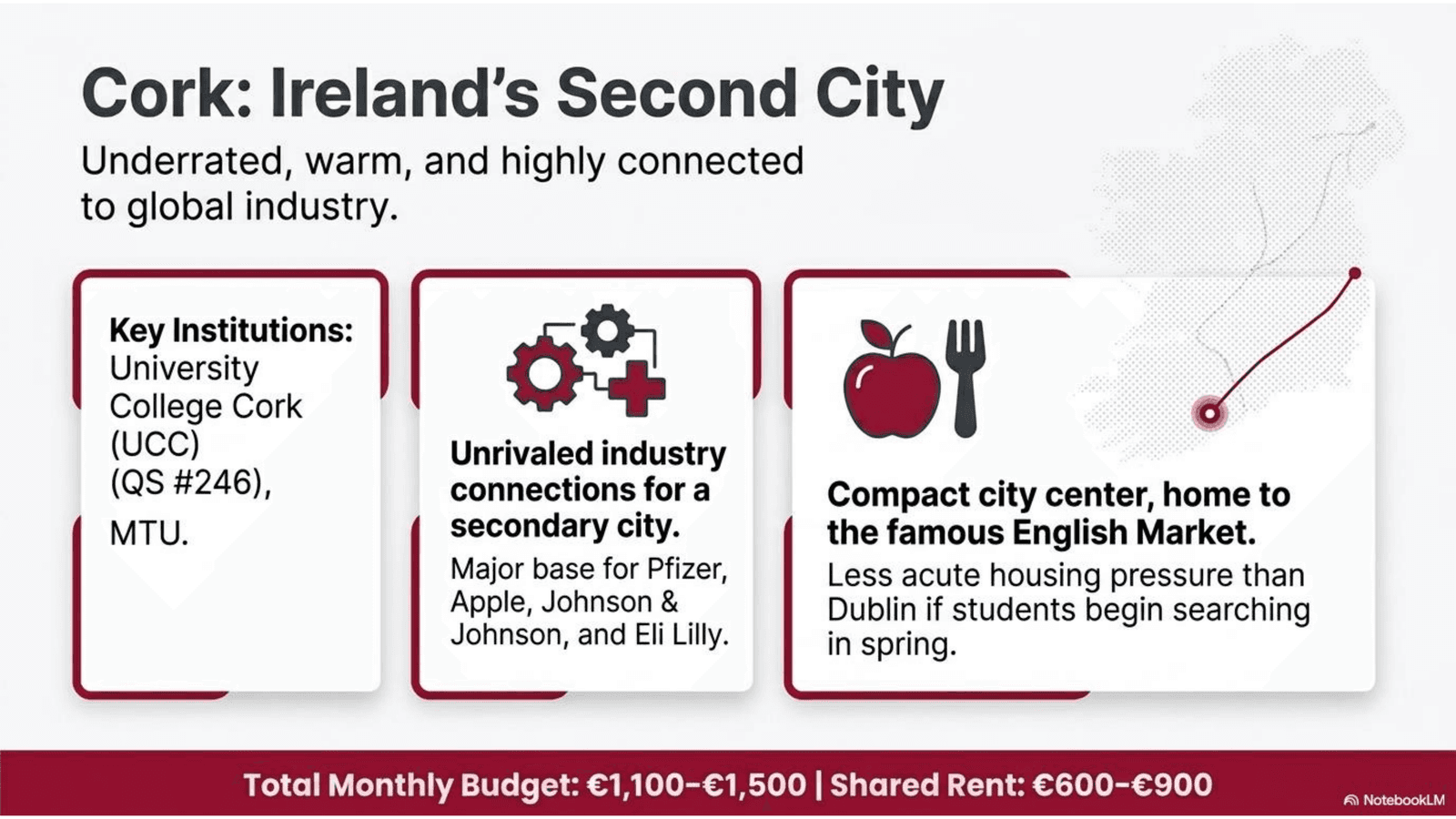
- University College Cork (UCC) — QS #246; main campus on the Western Road, a 20-minute walk from Cork city centre; 26,000+ students; strong in medicine, pharmacy, food science, law, and global business; named Sunday Times Irish University of the Year multiple times
- MTU (Munster Technological University) — Bishopstown campus, south-west Cork; applied programmes in engineering, science, business, and art and design; practical professional programmes with strong industry connections to Cork's pharmaceutical and technology sectors
Housing in Cork
Cork's rental market is under pressure — like most Irish cities in 2026 — but the supply situation is less acute than Dublin. Students who begin searching in spring for September entry can usually find suitable accommodation without the extreme competition seen in the capital.
- Shared room in Cork: €600–€900/month
- UCC Accommodation: On-campus and off-campus options managed by UCC Accommodation Services at ucc.ie/accommodation; limited places; early application essential
- Private PBSA near UCC: Several purpose-built developments on the Western Road corridor; typically €800–€1,100/month with bills included
Popular Student Areas in Cork
- Wilton: Southern suburb adjacent to CUH (Cork University Hospital) and within cycling distance of UCC; popular with medical and pharmacy students; well served by bus; Wilton Shopping Centre has a Lidl and Aldi.
- Douglas: South Cork suburb; mixed residential and student population; slightly further from UCC but quieter and often slightly cheaper than central areas.
- Ballintemple and Ballinlough: Popular with mature and postgraduate students; coastal proximity to Blackrock and Mahon Point; connected to UCC and the city centre by regular bus.
- Western Road corridor (near campus): Highest demand, highest rents closest to UCC; rooms here move very quickly in July and August.
Getting Around Cork
- Bus Éireann: Cork's public bus network; Leap Card accepted; key routes serve all major student areas; frequency has improved following Transport for Ireland investment
- Cycling: Cork has invested in cycle infrastructure in recent years; the city is hilly in parts (the Cork city hills are not a myth) but most student areas are manageable; Cork Bikes (docked scheme) available in the city centre
- Walking: The city centre is compact; most amenities within 25–30 minutes on foot from UCC campus
- Cork Kent railway station: Connects to Dublin Heuston (2 hours 20 minutes), Limerick Junction (1 hour), and Cobh (25 minutes); a key facility for weekend travel
Student Discounts in Cork
- UCC Students' Union: The UCCSU runs discount schemes with local restaurants near campus, the Mardyke Arena UCC sports complex (gym, swimming pool, sports courts), and academic supply shops on Western Road.
- Lidl and Aldi Cork: Multiple branches throughout the city; Lidl Wilton Shopping Centre is the most convenient for students in the southern suburbs.
- Triskel Arts Centre (Tobin Street): Student concession rates on cinema screenings, theatre, and cultural events; an independent arts venue with a genuinely eclectic programme.
- Everyman Palace Theatre: One of Ireland's finest regional theatres; student standby tickets available at significant discounts on most performances.
- English Market (Grand Parade): Cork's famous covered food market; outstanding local produce at competitive prices; the best place in the city to buy fresh fish, meat, cheese, and bread. Free to browse.
Things to Do in Cork
- English Market: One of the oldest covered food markets in the world; a genuine Cork institution; Queen Elizabeth II visited during her 2011 state visit to Ireland. An essential part of life in Cork city.
- Blarney Castle: 8 km from Cork city; the Blarney Stone and castle gardens; bus from Cork city centre; student discount available. Touristic but genuinely impressive grounds.
- Cobh: Harbour town 25 minutes by train from Cork Kent; the Titanic Experience and the Queenstown Story cover the history of Irish emigration from Cobh (then called Queenstown); emotionally resonant for students from countries with strong historical ties to Ireland.
- Kinsale: 25 km south of Cork; a picturesque harbour town with some of Ireland's best seafood restaurants; accessible by Bus Éireann; excellent for a day trip.
- Mardyke Arena and Lee Fields: UCC's sports complex and the riverside park adjacent to the Lee are popular for running, cycling, and team sports; open to the public as well as UCC students.
IRP Registration in Cork
Cork students previously registered their IRP at Anglesea Street Garda Station, but first-time registration is now centralised. All first-time IRP registrations for students living in Cork are booked through the ISD online customer portal and completed in person at the Registration Office, 13–14 Burgh Quay, Dublin 2.
When booking, choose a Burgh Quay slot that works with your travel from Cork to Dublin by train or coach and arrive early on the day with all required documentation and the €300 fee.
For Cork students who already hold an IRP card, renewals are processed online via the ISD renewal portal, and you only attend in person if ISD specifically instructs you to.
Cork Monthly Budget Summary
Cork consistently surprises international students who chose it as a second preference. The combination of UCC's academic reputation, the city's strong pharmaceutical and technology industry base (Pfizer, Apple, Johnson & Johnson, Eli Lilly all operate major facilities in Cork), and a living cost profile meaningfully below Dublin makes it an excellent choice for students who want a city experience without Dublin's price tag.
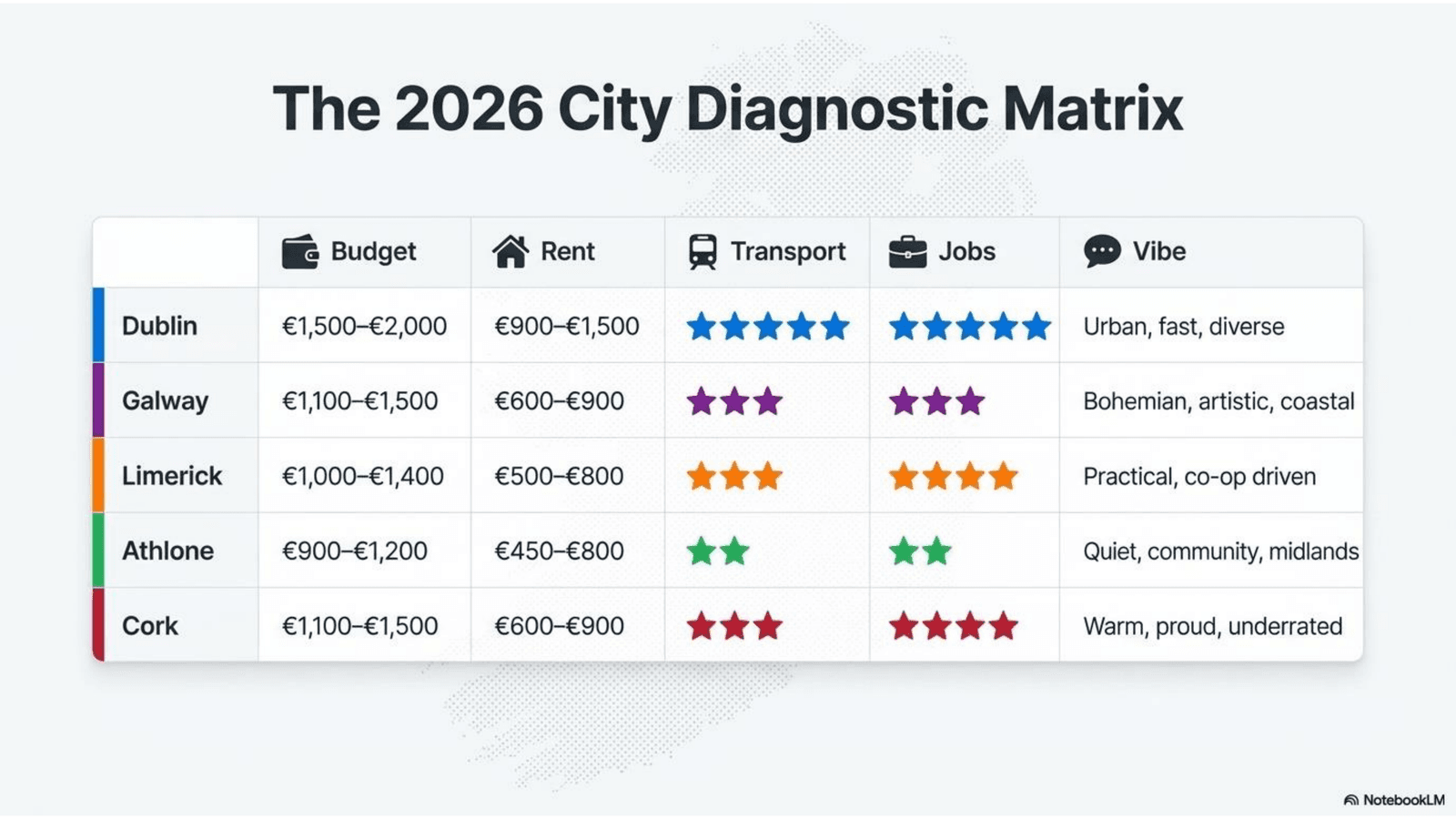
Five Cities — Side-by-Side Comparison
| City | Monthly Budget | Shared Rent | Transport Quality | Job Market | City Character |
|---|---|---|---|---|---|
| Dublin | €1,500–€2,000 | €900–€1,500 | ⭐⭐⭐⭐⭐ Excellent | ⭐⭐⭐⭐⭐ Largest | Urban, fast, diverse |
| Galway | €1,100–€1,500 | €600–€900 | ⭐⭐⭐ Good (walkable) | ⭐⭐⭐ Growing | Bohemian, artistic, coastal |
| Limerick | €1,000–€1,400 | €500–€800 | ⭐⭐⭐ Good (UL campus bus) | ⭐⭐⭐⭐ Strong (tech + pharma) | Practical, co-op driven |
| Athlone | €900–€1,200 | €450–€800 | ⭐⭐ Moderate (train + car) | ⭐⭐ Local | Quiet, community, midlands |
| Cork | €1,100–€1,500 | €600–€900 | ⭐⭐⭐ Good (bus network) | ⭐⭐⭐⭐ Strong (pharma + tech) | Warm, proud, underrated |
Q49 How Do I Use Public Transport as a Student in Ireland?
Ireland's public transport network is operated across multiple modes and brands, all coordinated under Transport for Ireland (TFI). Understanding how it works — and how to pay for it cheaply — is essential from your first week in the country.
The Leap Card — Ireland's Universal Transport Payment Card
The Leap Card is Ireland's reloadable contactless smartcard for public transport. It works on Dublin Bus, Luas, DART, Dublin Commuter rail, Bus Éireann intercity and city routes, Go-Ahead Ireland, and Irish Rail. It is the most cost-effective way to pay for public transport across the entire country.
- Where to buy a Leap Card: Centra, Spar, and newsagents across Ireland; also available at Dublin Airport arrivals
- Cost: €5 card deposit (non-refundable); top up with any amount
- Discount: Standard Leap Card fares are approximately 20–30% cheaper than cash fares on most services
- App: Manage your Leap Card balance, view travel history, and auto top-up via the TFI Leap Top-Up app
Student Leap Card — The Version You Actually Want
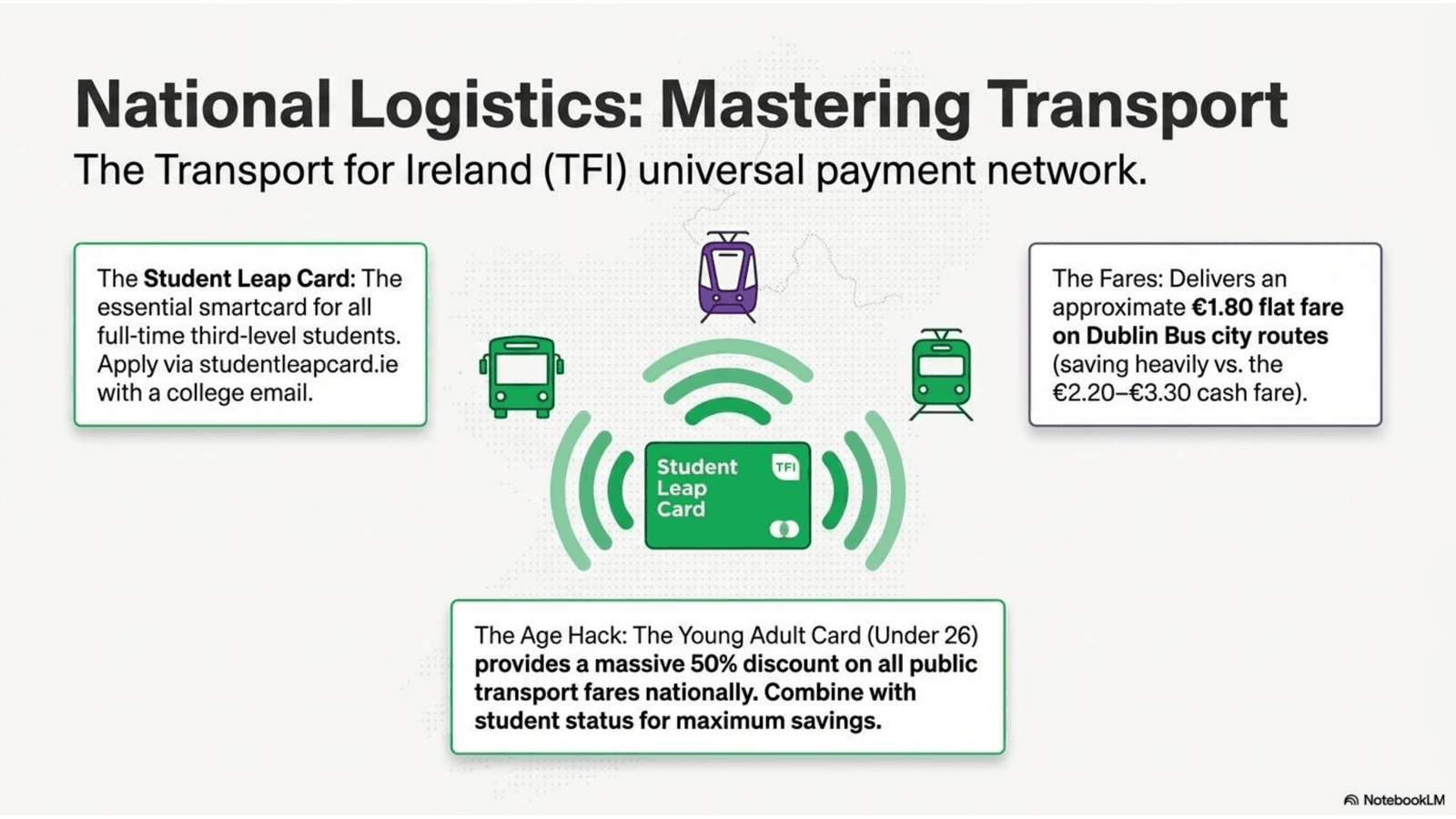
The Student Leap Card is available to full-time students in Irish third-level institutions. It gives discounted fares on Dublin Bus (approximately €1.80 flat fare on city routes), Luas, DART, Bus Éireann, and other TFI services. Apply at studentleapcard.ie using your institution's student ID number and your .ie college email address. The card typically arrives by post within 5–7 working days. You can also collect one at your institution's student services desk in many cases.
Young Adult Card (Under 26): Separately, TFI offers a Young Adult Card that gives a 50% discount on all public transport fares nationally for anyone under 26. This works on the same Leap Card; ask your provider or visit transportforireland.ie to activate it. For students under 26, combining the Student Leap with Young Adult status gives the maximum discount available.
Taxsaver Pass — For Students With Part-Time Jobs or Long Commutes
The Taxsaver Commuter Ticket scheme allows you to purchase monthly or annual travel passes at a pre-tax discount of up to 52% compared with individual daily fares. This scheme is primarily designed for employed commuters whose employer participates in the scheme — but students who work part-time and commute to a fixed workplace during term-time can benefit from it if their employer is enrolled in Taxsaver. Check with your part-time employer's HR or payroll contact. More information at taxsaver.ie.
Irish Rail — Intercity Travel Between Student Cities
Irish Rail (Iarnród Éireann) connects Ireland's main cities. Key routes relevant to students:
| Route | Journey Time | Advance Fare (7+ days) | Walk-Up Fare |
|---|---|---|---|
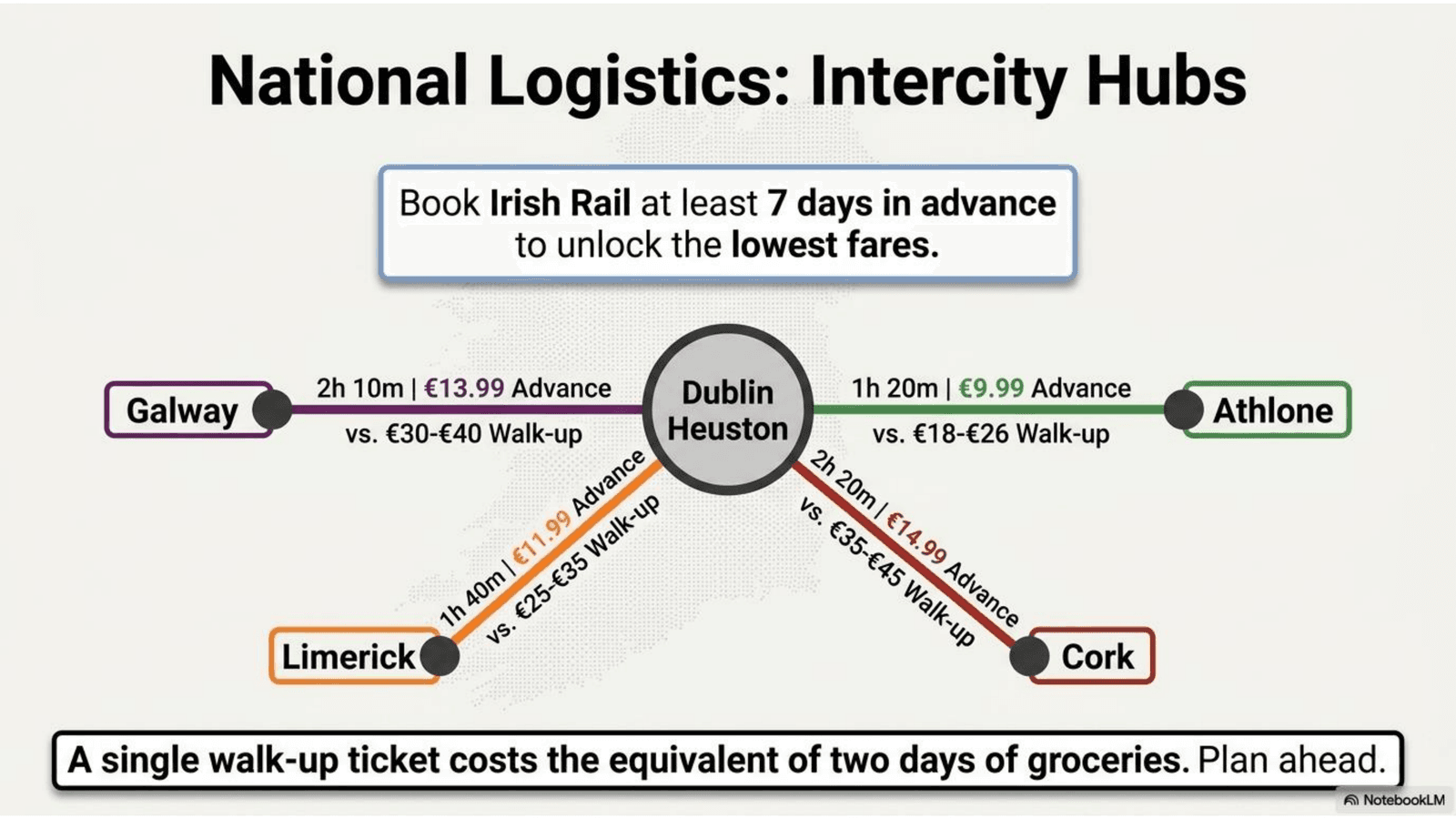
| Dublin Heuston → Cork | ~2 hrs 20 min | From €14.99 | €35–€45 |
| Dublin Heuston → Galway | ~2 hrs 10 min | From €13.99 | €30–€40 |
| Dublin Heuston → Limerick | ~1 hr 40 min | From €11.99 | €25–€35 |
| Dublin Heuston → Athlone | ~1 hr 20 min | From €9.99 | €18–€26 |
| Cork → Limerick Junction | ~1 hr | From €8.99 | €18–€25 |
Irish Rail's advance purchase fares are substantially cheaper than walk-up prices. A Dublin–Cork advance ticket from €14.99 versus a walk-up fare of €35–€45 is a saving of up to €30 on a single journey — the equivalent of two days of groceries. Book at irishrail.ie. All advance tickets are non-refundable but can sometimes be exchanged for a fee; check the terms at booking.
Bus Éireann — Intercity Coach
Bus Éireann operates Ireland's national coach network. Intercity services are generally cheaper than Irish Rail but slower; they are particularly useful for routes not well served by rail (e.g. Galway–Limerick–Cork). The Leap Card is accepted on many Bus Éireann routes; check at buseireann.ie for specific route acceptance. Citylink and GoBus are private coach operators that compete with Bus Éireann on Dublin–Galway and Dublin–Cork routes and are often cheaper — compare on gomapper.ie or Google Maps before booking.
Useful Transport Apps for Students in Ireland
- TFI App (Transport for Ireland): Journey planning, real-time departures, and Leap Card top-up across all TFI services.
- Irish Rail app: Booking, timetables, live train status, and seat reservation.
- FreeNow: Dublin's main taxi-hailing app; also operates in Cork, Galway, and Limerick; significantly safer than street hailing late at night.
- Bolt: Rideshare and taxi alternative; strong in Dublin and Cork; often cheaper than FreeNow on shorter journeys.
- Google Maps: Fully integrated with Irish public transport timetables; the most reliable way to plan a multi-modal journey (walk + bus + rail) in real time.
Q50 Can I Use My Indian or Chinese Driving Licence in Ireland?
One of the most common practical questions for international students arriving from India and China is whether their home driving licence is valid in Ireland. The answer is yes — but only for a limited period, and the path to a permanent Irish licence involves a process that many students significantly underestimate in time and cost.
The 12-Month Rule
This period is calculated from your date of entry, not your date of arrival at university. If you arrived in Ireland on 1 September 2026, your foreign licence is valid until 31 August 2027. After that date, you must not drive in Ireland using your foreign licence alone. You will need an Irish learner permit or a full Irish driving licence.
After 12 Months: Converting to an Irish Licence
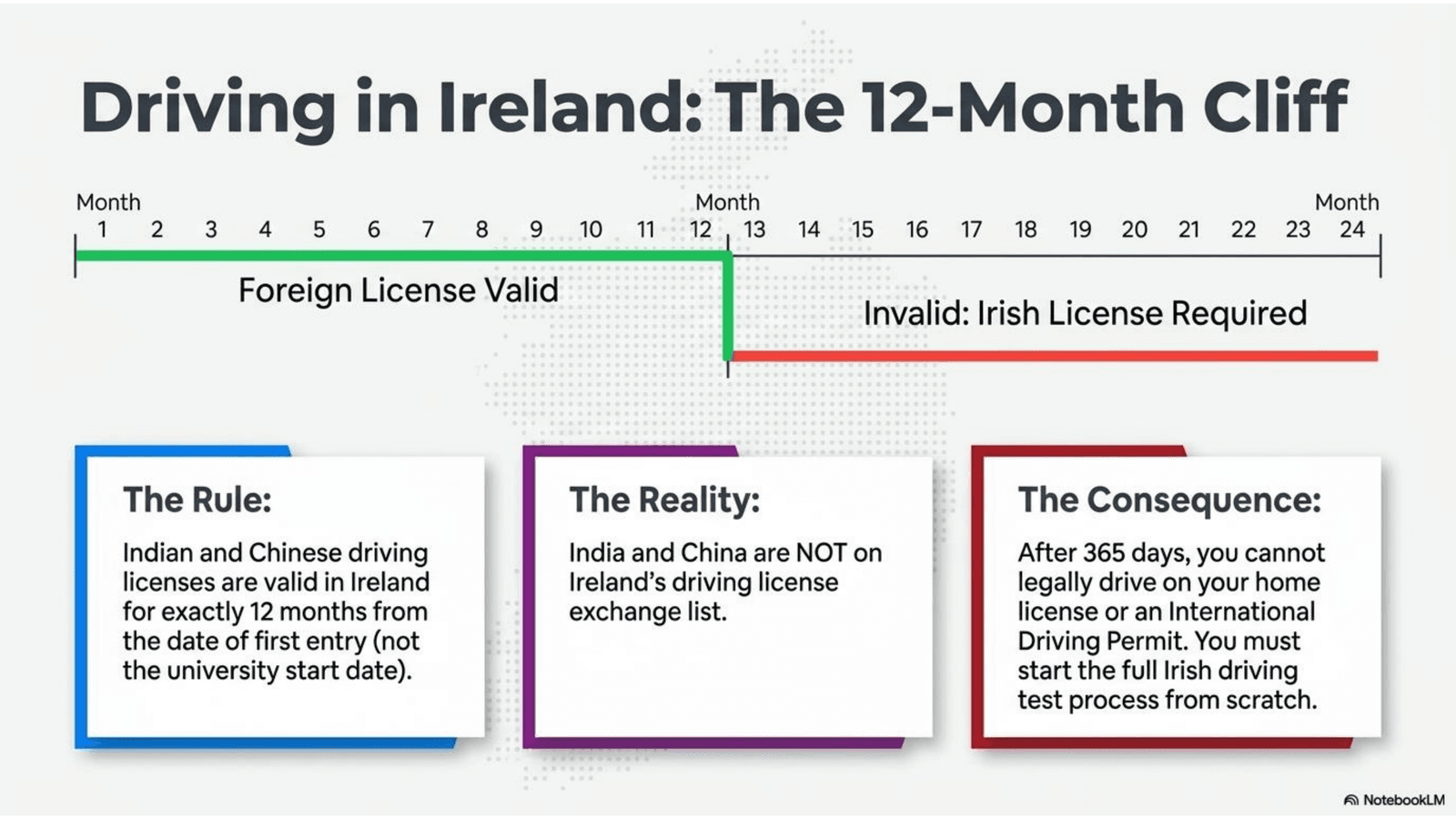
Ireland maintains a list of countries whose driving licences can be exchanged directly for an Irish licence without a full test. This list includes countries such as Australia, Japan, South Korea, and South Africa. India and China are not on this list. Students from both countries must complete the full Irish driving licensing process from the learner permit stage.
The full process for Indian and Chinese students after 12 months:
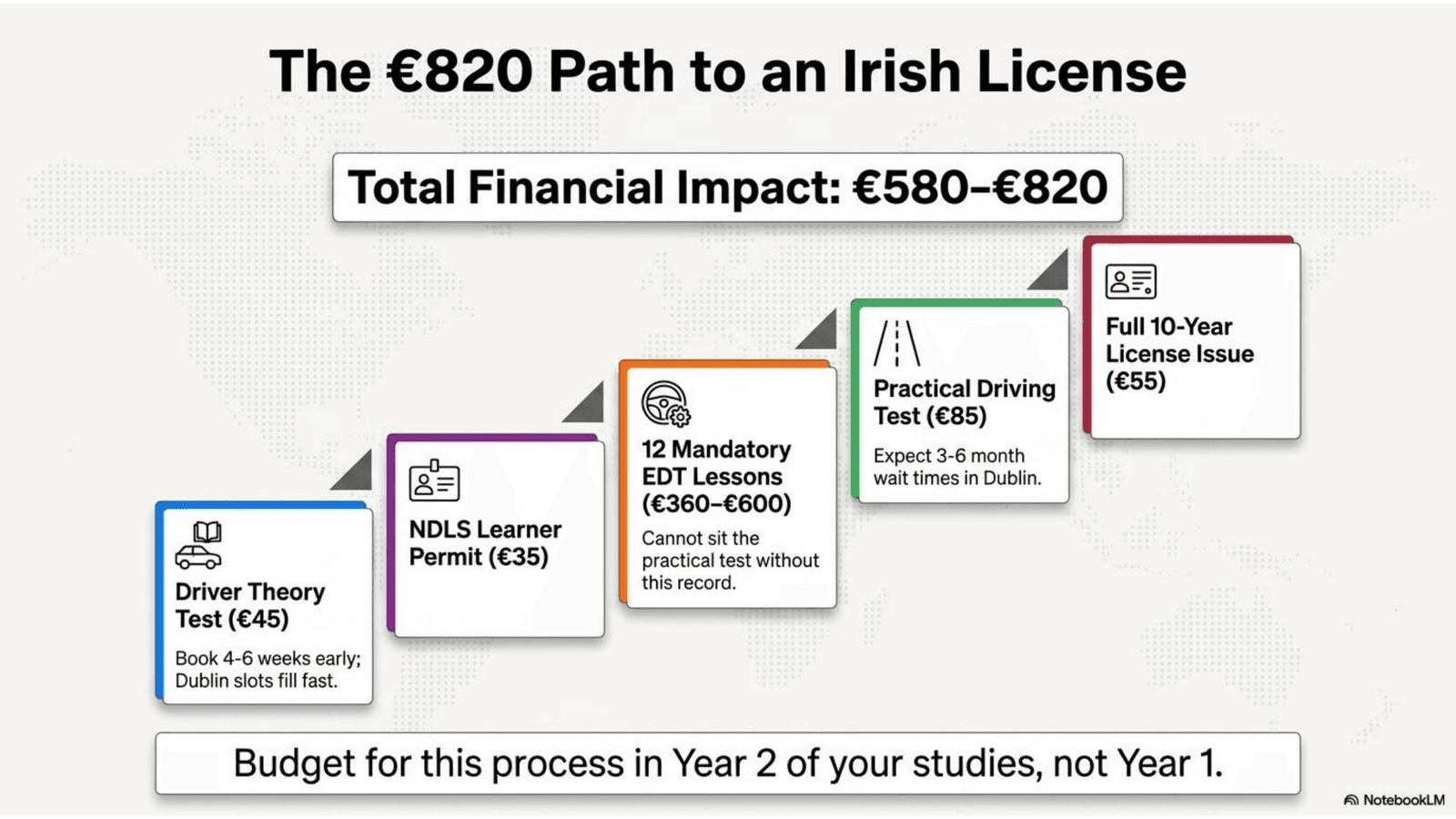
- Apply for an Irish Learner Permit: Visit the National Driver Licence Service (NDLS) at ndls.ie. You will need your passport, proof of PPSN (Personal Public Service Number), proof of Irish address, a passport photo, and the applicable fee. You must hold your Indian or Chinese licence. There are NDLS centres in Dublin, Cork, Galway, Limerick, and Athlone.
- Pass the Irish Driver Theory Test: The theory test covers Irish Road Traffic Rules, road signs, and safe driving principles. It is a computer-based multiple-choice test taken at a theory test centre. Book at rsa.ie/services/ learner-drivers/the-driver-theory-test. Cost: €45. Theory test centres are located in all major Irish cities and many towns. Slots in Dublin fill quickly — book at least 4–6 weeks in advance.
- Receive your Learner Permit: After passing the theory test, your NDLS application will be processed and your learner permit issued. A learner permit has restrictions: you must display L-plates, you must be accompanied by a full licence holder, and you cannot drive on motorways.
- Complete Essential Driver Training (EDT): First-time Irish driving test candidates must complete 12 Essential Driver Training (EDT) lessons with an approved driving instructor (ADI). These are mandatory — you cannot sit the driving test without an EDT record. Cost: approximately €30–€50 per lesson; total EDT cost approximately €360–€600.
- Pass the Irish Practical Driving Test: Book your practical driving test through the Road Safety Authority (RSA) at rsa.ie. Test fee: €85. Waiting times for practical driving tests in Dublin are currently 3–6 months in 2026; in provincial cities (Cork, Galway, Limerick), waiting times are typically shorter at 4–10 weeks. Book as early as possible.
- Apply for your Full Irish Driving Licence: After passing the practical test, return to the NDLS to apply for your full Irish licence. Cost: €55 for a 10-year licence. You will surrender your learner permit and your foreign licence will be endorsed.
Practical Tips for Driving in Ireland
- Drive on the left: Ireland, like India (and unlike China for international visitors), drives on the left-hand side of the road. The driving position is on the right side of the car. Indian students will find this familiar; Chinese students should allow adjustment time.
- Speed limits: 50 km/h in urban areas, 80 km/h on regional roads, 100 km/h on national roads, 120 km/h on motorways. Speed cameras are widespread.
- Insurance: Car insurance in Ireland is mandatory and expensive for young drivers and new licence holders. Expect premiums of €1,500–€3,000/year as a new Irish licence holder under 30. Insurance costs are a major factor in whether driving is financially viable for students.
- Book your theory test early: As noted above, theory test slots in Dublin fill several weeks in advance. If you know you will need your Irish licence within 12 months, book the theory test in your first month in Ireland.
- International Driving Permit (IDP): An International Driving Permit issued in India or China before departure can be used alongside your national licence and is recognised in Ireland. It is not a substitute for the 12-month rule — after 12 months, an IDP does not extend your entitlement to drive — but it can be useful in the event your national licence is only in a non-English script.
The National Driver Licence Service (NDLS) operates from centres across Ireland including Dublin, Cork, Galway, Limerick, Athlone, Waterford, Sligo, and Letterkenny. Full centre list and online appointment booking at ndls.ie. Bringing all required documents to your NDLS appointment in a single visit avoids delays — check the document checklist carefully before attending.
This is Part 3 of a 3-part guide for international students choosing Ireland. The other two parts cover the broader decision and the practical logistics of arriving:
- Part 1 — Universities, Courses, Costs & Flights (2026): Top 10 universities, tuition fees, GOI-IES scholarships, IELTS requirements, cost of living by city, flights from India and China, and Stamp 1G post-study work rights.
- Part 2 — Visa, IRP, Housing & Student Life: Finding housing in a competitive rental market, opening an Irish bank account before you arrive, health insurance requirements, and what daily life as a student in Ireland actually looks like.
- The Honest Guide — What Nobody Told Me Before Coming to Ireland: Real student-life insights on housing stress, emergency tax, CV and hiring expectations, and practical survival tips after arrival.
- Ireland vs UK & Northern Ireland (2026): Side-by-side comparison of destination fit, visa pathways, fees, and long-term post-study opportunities.
Use the right Indian credit card for your Dublin flight booking and you can earn airline miles, access airport lounges, and reduce forex markup on your first international transactions. Our Indian Payment Guides cover every major bank:
- Airport Lounge Access in India: Complete Credit Card Guide 2026 — DreamFolks, Priority Pass, guest access, and spend-based criteria
- Best HDFC Bank Cards for Flights & Travel 2026
- Best SBI Credit Cards for Flights & Travel 2026
- Best ICICI Bank Credit Cards for Flights & Travel 2026
- Axis Bank Credit Cards for Flight Bookings 2026
- Kotak Bank Credit Cards for Flights 2026
Ready to book your flight to Ireland?
Compare live fares from India and around the world to Dublin — find the cheapest month before you commit to your university start date.
Quick-Reference FAQ — All 7 Questions
Q44: What is student life like in Dublin?
Dublin hosts TCD, UCD, DCU, TU Dublin, RCSI, and Maynooth
University. It offers Ireland's largest job market and best
transport network but has the most expensive rent
(€900–€1,500/month shared) and a serious housing shortage. Monthly
budget: €1,500–€2,000. First-time IRP registration for all
counties is booked through the ISD online customer portal and
completed in person at Burgh Quay, Dublin 2.
Q45: What is student life like in Galway?
Galway is home to the University of Galway (QS #284) and ATU
Galway. Compact, walkable, and culturally rich. Shared rent
€600–€900/month. Monthly budget €1,100–€1,500. First-time IRP
registration is also booked via the national online portal and
takes place at Burgh Quay in Dublin, not at a local Garda station.
Q46: What is student life like in Limerick?
Limerick hosts UL and TUS. UL has Ireland's highest graduate
employment rate. Most students live in Castletroy, adjacent to
campus. Shared rent €500–€800/month. Monthly budget €1,000–€1,400.
First-time IRP registration is now handled centrally at Burgh Quay
in Dublin, booked through the ISD online customer portal, even if
you live in Limerick.
Q47: What is student life like in Athlone?
Athlone is home to TUS Athlone campus. It is the most affordable
student city in Ireland with rent from €450–€800/month and a total
monthly budget of €900–€1,200. Smaller international community;
excellent train links to Dublin (1 hr 20 min).
Q48: What is student life like in Cork?
Cork hosts UCC (QS #246) and MTU. Strong pharmaceutical and tech
industry presence. Shared rent €600–€900/month. Monthly budget
€1,100–€1,500. Blarney Castle, Cobh, and Kinsale easily
accessible. Cork students follow the same national process:
first-time IRP registration via the ISD online portal with an
in-person appointment at Burgh Quay in Dublin, and renewals online
from anywhere in Ireland.
Q49: How do I use public transport in Ireland?
Use a Leap Card (buy at Centra/Spar) for all urban transport.
Apply for a Student Leap Card at studentleapcard.ie using your
college email. Under-26 students can activate the Young Adult Card
for 50% off national fares. Book Irish Rail at least 7 days ahead
for cheapest intercity fares.
Q50: Can I use my Indian or Chinese driving licence in
Ireland?
Yes — for 12 months from your entry date. After 12 months, you
must obtain an Irish licence via the full process: theory test
(€45), NDLS learner permit (€35), 12 EDT lessons (€360–€600),
practical driving test (€85), and full licence (€55). India and
China are not on Ireland's exchange list. Book your theory test
early — Dublin slots fill 4–6 weeks in advance.
All housing prices, monthly budget estimates, transport fare details, IRP registration procedures, NDLS licensing costs, university information, student discount schemes, and city descriptions in this article are based on publicly available information from Transport for Ireland (transportforireland.ie), the National Driver Licence Service (ndls.ie), the Road Safety Authority (rsa.ie), Burgh Quay Registration Office (burghquayregistrationoffice.inis.gov.ie), Daft.ie rental market data (May 2026), university official websites, and Garda immigration office public guidance as of May 2026. Rental prices, transport fares, registration procedures, and immigration rules are subject to change. Always verify current information directly with the relevant institution or government office before making financial or logistical decisions. MyFlightOffers is not affiliated with any Irish university, Garda station, government department, or transport operator mentioned in this article. This article does not constitute immigration, legal, or financial advice.