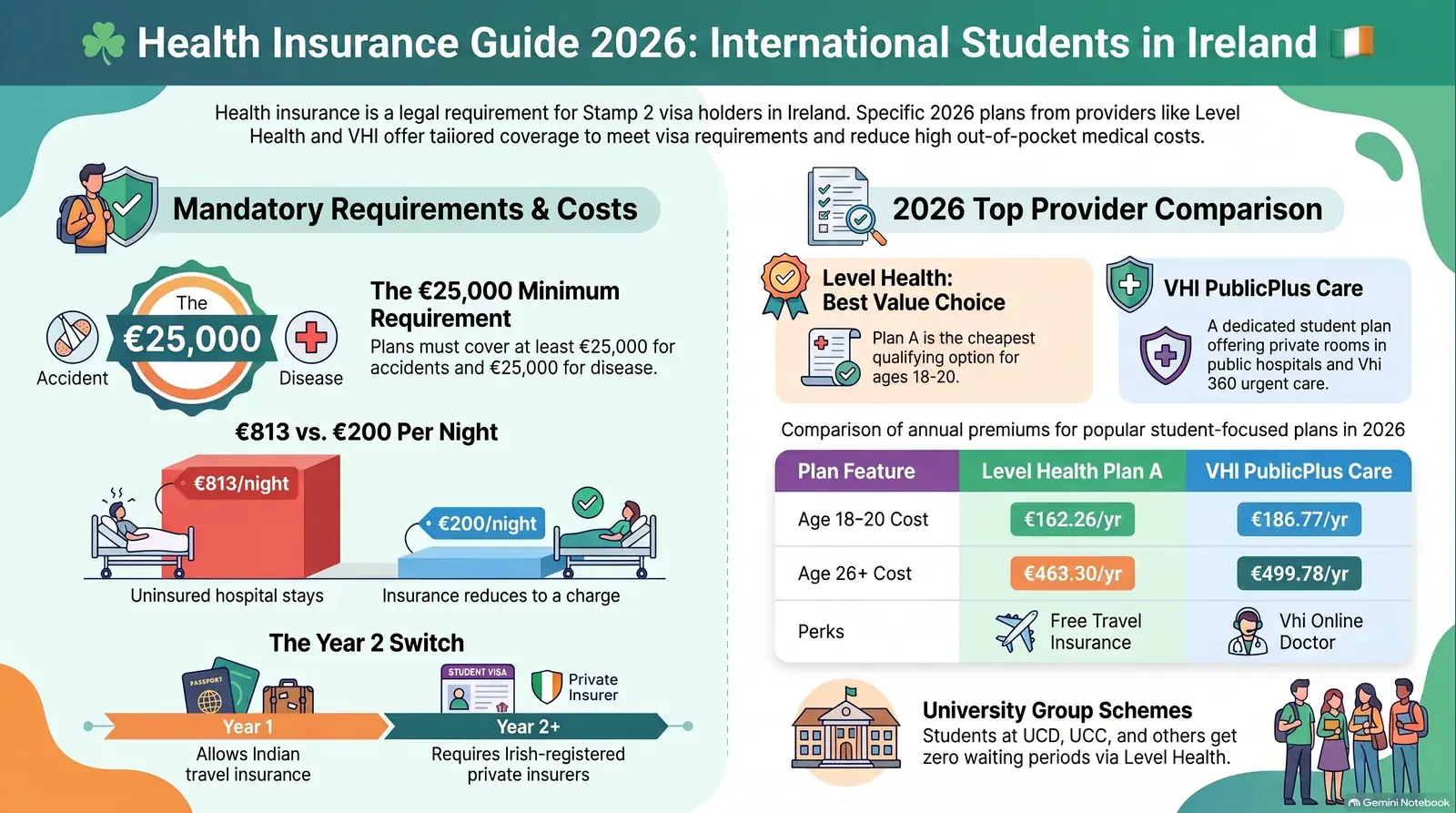
- Health insurance is mandatory for all non-EEA students on Stamp 2 — you need at least €25,000 accident cover and €25,000 disease cover to register your IRP card. EU/EEA students with an EHIC are exempt.
- The cheapest qualifying plan in 2026 is Level Health Plan A at €162.26/yr for ages 18–20 (with the 5% student group discount); VHI PublicPlus Care starts at €186.77/yr for the same age band. Both meet the immigration minimum.
- Indian travel insurance (e.g. HDFC ERGO Student Suraksha) can substitute for year 1 only — from year 2, you must switch to an Irish-registered private insurer to renew your IRP card.
€25,000 accident + €25,000 disease — must be in English and valid in Ireland
Level Health Plan A — €162.26/yr (5% student group discount included)
€50–€70 per visit; some student-friendly practices from €25–€35
€100 charge at any public hospital emergency department
Why health insurance is essential for non-EEA students in Ireland
Non-EEA international students in Ireland are not entitled to free public healthcare through the HSE (Health Service Executive) and must pay for all GP visits, hospital stays, and prescriptions as private patients — without private health insurance, a single overnight hospital admission can cost several thousand euro out of pocket. EU and EEA students holding a valid European Health Insurance Card (EHIC) are treated as Irish residents for HSE access purposes and are exempt from this requirement, but every student arriving from outside the EEA — including India, Pakistan, Nigeria, China, and the United States — must carry their own private cover.
Under the Immigration Service Delivery (ISD) rules for Stamp 2 permission, proof of private health insurance is checked at two points: when you first register your IRP card at your local immigration office, and at every annual renewal thereafter. Officers can and do ask to see a current insurance certificate. If your cover has lapsed, your renewal will be refused until you produce a valid policy.
The practical cost of going uninsured is severe. A standard public hospital emergency department attendance without a GP referral costs €100. An inpatient overnight stay at a public hospital as a private patient costs €813 per night (2026 rate) or €200 per night if you hold a valid private insurance card. A flight home on a medical stretcher (repatriation) costs €8,000–€25,000 depending on origin country. None of these are hypothetical: the Irish Council for International Students (ICOS) records welfare requests from students facing exactly these costs every year.
GP visits (full private rate applies), prescription medicines (no GMS card), A&E attendance without GP referral (€100 charge), inpatient hospital accommodation (full private rate), and dental/optical (separate private insurance required). Non-EEA students are not eligible for a medical card unless they satisfy strict means-testing criteria — which most full-time students on Stamp 2 do not meet due to the financial requirements for the student visa itself.
What is the €25,000 student visa health insurance minimum?
Irish immigration requires all non-EEA students to hold health insurance that provides at least €25,000 of coverage for accidents and a separate €25,000 for disease, for the full duration of their Irish stay — any policy that meets both thresholds, is issued in English, and is valid in the Republic of Ireland qualifies for IRP registration purposes.
Both requirements must be satisfied simultaneously — a policy with €50,000 combined cover but no split between accident and disease categories does not formally satisfy the ISD wording, though in practice most Irish insurer student plans are structured to satisfy both thresholds individually. When in doubt, request a written confirmation letter from your insurer stating it meets Irish immigration health insurance requirements.
The minimum is a floor, not a recommendation. A plan that only meets the €25,000 floor gives you public hospital cover only — no private room, no routine GP reimbursement, no mental health inpatient days. If you use healthcare regularly, the additional premium for a comprehensive plan is well spent. The comparison table below shows exactly what each plan provides above the minimum.
Top Irish health insurance providers compared for students in 2026
The four main health insurance providers in Ireland are VHI Healthcare, Level Health, Laya Healthcare, and Irish Life Health — of these, VHI and Level Health offer dedicated student pricing that makes them the most practical starting point for non-EEA students arriving in 2026.
VHI PublicPlus Care — the most widely recognised student plan
VHI's PublicPlus Care plan is the longest-established dedicated international student plan in Ireland, accepted by virtually all university immigration offices as satisfying Stamp 2 health insurance requirements. It covers a private room in a public hospital, online doctor consultations, urgent care at Vhi 360 Health Centres, mental health inpatient treatment, and repatriation to your home country — meeting all six key coverage areas that international students commonly need.
Annual pricing for the VHI PublicPlus Care plan (as of October 2024 tariff, the most recent published):
- Age 18–20: €186.77 per year
- Age 21: €272.69 per year
- Age 22: €323.07 per year
- Age 23: €373.98 per year
- Age 24: €425.40 per year
- Age 25: €474.86 per year
- Age 26+: €499.78 per year
VHI accepts payment in full by phone on +353 56 775 3157. There is no online checkout — a VHI advisor calls you within 48 hours of submitting the online application form to confirm cover and collect payment. Cover only activates once payment is received, so apply at least 3–5 business days before your IRP registration appointment.
Level Health Plan A — cheapest qualifying plan with university group discount
Level Health Plan A is currently the cheapest health insurance plan in Ireland that meets the Stamp 2 visa requirement, with prices from €162.26 per year for students aged 18–20 when purchased through a participating university's group scheme — a saving of €24.51 per year versus VHI for the same age band.
Annual pricing for Level Health Plan A (with 5% student group discount, 2026):
- Age 18–20: €162.26 per year
- Age 21: €254.98 per year
- Age 22: €301.34 per year
- Age 23: €347.70 per year
- Age 24: €394.06 per year
- Age 25: €440.42 per year
- Age 26+: €463.60 per year
Level Health Plan A includes several features that VHI PublicPlus Care does not: 24/7 unlimited video/WhatsApp consultations with an Irish-based doctor through the QuickClinic app, up to €100 back per urgent care visit at 31 minor injury clinics and private A&E departments, €30 reimbursement for one GP visit per year, €50 wellness benefit (towards gym or sports club membership), and free annual multi-trip worldwide travel insurance (up to 60-day trips, including winter sports). Claims can be paid via Revolut for same-day settlement. Critically, no waiting periods apply for pre-existing conditions when you sign up through the university group scheme — a significant advantage over purchasing directly.
Participating universities for the Level Health student group scheme: University College Dublin (UCD), University College Cork (UCC), University of Galway, Maynooth University, RCSI (Royal College of Surgeons in Ireland), and Dundalk Institute of Technology (DKIT). Students at other Irish institutions can apply through Level Health directly at the standard (non-discounted) rate.
Laya Healthcare — broad market leader, no dedicated student plan
Laya Healthcare is Ireland's second-largest insurer and offers a wide range of plans, but does not maintain a dedicated international student plan with the simplified application process of VHI or Level Health — making it better suited to students who have been in Ireland for one or more years and want to upgrade to more comprehensive cover.
Laya announced multiple price increases in 2026: an average 4.7% rise across 65 plans effective April 2026 (per the Health Insurance Authority), and a further round of increases effective October 2026. Comprehensive Laya plans covering private hospital rooms and specialist consultants range from approximately €1,000 to €1,800 per year for adults — significantly above the student-plan tier. Laya's Express Care Clinics (located in pharmacies and shopping centres) provide an alternative to A&E for minor injuries and illnesses, which is a practical advantage for Level Health members (who have up to €100 urgent care cover usable at Laya clinics).
Irish Life Health — competitive second-year option
Irish Life Health's entry-level plan (First Cover) starts at approximately €468 per year for adults and is a viable upgrade option for students in their second year who want private hospital cover beyond what the base student plans offer. Irish Life Health does not offer a dedicated international student product, but its First Cover plan meets the €25,000 visa minimum and includes access to Irish Life Health Express Care Clinics — a network of drop-in clinics at pharmacies that charge a flat fee far below standard GP rates.
The Health Insurance Authority of Ireland maintains a free independent comparison tool at hia.ie where you can compare all four providers' current plans side by side. Use it once a year at renewal to check whether a competitor plan now undercuts your existing premium.
Provider comparison table: key student plan features (2026)
| Feature | VHI PublicPlus Care | Level Health Plan A | Laya Healthcare | Irish Life Health (First Cover) |
|---|---|---|---|---|
| Dedicated student plan? | ✅ Yes | ✅ Yes (group scheme) | ❌ No | ❌ No |
| Annual cost (age 18–20) | €186.77 | €162.26 (5% disc.) | ~€1,000+ (general plans) | ~€468 (First Cover) |
| Annual cost (age 26+) | €499.78 | €463.60 (5% disc.) | ~€1,000–€1,800 | ~€468–€600 |
| Meets Irish visa minimum | ✅ Yes | ✅ Yes | ✅ Yes (all plans) | ✅ Yes (First Cover) |
| Public hospital (private room) | ✅ Yes | Semi-private (public hospital) | Private hospital (higher plans) | Semi-private (public hospital) |
| 24/7 online/video doctor | ✅ Yes (Vhi Online Doctor) | ✅ Yes (QuickClinic, unlimited) | Varies by plan | Varies by plan |
| Urgent care / minor injury | Vhi 360 Centres | €100 per visit, 31 centres | Laya Express Care Clinics | Irish Life Express Care Clinics |
| GP reimbursement | Not specified in basic plan | €30 per visit (1/yr) | Varies by plan | Varies by plan |
| Mental health inpatient | ✅ Yes | ✅ Up to 100 days/yr | ✅ Varies by plan | ✅ Varies by plan |
| Repatriation cover | ✅ Yes (companion expenses) | ✅ Up to €1,000,000 | ✅ Varies by plan | ✅ Varies by plan |
| Free travel insurance | ❌ Not included | ✅ Yes (annual multi-trip) | ❌ Separate product | ❌ Separate product |
| No waiting periods (students) | Conditions apply | ✅ None (group scheme) | Standard waiting periods | Standard waiting periods |
| Application process | Phone callback (48h) | Online via university portal | Online / broker | Online / broker |
Laya and Irish Life prices are indicative for general adult plans; dedicated student pricing for those insurers is not published. Always verify current premiums at hia.ie before purchasing.
On-the-Ground Insight: "I arrived at UCD in September and went straight to the International Office — they had a Level Health desk right there during orientation week. No waiting period, no forms in the post, and the QuickClinic app meant I didn't have to find a GP when I had a chest infection in November. I just video-called a doctor at midnight and had a prescription ready by morning." — Arjun S., MSc Computer Science, UCD, September Intake 2025
Annual health insurance cost calculator — compare VHI vs Level Health by age
Enter your age to see the annual cost of VHI PublicPlus Care versus Level Health Plan A side by side — both plans meet the Irish student visa requirement and are the two most common options for non-EEA students in 2026.
🧮 Student Health Insurance Cost Comparison (Ireland 2026)
Select your age to compare VHI PublicPlus Care and Level Health Plan A annual premiums. All prices sourced from insurer published tariffs (VHI: October 2024 tariff; Level Health: 2026 with 5% student group discount).
Student union and college group schemes — where to find cheaper cover
The cheapest way to buy Irish health insurance as an international student is through your university's group scheme, which typically waives waiting periods, reduces premiums by 5–10%, and streamlines the application so you can have a valid insurance certificate before your IRP registration appointment.
Group schemes work because the insurer rates the entire student cohort as a single pool — younger, healthier, and with low claims frequency — which allows below-market pricing. The best-documented student group scheme in Ireland in 2026 is run by Level Health in partnership with UCD, UCC, University of Galway, Maynooth University, RCSI, and DKIT. Students at these institutions access the scheme through their student portal or the International Student Office during orientation week.
VHI operates a similar scheme through some institutions but does not publish a list of partner universities. Check with your institution's International Student Office before your first week — many offices have a dedicated insurance desk during Freshers' Week (typically the first week of September and January) where you can apply in person and receive a paper certificate on the same day.
If your university is not listed on any group scheme, compare plans using the Health Insurance Authority's comparison tool (hia.ie), which is maintained by the Irish government as a neutral comparison service. The HIA tool includes all four Irish insurers and is updated whenever prices change. It also flags plans that have received formal price increase notices, which is useful for timing your renewal.
Cornmarket is Ireland's largest not-for-profit financial services group for public sector workers and has historically offered Level Health and other insurer plans through affinity deals. Some universities route their group scheme through Cornmarket. Check whether your institution's HR or student welfare office has a Cornmarket relationship — if so, you may access the same plans with additional payment flexibility.
How to claim on your Irish student health insurance
The Irish private health insurance claims process has three distinct pathways depending on whether you are seeing a GP, attending an emergency department, or being admitted to hospital — knowing which pathway applies before you need care saves both money and stress.
GP (family doctor) visits
GP visits are not automatically paid by your insurer in Ireland — you pay the GP directly (typically €50–€70 per consultation, or €25–€35 at student-friendly practices) and then submit a claim for partial reimbursement. Level Health Plan A reimburses €30 per GP visit for one visit per year. VHI PublicPlus Care's reimbursement for GP visits depends on the plan specification — check your Table of Benefits document for the exact figure.
To claim: keep the original GP receipt, complete your insurer's claim form (available on the insurer's app or website), and submit within the policy's claim window (typically 12 months of the visit). Claims under both VHI and Level Health can be submitted by phone or via the member's app; Level Health claims can be settled directly to a Revolut account within 24–48 hours.
A&E (emergency department) visits
If you attend a public hospital A&E without a GP referral letter, you will be charged €100 by the hospital. Level Health Plan A covers up to €100 per urgent care visit at 31 participating minor injury clinics and private emergency departments — meaning your out-of-pocket cost can be €0 if you attend an in-network urgent care centre rather than a public hospital A&E. VHI members should attend a Vhi 360 Health Centre for minor emergencies instead of a public hospital A&E where possible.
For genuine emergencies (chest pain, difficulty breathing, serious injury), call 999 or 112 — do not worry about referral letters in a life-threatening situation. The €100 charge is waived for patients admitted to the hospital as inpatients.
Hospital admission (inpatient)
When admitted to a public hospital as a private patient, present your insurance card at reception. The hospital bills your insurer directly for the accommodation cost; you may be responsible for any applicable excess stated in your policy. VHI PublicPlus Care provides cover for a private room in a public hospital. Level Health Plan A provides semi-private accommodation in a public hospital.
Prescriptions
Prescriptions in Ireland are not free for private patients without a medical card. Standard prescription costs vary by medication and pharmacy; there is no set government rate for private patients. Non-EEA students are generally not eligible for a medical card (which provides free prescriptions under the GMS scheme). The Drug Payment Scheme (DPS) limits the amount any individual or family pays for prescription drugs to €80 per month regardless of how many items are dispensed — register for the DPS with the HSE at a pharmacy on your first prescription visit.
Indian travel insurance vs Irish private health insurance: can you use one for both?
Indian travel insurance policies — such as HDFC ERGO Student Suraksha, Bajaj Allianz Student Guard, or Star Health's student plan — can satisfy the Irish student visa health insurance requirement for your first year of study only, provided the policy provides at least €25,000 each for accident and disease coverage, is issued in English, and is confirmed as valid in the Republic of Ireland.
This is a meaningful concession for students arriving directly from India who already hold a multi-year travel insurance policy or whose parents purchased a student overseas travel plan before departure. HDFC ERGO Student Suraksha, for example, can be taken out for durations from 30 days up to two years for Indian students between 16 and 35 years old, and covers emergency medical evacuation and repatriation — the two categories that matter most to Irish immigration. The key check: confirm the policy schedule explicitly states coverage in Ireland and that the covered amounts meet the €25,000 thresholds individually.
From your second year onwards, Irish immigration requires private health insurance from an Irish-registered insurer for IRP renewal. Indian travel insurance, no matter how comprehensive, does not satisfy the second-year requirement. Build your switch to VHI, Level Health, or another Irish insurer into your year-1 timeline — set a reminder three months before your first IRP renewal date so you have time to apply, receive your certificate, and present it at your renewal appointment.
There is a practical coverage gap to consider even within year 1. Indian travel insurance typically provides emergency and hospitalisation cover but does not include GP visit reimbursement, mental health inpatient days, or urgent care walk-in credits. If you anticipate routine healthcare use — GP consultations, physiotherapy, counselling — an Irish student plan provides noticeably better day-to-day coverage even in year 1, at a price difference of roughly €162–€500 per year versus a comparable Indian student travel policy.
What to check before using Indian travel insurance in Ireland
- Policy must be in English (a Hindi or dual-language policy may be rejected at the immigration counter).
- Coverage amounts must show at least €25,000 accident and €25,000 disease separately — a combined "any claim" limit does not clearly satisfy both conditions.
- The policy must cover the Republic of Ireland specifically, not just "Europe" — some Indian travel policies define Europe as Schengen only, which excludes Ireland.
- The policy must be valid for the entire period of your Stamp 2 permission — a 12-month policy that expires while your permission runs to 15 months creates a gap.
- Repatriation cover is required separately from medical cover — confirm the policy includes medical repatriation to India, not just "return of mortal remains" (the latter is narrower).
Frequently asked questions
Do international students in Ireland need private health insurance?
Yes. All non-EEA students on Stamp 2 permission are required to hold private health insurance for their entire stay. Without it, you cannot register your IRP card or renew your student permission. EU/EEA students with a European Health Insurance Card (EHIC) are exempt because the EHIC grants access to HSE services at the same cost as Irish residents.
What is the minimum health insurance coverage required for an Irish student visa?
The Irish immigration service requires a minimum of €25,000 in accident coverage and €25,000 in disease coverage for the full duration of your stay. Both VHI PublicPlus Care and Level Health Plan A meet this minimum. Your policy must be in English and valid in the Republic of Ireland.
Can I use Indian travel insurance instead of Irish health insurance?
Yes — but only for your first year in Ireland. Newly arrived non-EEA students may use eligible travel insurance (including policies from Indian insurers such as HDFC ERGO Student Suraksha) for up to 12 months, provided the policy covers at least €25,000 for accident and €25,000 for disease, is issued in English, and is valid in the Republic of Ireland. From your second year, you must switch to private health insurance from an Irish-registered provider to renew your IRP card.
How much does a GP visit cost for international students in Ireland?
A standard GP (family doctor) visit in Ireland costs €50–€70 for private patients. Some practices offer student rates as low as €25–€35. Non-EEA students are not eligible for a medical card unless they meet strict income and residency criteria, so most will pay the private rate. Keep all receipts: VHI PublicPlus Care and Level Health Plan A each provide a partial reimbursement (€30 per visit on Level Health Plan A) for GP visits.
Which Irish health insurance plan is cheapest for international students aged 18–20?
Level Health Plan A is the cheapest plan that satisfies the Irish student visa requirement for students aged 18–20, at €162.26 per year (with the 5% student group discount). VHI PublicPlus Care costs €186.77 per year for the same age band. Both meet the €25,000 minimum coverage requirement.
What does an A&E visit cost in Ireland without a GP referral?
Attending a public hospital A&E (accident and emergency) department without a referral letter from a GP costs €100 in Ireland. With a GP referral letter the charge is waived. Level Health Plan A covers up to €100 per urgent care visit at 31 minor injury clinics and private emergency departments, and VHI PublicPlus Care provides similar urgent care benefits at Vhi 360 Health Centres.
Ready to fly to Ireland for your studies? Compare live fares first.
Once your health insurance is sorted, compare live Dublin flight fares and check the cheapest booking window before you buy your student flights.
All information in this article is based on publicly available official sources including Immigration Service Delivery, Health Insurance Authority, VHI Healthcare, and Level Health as of September 2026. Insurance premiums, immigration requirements, and coverage terms change regularly. Always verify the current position directly with your insurer and with the Immigration Service Delivery before making decisions. MyFlightOffers is not affiliated with any insurer mentioned. This article does not constitute insurance, legal, or immigration advice.
- NEW Ireland Student Medical & Health Guide 2026 — HSE doctors, A&E vs urgent care clinics, mental health supports and what international students are actually entitled to
- Ireland Banking Guide for International Students 2026 — opening a bank account before and after arrival, N26, Revolut, Bank of Ireland and KBC options compared
- The Indian Student's Money Survival Guide in Ireland — forex cards, sending money home, managing two currencies during placement year
- Ireland Student Survival Guide: Hidden Subsidies 2026 — welfare funds, student union emergency grants, free HSE services you can access