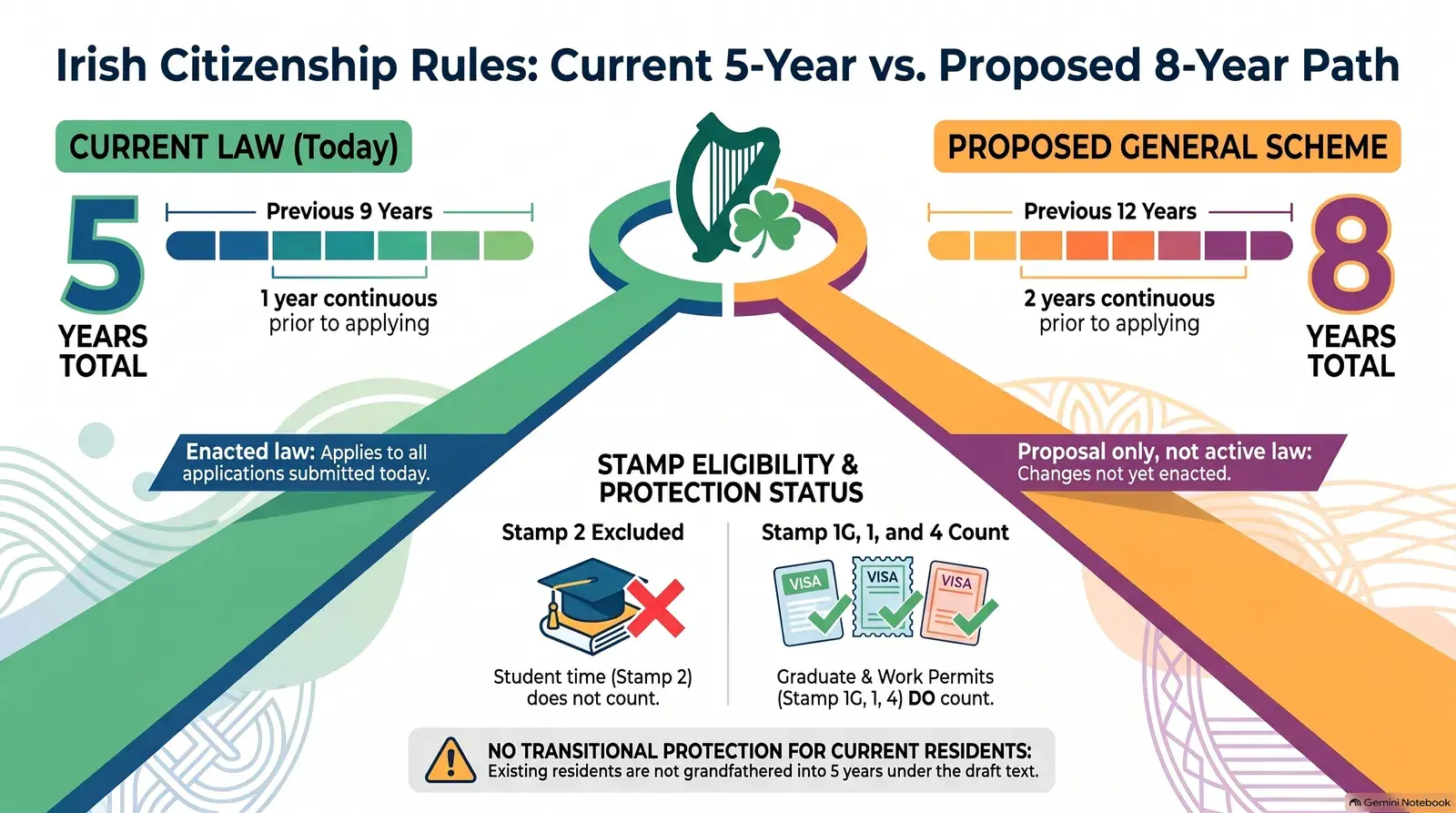
- It is a proposal, not law: as of 10 October 2026 there is a General Scheme, not a Bill. Every application made today is still decided under the current rule of five years' reckonable residence in the previous nine.
- The proposed rule is 2 + 6: two years' continuous residence immediately before applying, plus six years in the ten years before that. Stamp 2 student time does not count now and would not count then.
- Nobody already here is protected yet: the General Scheme has no transitional rule preserving five years for existing residents. The Minister said on 5 October 2026 that one is under consideration.
5 years in the last 9, including 1 continuous year
2 continuous years + 6 years in the 10 before that
General Scheme published; Bill text not yet published
None in the Scheme; under consideration
What does the Irish Nationality and Citizenship (Amendment) Bill 2026 propose?
The General Scheme proposes replacing the current residence test with two years' continuous residence immediately before the application plus a total of six years' residence in the ten years before that — eight years inside a twelve-year window. It also adds a language test, a civics test, a self-sufficiency test and a bar for listed immigration offences.
The source for everything in this section is the General Scheme of the Irish Nationality and Citizenship (Amendment) Bill 2026, a 22-page document prepared by the Department of Justice, Home Affairs and Migration. A General Scheme is the outline that is sent for drafting; it is not the Bill, and its wording can change. It would amend the Irish Nationality and Citizenship Act 1956.
| Condition | Current law (applies today) | General Scheme proposal | Where in the Scheme |
|---|---|---|---|
| Total residence, standard route | 5 years (1,825 days) in the previous 9 | 8 years in the previous 12 | Head 5 |
| Continuous residence before applying | 1 year | 2 years | Head 5 |
| Earlier residence | 4 years in the 8 years before that | 6 years in the 10 years before that | Head 5 |
| Spouse or civil partner of an Irish citizen | 3 years' residence | 5 years: 2 continuous + 3 in the 5 before that | Head 6 |
| Language | No test | Proficiency in Irish, English or Irish Sign Language; standard to be set by regulation | Head 5 |
| Civics | No test | Knowledge of Irish civics; standard to be set by regulation | Head 5 |
| Self-sufficiency | No income test | Minimum income to be prescribed; no prescribed welfare or housing support in the previous 2 years (up to 6 months may be excused) | Heads 5 and 7 |
| Debts and fines | Considered under good character | No debt to Revenue or the Department of Social Protection and no outstanding court fine | Head 5 |
| Immigration offences | Considered under good character | A listed offence, before or after applying, precludes naturalisation | Head 5, Schedule 1 |
| While the application is pending | Intention to continue living in Ireland | Must keep residing in Ireland and keep meeting the character, resources and offence conditions until the decision | Head 5 |
Sources: current law per the existing Irish citizenship guide and Citizens Information; proposals per the General Scheme, read 10 October 2026.
Why is the Government doing this, and when?
The Government says the change brings Ireland into line with other EU states, and press reports say it wants the law passed before the end of 2026 — but no commencement date has been published. Head 2 of the Scheme says only that the Act comes into operation on the day or days the Minister appoints by order.
The Irish Examiner reported on 8 September 2026 that eleven EU member states including Ireland use five years, while Croatia, Estonia, Finland, Hungary, Romania, Slovakia and Sweden use eight, Denmark nine, and Austria, Italy, Lithuania, Slovenia and Spain ten. In his press release of 9 September 2026, Minister Jim O'Callaghan called the reforms “balanced, proportionate and necessary”.
Indian nationals have more at stake than any other group. According to European Commission figures reported by Brussels Signal in August 2026, Ireland granted 24,059 naturalisations in 2024 and Indian nationals were the largest group, with 3,946.
Which years count as reckonable residence for Indian students on Stamp 2 and Stamp 1G?
Stamp 2 years do not count, today or under the proposal; Stamp 1G, Stamp 1 and Stamp 4 time counts today, and the General Scheme does not name any of them. The one provision graduates should watch is a new power for the Minister to prescribe “temporary or limited duration” permissions as not reckonable.
Reckonable residence is the time in Ireland that the law allows you to count towards naturalisation. Section 16A of the 1956 Act lists periods that are left out, and a permission given so that you can study is one of them. That is why a one-year MSc on Stamp 2 adds nothing to your total. Stamp 1G is different: the Minister for Justice told the Dáil in a written answer of 20 October 2022 that time on the Third Level Graduate Programme is reckonable.
| Permission | Typical holder | Counts today? | What the General Scheme says |
|---|---|---|---|
| Stamp 2 | Full-time student | No — excluded by section 16A | No change |
| Stamp 1G | Graduate (12 months at Level 8; up to 24 months at Level 9 and above) | Yes — ministerial answer, October 2022 | Not named. Head 9 lets the Minister prescribe temporary or limited-duration permissions as not reckonable |
| Stamp 1 | Employment permit holder, including CSEP | Yes | Not named |
| Stamp 4 | After 21 months on a CSEP, and other routes | Yes | Not named |
| Temporary Protection | People who fled Ukraine | Yes | Would stop counting (Head 9) |
Head 9 would add a new excluded category: residence “on the basis of a permission of a temporary or limited duration as the Minister may prescribe”. The explanatory note says the aim is that permissions which are “inherently transitory, temporary or not intended to be durable in nature” are not reckonable. Nothing published says Stamp 1G will be prescribed, and we are not predicting that it will be. But Stamp 1G is time-limited by design, so this is the clause to check when the Bill and any regulations are published.
Who is protected if you are already in Ireland before the law starts?
On the published text, only people who have already lodged a naturalisation application have any stated protection, and even that clause is written for the changes to what counts as residence — not for the new eight-year period. There is no provision in the General Scheme that preserves the five-year pathway for students, graduates or workers already living in Ireland.
The savings clause sits in Head 9. Its explanatory note reads:
In the Department's Words: “Subhead 2 provides that the changes to reckonable residency made in these amendments do not apply to applicants that have already submitted an application for naturalisation prior to the commencement of this legislation.” — Department of Justice, Home Affairs and Migration, General Scheme of the Irish Nationality and Citizenship (Amendment) Bill 2026, explanatory note to Head 9, September 2026
Head 5, which contains the move to eight years, has no matching clause. The Irish Examiner reported on 8 September 2026 that people without an application submitted before the law takes effect would need eight years, and that the Minister accepted this would catch someone with four years and ten months of residence on the day the law changes.
What have the Taoiseach and the Minister said since?
Both have signalled that the position of people already in Ireland is being looked at, but neither has committed to a rule. Until wording appears in a published Bill, treat these as statements of intent.
- 24 September 2026: the Taoiseach, asked about the change, said “We will be fair” and referred to people who came on work permits and had played by the rules as they existed, according to The Journal. Students and graduates were not mentioned.
- 30 September 2026: the Irish Examiner reported that TDs from Fianna Fáil, Fine Gael, Sinn Féin, Labour and the Social Democrats called in the Dáil for a transitional period.
- 5 October 2026: the Minister said issues had been raised about people already in Ireland and whether “a more generous scheme” for them could be put into the legislation, adding “That's something that we're considering”, according to the Irish Examiner.
What is the transitional provisions petition?
It is a campaign petition on Uplift asking the Minister and the Joint Committee on Justice to write transitional provisions into the Bill; it has no legal effect on its own. Signing it protects nobody unless the Oireachtas acts on it.
The petition, “Protect the 5-year citizenship pathway for people already living in Ireland” on Uplift, asks that anyone lawfully resident in Ireland before the Bill commences keeps the current five-year pathway, and that any language requirement is proportionate. Its own update log shows it passed 5,000 signatures on 23 September 2026. Other petitions ask for the eight-year proposal to be dropped altogether.
Does the Master's to Stamp 1G to CSEP to Stamp 4 pathway still add up?
Yes: the route itself is untouched, and under the law in force today a Master's graduate can still apply roughly five years after their Stamp 1G begins. What the proposal would change is the length of the wait — three more years — not the steps. The work and residence rights you earn along the way do not depend on citizenship.
The steps, as they stand in October 2026:
- Stamp 2 (Master's year): not reckonable. Work is limited to 20 hours a week in term and 40 in holidays.
- Stamp 1G (graduate permission): reckonable. Level 9 graduates can hold it for up to 24 months. See our Stamp 2 to Stamp 1G application guide.
- Stamp 1 (Critical Skills Employment Permit): reckonable. The minimum salary set by the Department of Enterprise, Trade and Employment is €40,904, or €36,848 at the recent-graduate rate, from 1 March 2026. See Stamp 1G to CSEP.
- Stamp 4: reckonable. You can apply after 21 months on a CSEP, and it removes the need for an employment permit.
- Naturalisation: five years of reckonable residence today; eight if the proposal is enacted as drafted.
The table below is illustrative. It assumes a one-year Master's, a Stamp 1G that starts the month after the course ends, and unbroken reckonable residence afterwards.
| Illustrative student | Stamp 1G starts | Can apply under current law | Could apply under the proposal | Position |
|---|---|---|---|---|
| Arrived September 2020 | October 2021 | October 2026 | October 2029 | Eligible now; an application lodged before commencement is made under today's rules |
| Arrived September 2021 | October 2022 | October 2027 | October 2030 | Most exposed: four years in, and dependent on a transitional rule |
| Arrived September 2024 | October 2025 | October 2030 | October 2033 | Dependent on a transitional rule |
| Arriving September 2026 | October 2027 | October 2032 | October 2035 | Plan on eight years unless the final Act says otherwise |
What would three extra years mean in practice?
Three more years as a non-citizen means three more years of renewing your immigration permission at €300 a time, and three more years of planning travel around residence rules. The naturalisation fees themselves — €175 to apply and €950 for the certificate — are not changed by the General Scheme.
On travel, the current law treats the final year as continuous only if you are out of Ireland for no more than 70 days, with up to 30 more for exceptional circumstances. The General Scheme doubles the continuous period to two years but does not say how absences will be measured across it. Until that is settled, keep a dated record of every trip. If you fly home to India each year, use our fare calendar to pick the cheapest month and the Dublin to Delhi route page to compare options, then log the exit and re-entry dates the same day.
The self-sufficiency test also matters to recent graduates. The minimum income has not been set; Head 7 says the Minister will have regard to Central Statistics Office data on earnings and the cost of living. We will not guess a figure.
When could you apply under each rule?
Add five years to the date your first reckonable permission began for the current rule, and eight years for the proposal. The tracker below does that from your own start date and shows how much reckonable time you hold today.
🧮 Reckonable residence tracker: 5 years vs 8 years
Enter the month and year your first reckonable permission (usually Stamp 1G) began. The defaults are illustrative: a Stamp 1G that began in month 10 (October) of 2025. The result assumes unbroken reckonable residence with no gaps between permissions, and it is not legal advice.
How do you track the Bill through the Oireachtas?
Watch three places: the Department's General Scheme page, the Oireachtas Bills register, and the Joint Committee on Justice, Home Affairs and Migration, which carries out pre-legislative scrutiny. As of 10 October 2026 we found no published hearing date for this Scheme and no published Bill text.
| Stage | What happens | Status on 10 October 2026 |
|---|---|---|
| Government approval | Cabinet approves priority drafting | Done — 9 September 2026 |
| General Scheme | Heads of the Bill published on gov.ie | Done — September 2026 |
| Pre-legislative scrutiny | Joint Committee can take submissions, hear witnesses and report | Referred; no hearing date found |
| Bill published | Full legal text appears on the Oireachtas Bills register | Not yet |
| Dáil and Seanad | Five stages in each House; amendments are made at Committee and Report Stage | Not started |
| Signature and commencement | President signs; Minister commences by order, possibly in parts | Not started; no date published |
Bookmark the Oireachtas Bills register and the Oireachtas committees page. The moment that matters most for people already here is Committee Stage in the Dáil, because that is where a transitional amendment would be added. Check the commencement section of the published Bill as well: Head 2 allows different provisions to start on different days.
Posts claiming the eight-year rule “starts on” a particular day are guesses. A commencement date exists only when the Minister signs a commencement order. Check Immigration Service Delivery for the rules that apply on the day you apply.
What should you do now?
Keep your permission unbroken, build a dated record of your residence, apply promptly if you already qualify, and follow the Bill rather than the rumours. None of these steps depends on how the final Act is worded.
- Work out your own dates. List each permission with its start and end date from your IRP cards. Count only reckonable stamps. Use the tracker above for a first estimate and the official residency calculator on the Immigration Service Delivery site before you apply.
- If you already have five years, do not sit on it. An application lodged before commencement is made under the law in force that day. You cannot apply early to beat the change: the five years must already be complete.
- Never let your IRP lapse. A gap breaks continuous residence under today's rules, and Schedule 1 of the General Scheme lists offences under the Immigration Act 2004 among those that would rule out naturalisation. Our IRP registration guide covers renewals.
- Keep documents for every year. Passports with entry and exit stamps, every IRP card, employment permits, payslips and Employment Detail Summaries from Revenue, tenancy agreements, utility bills and bank statements. Under the proposal you may have to prove eight years, not five.
- Clear debts and fines. The Scheme would bar applicants who owe Revenue or the Department of Social Protection or have an outstanding court fine.
- Log every trip abroad. Date out, date back, reason. The absence rule for the proposed two-year continuous period is not yet written.
- Have your say if you wish. You can write to your local TDs or the Joint Committee, or sign a petition. These are lawful ways to take part and do not affect an application.
If your case has gaps, a change of stamp category or a pending application, speak to a solicitor or to the Immigrant Council of Ireland before acting. Planning to bring family over in the meantime? See bringing your spouse and family to Ireland.
Frequently asked questions
The short answers below reflect the General Scheme and public statements as of 10 October 2026.
Is the 8-year citizenship rule already law in Ireland?
No. As of 10 October 2026 it is a proposal in a General Scheme, not a Bill and not law. The current rule of five years' reckonable residence in the previous nine years still applies to every application made today. The change would only apply once a Bill is passed by the Dáil and Seanad, signed, and commenced by ministerial order.
Do my Stamp 2 student years count towards Irish citizenship?
No. Time spent in Ireland on a permission given for study is not reckonable for naturalisation under section 16A of the Irish Nationality and Citizenship Act 1956, and the General Scheme does not change that. Your clock normally starts when you move to a reckonable permission such as Stamp 1G.
Will Stamp 1G still count as reckonable residence under the new Bill?
The General Scheme does not name Stamp 1G. However, Head 9 would let the Minister prescribe permissions of a temporary or limited duration as not reckonable. Nothing published says Stamp 1G will be prescribed, but it is the provision graduates should watch when the Bill text and any regulations appear.
Are people already living in Ireland protected from the change?
Not yet. The General Scheme contains no transitional provision that keeps the five-year period for people already resident. The only savings clause, in Head 9, covers the changes to what counts as reckonable residence for applications lodged before commencement. The Minister said on 5 October 2026 that a more generous scheme for people already in Ireland is under consideration.
Should I apply for naturalisation now if I already have five years?
If you already meet the current five-year requirement and the other conditions, applying before any new law commences means your application is lodged under the rules in force today. You cannot apply early: an application made before you have five years of reckonable residence does not meet the current conditions. This is general information, not legal advice.
Does signing the Uplift petition protect my five-year pathway?
No. A petition has no legal effect. It is a way of asking the Minister and the Joint Committee on Justice to add transitional provisions. Protection only exists if it is written into the Bill that the Oireachtas passes.
Flying home while you wait? Compare live fares first.
Every trip abroad counts against your continuous residence. Pick the cheapest month, keep the trip short, and log the dates.
This article describes a General Scheme published by the Department of Justice, Home Affairs and Migration and public statements up to 10 October 2026. A General Scheme is not law; the Bill, its transitional provisions and its commencement date may differ from what is described here. Worked timelines are illustrative. Always verify the current position with Immigration Service Delivery and the Oireachtas before acting. MyFlightOffers is not affiliated with any organisation mentioned. This article does not constitute legal, financial, tax or immigration advice.
- Irish Citizenship for International Students 2026: Reckonable Residence, Naturalisation and the Passport Path — the current rules, fees, the 70-day absence rule and the India renunciation question
- Stamp 1G to Critical Skills Employment Permit 2026 — salary thresholds and the move to Stamp 4 after 21 months
- Stamp 2 to Stamp 1G: how to apply for the graduate permission — the step that starts your reckonable residence
- IRP card registration guide 2026 — keeping your permission unbroken