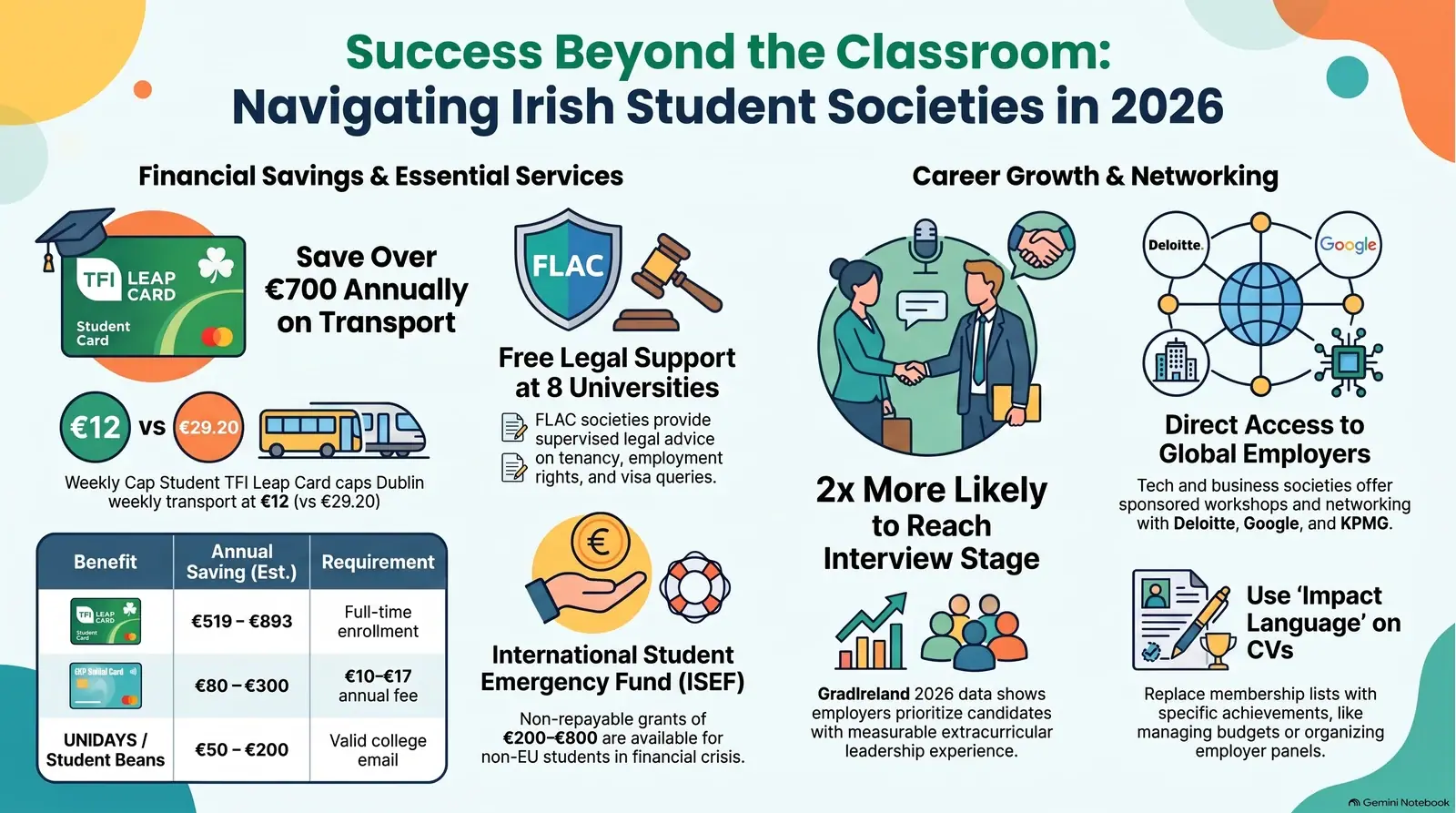
- Immediate cost saving: A Student TFI Leap Card cuts your Dublin weekly transport spend from €29.20 to €12. An ISIC card (€10–17/year) unlocks discounts at 150,000+ businesses globally. Both require only proof of enrolment.
- Free professional services through your union: FLAC societies at eight Irish universities provide free legal advice on tenancy, employment, and consumer rights — supervised by qualified solicitors. Your welfare officer can unlock emergency hardship funds that most students never claim.
- Employers are watching: GradIreland data for 2026 confirms that Irish and multinational graduate employers actively ask for extracurricular activities on CVs. One leadership role in a business or tech society, done well, is worth more than six society memberships on a list.
€12 (vs €29.20 adult)
€10–17 (digital or physical)
Available at 8 Irish universities
Over 90% (GradIreland 2026)
What do Irish student unions and societies actually offer beyond social events?
Irish student unions are statutory representative bodies — not just event organisers. Every enrolled student is automatically a member, which means from day one you have legal representation, welfare support, access to hardship funds, free professional services, and hundreds of student-run clubs and societies, all without paying a separate membership fee.
The national umbrella body is Aontas na Mac Léinn in Éirinn (AMLÉ) — the Union of Students in Ireland — which represents more than 374,000 students across 40 colleges on the island of Ireland. AMLÉ lobbies government on tuition fees, mental health funding, and accommodation policy. Your college student union is the local branch of this national structure, and it is funded by your registration fee. That means the welfare officer, the counselling referral service, the free legal advice clinic, and the emergency fund are already paid for — the only question is whether you claim them.
Below the student union level are societies and clubs — hundreds of them at each major university. At UCD, Fresher's Week 2026 runs 14–18 September at the Freshers Pavilion with 90+ societies available to join. DCU hosts over 140 clubs and societies across its campuses. TCD lists over 200 societies through its Central Societies Committee. Society categories span academic and professional (business consulting, law, technology, economics), cultural and nationality-based (Indian Student Society, Chinese Cultural Society, African Society), sports (GAA, cricket, swimming), arts (drama, music, film), and activist (environmental, political, humanitarian).
Most societies charge a small annual membership fee of €5–€20, though many are free. Some — particularly business consulting, tech, and economics societies — also access external sponsorship from companies like Deloitte, Google, and KPMG, which funds speaker events, sponsored trips, and CV workshops that are worth significantly more than the membership fee.
For international students specifically, societies fill a gap that no amount of academic orientation can address: they give you access to Irish social and professional networks from the first week of term. Research published by UCD Global in 2026 confirms that international students who engage with at least one society in their first semester report significantly higher social integration and lower rates of homesickness by December.
How joining a society saves you money: discounts, free events and emergency welfare funds
The most immediate financial benefit of being an enrolled student in Ireland is the Student TFI Leap Card, which caps your weekly Dublin transport spending at €12 — saving €17.20 per week versus the adult fare, or more than €700 per academic year on public transport alone.
Student TFI Leap Card: the transport saving most international students miss
The Student TFI Leap Card is available to all full-time students enrolled at an Irish college, giving up to 50% off all Transport for Ireland bus, DART, Luas, and commuter rail fares. In Dublin, the weekly spending cap drops to €12 for students (versus €29.20 for adult Leap Card holders). On a 30-week academic year this saves approximately €519 on Dublin transport alone — and that is before counting savings on rail journeys to Cork, Galway, or Limerick for fieldwork or personal trips.
To apply, visit leapcard.ie online, select your institution from the dropdown menu, enter your student ID number, and upload proof of enrolment (an official letter from your registrar or student services confirming full-time enrolment for the 2026–27 academic year). The card costs a €5 refundable deposit. Students aged 19–25 can alternatively use the Young Adult TFI Leap Card, which offers the same 50% discount on commercial bus operators. You cannot hold both simultaneously — choose the version with the lower effective weekly spend based on your travel pattern.
ISIC Card: global discounts for €10–17 per year
The International Student Identity Card (ISIC) is accepted in more than 130 countries and provides discounts on travel, museums, cinema, and retail from 150,000+ participating businesses worldwide. In Ireland, ISIC discounts apply at participating shops, restaurants, and tourist attractions. The card costs €10–17 per year depending on whether you choose a digital or physical version, and is valid for 12 months from the purchase date. Any student enrolled full-time at an Irish institution can apply through the ISIC website. Digital verification platforms such as UNiDAYS and Student Beans also provide no-cost online discounts at major retailers including Apple, Microsoft, Spotify, and ASOS for anyone with a valid college email address.
Free events, subsidised trips and society-funded activities
Most societies run free weekly events — film screenings, hiking days, language exchanges, talks from industry speakers — that would cost €20–€60 per person on the open market. Business and tech societies in particular receive sponsorship from companies like Deloitte, Google, and KPMG to fund speaker series, mock interviews, and networking dinners. The DCU Student Business Consulting Society (SBC) — sponsored by Deloitte — provides paid CV workshops, interview skills practice, and Q&A sessions with Deloitte staff that would cost €200+ as a commercial career coaching session.
Emergency welfare funds: what international students can claim
The HEA Student Assistance Fund (SAF) 2026–27 is a government-funded hardship programme administered by your college. Standard SAF eligibility is limited to EU/EEA fee-paying students. However, most Irish colleges also operate a separate International Student Emergency Fund (ISEF) for non-EU students facing genuine financial crisis — unexpected medical expenses, passport loss, accommodation emergency, or a delay in family remittance. Ask your student welfare officer or international office specifically about the ISEF rather than the SAF. The fund is non-repayable and awards are means-tested; typical awards range from €200–€800 depending on the institution and circumstances. Applications for 2026–27 open in October at most colleges.
Cost savings comparison: what society membership delivers
| Benefit / Service | What you get | Annual saving (est.) | Eligibility |
|---|---|---|---|
| Student TFI Leap Card | 50% off all TFI fares; Dublin weekly cap €12 | €519–€893 on commuting | All enrolled full-time students; €5 deposit |
| ISIC Card | Discounts at 150,000+ outlets globally; cinema, museums, retail | €80–€300 depending on usage | Any full-time student; €10–17/year fee |
| UNiDAYS / Student Beans | Online discounts: Apple, Spotify, ASOS, Microsoft, Nike | €50–€200 depending on purchases | Free; valid college email required |
| Society free events | Speaker series, hiking days, film screenings, workshops | €100–€500 (market value) | Small society membership fee (€5–€20) |
| FLAC legal clinics | Free legal information and advice (tenancy, employment, consumer) | €150–€400 per consultation avoided | All students; available at 8 Irish universities |
| International Student Emergency Fund | Non-repayable emergency grant for non-EU students in financial crisis | €200–€800 per award | Non-EU students; means-tested; October intake |
Building your professional network through tech clubs, business societies and nationality associations
The fastest way to build a professional network in Ireland as an international student is not LinkedIn cold-messaging — it is showing up consistently to one well-chosen society, contributing meaningfully, and letting the resulting relationships do the work over 9–12 months.
Business and tech societies: direct employer access
Business consulting, finance, and technology societies at Irish universities have embedded sponsorship relationships with major employers — relationships that translate directly to interview shortcuts, CV-shortlisting advantages, and first-mover access to graduate schemes. The most well-documented example is the DCU Student Business Consulting Society, sponsored by Deloitte, which has placed members into Deloitte graduate roles for over a decade. Trinity's TEF (The Economic Forum) — launched by President Michael D. Higgins and described as Ireland's first and largest student-run economic forum — has brought speakers from the European Central Bank, AIB, and IBEC, with attendees regularly referencing TCD TEF membership in interviews for finance and policy roles.
Tech societies operate similarly at UCD (UCD Computer Science Society, UCD AI Society), DCU (Connected DCU Society), and UCC (UCC Tech Society). Events typically include hackathons, coding workshops, CTF (Capture the Flag) competitions, and company visits to Google Dublin, Meta, and Accenture's Irish offices. Participation in even one company visit gives you a genuine in-person connection with a recruiter that no application form can replicate.
Nationality associations and international societies
For Indian students specifically — and for international students from any country — nationality-based societies and international students societies provide an immediate social anchor in the first weeks of term. UCD's International Students Society (ISS) is the largest cultural society in Ireland with over 3,000 members, organising social gatherings, day trips across Ireland, and an annual cultural night. TCD's Dublin University International Students' Society similarly organises trips from Donegal to Cork that function as the social backbone of the international student experience at TCD. University of Galway's ISS serves the large international cohort at that campus.
Beyond the official ISS model, WhatsApp and Discord communities of Indian students at each college are typically active from August — before term begins — and provide the most practical real-time information on student accommodation, grocery stores (Asian supermarkets in Dublin are well-mapped in these groups), SIM card deals, and IRP registration queues. Ask your college's international office how to connect to the existing Indian student network at your specific institution.
On-the-Ground Insight: "I joined UCD's International Students Society in week one, thinking it was just for parties. By November I had been introduced to a UCD alumna working at Google Dublin who became an informal mentor. She referred me for a summer internship application. I got the internship. The €10 society membership fee was the best investment I made in my entire programme." — Priya M., MSc Data Analytics, UCD, Autumn 2025 Intake
LinkedIn and follow-through: turning event contacts into working relationships
Meeting someone at a society event creates a warm connection; what you do in the 48 hours afterward determines whether it becomes a professional relationship. Send a LinkedIn connection request with a short personalised note referencing the event within 24 hours. Comment meaningfully on their posts over the following weeks. If they work at a company you are targeting, ask for a brief virtual coffee chat — not for a job, but to learn about their role and sector. Irish professionals, in my experience, respond well to this approach when the request is specific and low-effort for them.
How student union welfare services work in practice: counselling, legal advice and emergency funds
Your student union welfare officer is your single most important contact for any crisis — housing, mental health, visa anxiety, or financial emergency — and they can refer you to services most international students never discover unless someone tells them about them directly.
Free counselling and mental health support
All Irish universities provide access to professional counselling services for enrolled students, typically at no charge or at a subsidised rate. Waiting lists at large colleges (UCD, UCC, TCD) can run to several weeks for non-urgent appointments; if you are in acute distress, contact your student welfare officer who can expedite a referral or direct you to same-day supports. HSE mental health services are also available to all residents, though waiting times for CAMHS and CMHT are longer. The student union counselling service is always the faster entry point.
AMLÉ (the Union of Students in Ireland) has lobbied for and secured increased government funding for student mental health supports in the 2026 higher education budget. New colleges participating in the 2026–27 expanded programme will have a dedicated mental health counsellor from September 2026. Check your own college's student services website for the specific expansion at your institution.
FLAC legal clinics: free legal advice at 8 Irish universities
FLAC (Free Legal Advice Centres) operates student societies at eight universities in the Republic of Ireland — run by law students with supervision from qualified solicitors. These clinics address practical legal issues that affect students disproportionately: tenancy disputes with landlords, wage theft by employers, consumer complaints, and — importantly for international students — questions about visa status, permission renewals, and employment rights under Irish Immigration Service Delivery rules.
You do not need to be a law student to use the clinic. Any enrolled student can attend as a client. Sessions are confidential. To find your college's FLAC clinic, search "[your college name] FLAC society" or ask at the student union office. If your college does not have a FLAC society, Citizens Information provides free general information on legal rights for all residents of Ireland.
- Landlord withholding deposits without valid reason (Residential Tenancies Board process)
- Employer paying below the €14.15/hr national minimum wage for part-time work
- Airline refund claims and flight cancellation rights under EU Regulation 261/2004
- Questions about Stamp 2 work-hour limits and IRP re-registration process
- Consumer rights when a product or service is defective (Consumer Rights Act 2022)
Welfare officer and hardship funds: what to ask for
Every Irish student union employs at least one full-time welfare officer — a paid sabbatical position held by a student elected annually. Their job is to connect students in difficulty with the right institutional support. If you are facing financial hardship, the welfare officer is the gateway to the International Student Emergency Fund (ISEF), the college's food bank (most large Irish universities have one), emergency accommodation referrals, and in some cases grant funding from the student union's own welfare budget. Do not wait until a crisis becomes unmanageable — welfare officers report that the students most in need often wait the longest to make contact.
How Irish employers view society leadership on your CV in 2026
Irish graduate employers in 2026 explicitly ask for extracurricular activities — but they are looking for evidence of measurable contribution, not a list of memberships. One well-documented leadership role outweighs ten society names.
What the data says: GradIreland 2025/26
GradIreland's 2025/26 employer survey (published September 2026) confirms that over 90% of tertiary graduates in Ireland secured employment within nine months of graduation. Employers in the survey — including Deloitte, KPMG, Google, AIB, and Accenture — stated that candidates who combined relevant extracurricular activities with academic qualifications were "over twice as likely to reach the interview stage" in Dublin and Cork markets, where recruiters receive up to 250 CVs per vacancy. The Irish recruitment market remains cautiously optimistic for 2026, with one in four firms planning expansions in tech, data, and sustainability roles.
Skills-based hiring is the dominant mode in Ireland in 2026 — employers value demonstrated adaptability, communication, and leadership over degree classification alone. A student who organised three events for their college's Indian Cultural Society, managed a €500 event budget, and negotiated a venue discount is demonstrating project management, financial literacy, and negotiation skills more concretely than any course description can.
How to write society experience on your CV for Irish employers
Irish CVs follow a format where extracurricular activities are listed under "Activities and Interests" or "Leadership and Volunteering." The key is to write in impact language, not task language. Weak: "Member of UCD Business Society." Strong: "Events Officer, UCD Business Society (2025–26) — organised four employer panels with 80+ attendees per event; coordinated logistics for a Deloitte-sponsored networking evening attended by 12 company representatives."
Roles that Irish employers in finance, tech, and consulting specifically value include: society president or vice-president, treasurer (demonstrates financial responsibility), events coordinator (project management), and marketing or communications officer (digital and content skills). If you hold a leadership role in a business or tech society, list it near the top of your CV's activities section. If you are only a general member, list it briefly and redirect space to internship experience instead.
Societies most valued in specific Irish sectors (2026)
| Target sector | Most valued society type | Example Irish society | Why employers value it |
|---|---|---|---|
| Finance / Consulting | Business consulting, economics forum | DCU Student Business Consulting Society (Deloitte-sponsored); TCD TEF | Direct employer contact; case study experience; real client projects |
| Technology / Data | Computer science, AI, data science societies | UCD CS Society; Connected DCU Society; UCC Tech Society | Hackathon wins; GitHub contributions; company visit access |
| Law | FLAC society, mooting society, law society | FLAC Ireland at 8 universities; TCD Law Society | Supervised client-facing legal practice; advocacy skills |
| Healthcare / Life Sciences | Medical society, pharmacy society, global health society | UCD Med Society; TCD Global Health Society | Clinical volunteering; cross-disciplinary collaboration |
| Any sector | Student union welfare, international society | Any college welfare committee; UCD ISS | Cultural intelligence; cross-cultural communication; empathy skills valued by multinational employers |
Getting started: when to sign up, what to prioritise and avoiding over-commitment
Fresher's Week — the first week of September at most Irish colleges — is the only time all societies recruit simultaneously, which makes it the most efficient moment to explore options. After that window, most societies accept new members by emailing the committee or attending an open event.
Key Fresher's Week dates for 2026
At UCD, Fresher's Week 2026 runs 14–18 September at the Freshers Pavilion on the Belfield campus, with 90+ societies available to join. Society representatives staff stalls, membership sign-up is immediate, and many societies offer free merchandise or sample events during the week. At TCD, the equivalent event is the Freshers' Fair in Front Square, typically in the same week. At DCU, the Welcome Event is held at the Collins Avenue campus. At UCC, UCC International runs a separate international student orientation that includes society access during the first week of term.
If you arrive late (e.g. you received a late offer and began in October) or join in January for a second semester, most colleges hold a "Refresher's Week" in mid-to-late January for students who missed the September event. You can also join any society year-round by finding them on the college societies website and messaging the committee on Instagram or by email.
What to prioritise in your first semester
The most effective approach is to sign up to three or four societies in Fresher's Week to explore them, then narrow to one or two by October and invest your time in those. Ask yourself: Does this society give me access to people I want to learn from? Does the committee work on something that will give me a specific achievement to cite on a CV? Is the time commitment compatible with my programme's contact hours and assessment deadlines?
For international students whose primary goal is employment in Ireland after graduation, the hierarchy is: (1) one professional-track society (business, tech, law, or your industry) with an active committee you can join; (2) one social or cultural society for your own wellbeing; (3) stop there. A society leadership role that is done well for one year — with events organised, attendance tracked, and outcomes documented — is all you need.
Signs you are over-committed and how to step back
Academic performance is the primary criterion for your Irish degree classification, which in turn is the primary criterion for graduate employment. If society work is costing you assignment time, the return on investment has inverted. Warning signs include: missing lectures to attend society events, submitting assessments late, or feeling anxious about society obligations during exam periods. Irish societies operate on an annual committee election cycle — if your current semester requires peak academic focus, step back to general membership and return to a committee role in second year or after your dissertation is submitted.
Frequently asked questions
Can international students on a Stamp 2 visa join student societies in Ireland?
Yes, absolutely. Joining student societies and clubs is entirely open to all enrolled students regardless of visa type. There is no immigration restriction on participating in student unions, hobby clubs, academic societies, or nationality associations. Society membership is typically free or costs a small annual fee (€5–€20), and your Student ID is your only entry requirement.
What is the Student Leap Card and how much does it save me?
The Student TFI Leap Card gives full-time students up to 50% off all Transport for Ireland fares and caps weekly Dublin spending at €12 (versus €29.20 for an adult). It costs €5 as a refundable deposit and requires proof of enrolment and a student ID number. Apply online at leapcard.ie/students, selecting your institution from the dropdown. Young Adult Leap Cards (ages 19–25) offer the same 50% discount.
How do I get free legal advice through my student union?
FLAC (Free Legal Advice Centres) operates student societies at eight Irish universities where qualified lawyers supervise student members in providing free legal information and advice clinics. To access the service, search for your college's FLAC society page or ask at your student union office. Issues commonly addressed include tenancy disputes, employment rights, visa queries, and consumer complaints.
Are there Indian student societies in Irish universities?
Yes. Major Irish universities all have active international and nationality-based societies. UCD's International Students Society (ISS) is Ireland's largest cultural society with over 3,000 members. TCD has the Dublin University International Students' Society. DCU has the International Relations Society and Connected DCU Society. University of Galway has an ISS dedicated to international students. Indian student communities often organise informal WhatsApp networks, cultural events, and Diwali celebrations through these broader international societies.
Will joining a student society actually help me get a job in Ireland?
Yes, when approached strategically. GradIreland data for 2026 shows that over 90% of Irish tertiary graduates secure employment within nine months, with employers explicitly requesting extracurricular activities on CVs. Employers value measurable contributions — not just membership — so lead a project, organise an event, or hold a committee role. The DCU Student Business Consulting Society (sponsored by Deloitte) and TCD's TEF (Ireland's first student economic forum) are particularly valued in finance and consulting recruitment.
Planning your flight to Ireland? Compare live fares now.
Find the cheapest Dublin fares for your intake, compare airlines and baggage policies, and check the best booking window before you buy.
All information in this article is based on publicly available sources including official Higher Education Authority, Irish Immigration Service Delivery, and individual university websites as of September 2026. Society membership fees, welfare fund amounts, and Fresher's Week dates may change each academic year. Always verify current information directly with your college's student union and international office before making decisions. MyFlightOffers is not affiliated with any organisation mentioned. This article does not constitute legal, immigration, or financial advice.
- Ireland Student Survival Guide: Hidden Subsidies 2026 — the grants, free services, and entitlements most international students never claim
- Internships and Work Placements on Stamp 2: 2026 Rights Guide — the 20-hour exception, 50% rule, minimum wage, and CSEP pathway from a placement
- Ireland Banking Guide for International Students 2026 — opening an Irish bank account, choosing between N26, Revolut and AIB, and avoiding fees
- The Indian Student's Money Survival Guide in Ireland — forex cards, UPI for NRIs, TCS thresholds, and the cheapest way to send money home
- Dublin Networking Guide: Post-Study Jobs 2026 — how to connect with Irish employers, find mentors, and access the hidden job market