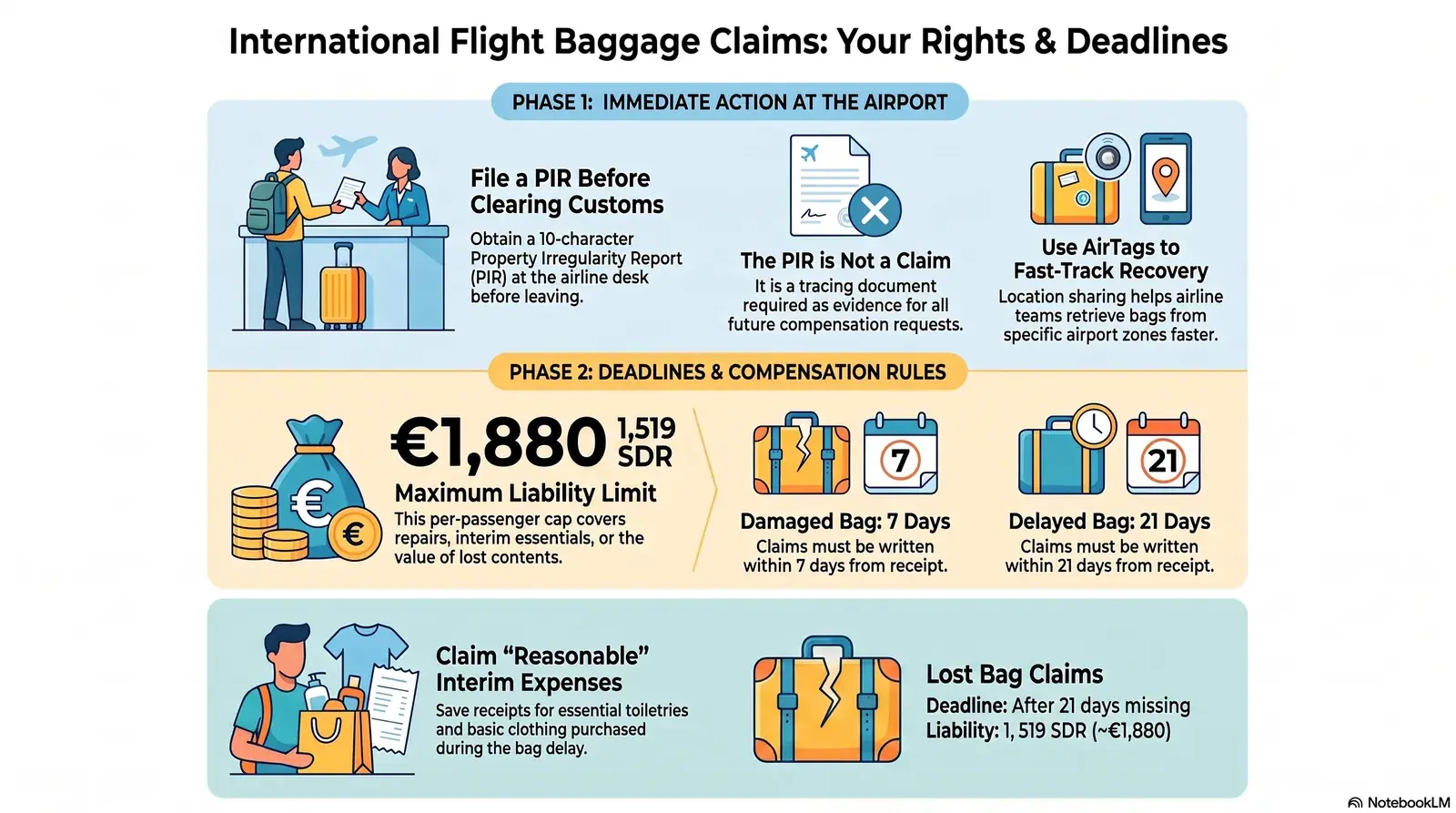
- File a PIR at the airport: Before leaving the baggage hall or walking through customs, report your missing or damaged bag to the airline and collect a Property Irregularity Report with a 10-character reference. Without it, later claims become extremely difficult.
- You are owed up to 1,519 SDR (≈€1,880): The Montreal Convention caps airline liability per passenger at 1,519 Special Drawing Rights, revised on 28 December 2024. This covers delayed, lost, and damaged checked bags — but only if you meet the written-claim deadlines.
- Deadlines are absolute: 7 calendar days to claim for a damaged bag; 21 calendar days for a delayed bag. Miss either deadline and the airline is legally released from liability.
1,519 SDR ≈ €1,880 per passenger
7 calendar days from receiving your bag
21 calendar days from receiving your bag
21 days not received → claim within 2 years
What Is the Montreal Convention and How Much Can You Claim?
The Montreal Convention 1999 (officially the Convention for the Unification of Certain Rules for International Carriage by Air) is the primary international treaty governing airline liability for passengers and cargo. Ratified by 137 countries including Ireland, India, the UK, the EU, and the USA, it sets a mandatory upper limit of 1,519 Special Drawing Rights (SDR) per passenger for loss, delay, or damage to checked baggage.
An SDR is the International Monetary Fund's composite currency basket. At the rate applicable as of July 2026, 1,519 SDR converts to approximately €1,880, £1,600, or US$2,080. The exact euro value fluctuates daily with the SDR/EUR exchange rate, but the convention locks in the SDR amount.
This limit was raised from approximately 1,288 SDR effective 28 December 2024 under the convention's five-yearly review mechanism (ICAO Decision C-DEC 228/6), increasing real compensation levels by roughly 18% in a single step. Any airline that applies the old 1,288 SDR limit after that date is non-compliant with the convention.
The convention applies to any international flight: a journey where the departure and destination are in different countries, or where the departure and destination are in the same country but there is a scheduled stop in another country. For passengers flying Dublin–Dubai–Mumbai on Emirates, or Dublin–Doha–Delhi on Qatar Airways, the Montreal Convention governs the entire ticketed journey even if both sectors are operated by the same carrier.
| Baggage Situation | Written Claim Deadline | Maximum Liability (Jul 2026) | Escalation Body (Ireland) |
|---|---|---|---|
| Damaged bag (received but damaged) | 7 calendar days from receiving the bag | 1,519 SDR ≈ €1,880 | ECC Ireland / CCPC |
| Delayed bag (arrived late, recovered) | 21 calendar days from receiving the bag | 1,519 SDR ≈ €1,880 | ECC Ireland / CCPC |
| Lost bag (not received within 21 days) | Up to 2 years from scheduled arrival date | 1,519 SDR ≈ €1,880 | ECC Ireland / CCPC |
| Items excluded from cover | N/A | €0 (airline exempt) | Credit card insurance or standalone policy |
Note that the Irish Aviation Authority (IAA) has no powers to assist with baggage compensation complaints. The IAA's remit covers safety and EU261 flight delay/cancellation rights, not Montreal Convention baggage claims. For baggage, your escalation paths are the Competition and Consumer Protection Commission (CCPC) for Irish-registered carriers, or the European Consumer Centre Ireland (ECC Ireland) for EU-based carriers.
Your First Move at the Airport: Filing a Property Irregularity Report (PIR)
If your bag does not appear on the carousel, do not walk through customs. Proceed directly to the airline's baggage desk in the arrivals hall and file a Property Irregularity Report (PIR) before leaving the baggage reclaim area.
A PIR is an official airline form that records the details of your missing, damaged, or delayed bag: the colour, size, brand, any distinguishing features, and the last known routing. Completing one gives you a 10-character PIR reference number, typically in the format DUBEK12345 (3-letter airport code + 2-letter airline code + 5 digits). This reference is the single most important piece of documentation for every subsequent step, from tracking inquiries to formal compensation claims.
The PIR is not a complaint form and it is not a request for compensation. It is a tracing document. Filing it:
- Activates the airline's baggage tracing system (typically SITA WorldTracer, used by over 500 airlines worldwide)
- Creates a formal record that your bag was not delivered at the expected time and place
- Establishes the date from which the 7-day and 21-day claim deadlines begin to run
- Is required as evidence when submitting your formal compensation claim
While filing a PIR is not a strict legal requirement under the Montreal Convention, attempting to make a claim without one puts the burden of proof entirely on the passenger. Every airline will ask for the PIR reference as the first item in any claim form. Keep your boarding card, baggage tag receipts, and booking confirmation alongside the PIR.
On-the-Ground Insight: “When I landed in Dublin from Mumbai and my bag didn’t appear, I nearly walked through customs before an Aer Lingus staff member stopped me. Filing the PIR at the desk took about 15 minutes, but it was the document that got me €178 in reimbursed expenses over four days of delay. My bag arrived on day five with a broken wheel — I then had a separate claim for the damage.” — Priya S., Trinity College Dublin, Autumn 2025 intake
Interim Expense Claims: What Can You Buy While Waiting for Your Bag?
Airlines are required under the Montreal Convention to reimburse reasonable and necessary interim expenses you incur because your bag was delayed. This covers toiletries, underwear, and a change of clothing appropriate for your immediate destination — not a shopping spree.
There is no fixed daily cap written into the Montreal Convention text, but "reasonable" is interpreted by airlines and courts as what a prudent traveller would need to function for one or two days without their luggage. Real-world guidance from Irish consumer bodies and established claims precedents suggests approximately €40–€80 per day for a combined package of toiletries, basic clothing, and any work-essential items you can document.
Specific items that airlines typically reimburse without dispute:
- Toothbrush, toothpaste, deodorant, and basic toiletries
- Underwear and socks (one or two pairs per day of delay)
- A single change of outfit at reasonable high-street prices (not designer labels)
- Any prescription medication you needed but was in the hold bag, where you can provide a prescription
- Business-essential items such as a USB cable or phone charger if you can show the delayed bag contained yours
Items that airlines routinely reject:
- Designer or luxury clothing priced significantly above functional replacements
- Electronics that were not already in your bag (a new laptop is not an interim expense)
- Meals beyond what can be directly attributed to the baggage situation
- Items purchased more than 24–48 hours after the airline confirmed your bag was on its way
Always get itemised receipts. Submit your interim expense claim to the airline in writing (email with receipts attached) within a few days of receiving your bag, or within 21 days if the bag was never recovered. The Citizens Information Ireland baggage rights page confirms this approach and notes that the claim must be submitted in writing, not verbally.
The 21-Day Rule: When a Delayed Bag Officially Becomes a Lost Bag
Under Article 17 of the Montreal Convention, a delayed bag transitions into a lost bag when 21 calendar days have passed from the date it was supposed to arrive, and it still has not been delivered to you. Once that threshold passes, you can submit a full loss claim for the contents — not just interim expenses.
The 21-day countdown begins on the date the flight was scheduled to arrive, not the date you noticed your bag was missing or the date you filed the PIR. If your flight from Dubai to Dublin was scheduled to arrive on 1 June, the 21-day window closes on 22 June. The bag is officially lost from that point.
After 21 days without the bag arriving:
- You can claim for the full replacement value of the lost bag and its contents, up to the 1,519 SDR cap (≈€1,880)
- You do not need to wait any further for the airline to declare it lost officially; the treaty defines the point for you
- You then have up to 2 years from the original scheduled arrival date to submit your written claim
In practice, airlines often find bags well within 21 days. The global SITA WorldTracer system resolves approximately 97% of mishandled bags within 5 days. The real danger zone is the passenger who, after day 10, assumes the bag is coming and does not keep written records. Keep your PIR reference active and follow up by email every 3–5 days so you create a timestamped paper trail.
Damaged Baggage Claims: The 7-Day Deadline and Evidence Checklist
If your bag arrives visibly damaged — broken wheels, torn seams, crushed frame, or a broken handle — you have exactly 7 calendar days from the date you received the bag to submit a written complaint to the airline. This is the shortest mandatory deadline in the Montreal Convention and the one most passengers miss.
The 7 days are calendar days, not working days. A bank holiday in Ireland or India does not extend the window. If you received your bag on a Friday evening, your deadline is the following Friday evening. Submit your claim by email so the timestamp is recorded.
Evidence checklist for a damaged bag claim:
- Photographs taken at the airport — ideally before you leave the baggage hall, as some airlines dispute claims where damage is only photographed at home
- PIR reference — even for a damaged bag that was returned, some airlines require a damage PIR filed at the airport; ask the desk to note visible damage on your PIR before you leave
- Boarding card and baggage tag receipt — proves you checked the bag on the named flight
- Booking confirmation — links your name to the flight and the bag reference
- Repair quote or replacement cost — a local luggage repair quote within the 7-day window strengthens your case; if the bag is beyond repair, a replacement price from the same or comparable brand is needed
- Proof of original bag value — purchase receipt or credit card statement; airlines depreciate the bag's value by age, so document the purchase date
Airlines apply depreciation to bags (typically 20–33% per year of ownership). A three-year-old suitcase that cost €300 may be compensated at €120–€180. Where the repair cost is lower than the depreciated value, the airline will pay only for repair. This is why keeping a purchase receipt for your luggage and photographing damage immediately at the airport carousel makes a significant difference to the final payout.
How to Stack Credit Card Travel Insurance on Top of Airline Liability
Many premium credit cards — particularly those held by Indian passengers and Irish residents — include secondary travel insurance that pays out on top of whatever the airline has already compensated. Knowing how to layer these policies can meaningfully increase your total recovery.
Credit card baggage insurance is almost always "secondary coverage," meaning it pays the gap between what you actually lost (the true value of your bag and contents) and what the airline compensated under the Montreal Convention. If your bag contained items worth €2,500 and the airline paid €1,880, a credit card policy could in theory cover the remaining €620 — but only if the total claim does not exceed the card's stated coverage limit and only if you purchased the ticket on that card.
| Card / Policy | Baggage Delay Cover | Baggage Loss/Damage Cover | Key Requirement |
|---|---|---|---|
| HDFC Regalia Gold (India) | USD 500 (delay >12 hours) | USD 1,000 per trip | Ticket charged to card; international travel only |
| HDFC Diners Club Black (India) | USD 500 (delay >6 hours) | USD 3,000 per trip | Ticket charged to card; primary cardholder only |
| Axis Atlas (India) | USD 300 (delay >6 hours) | USD 1,500 per trip | Ticket charged to card |
| AIB Advantage Visa (Ireland) | €300 (delay >4 hours) | €1,000 per trip | Ticket purchased with card; PIR required |
| Revolut Premium (Ireland) | €250 (delay >4 hours) | €1,500 per incident | Paid Revolut plan; ticket paid with Revolut card |
The practical stacking process for an Irish-based Indian passenger is: (1) file the PIR and airline claim first, get the airline's settlement in writing; (2) then file the credit card insurance claim, providing the PIR reference, airline settlement letter, receipts, and original ticket booking confirmation. Most insurers require all of these documents before processing a claim and will not advance payment until the airline has formally responded.
Note that credit card insurance does not cover items that are excluded from the Montreal Convention — specifically cash, jewellery, electronics, and fragile items. Those categories require a separate standalone travel insurance policy taken out before departure, such as one provided by HDFC ERGO or AIB Travel Insurance.
AirTags and GPS Trackers: Using Technology to Accelerate Bag Recovery
Apple AirTags, Samsung SmartTags, and Tile trackers have transformed the lost-baggage recovery process in 2026. A July 2026 SITA Baggage IT Insights report found a 90% reduction in bags that remained permanently lost when the bag contained an Apple AirTag connected to the Find My network.
The reason for this shift is SITA's integration of Apple's Find My network directly into SITA WorldTracer, the global baggage tracing system used by over 500 airlines. Since early 2026, baggage agents at participating airports — including Dublin Airport — can pull up an AirTag location link inside WorldTracer and dispatch a ramp team to the exact tarmac position where a bag has been set aside, rather than searching an entire baggage sorting area. More than 50 carriers had signed on to the system as of July 2026, including Aer Lingus, Emirates, and the Lufthansa Group.
How to use an AirTag effectively in a claim:
- Share your AirTag location with the airline proactively at the PIR desk. Aer Lingus, for example, has an optional sharing mechanism that feeds the location directly into their tracing team
- Screenshot the location at the time of filing the PIR — this creates a timestamped record that the bag was in a specific airport facility, not genuinely missing
- Use the tracker to push for faster dispatch — if your AirTag shows the bag sitting at a specific baggage belt 48 hours after your flight, contact the airline's baggage service team with the location and request immediate retrieval. This often produces results within hours rather than days
- Do not use it as a substitute for the PIR — some passengers have tried to claim directly using only AirTag evidence. The Montreal Convention requires a formal written record through airline channels
High-Value Items and Excess Valuation Declarations
If the contents of your checked bag are worth more than 1,519 SDR (≈€1,880), you can purchase an excess valuation declaration at the check-in desk before your flight, which increases the airline's maximum liability for that specific bag beyond the standard convention limit.
Excess valuation is not travel insurance. It is a contract with the airline to increase their declared liability in exchange for a fee. The fee structure varies by airline, but a common benchmark is approximately €5 for every €100 of additional declared value. For example, declaring €5,000 of value (above the standard €1,880) on an Emirates flight would cost roughly €155 in excess valuation fees at check-in. This must be requested at the check-in desk when you hand over the bag — it cannot be added after the fact.
However, there are critical limitations on what airlines will cover even with an excess valuation declaration:
- Cash — virtually all major airlines explicitly exclude cash from liability entirely, even with excess valuation
- Jewellery and precious metals — excluded by most airlines, including Emirates and Aer Lingus, from both standard and excess valuation cover
- Electronics (laptops, cameras, tablets) — excluded by most airlines; carry these in your hand luggage
- Fragile items — breakable items may be excluded unless packed to airline standards
- Perishable goods — not covered
The practical conclusion is that excess valuation covers clothing, shoes, and non-electronic personal items better than it covers electronics or valuables. If you are travelling with a wedding outfit worth €2,000 in your checked bag, excess valuation makes sense. If you are travelling with a €3,000 camera and a gold necklace, pack the camera in your carry-on and leave the necklace in a hotel safe — neither the Montreal Convention nor excess valuation will cover them in a lost bag.
- All electronics: laptop, tablet, camera, phone
- All jewellery and precious metals
- Cash, debit cards, and credit cards
- Prescription medication (enough for the journey plus a few days)
- Irreplaceable personal documents: passport, visa approvals, IRP card
Should You Use AirHelp, SkyRefund, or Claim Yourself?
Claim companies such as AirHelp and SkyRefund handle baggage claims on your behalf in exchange for a fee of 35% of the recovered amount (plus VAT), rising to approximately 50% if legal action is required. For straightforward claims where the airline cooperates, claiming yourself and keeping 100% is nearly always the better option.
| Method | Cost | Best For | Cons |
|---|---|---|---|
| DIY direct claim to airline | €0 | Clear-cut delays, strong documentation | Requires your time; some airlines are slow or obstructive |
| Claim via CCPC or ECC Ireland | €0 | Airline refuses to respond or offers unfair settlement | Slower process; ECC mediation is not legally binding on airlines |
| AirHelp / SkyRefund | 35% + VAT (50% + VAT if legal action) | Airline refuses valid claim outright; you lack time/confidence to pursue it | Expensive; baggage claims only available on AirHelp Plus subscription |
| Solicitor / small claims court | Small Claims Court fee (€25 in Ireland); solicitor fees beyond that | High-value claim; airline has given a written refusal | Time-intensive; small claims court limit in Ireland is €2,000 |
The Irish Small Claims Court (limit €2,000) is a practical self-service option for claims near the convention maximum. The process is online via courts.ie and requires no solicitor. Airlines often settle before a hearing once a claim is formally filed in court, because the legal costs of contesting a small claim typically exceed the settlement value.
For Indian passengers who encounter HDFC ERGO baggage insurance claims, the insurer requires notification within 60 days of the incident. Claims are submitted directly to HDFC ERGO (not the airline) once the airline's own settlement is finalised. Delay this step and the insurer's 60-day window closes.
Frequently Asked Questions
How much can I claim for lost baggage under the Montreal Convention?
Under the Montreal Convention 1999, the maximum airline liability for lost, delayed or damaged checked baggage is 1,519 Special Drawing Rights (SDR) per passenger, equivalent to approximately €1,880 as of the December 2024 rate revision. This limit applies per passenger, not per bag.
What is a PIR and do I need to file one at the airport?
A Property Irregularity Report (PIR) is an official airline form you complete at the baggage hall if your bag is missing, damaged, or delayed. You must file it before leaving the baggage reclaim area and going through customs. It gives you a 10-character reference number needed for all subsequent claims.
When does a delayed bag officially become a lost bag?
Under the Montreal Convention Article 17, a delayed bag is officially declared lost once 21 calendar days have passed from the date it was supposed to arrive. After that point, you can submit a full loss claim. You then have up to 2 years from the original arrival date to lodge your claim with the airline.
Can I claim interim expenses for essential items while my bag is delayed?
Yes. Airlines are obliged under the Montreal Convention to reimburse reasonable interim expenses incurred because your bag was delayed. This includes essentials such as toiletries, underwear, and a change of clothing appropriate for your destination. There is no fixed daily limit, but keep all receipts and claim only for verifiable, reasonable purchases.
Does my credit card travel insurance cover lost baggage?
Many premium credit cards (including HDFC Regalia Gold, Diners Club Black, and Amex Platinum) include secondary travel insurance that covers baggage loss or delay beyond what the airline pays. HDFC card coverage for international checked baggage is typically USD 200–500 per incident and activates only when the ticket was purchased on that card. Always check your specific card policy and keep the PIR reference as evidence.
Compare Live Flights — Before You Book, Know Your Rights
Use MyFlightOffers to compare fares on Emirates, Qatar Airways, Etihad, and Aer Lingus across Dublin–India routes. Filter by baggage allowance so you can see exactly what is included — and what you will pay if your bag is mishandled.
- EU261 Flight Delay & Cancellation Compensation Guide 2026 — claim up to €600 for delayed or cancelled flights on Ireland–India routes
- Dublin to Delhi Flight Guide 2026 — airline comparison, fare benchmarks, and baggage allowance breakdown
- Dublin to Mumbai (BOM) Flights 2026 — hub comparison, cheapest months, and baggage tips for the DUB–BOM route
- Best Time to Book Flights in 2026 — data-backed booking windows for Ireland–India and Europe routes
- What Is Conditional Flight Booking? — how fare rules and ticket types affect your rights when something goes wrong
All information in this guide is based on publicly available official sources as of July 2026, including the Montreal Convention 1999 (as amended), ICAO Decision C-DEC 228/6 on the revised liability limits effective 28 December 2024, and guidance from Citizens Information Ireland, ECC Ireland, and the CCPC. SDR conversion rates fluctuate daily; the euro equivalents given are approximate. This guide does not constitute legal advice. Always verify the exact terms of your airline's conditions of carriage and your credit card's insurance policy wording before making a claim. MyFlightOffers is not affiliated with any airline, insurance company, or claims handler mentioned.