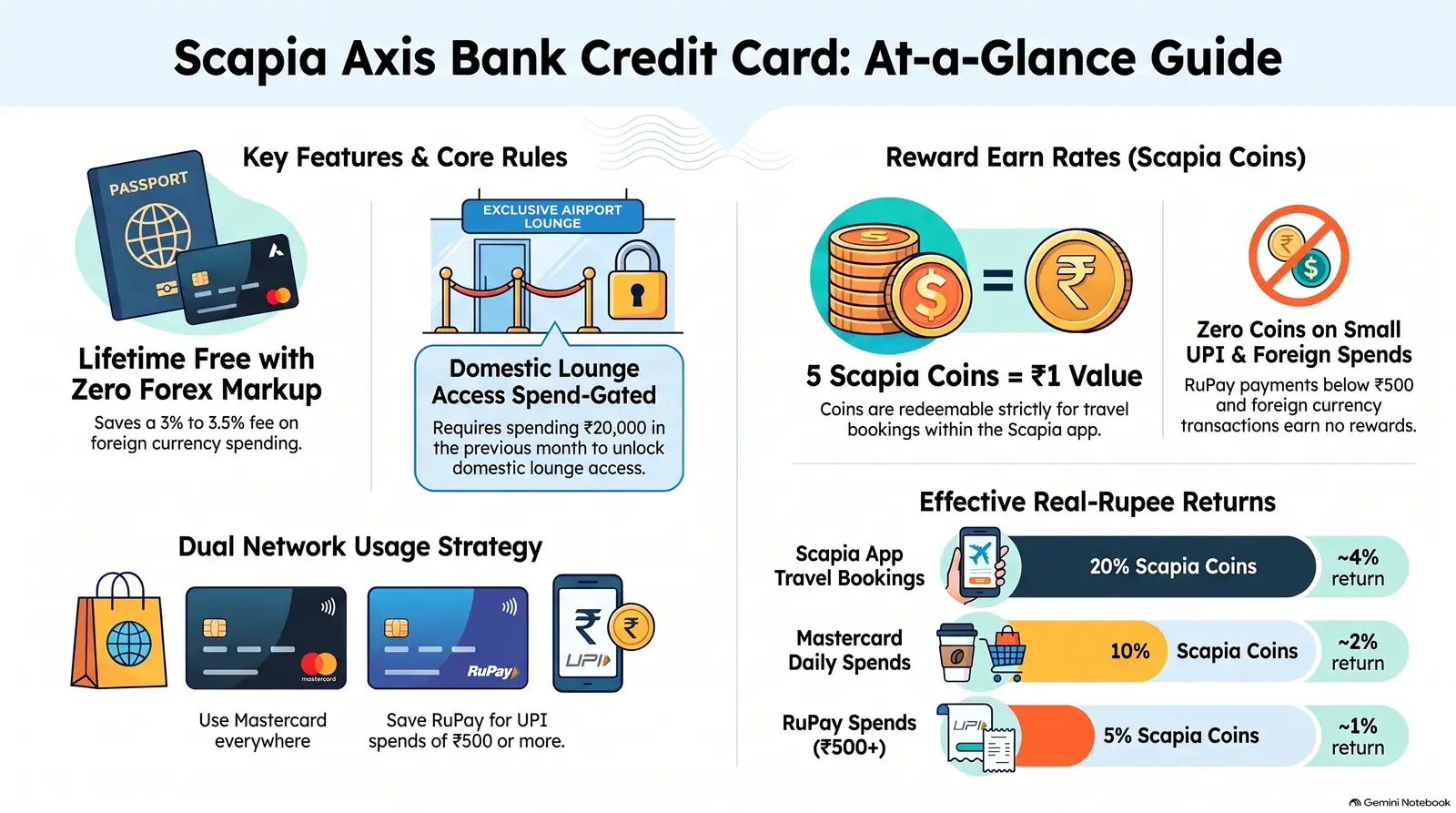
- Free to hold, zero forex: Axis Bank lists the joining fee, annual fee, foreign currency transaction charge and DCC surcharge as nil. On an illustrative ₹1,50,000 Dublin–Delhi fare that avoids roughly ₹4,500–₹5,250 of the 3%–3.5% markup a standard Indian card adds.
- The headline rates are in coins: 20% on Scapia app bookings and 10% on Mastercard spends are paid in Scapia Coins, reported at 5 coins = ₹1 — about 4% and 2% in rupees. The RuPay variant earns 5% (about 1%), and only on spends of ₹500 or more.
- What changes from Federal Bank: Mastercard replaces Visa, the RuPay rate is lower, and the issuer, fee schedule and approval decision are Axis Bank's. The ₹20,000-a-month lounge rule and the domestic-only lounge access carry over.
3 September 2026
Zero / zero
Nil (Mastercard rate applies)
₹20,000 spend in the preceding month, domestic only
Why did Scapia launch a card with Axis Bank in September 2026?
Scapia added Axis Bank as its third issuing partner to reach more applicants: Axis brings a far larger customer base and its own underwriting, while Scapia brings the travel app that the rewards are spent in. Scapia is a travel fintech, not a bank, so every Scapia card is issued by a regulated partner. The first was Federal Bank, the second BOBCARD, and Business Today's launch report of 5 September 2026 describes the Axis card as Scapia's third banking partnership, with onboarding starting on 3 September.
The product logic is unchanged from the card we covered in our Federal Bank Scapia guide: a no-fee card that removes the foreign currency markup and pays rewards that can only be spent on travel inside one app. What the third partner changes is who can get it. Each issuer applies its own approval rules, so an applicant turned down by one bank is assessed afresh by another — although approval by Axis is no more guaranteed than it was elsewhere.
In the Founder's Words: "We are excited to partner with Axis Bank - this is a new chapter for us. […] One app where they can spend, book their trips, shop for travel and earn rewards, all designed around the traveller." — Anil Goteti, Founder and CEO, Scapia, launch statement reported by Deccan Chronicle, 4 September 2026
Nothing in the launch material says that the Federal Bank or BOBCARD cards are being withdrawn or migrated. CardInsider's 17 September 2026 write-up describes the Scapia card as still available through both earlier partners. If you already hold one, treat the Axis card as an additional option rather than a replacement, and check in the Scapia app whether a second card is offered to you before assuming you can hold two.
How much do the 10% and 20% Scapia Coin rates actually pay?
About 2% and 4% in rupees: the percentages are paid in Scapia Coins, and reviews published since launch report the redemption value as 5 coins = ₹1. Axis Bank's product page states three earn rates: 20% on Scapia app spends (flights, stays, trains, buses, visas, experiences and shopping), 10% on daily spends on the Mastercard card, and 5% on eligible UPI, online and offline spends of ₹500 or above on the RuPay edition issued alongside it. The page says there is no cap on redemption. It does not print the rupee value of a coin; the 5-coins-to-₹1 figure comes from independent reviews and matches the value recorded in our Federal Bank guide.
| Where you spend | Headline rate (Scapia Coins) | Coins on ₹10,000 | Rupee value at 5 coins = ₹1 | Effective return |
|---|---|---|---|---|
| Scapia app bookings (flights, stays, trains, buses) | 20% | 2,000 | ₹400 | ~4% |
| Mastercard — eligible daily spends | 10% | 1,000 | ₹200 | ~2% |
| RuPay — eligible UPI, online and offline spends of ₹500+ | 5% | 500 | ₹100 | ~1% |
| International spends | Reported as excluded | 0 | ₹0 | 0% (the saving is the markup avoided) |
Why does the RuPay variant matter so much?
Because UPI payments run on the RuPay card, and on the Axis version that card earns half the Mastercard rate and nothing at all on payments below ₹500. Small UPI payments — a ₹180 auto fare, a ₹350 lunch — are exactly what most people use a RuPay credit card for. On this card they earn no coins. CardInsider reports the Mastercard minimum as ₹20 per transaction, so the practical rule is simple: tap or enter the Mastercard wherever cards are accepted, and keep the RuPay card for UPI payments of ₹500 or more. Our RuPay credit cards and UPI guide explains how RuPay-on-UPI works across banks.
Which spends earn nothing?
Reviews of the card's terms list rent, fuel, cash withdrawals, EMI transactions, forex transactions, education fees, gift cards, credit card repayments, crypto, insurance, utilities, telecom and cable, and wallet loads as excluded from rewards. That list is taken from CardInsider's reading of the terms, not from the bank's product page, which links to a separate terms and conditions PDF. Read that PDF in the Scapia app before you plan around any one category — exclusion lists on co-branded cards are the part most likely to be revised.
What are the forex markup, fees and lounge rules on the Axis version?
Forex markup is nil, the card is free to hold, and unlimited domestic lounge access unlocks only after you spend ₹20,000 in the preceding month — there is no international lounge benefit. The bank's page advertises zero forex markup across 180+ countries and lists both the foreign currency transaction charge and the DCC surcharge as nil. Launch coverage also mentions a "Smart Forex" feature in the app for tracking overseas spends.
| Charge or benefit | Scapia Axis Bank Credit Card (Axis Bank product page, checked 11 October 2026) |
|---|---|
| Joining fee / annual fee | Zero / zero |
| Foreign currency transaction charge | Nil |
| Finance charges | 3.75% per month (55.55% per annum) |
| Cash withdrawal fee | 2.5% of the amount, minimum ₹500 |
| Late payment charge | Slab-based: nil below ₹500 due, ₹500 for ₹501–₹5,000, rising to ₹1,300 above ₹50,000 |
| Rent payments | 1% fee |
| Wallet loads | 1% once cumulative loads reach ₹10,000 in a statement period |
| Utilities | 1% once cumulative spends reach ₹25,000 in a statement period |
| Fuel | 1% surcharge waived on transactions up to ₹5,000; 1% fee once fuel spends reach ₹50,000 in a statement period |
| Domestic lounges | Unlimited across 100+ airports in India on a monthly spend of ₹20,000 |
| Airport dining or shopping | Up to ₹1,000 at domestic airports, on the same ₹20,000 monthly spend |
| International lounges | Not listed |
The lounge rule works a month in arrears: spend ₹20,000 in October and the benefit is live in November. Business Today reports that the ₹20,000 can be met on either variant or across both together, and CardInsider notes that entry is by a QR code generated in the Scapia app and shown with your boarding pass. Launch coverage also quotes up to ₹2,000 back in coins on eligible airport shopping, subject to billing-cycle and city-wise limits; the bank's page shows ₹1,000 for domestic airports, so check which figure the app shows for your airport. Our airport lounge access guide compares this spend-gated model with cards that give a fixed number of visits.
What changes from the Federal Bank Scapia card?
Three things change — the international network (Mastercard instead of Visa), the RuPay earn rate (5% on ₹500+ instead of the common structure our Federal guide records for both cards), and the issuer whose fee schedule, credit limit and approval decision you live with. The parts most readers care about do not change: both versions are lifetime free, both charge no forex markup, both pay 10% and 20% in coins on the main card and in-app travel, and both tie unlimited domestic lounge access to a ₹20,000 monthly spend — the threshold the Federal Bank card moved to in February 2026.
- Network: Federal Bank issues Visa plus RuPay; Axis issues Mastercard plus RuPay. For airline websites this is neutral — both Visa and Mastercard are accepted by every major carrier on the Dublin–India corridor — but the exchange rate applied is the network's own daily rate.
- RuPay earnings: the Axis RuPay variant earns 5% and needs ₹500 per transaction. Heavy UPI users lose value compared with the main-card rate.
- Issuer relationship: billing disputes, credit limit and credit bureau reporting sit with Axis Bank. If you already hold Axis cards, the bank decides how much total credit it extends to you across all of them.
- What does not change: coins stay inside the Scapia app, international lounges are still absent, and international spends are still reported as earning nothing.
Is it a good card for booking Dublin–India flights?
Yes for the payment itself — paying a foreign airline in euros with no markup is the card's strongest use — but it earns nothing on that payment and gives you no lounge on a Gulf layover. A fare paid on an airline's Irish website is charged in euros, so a typical Indian card adds a 3%–3.5% markup. On an illustrative ₹1,50,000 return fare on a route such as Dublin to Delhi with Emirates or Qatar Airways, that is ₹4,500–₹5,250 avoided. The same fare booked inside the Scapia app in rupees would instead earn 20% in coins — 30,000 coins, worth about ₹6,000 against a later booking — provided the app's price matches the airline's. Compare the two before paying; the cheaper month for either is easiest to spot on our fare calendar.
True Cost = Base Fare + Cost of Extra Checked Bag (if restricted to 1 bag) + Forex Markup Fee
A zero-forex card sets the last term to zero; it does nothing about the first two. A fare that looks ₹4,000 cheaper but includes one 23 kg bag can cost more than a fare with two bags once the second bag is paid for at the airport, whichever card you use.
Does zero forex protect you from Dynamic Currency Conversion?
No. A nil DCC surcharge from the bank does not remove the conversion margin the merchant's own bank adds when you accept a price in rupees abroad. If a foreign airline site or a card terminal in Dublin offers to charge you in INR, decline and pay in euros. Paying in the local currency lets the Mastercard rate apply with no markup; accepting the INR quote hands the conversion to the merchant at a worse rate. It is also worth checking the same flight on the airline's Indian site in INR and its Irish site in EUR — point-of-sale pricing differs, and with no markup you can simply take the lower of the two.
What about OTPs and TCS when you pay from Ireland?
Card payments to foreign airlines now need an OTP or equivalent second factor where the merchant requests it, and a standalone air ticket attracts no TCS at all. Keep your Indian mobile number reachable abroad — our Yesim eSIM review covers running travel data alongside an Indian SIM kept for OTPs — and make sure international usage is switched on in the Scapia app before you start a booking. The background is in our RBI October 2026 2FA mandate guide. On tax: there is no Tax Collected at Source on a standalone airline ticket, while overseas tour packages carry a flat 2% TCS from 1 April 2026 and other Liberalised Remittance Scheme transfers are TCS-free up to ₹10 lakh in a financial year, as set out in our TCS on international travel spend guide.
Scapia Axis vs Federal Bank Scapia vs RBL World Safari: which should you pick?
Pick either Scapia card if you want a free zero-forex card and are happy spending rewards in one app; pick RBL World Safari only if two Priority Pass visits a year and a higher fee make sense for how you travel. Between the two Scapia versions the deciding factor is rarely the feature list — it is which bank approves you and how much of your spending runs over UPI.
| Feature | Scapia Axis Bank | Federal Bank Scapia | RBL Bank World Safari |
|---|---|---|---|
| Networks | Mastercard + RuPay | Visa + RuPay | Single card |
| Annual fee | Zero | Zero | ₹3,000 + GST (about ₹3,540) |
| Forex markup | Nil | Nil | 0% |
| Everyday earn | 10% coins on Mastercard (~2%); 5% on RuPay spends of ₹500+ (~1%) | 10% coins (~2%) | 2 points per ₹100 (~0.5%) |
| Travel earn | 20% coins in the Scapia app (~4%) | 20% coins in the Scapia app (~4%) | 5 points per ₹100 on travel (~1.25%) |
| Rewards on international spends | Reported as none | None | None |
| Domestic lounges | Unlimited on ₹20,000 in the preceding month | Unlimited on ₹20,000 in the preceding month | 8 a year, on ₹35,000 in the previous quarter |
| International lounges | None listed | None | 2 Priority Pass visits a year |
| Main drawback | Weak RuPay rate; coins locked to one app | Coins locked to one app | Fee needs real spend to justify |
The Federal Bank and RBL Bank columns use the figures in our Federal Bank Scapia vs RBL World Safari comparison and our RBL World Safari guide; confirm them with the issuer before applying, because spend-linked lounge rules are revised often. The Priority Pass visits on World Safari are the one thing neither Scapia card can replace on a long Doha or Dubai connection.
- Choose Scapia Axis if Federal Bank or BOBCARD declined you, you already bank with Axis, or most of your spending is on a physical or online card rather than UPI.
- Stay with Federal Bank Scapia if you already hold it and are satisfied — nothing in the Axis version pays more, and a new application is another credit enquiry.
- Choose RBL World Safari if you fly long-haul several times a year, value an international lounge on the layover and will spend enough to justify about ₹3,540 a year.
What would the card be worth on your own spending?
On the illustrative profile below it is worth about ₹11,850 a year: ₹6,600 of travel credit in coins plus ₹5,250 of forex markup avoided. The example assumes ₹15,000 a month on the Mastercard (18,000 coins a year), ₹5,000 a month of ₹500+ payments on RuPay (3,000 coins), ₹60,000 a year of bookings in the Scapia app (12,000 coins) and ₹150,000 (₹1.5 lakh) of international spending that would otherwise carry a 3.5% markup. Those 33,000 coins are worth ₹6,600 at 5 coins = ₹1. Had the RuPay spend earned the 10% main-card rate, it would have added another 3,000 coins — ₹600 a year. Change the inputs to your own figures.
🧮 Scapia Axis annual value calculator
Estimates a year of Scapia Coins by network and the forex markup avoided. Defaults are illustrative, not figures published by Axis Bank: ₹15,000 a month on Mastercard, ₹5,000 a month on RuPay, ₹60,000 a year in the Scapia app, ₹150,000 a year abroad and a 3.5% markup on the card you would otherwise use.
Who is eligible and how do you apply?
Axis Bank states two criteria — the primary cardholder should be 18 to 70 years old and a resident of India — and the application is completed digitally in the Scapia app. The bank's page does not publish a minimum income or a minimum credit score for this card; it asks for proof of income and leaves the decision to its underwriting. Be wary of any site quoting a specific score as "required" — no such figure appears in the bank's material.
The documents listed on the product page are:
- Identity: a copy of your PAN card, or Form 60.
- Income: latest payslip, Form 16 or income tax return.
- Residence: driving licence, electricity bill or landline telephone bill.
The practical sequence, based on the bank's page and launch coverage describing fully digital onboarding:
- Install the Scapia app and start a card application; the app shows which issuing bank's card you are being offered.
- Enter your PAN and personal details, and complete the KYC and income checks the app requests.
- If approved, set your card controls in the app — switch on international and online usage before your first foreign booking.
- Link the RuPay card to your UPI app for payments of ₹500 or more, and use the Mastercard everywhere else.
For how this card sits beside the bank's own travel range, see our Axis Bank credit cards for flight bookings guide. Card issuance rules are set by the Reserve Bank of India, and co-branded cards remain the issuing bank's product — complaints go to Axis Bank, not to Scapia.
Frequently asked questions
The five questions below cover the points readers ask most often about the Axis version of the Scapia card.
Is the Scapia Axis Bank Credit Card lifetime free?
Yes. Axis Bank's product page lists the joining fee and the annual fee as zero. The costs to watch are the ones outside the fee line: finance charges of 3.75% per month if you carry a balance, a 2.5% cash withdrawal fee (minimum ₹500) and a 1% fee on rent payments.
Does the Scapia Axis Bank Credit Card charge a forex markup?
No. Axis Bank lists the foreign currency transaction charge and the DCC surcharge as nil and advertises zero forex markup across 180+ countries. You still pay the Mastercard exchange rate of the day, and third-party reviews list forex transactions as excluded from Scapia Coin earnings.
How much is one Scapia Coin worth on the Axis Bank card?
Independent reviews published in September 2026 report 5 Scapia Coins = ₹1, the same value our Federal Bank Scapia guide records. That makes 10% in coins worth about 2%, 5% worth about 1% and 20% worth about 4%. Coins can only be redeemed inside the Scapia app.
Can an NRI or an Indian student already in Ireland apply for the Scapia Axis Bank Credit Card?
Axis Bank's eligibility criteria say the applicant should be a resident of India aged 18 to 70, and the bank asks for Indian proof of income and residence. A student who has not yet left India can apply if they have income proof; someone already living in Ireland as a non-resident does not meet the stated criterion.
Does the Scapia Axis Bank Credit Card give international lounge access?
No international lounge access is listed. The bank's page offers unlimited domestic lounge access across 100+ airports in India, unlocked by spending ₹20,000 in the preceding month. For Dubai, Doha or Abu Dhabi layovers you need a separate card or a paid pass.
Sorted the card? Now find the cheapest month to fly.
Compare Dublin–India fares across Emirates, Qatar Airways and Etihad, then pay in euros with a zero-forex card.
All information in this article is based on publicly available sources as of 11 October 2026, chiefly the Axis Bank product page for the Scapia Axis Bank Credit Card and launch coverage from September 2026. The coin redemption value, the ₹20 Mastercard minimum and the list of excluded categories are taken from independent reviews of the card's terms, not from the bank's product page. Earn rates, exclusions, fees and lounge conditions change without notice — always confirm the current terms in the Scapia app or with Axis Bank before applying. Worked examples are illustrative. MyFlightOffers is not affiliated with any bank, card network, airline or fintech mentioned. This article does not constitute financial or tax advice.
- Federal Bank Scapia Credit Card 2026 — the original version, including the February 2026 lounge-threshold change
- Federal Bank Scapia vs RBL World Safari — the two zero-forex cards compared in detail
- Axis Bank Credit Cards for Flight Bookings 2026 — where Atlas and the bank's other travel cards fit
- Airport Lounge Access India: Full Credit Card Guide 2026 — spend-gated versus fixed-visit lounge cards
- RBI October 2026 2FA Mandate — why foreign airline payments now ask for a second factor