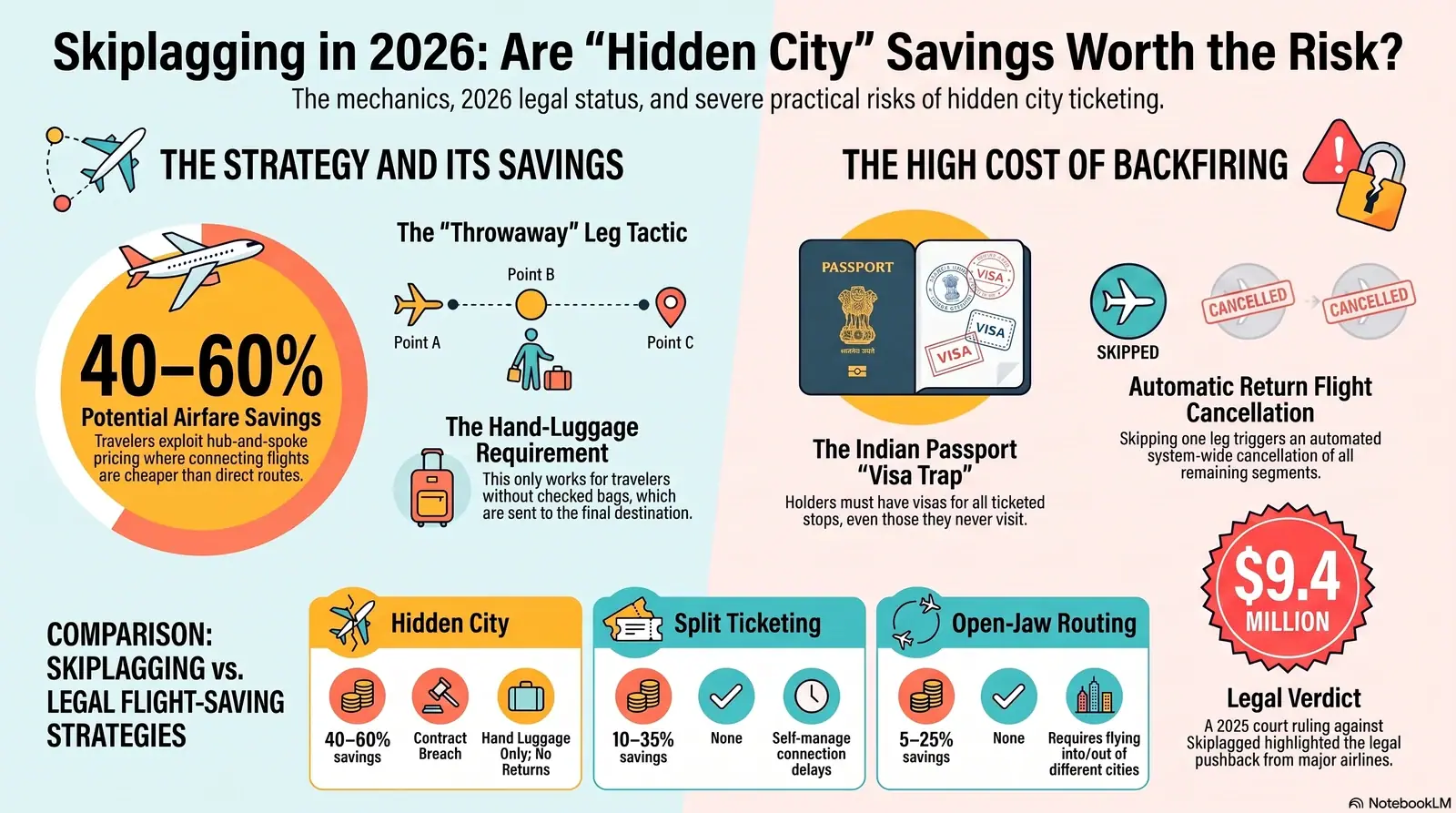
- The savings are real: Hidden city ticketing can save 40–60% on selected routes, but only on one-way, hand-luggage-only itineraries where you have no return journey on the same ticket.
- The legal picture: Skiplagging is not illegal, but it is a contractual breach. American Airlines won a $9.4 million copyright verdict against Skiplagged in June 2025; the platform remains live while appeals continue in 2026.
- Indian passport holders face extra risk: You need a valid visa for every country on your ticketed itinerary — including the final destination you never intend to reach. A disruption can strand you at an airport without the right entry documentation.
40–60% vs direct fare on the same route
Not a crime — but breaches your airline contract
Carry-on luggage only; one-way tickets only
Live and operational; $9.4M verdict under appeal
What is hidden city ticketing and how does it work?
Hidden city ticketing means booking a flight with a connecting stop at your real destination, then deliberately getting off at the layover city and never boarding the final leg. The trick works because airlines sometimes price connecting itineraries lower than point-to-point tickets on the same route.
Here is a concrete Dublin-based example. Suppose you want to fly Dublin (DUB) to Frankfurt (FRA). A direct Aer Lingus or Lufthansa fare might show at €380 on a Wednesday in October 2026. But a Lufthansa itinerary routing Dublin–Frankfurt–Prague on the same morning departure — using the same actual DUB–FRA aircraft — might be listed at €240, because Lufthansa is competing hard for the Prague market that week.
A hidden city traveller books the €240 DUB–FRA–PRG ticket, boards the Dublin to Frankfurt segment, collects their hand luggage at Frankfurt baggage reclaim (which is accessible without clearing immigration if they have onward check-in), and walks out of the terminal. The Frankfurt–Prague segment departs without them. Net saving: €140 on a ticket they fully paid for.
The pricing asymmetry that makes this possible is structural, not accidental. Airlines operate on a hub-and-spoke model, routing passengers through major hubs like Frankfurt, Amsterdam, and Dubai to reach smaller destinations. To fill seats on less popular onward routes, they discount the combined ticket. As supply on the onward segment increases — more airline options, more flight combinations — downward price pressure follows. A study of connecting vs direct fares across European routes found that passengers saved an average of 20–50% when accepting a stopover, even on routes where multiple nonstop options existed.
How Skiplagged finds hidden city fares
Skiplagged is a flight search engine that identifies hidden city opportunities automatically, surfacing itineraries where the connecting city is the same as the searched destination, then displaying the cheaper through-ticket price alongside or instead of the direct fare.
Founded in 2013 by Aktarer Zaman, Skiplagged.com functions like a standard flight search engine with one extra layer of logic: it cross-references the user's desired destination against all intermediate stops on connecting itineraries, then surfaces cases where the stop matches the target city. If you search for Dublin to Frankfurt, Skiplagged shows you standard direct fares plus any connecting tickets where Frankfurt is the layover — even if those tickets officially route onwards to Prague, Bratislava, or Budapest.
Reported average savings range from 40–60% per booking, with an average saving of approximately $180 per transaction cited by travel analysts in 2025. Specific route examples where hidden city economics have surfaced include:
| Actual journey | Booked as | Direct fare | Hidden city fare | Saving |
|---|---|---|---|---|
| San Francisco → Seattle | SFO–SEA–Portland | $300 | $200 | $100 (33%) |
| Chicago (direct) | Chicago–Milwaukee via ORD | $420 | $290 | $130 (31%) |
| Zurich → Dubai | ZRH–DXB–Muscat | €600 | €400 | €200 (33%) |
Skiplagged does not book tickets itself — it redirects to the airline or a third-party OTA where you complete the purchase. The hidden city segment is identified visually, but you transact on the normal booking flow, which means you agree to the airline's conditions of carriage at checkout.
The five risks of hidden city ticketing
Hidden city ticketing carries five distinct categories of risk. Any one of them can wipe out the fare saving many times over — and in the case of visa complications, can cause delays and costs that money cannot immediately fix.
Risk 1: Checked baggage ends up at the wrong airport
This is the most common practical failure of hidden city ticketing and the reason it is completely unworkable with checked luggage. When you check a bag, it is tagged through to your ticketed final destination — not your hidden city layover. Your bag will travel to Prague even if you disembark at Frankfurt. You cannot intercept it at the layover. The airline will not redirect it without a considerable fee and a delay of days. The only safe approach is hand luggage only — a personal item or a cabin bag that fits in the overhead bin.
Risk 2: Your return flight is automatically cancelled
If your hidden city ticket is part of a round-trip booking, skipping any outbound segment triggers automatic cancellation of every subsequent segment in the same booking, including your return. Airlines run automated processes that flag "no-shows" and cascade cancellations through connected itineraries. A traveller who skips the DUB–FRA leg on day one of a round-trip would find their FRA–DUB return cancelled by the time they try to check in. This is why hidden city ticketing is viable only on pure one-way tickets with no connecting or return segments you actually need.
Risk 3: Your frequent flyer account is suspended or terminated
Airlines deploy automated detection systems that cross-reference flight records against frequent flyer accounts, flagging accounts where itinerary no-shows correlate with repeated booking patterns. In 2026, multiple carriers have confirmed that enforcement letters are being sent within weeks of detection, with consequences escalating from warning letters to outright account termination. Losing a frequent flyer account means losing every accumulated mile, point, and elite status perk. For someone with 100,000 miles and Gold status, the financial value destroyed can far exceed the fare savings achieved.
Airlines can also bill the fare difference between the hidden city ticket and the published direct fare, recovering the saving plus interest. In practice this is rare, but the contractual right exists and is cited in most major carriers' conditions of carriage, including those of United Airlines, Aer Lingus, and Lufthansa.
Risk 4: The airline reroutes you due to disruption
If your inbound segment is disrupted — delayed, cancelled, or rerouted — the airline may rebook you onto an alternative path to your ticketed final destination, not your intended hidden city stop. If a DUB–FRA–PRG traveller's Frankfurt connection is cancelled due to weather, Lufthansa may rebook them onto DUB–MUC–PRG, bypassing Frankfurt entirely. The traveller ends up in Prague with no intention of being there, potentially without a visa if Prague is in a country they did not plan to enter, and with accommodation, onward plans, and checked bags all in the wrong place.
Risk 5: Airline legal action
Airlines can — and occasionally do — pursue legal claims against frequent hidden city travellers and against platforms that facilitate the practice, as Skiplagged discovered in 2023. While a single anonymous skiplagged ticket is unlikely to result in personal legal action, the pattern of bookings associated with a named frequent flyer account creates a record. Lufthansa pursued a passenger in German courts (case dismissed on appeal as of mid-2025, still subject to German legal proceedings). The legal and reputational risk is low for a one-off, but non-zero for anyone making it a habit.
On-the-Ground Insight: "I tried a hidden city trick on a Dublin–Amsterdam–Dubai booking to save €180. Everything went fine — until my Amsterdam flight was delayed 40 minutes. By the time I landed, my onward 'unused' Prague segment had been flagged as a no-show. The airline's system had already tried to rebook me via Frankfurt on a later connection. Customer services could see the whole pattern instantly and asked some pointed questions. I got through, but it was deeply uncomfortable and I won't do it again with an active Aer Club account." — Kavya R., Dublin, MSc Computer Science Graduate, July 2026
What are the risks of hidden city ticketing for Indian passport holders?
Indian passport holders face amplified hidden city risks on international routes because a valid visa is required for every country listed as a destination on the itinerary — including any final destination the traveller never intends to reach.
When you check in at Dublin Airport, the ground agent verifies your documentation against the itinerary on record. If your ticket shows Dublin–Amsterdam–New York and you plan to exit at Amsterdam, you still need a valid US B1/B2 or F-1 visa in your passport before you can board at Dublin — the airline is legally responsible for carrying only passengers who can enter the final ticketed destination. If you do not have the visa, you will be denied boarding.
The scenario becomes genuinely dangerous in the case of mid-journey disruption. Consider an Indian student on an Irish Stamp 2 visa routing Dublin–Frankfurt–Prague and planning to exit at Frankfurt. If Lufthansa cancels the Frankfurt–Prague segment and places them on a Frankfurt–Vienna–Prague alternative, they now need an Austrian transit airside visa — which Indian passport holders require even for connections through Vienna. Without it, they may be refused boarding at Frankfurt or detained on arrival at Vienna.
Additionally, immigration documentation mismatches — where your entry record at Frankfurt shows an arrival but no departure to Prague — can create complications on future Schengen visa applications. The Schengen Information System records show unexplained gaps. While this is rarely enforced in 2026, consulate officers reviewing your travel history may ask about it.
For students and graduates on Irish Stamp 2 or Stamp 1G visas, the stakes are even higher. Any immigration irregularity — however minor — can complicate IRP renewals and future permission applications with the Irish Immigration Service.
Is hidden city ticketing legal in 2026?
Hidden city ticketing is not illegal under any national law in Ireland, the EU, the UK, or the United States. However, it almost universally breaches the airline's contract of carriage — a private commercial agreement — and courts have consistently treated it as such, not as a criminal matter.
The most significant legal development of recent years is the American Airlines v. Skiplagged case. American Airlines sued Skiplagged in 2023 in a Texas federal court, alleging copyright infringement and tortious interference. After a five-day trial in October 2024, a jury awarded American Airlines $9.4 million in copyright damages — based on Skiplagged displaying American's copyrighted flight logos and price data without authorisation.
In May 2025, the court issued a permanent injunction barring Skiplagged from displaying American Airlines' proprietary logos and branding. Critically, the injunction does not prohibit Skiplagged from listing American Airlines flights — only from misusing the branding. Skiplagged remains live and operational as of July 2026. Both parties have cross-appealed to the Fifth Circuit; briefing is ongoing with no oral argument date set as of this article's publication.
In Europe, Lufthansa pursued a German passenger through the German courts for booking a hidden city fare, arguing the passenger owed the fare difference. The Berlin courts dismissed the case in 2023; the case is subject to ongoing appeal. No European airline has successfully recovered a fare difference from a passenger in a published ruling as of July 2026.
When hidden city ticketing can make sense
There is a narrow set of circumstances where the approach is low-risk and genuinely useful: one-way domestic or short-haul hops, carry-on-only, with no frequent flyer account linked to the booking and no visa complications.
The conditions that make hidden city workable:
One-way ticket only. You have no return segment or future segments on the same booking that could be cascaded-cancelled if you no-show. A pure one-way ticket eliminates Risk 2 entirely.
Hand luggage only. A personal item that can go under the seat eliminates Risk 1. If you can travel with a small rucksack, your bag never leaves your hands. Gate-checked bags are a grey area — if an airline requires you to check your bag at the gate due to overhead bin scarcity, it goes to the final destination.
No frequent flyer number linked to the booking. If you do not attach a loyalty account to the ticket, there is no cross-referencing trail that can trigger account action. You forgo miles on that trip, but eliminate Risk 3.
No visa complications. Domestic itineraries within a single country have no immigration dimension. For short European routes from Ireland, if you hold a Schengen visa or are an Irish/EU citizen, your transit rights through Schengen airports are unrestricted — but always verify the final destination country's entry rules still apply to you.
No disruption-sensitive plans at the layover. If you have a meeting, a connecting coach booking, or accommodation check-in waiting at your hidden city, a single airline disruption can unravel everything. Build in a buffer or avoid it if the hidden city stop has a fixed time-sensitive commitment.
What are the safer alternatives to hidden city ticketing?
Three legal strategies capture much of the same price asymmetry as hidden city ticketing without breaching the contract of carriage: split ticketing, open-jaw routing, and nearby-airport arbitrage. A fourth — systematic fare alerts — is the most reliable long-term tool.
Split ticketing
Split ticketing means booking the journey as two separate one-way tickets rather than a single through ticket, legally assembling your own cheaper combined itinerary. For example, DUB–FRA on a standalone Ryanair or Aer Lingus ticket might cost €89, while a separate FRA–PRG ticket costs €49 — a total of €138 vs a single €180 through fare. You are fully entitled to book this. Each ticket stands independently; the airline has no grounds to challenge it. The practical risk is that if the first flight is delayed and you miss the second, the two carriers owe you nothing on the other ticket — you carry the rebooking risk yourself. Always allow generous connection time (a minimum of three hours for European connections at busy airports) and consider travel insurance that covers missed connections.
Open-jaw flights
Open-jaw booking means flying into one city and departing from another, eliminating a backtrack — and often revealing cheaper fare combinations. If you are visiting Germany and France, flying DUB–Munich inbound and Paris–DUB outbound will frequently be cheaper than a standard return to either city, while also giving you a more logical travel route. Google Flights and Skyscanner both support open-jaw searches natively.
Nearby-airport arbitrage
For Irish travellers, flying from Cork or Shannon instead of Dublin, or positioning via a UK airport (Manchester, Birmingham, Edinburgh) adds a short domestic hop but can cut long-haul fares by 20–35% — legally and transparently. Ryanair, Aer Lingus, and Flybe connect Dublin to these UK airports for under €50 return; combined with a cheaper onward long-haul, total cost often beats Dublin originating fares. The key is treating the Dublin-to-UK leg as a separate, independent booking — split ticketing again — with enough buffer for connection.
Fare alerts and Google Flights price tracking
Setting a price alert on Google Flights or Skyscanner for your intended route is the simplest zero-risk method of capturing short-lived low fares without any contractual exposure. When fares drop — due to airline seat sales, reduced competition on a route, or algorithm-driven dynamic pricing — you receive an email notification. If the dropped fare is below your threshold, you book immediately at the transparent price. This approach lacks the dramatic savings of a well-timed hidden city ticket, but is consistent, legal, and repeatable.
Hidden city vs alternatives: comparison table
| Strategy | Potential saving | Legal risk | Luggage restriction | FFP risk | Visa risk | Works on return trips? |
|---|---|---|---|---|---|---|
| Hidden city ticketing | 40–60% | Contractual breach — civil only | Hand luggage only | High (account termination) | High for Indian passports | No — cancels return |
| Split ticketing | 10–35% | None | None | None | None | Yes |
| Open-jaw booking | 5–25% | None | None | None | None | Yes (it is the return) |
| Nearby-airport arbitrage | 15–35% | None | None | None | None | Yes |
| Fare alerts (Google Flights) | Varies — 10–50% vs peak | None | None | None | None | Yes |
Verdict: should you skiplag?
For the vast majority of travellers flying from Ireland — especially those with checked luggage, an active frequent flyer account, a return ticket, or an Indian passport on an international route — hidden city ticketing is not worth the risk.
The mathematical appeal is clear: saving €150–€200 on a Dublin–Frankfurt flight is real money. But the conditions that make it work safely — one-way, hand luggage, no FFP, no visa complications, no disruption dependency — eliminate most of the scenarios where an Irish-based traveller actually flies. The majority of trips involve at least one of: checked luggage, a return ticket, or an international segment where the final destination creates a visa requirement for Indian passport holders.
Where it can legitimately function: a carry-on-only solo trip for an EU/Irish citizen on a one-way domestic connection with no frequent flyer account attached. In that narrow scenario, the risks are low and the savings are genuine. Outside that scenario, the expected value of the saving is eroded by the probability of losing a return flight, a frequent flyer account, or creating an immigration documentation problem that costs far more than €150 to resolve.
The three legal alternatives — split ticketing, open-jaw routing, and nearby-airport arbitrage — often capture savings in the 15–35% range without any of the exposure. Combined with systematic fare alerts, they represent a genuinely durable flight-saving strategy for 2026 and beyond.
Hidden city ticketing is a clever exploit of airline pricing logic. It is not illegal. It can save real money in a narrow set of circumstances. But in 2026 — with automated detection, a major $9.4M lawsuit verdict on the books, and heightened immigration scrutiny of Indian passport holders in the Schengen zone — the risk-reward ratio has shifted materially against the traveller. Use split ticketing, open-jaw, and fare alerts instead.
Find the cheapest legal fare from Dublin now
Compare live fares across Ryanair, Aer Lingus, Emirates and more — no airline tricks required.
- Best Practices for Booking One-Way Flights — when one-way is cheaper, how to build multi-city itineraries, and how to protect yourself when using split tickets
- What Is a Fare Comparison Engine? — how meta-search tools like Skyscanner and Google Flights work and which to use for which route type
- Best Time to Book Flights in 2026 — data-backed booking windows for Dublin–India, Dublin–USA, and European city break routes
- What Is a Multi-City Itinerary? — the legal, structured alternative to hidden city ticketing for multi-stop trips
All information in this article is based on publicly available official and court sources as of July 2026. The American Airlines v. Skiplagged case is subject to ongoing Fifth Circuit appeals; outcomes may change. Visa and immigration rules for Indian passport holders change frequently — always verify requirements at the IATA Travel Centre, the relevant embassy, and the Irish Immigration Service before travel. This article does not constitute legal or immigration advice.