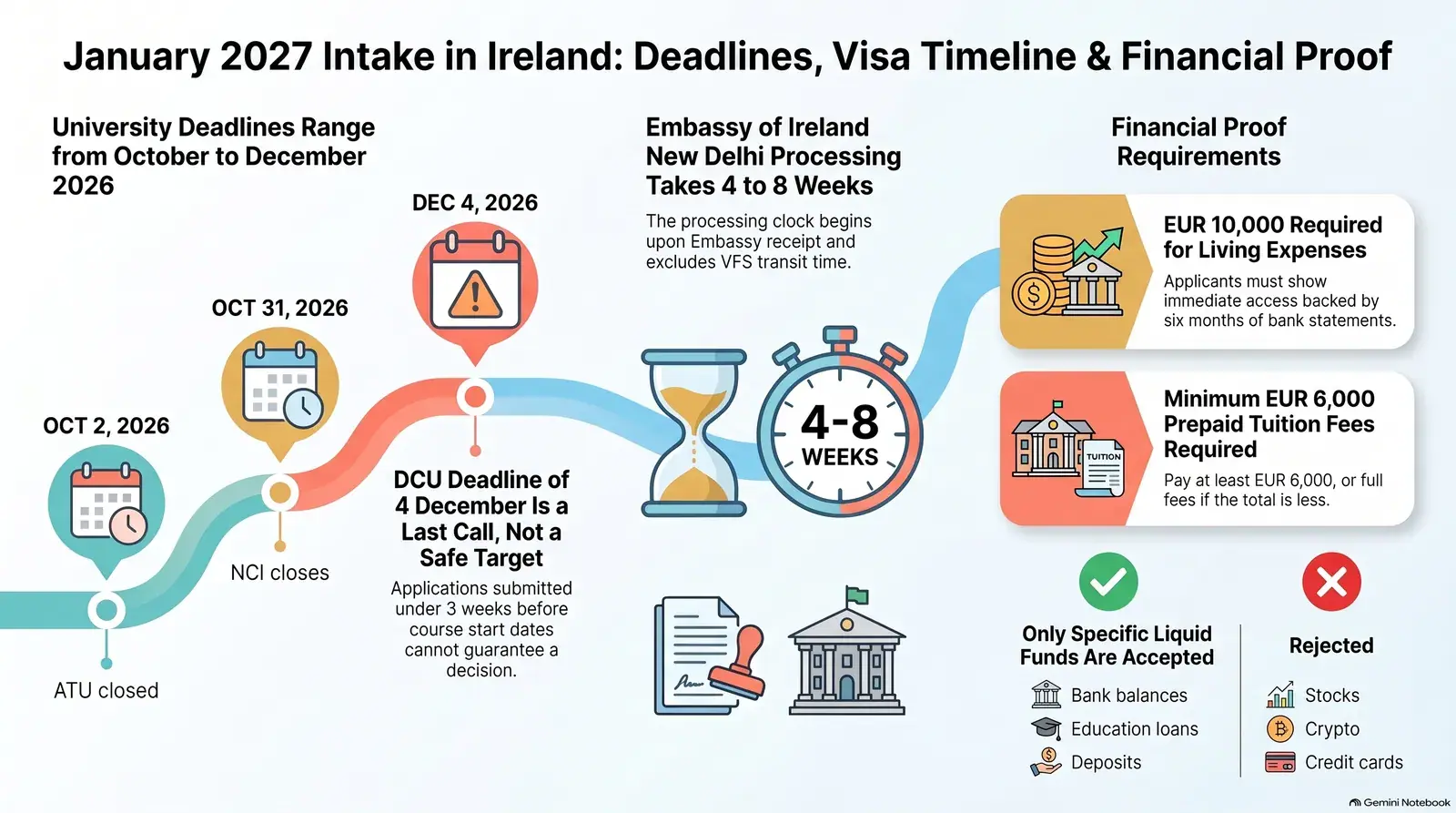
- 4 December is one university's date: it is when DCU says its January courses close. NCI's deadline for visa-required students is 31 October 2026, and ATU's was 2 October 2026.
- The visa clock is 4-8 weeks from Embassy receipt: the Embassy of Ireland in New Delhi does not count VFS appointment or transit time, and cannot guarantee a decision on files lodged less than 3 weeks before the course starts.
- Money has to be ready before you lodge: €10,000 in living costs with six months of statements, plus at least €6,000 of fees already paid (or full fees where the college requires it).
4-8 weeks, first decision
Five months before the course start date
€10,000 immediate access
At least €6,000
Which Irish universities and colleges are open for January 2027?
Four institutions had a January 2027 intake for international students published on their own websites when we checked on 10 October 2026: Dublin City University, National College of Ireland, Atlantic Technological University and Dublin Business School. The University of Limerick also publishes a closing date for programmes starting in spring 2027. For the other names that usually appear on agency lists, we could not find a January 2027 course list or deadline on an official page.
The January intake is the smaller of Ireland's two intakes. It is almost entirely taught Master's programmes, concentrated in computing, engineering and business. The table below shows only what each institution states itself.
| Institution | January 2027 courses listed on its own page | Published deadline if you need a visa | Other published dates |
|---|---|---|---|
| Dublin City University (DCU) | MSc in Management (Strategy), MSc in Business Analytics, MSc in Finance, MEng in Electronic and Computer Engineering, MSc in Electronic and Computer Technology, MEng in Mechanical and Manufacturing Engineering | No separate visa deadline shown. Courses close on 4 December 2026 | MSc in Computing (Data Analytics and Artificial Intelligence) already closed |
| National College of Ireland (NCI) | MA in Human Resource Management; MSc in Business Analytics for Decision Makers, International Business, Management, AI for Business, Artificial Intelligence, Cloud Computing, Cybersecurity and Data Analytics | 31 October 2026 | 30 November 2026 if no visa is needed; 11 January 2027 if already resident in Ireland; fee payment to reach NCI by 6 November 2026 for visa-required students |
| Atlantic Technological University (ATU) | MSc in Computing (Galway), MSc in Engineering Management, MSc in Healthcare Innovation and Technology, MSc in Supply Chain Analytics (Letterkenny) | 2 October 2026 (now passed) | Early December 2026 if no visa is needed; online Master's close in early January 2027 |
| Dublin Business School (DBS) | Page confirms applications are open for January 2027; the course list sits on its international programmes pages | Not published on the page we checked | Ask DBS for your country's cut-off |
| University of Limerick (UL) | Check the individual programme page | No separate spring visa deadline shown | Closing date for programmes starting in spring 2027 is 5 January 2027 |
Two notes on that table. ATU's page shows two different dates for applicants who do not need a visa (10 December in the heading and 2 December in the sentence beneath it), so confirm with ATU before relying on either. And NCI adds that "applicants from some countries may have early deadlines", so ask for the date that applies to India.
What about UCD, University of Galway, Maynooth, TU Dublin and Griffith College?
None of these five publishes a January 2027 course list or deadline for international applicants on the pages we read, so treat any list that includes them as a lead to verify and not as a fact. Here is what each official page did say:
- University of Galway reviews taught applications on a rolling basis until a course quota fills. Its key-dates page mentions January starts only for certain research degrees, with applications due by mid-November.
- University College Dublin (UCD) says most taught Master's courses begin in September, "with some courses offering an alternative start date in January", and that there is no January intake for full-time undergraduate programmes. It does not publish a January list or deadline on that page; start dates are on each entry in the UCD Course Catalogue.
- Maynooth University, TU Dublin and Griffith College did not show a January 2027 deadline for international applicants on the pages we read; TU Dublin's page gave only its September 2026 international closing date. Email the international office and ask for the start date and the visa-required deadline in writing.
Is 4 December 2026 really the deadline for Indian students?
No. 4 December 2026 is the date DCU gives for closing its January courses; it is not a national deadline and it is not a visa deadline. DCU's January intake page says: "Applications for these courses will close on December 4th 2026." No other institution we checked uses that date, and the Embassy of Ireland in New Delhi publishes no January cut-off at all.
The more useful signal is how the colleges that do publish a separate date for visa-required students have set it. ATU chose 2 October. NCI chose 31 October, with fees to arrive by 6 November. Both sit five to nine weeks ahead of the dates they give students who do not need a visa. That gap is the colleges' own estimate of how long an Indian applicant needs to pay fees, lodge a visa file and get a decision before a January start.
Put the DCU date against the Embassy's processing time and the problem is plain. As an illustration, take a course that starts on Monday 18 January 2027. A student who applies on 4 December has about six and a half weeks left. In that time the university has to issue an unconditional offer, the fee payment has to clear, a VFS appointment has to be found, the documents have to reach the Embassy, and the Embassy then needs its 4-8 weeks, with the Christmas and New Year closure days in the middle.
How long does the Irish study visa take from India?
The Embassy of Ireland in New Delhi lists 4-8 weeks for a first decision on a study visa, in a table marked "Update: 17 September 2026". The Embassy calls these "usual timeframes" and says they are not guaranteed.
Three details on that page change how you should count:
- The clock starts at the Embassy, not at VFS. Processing times run from the date the Embassy receives the application to the date of decision. They exclude the time to get a VFS Global appointment, the transit of documents to the Embassy and the return of your passport.
- Only working days count. Saturdays, Sundays and Embassy closure dates are excluded, which matters for a file that sits over late December.
- Files are handled in order. The Embassy says applications are processed chronologically and that it will not give status updates.
In the Embassy's Words: “Applications submitted less than 3 weeks prior to the course start date cannot be guaranteed a decision. Please do not contact the Visa Office at any point for status updates as they will not be responded to. Applications will be processed in chronological order so apply in good time.” — Embassy of Ireland, New Delhi, "Processing times and decisions" page, study applications notice, read 10 October 2026
That notice is headed for summer 2026 applications; the Embassy had not posted a January version when we checked. The Embassy's study visa information note (version dated 25 April 2025) adds two rules that frame the whole window. You can submit your application five months before your course start date. And if the start date on your original unconditional offer letter has passed by the time your file is assessed, the application "will be withdrawn without prejudice".
| Milestone | Rule and source | Illustrative date for an 18 January 2027 start |
|---|---|---|
| Earliest lodging date | Five months before the course start (Embassy note) | 18 August 2026 |
| NCI visa-required deadline | NCI international application page | 31 October 2026 |
| File at the Embassy for a full 8 weeks | Upper end of the 4-8 week band (Embassy table) | 23 November 2026 |
| DCU January courses close | DCU January intake page | 4 December 2026 |
| No decision guaranteed after | Less than 3 weeks before start (Embassy notice) | 28 December 2026 |
The 18 January start date is an example only. Use the start date printed on your own offer letter; the calculator below does the same sums for any date.
When should you lodge your visa file for your start date?
Count back eight weeks from your course start date, then subtract the days you expect to lose to the VFS appointment and document transit; that is your lodging target. The calculator uses only the Embassy's published figures: the five-month earliest lodging rule, the 4-8 week processing band and the 3-week no-guarantee notice.
🧮 Irish study visa lodging-window calculator
Enter the start date on your offer letter to see your lodging window. The default start date of 18 January 2027 and the default buffer of 7 days for the VFS appointment and transit are illustrative, not official figures; the Embassy only says this step "may take a number of days".
The calculator counts calendar weeks. The Embassy counts working days and excludes its closure dates, so a file that spans Christmas and New Year needs more room than the figure shown.
What financial proof do you need for a January 2027 visa?
You must show immediate access to at least €10,000 for living costs, on top of your course fees, with six months of bank statements behind it. Immigration Service Delivery (ISD) describes €10,000 as "the estimated cost of living in Ireland for a student for one academic year". If your course runs longer than a year, you must also show ready access to €10,000 plus fees for each later year.
How much of the tuition fee must be paid before you apply?
At least €6,000, or the full fee if it is €6,000 or less. The Embassy's study visa note sets it out in two lines: if course fees are €6,000 or less you pay them in full before the visa application, and if they are more than €6,000 you pay at least that amount. The exception is where your provider requires full payment first. NCI, for one, says a place is confirmed only on receipt of full fee payment.
Which funds does the Embassy accept, and which does it reject?
Bank balances, fixed deposits, loans, education bonds and provident funds are accepted; market-linked holdings, gold valuations and chit funds are not. The split below is taken from the Embassy's note and ISD's student finances page.
| Source of funds | Accepted? | Condition stated in the official guidance |
|---|---|---|
| Savings or current account | Yes | Six months of statements on headed paper; large or irregular lodgements fully explained |
| Fixed deposit or savings account | Yes | Letter from the bank confirming you can take money from the account |
| Education loan | Yes | Original loan documents; the sanction letter alone is not sufficient; the guarantor is declared as a sponsor |
| Education bond | Yes, degree programmes only | Minimum value €10,000, lodged with an approved fee payment service and held until you register in Ireland |
| Sponsor's funds | Yes | Six months of the sponsor's statements, proof of the relationship, employer letter and three recent payslips |
| Crypto, stocks, shares, mutual funds | No | Described as volatile market-linked funds |
| Gold valuation or chit fund | No | Gold counts only if liquidated into a bank account or converted to a gold loan |
| Credit card limit | No | ISD: credit cards are not accepted as evidence |
The Embassy also asks for verifiable income tax return acknowledgments for everyone whose money you rely on, and recommends that you "simplify your finances as much as possible". Funds spread across several sponsors and holdings raise the risk of refusal. For the background to the €10,000 threshold and how source-of-funds checks work, see our Ireland student visa 2026 financial proof update.
Will your bank collect TCS when you send the fees from India?
Not if the money comes from an education loan from a specified lender; for self-funded education remittances, TCS is 2% on the amount above ₹10 lakh in a financial year. Those are the rates in force for the 2026-27 financial year. Ask your bank to code the transfer as an education remittance under the Liberalised Remittance Scheme and keep the fee receipt; the tax collected is credited against your family's income tax and can be claimed back in the return. A standalone air ticket to Dublin does not attract TCS. If you pay the college by card instead of bank transfer, pay in euro and decline any offer to be charged in rupees: that is dynamic currency conversion, and the rate is set by the payment terminal and not by your bank.
What happens between applying and getting your offer letter?
You move through four stages: application, conditional offer, unconditional offer and fee payment, and only the last two unlock the visa file. The New Delhi Visa Office processes applications only from students who hold an unconditional offer for an eligible course, so every week spent clearing a condition is a week taken from the visa window.
- Apply with a complete file. NCI's list is a good template for any college: transcripts, degree certificate, English test result if you have it, CV, passport and a statement of purpose of up to 600 words. NCI assesses you for one programme at a time.
- Clear conditions the day they arrive. The usual ones are a final transcript, the degree certificate and the English test score. The Embassy states that an approved English language test is compulsory for all student visas and that failing to submit one will result in refusal.
- Pay the fee and get the receipt. The visa file needs evidence of the fee payment, including the electronic fund transfer record.
- Chase by email, with your application number. Write to the international office, not a general admissions inbox. DCU lists [email protected] and NCI lists [email protected]. Ask one question per email: "What is outstanding on my file, and by what date must I pay to meet the January 2027 visa timeline?"
If you are also hoping for funding, read our guides to the Government of Ireland scholarship and to university merit awards. DCU says January applicants can be considered for partial merit-based scholarships.
When should you book flights for a January arrival?
Book after the visa is in your passport, or book a fare you can change. The Embassy is direct about this: "Flight bookings are not required for a visa. Flights booked before the receipt of a visa are booked at your own risk."
That advice pulls against how fares behave. Early January is when people who went home for Christmas and New Year fly back to Ireland, so seats on the India to Dublin routes through the Gulf and European hubs are in demand just when a January student wants to travel. We do not publish a "cheapest date" here because we did not verify one for this intake. Use the live fare calendar to compare months and days, and check the Dublin to Delhi route page for the airlines and connections on that corridor.
A workable approach for a file that is still pending:
- Track fares now, pay later. Watch the price for the week before your orientation from the day you lodge.
- If you must book early, buy flexibility. Read the change and refund rules before paying, and compare a student fare against the standard one. Our guide to student airfare discounts explains what the extra baggage and date-change terms are worth.
- Price the bags, not just the seat. You are moving for a year in winter, with a heavier suitcase than a September arrival.
True Cost = Base Fare + Cost of Extra Checked Bag + Forex Markup Fee
A cheaper base fare with one checked bag can end up costing more than a dearer fare that includes two. One-way tickets, single bookings and self-made connections also behave differently if a first flight runs late; see types of one-way student flight tickets before you split a journey across two bookings. And if you want to keep your Indian number active for bank OTPs after you land, our Yesim eSIM review covers travel data alongside your home SIM.
Which documents should you prepare now?
Prepare the twelve items on the Embassy's own checklist, and start today with the three that take longest: six months of bank statements, the police clearance certificate and the English test result. None of those three can be produced in a hurry in December.
The Embassy's "checklist before you submit" lists:
- Signed application form from AVATS, the online visa application system
- All passports, with any missing passport fully explained
- Letter of application or statement of purpose, giving your reasons for choosing Ireland, the provider and the course
- Unconditional course placement offer letter
- Course fee payment, including electronic fund transfers
- Previous qualifications: certificates and semester mark sheets, as originals and as DigiLocker versions
- English language test results
- Financial summary form
- Evidence of declared finances, including your personal bank account
- Private medical insurance
- Police clearance certificates for every country where you held residence permission in the previous five years
- If it applies, a letter disclosing all previous visa refusals, with the original refusal letters
Two habits speed up a file. First, make documents easy to verify: the Embassy says in-depth verification depends on how quickly employers, banks and sponsors respond, and suggests DigiLocker documents for applicants resident in India. Second, answer your phone. The Embassy may call you or your sponsor to test the credibility of an application, from the number 011 49403200. A refusal can be appealed within two months of the date on the refusal letter, but the Embassy warns there is no guarantee an appeal will be processed before your course starts, so the first application has to be the good one.
For insurance options, see health insurance for international students in Ireland. Once the visa arrives, move on to the pre-departure checklist and, because you will land in mid-winter, our guide to your first Irish winter.
Frequently asked questions
The short answers below reflect the official pages as we read them on 10 October 2026.
Is 4 December 2026 the deadline for the January 2027 intake in Ireland?
No. 4 December 2026 is the date on which Dublin City University says applications for its January intake courses close. It is not a national deadline and it is not a visa deadline. National College of Ireland lists 31 October 2026 for students who need an entry visa, and Atlantic Technological University listed 2 October 2026. The Embassy of Ireland in New Delhi publishes a 4-8 week study visa processing time and does not publish a January cut-off date.
How long does an Irish study visa take from India?
The Embassy of Ireland in New Delhi lists 4-8 weeks for a first decision on a study visa, in a table updated on 17 September 2026. The time is counted in working days from the date the Embassy receives the application, so it does not include the wait for a VFS appointment or the transit of documents. The Embassy says the times are usual timeframes and are not guaranteed.
How much money do I need to show for a January 2027 Irish study visa?
Immigration Service Delivery requires evidence of immediate access to at least €10,000 for living costs for a course of more than eight months, on top of course fees. The Embassy of Ireland's study visa note says that where fees are more than €6,000 you must pay at least €6,000 before applying, and where fees are €6,000 or less you must pay them in full, unless your college requires full payment.
Can I book my flight to Dublin before my visa is approved?
You can, but the Embassy of Ireland in New Delhi states that flight bookings are not required for a visa and that flights booked before the receipt of a visa are booked at your own risk. If you book early, choose a fare that can be changed or refunded and check the change fee before you pay.
What happens if my visa is not decided before my course starts?
The Embassy of Ireland's study visa note says that if the start date on your original unconditional offer letter has passed when your application is assessed, the application will be withdrawn without prejudice. Ask your college early whether it can issue a later start date or defer your place to the next intake.
Visa lodged? Start watching January fares to Dublin.
Compare months and days on the fare calendar now, and book once the visa is in your passport or on a fare you can change.
Deadlines, course lists and visa processing times in this article were read from the institutions' own pages, the Embassy of Ireland in New Delhi and Immigration Service Delivery on 10 October 2026. Colleges close courses early when places fill and the Embassy updates its processing table without notice. The 18 January 2027 start date, the 7-day buffer and the dates derived from them are illustrative. Always confirm the deadline for your course and country with the college, and the current visa requirements with the Embassy, before paying fees or booking travel. MyFlightOffers is not affiliated with any organisation mentioned. This article does not constitute financial, tax or immigration advice.
- Ireland Student Visa 2026 Financial Proof Update — the €10,000 rule, source-of-funds checks and the tuition deposit
- Pre-Departure Checklist for Indian Students Flying to Ireland 2026 — the 30-day countdown once your visa arrives
- What is a Student Airfare Discount? — baggage and date-change terms on student fares
- Choosing Your Arrival Airport: Dublin vs Cork vs Shannon — which airport suits a Galway, Letterkenny or Limerick campus
- IRP Card Registration: A Step-by-Step Guide — the first immigration task after you land